UNOPose: Unseen Object Pose Estimation with an Unposed RGB-D Reference Image
UNOPose reduces reference acquisition to a single unposed RGB-D image, canonicalizing the object with an SE(3)-invariant reference frame and reweighting correspondences by overlap likelihood.
Authors / affiliations: Xingyu Liu et al.; Tsinghua University, TUM, and Google.
Task: estimate an unseen object’s relative pose between a query RGB-D image and one RGB-D reference without a pose annotation.
Reading mode: Overview.
2. Positioning in one sentence
UNOPose uses an SE(3)-invariant reference frame to handle unknown reference pose, and an overlap predictor to reweight correspondences, targeting low overlap with a single reference.
3. Problem and motivation
Ordinary single-reference methods still use the reference as a known-pose anchor, retaining acquisition costs.
Relative transforms may vary arbitrarily; extreme viewpoints, noise, and occlusion make equal treatment of correspondences inappropriate.
4. Method overview
Construct reference frames from reference / query clouds that are invariant to global SE(3) transforms.
Solve pose through weighted rigid registration, and introduce the UNOPose single-reference benchmark.
5. Experiments at a glance
The BOP-based LM-O, TUD-L, and YCB-V evaluation reports segmentation mAP and BOP AR, comparing single-reference and CAD-based settings.
Check whether references are unposed: this can change deployment assumptions more than reference-image count alone.
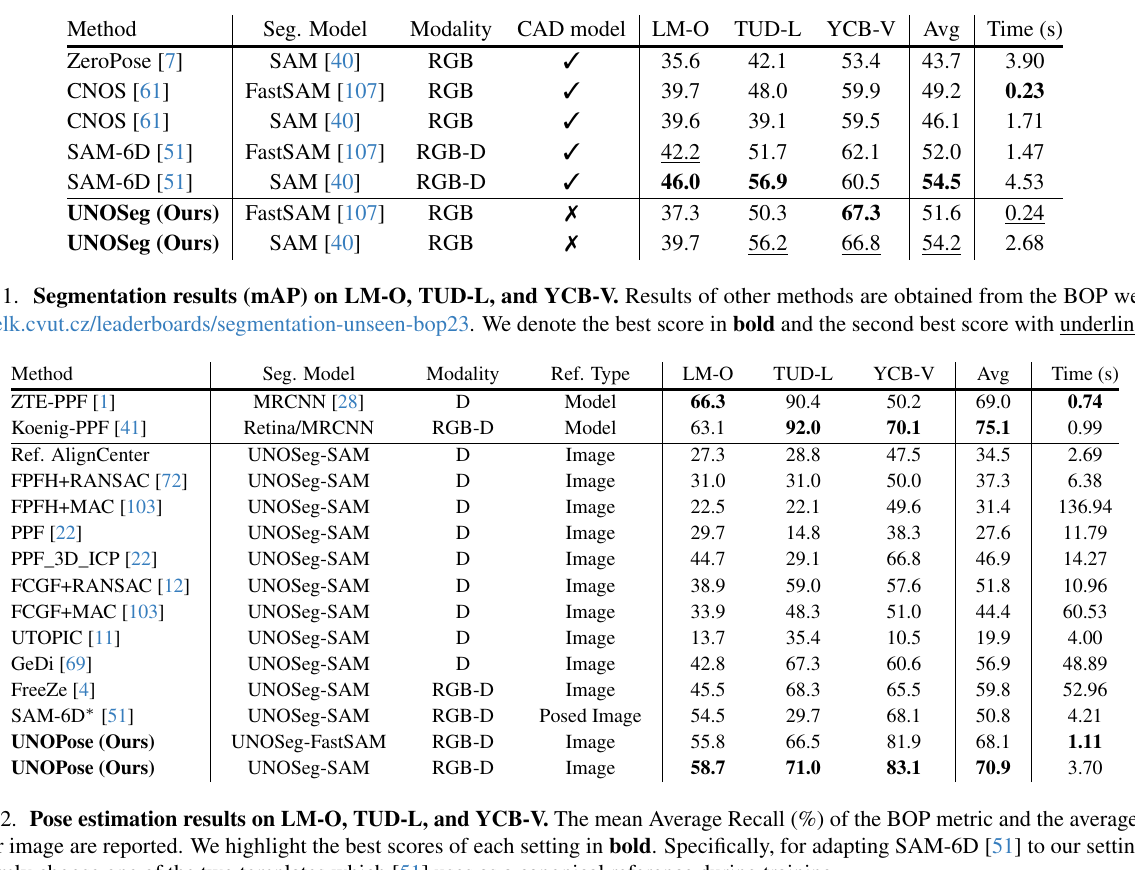
Original UNOPose Tables 1–2: UNOSeg-SAM averages 54.2 mAP across three datasets; full UNOPose-SAM achieves BOP AR of 58.7 / 71.0 / 83.1 on LM-O / TUD-L / YCB-V, averaging 70.9. Source: original CVPR 2025 paper. Image copyright belongs to the authors and publisher; reproduced here for paper analysis.
UNOPose-SAM averages 70.9 BOP AR, comparable to CAD-based ZTE-PPF’s 69.0 and below Koenig-PPF’s 75.1, while using one unposed RGB-D reference instead of a model. The full pipeline takes 3.70 s / image: 2.68 s for segmentation and 1.02 s for pose. Performance and onboarding cost should be reported together.
6. Quick assessment
Value: removes reference-pose annotation from new-object onboarding.
Key problem: removing reference-pose annotations permits query–reference transforms across the full SE(3) space, while a single reference also limits visible-surface overlap.
Core answer: construct SE(3)-invariant reference frames so the object representation does not depend on anchor pose, then weight cross-view correspondences with an overlap predictor.
2. Positioning in one sentence
UNOPose replaces the need for an annotated reference pose with a single RGB-D capture, treating low-overlap correspondences as an explicit confidence problem.
2.1 Guide to the paper’s figures and tables
Figure / table
What to look for
Figure 2
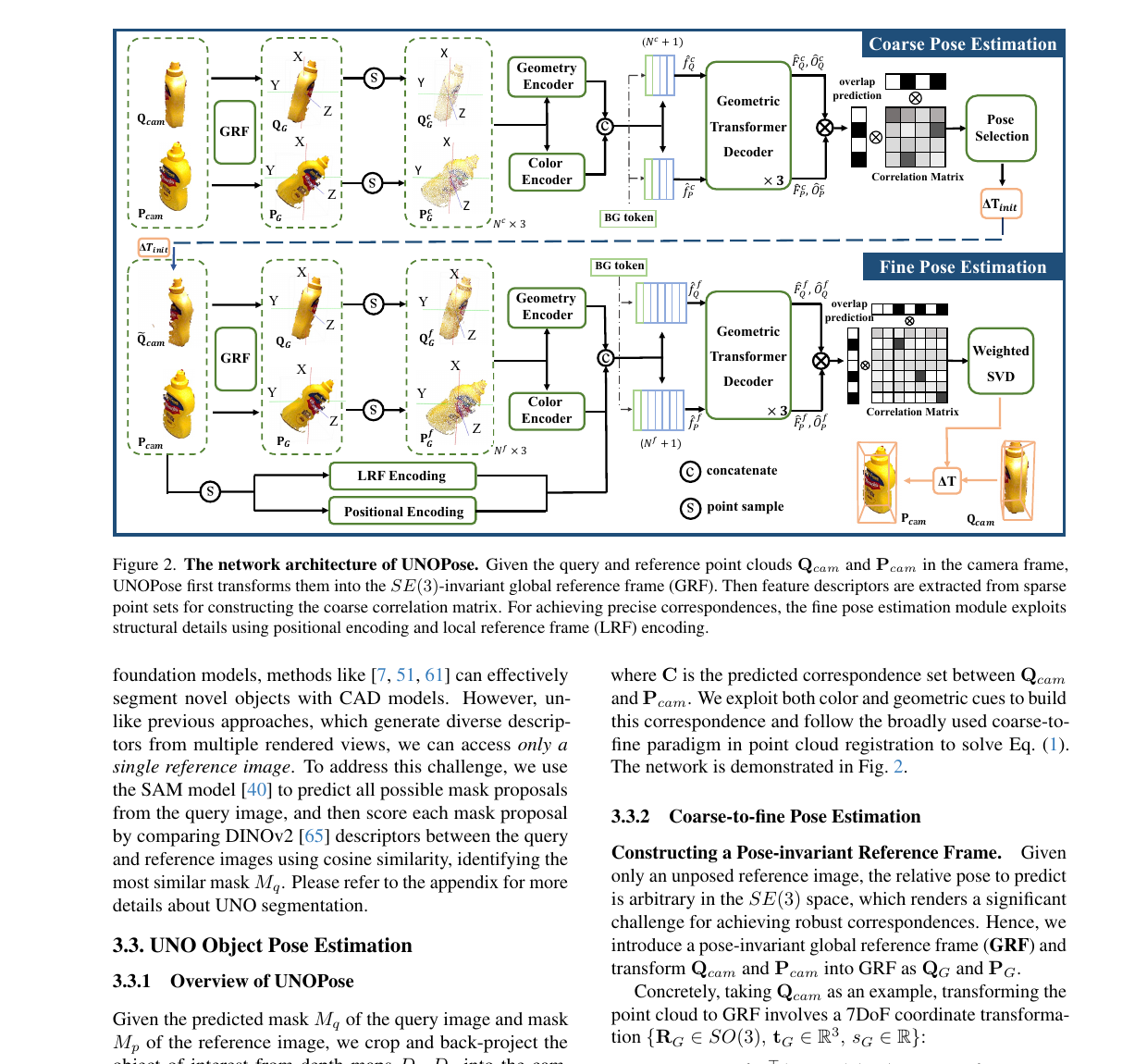
How query / reference clouds enter LRF, GRF, matching, and pose estimation.
Figure 3
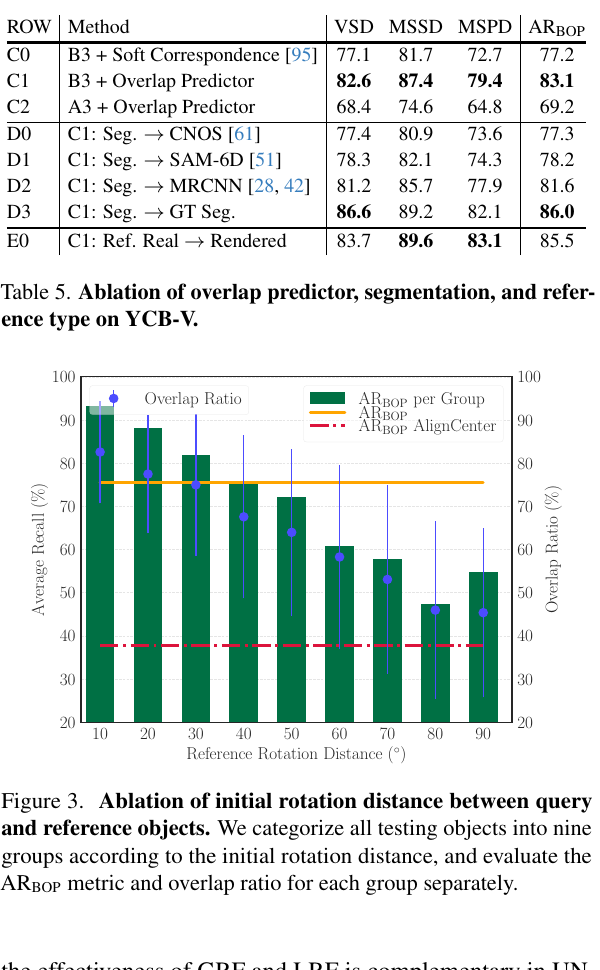
Degradation as initial rotation distance grows: does the method actually handle full SE(3)?
Tables 1–2
Keep segmentation mAP, BOP AR, and runtime separate.
Tables 3–5
Ablations of one reference per category, reference frames, overlap prediction, and segmentation.
Original method-figure excerpt: UNOPose constructs invariant reference frames from unposed RGB-D references and estimates unseen-object poses with overlap reweighting. Source: CVF Open Access. Image copyright belongs to the authors and publisher; reproduced here for paper analysis.
3. Problem setting and boundaries
Input is one unposed reference RGB-D image and a query RGB-D image; output is their relative pose, with an object-segmentation frontend in evaluation.
The setting reduces reference-annotation cost, while still requiring reference capture, depth, masks, and camera intrinsics.
The unseen-object setting still needs the same object in both images; it does not address cross-object category matching.
4. Method details
Invariant frames: construct global / local reference frames from object clouds to neutralize unknown reference rigid transforms.
Correspondence: match query and reference in normalized geometry / features.
Overlap-aware weighting: predict whether correspondences lie in genuinely overlapping regions, downweight occlusion, back surfaces, and depth noise, then solve weighted pose.
5. Experimental analysis
Table 2 measures LM-O, TUD-L, and YCB-V with mean BOP AR and time. It lists segmentation models, not segmentation mAP; segmentation results are in Table 1 and should be interpreted separately from pose.
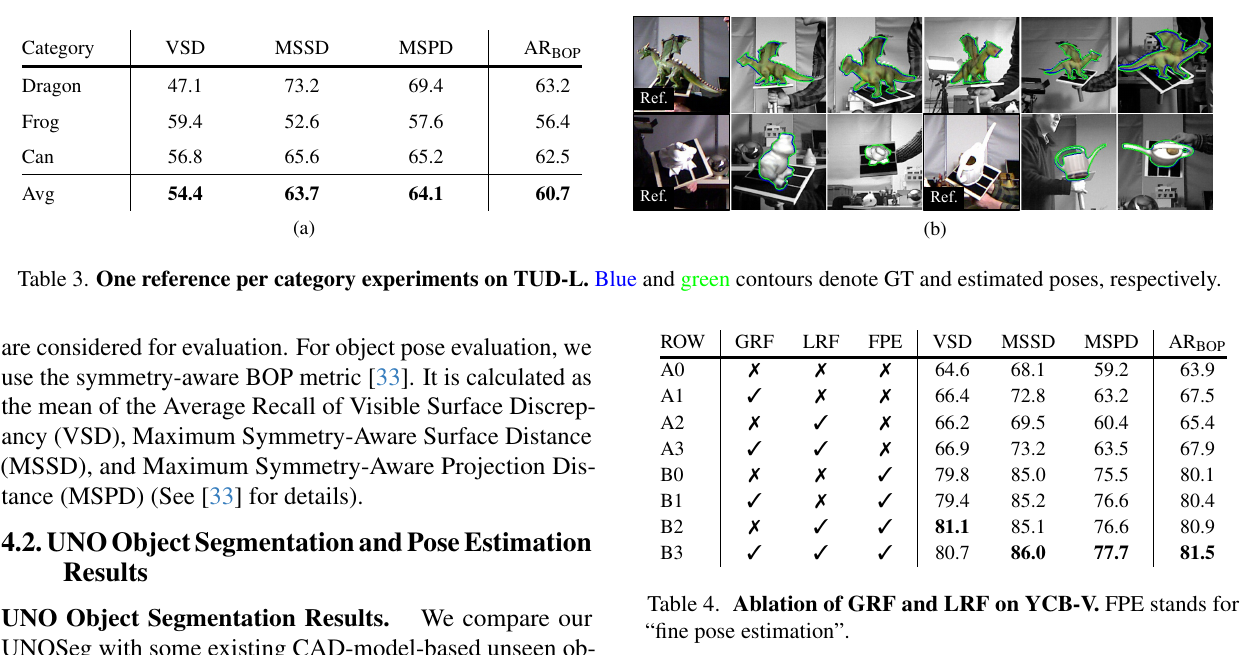
Table 3’s one-reference-per-category setting matters: the main benchmark already inputs one randomly selected reference per query; this experiment fixes one reference per category for reuse across every query in that category, reducing dataset-level reference acquisition.
Tables 4–5 separate GRF / LRF, overlap prediction, and segmentation, revealing whether gains merely come from better frontend masks.
Original TUD-L one-reference-per-category experiment and frame ablation: upper-left table reports the three BOP AR metrics for dragon / frog / can; the right table separates GRF, LRF, and fine pose estimation. Source: original CVPR 2025 paper. Image copyright belongs to the authors and publisher; reproduced here for paper analysis.
With one reference captured per category, mean ARVSD/ARMSSD/ARMSPD across the three TUD-L categories is 54.4 / 63.7 / 64.1, and combined ARBOP is 60.7; dragon / frog / can score 63.2 / 56.4 / 62.5. This tests fixed-reference reuse across queries; the table alone should not establish category-level generalization across differently shaped instances, and evaluation still covers only these three categories.
Read GRF / LRF ablations in two stages. The coarse baseline without all three components is 63.9; GRF gives 67.5, LRF 65.4, and both 67.9. With fine pose estimation, full GRF+LRF reaches 81.5. GRF contributes more to coarse initialization, while LRF supplies local geometry for fine correspondences, consistent with their distinct roles.
Original Table 5 / Figure 3: the top table separates overlap prediction, segmentation, and rendered references; the bottom plot groups overlap ratios and BOP AR by initial query–reference rotation distance. Source: original CVPR 2025 paper. Image copyright belongs to the authors and publisher; reproduced here for paper analysis.
In YCB-V ablations, the soft-correspondence baseline scores 77.2 ARBOP, increasing to 83.1 with overlap prediction; retaining only overlap prediction without the full GRF/LRF fine pipeline gives 69.2. GT segmentation instead of UNOSeg yields 86.0, leaving about 2.9 AR from segmentation. Pose-identical rendered references give 85.5 but require CAD, so they have different acquisition costs.
The rotation-distance plot reveals a failure boundary: from 10° to 90°, mean overlap and AR generally decline together. The 80°–90° group has about 45.4% overlap and 54.8 ARBOP. Although still above direct reference alignment, degradation is substantial beyond 50°. A deployment could use predicted overlap to request another reference rather than forcing output at any overlap level.
6. Authors’ claims and my assessment
Authors’ claims
My assessment
One unposed reference suffices for unseen-object pose
The task and rotation-distance experiment support this directly, while symmetric objects still limit invariant-frame uniqueness.
Overlap weighting improves low-overlap robustness
Its ablation and extreme-viewpoint split are the main evidence; mean AR can hide low-overlap failures.
7. Reproduction considerations and limitations
Check cloud units, frame-axis signs, reference / query masks, and equivalent-pose handling for symmetric objects.
Depth holes and symmetric shapes destabilize frame construction; incorrect masks also change PCA / local geometry itself.
Deployments should record overlap scores and request additional references at low scores rather than output poses blindly.
Default reference–query rotation difference is at most 50°, with reference occlusion below 30%; the 90° analysis is an additional stress test. Preserve these sampling constraints when reproducing the main tables for comparable numbers.