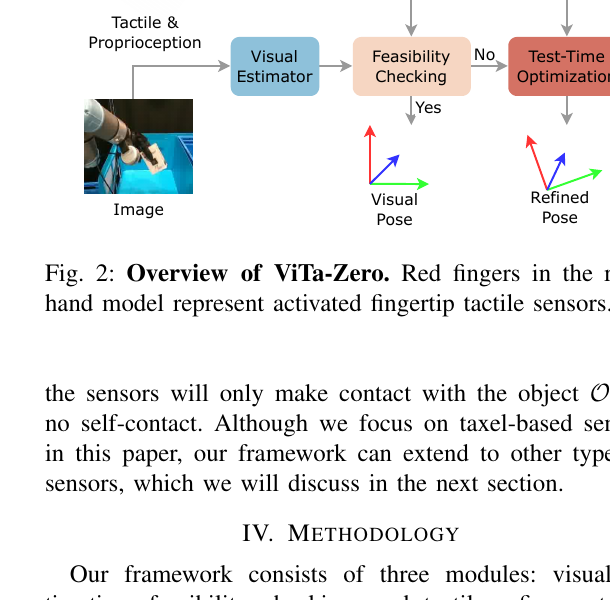
ViTa-Zero checks whether visual poses satisfy contact, penetration, and kinematic constraints. If infeasible, it models hand–object interaction as a spring–mass system and optimizes FoundationPose / MegaPose results at test time.
ViTa-Zero starts from FoundationPose / MegaPose visual estimates and checks tactile contact, hand–object nonpenetration, and robot kinematics. Infeasible poses undergo spring–mass test-time optimization toward physically feasible configurations.
2.1 Guide to the paper’s figures and tables
Left-side crop of original Figure 2: visual poses pass feasibility checking before output or test-time optimization; the optimization region on the right is not shown fully. The text separately explains spring–mass attraction, repulsion, and regularization. Source: authors' public PDF. Image copyright belongs to the authors and publisher; reproduced here for paper analysis.
3. Method pipeline
FoundationPose (RGB-D) or MegaPose (RGB) produces a zero-shot pose.
Forward kinematics transforms taxels / hand geometry into scene coordinates.
Evaluate tactile-contact consistency.
Check whether the object penetrates hand / arm geometry.
Check adjacent-frame and kinematic feasibility.
If infeasible, spring–mass TTO corrects SE(3) with contact attraction, penetration repulsion, and regularization toward the original pose.
4. Main results
Backbone
ADD-S AUC
ADD AUC
Position error
FoundationPose
26.30
21.09
0.24
FoundationPose + ViTa-Zero
40.68
33.68
0.05
MegaPose
21.90
16.88
0.25
MegaPose + ViTa-Zero
26.19
21.48
0.09
Relative to FoundationPose, the authors summarize about +55% ADD-S AUC, +60% ADD AUC, and an 80% reduction in position error.
5. Coarse reading conclusion
ViTa-Zero corrects estimates using test-time physical consistency without retraining the visual model. It suits post-contact grasping and bimanual handover, while still needing CAD / reconstructed models, robot kinematics, and tactile sensing. Optimization at about 20 Hz better suits manipulation loops than high-speed dynamic tracking.
Available src/paper-notes/vita-zero-icra2025/deep.md
In-depth paper notes
Support reproduction, comparison, related-work writing, and identifying opportunities for further research.
Deep Reading Notes: ViTa-Zero: Zero-Shot Visuotactile Object 6D Pose Estimation
1. Research positioning
ViTa-Zero is a test-time pose-correction layer rather than a newly trained visual–tactile network:
Here T^v comes from FoundationPose or MegaPose, C denotes tactile contacts, and H denotes robot-hand and kinematic geometry.
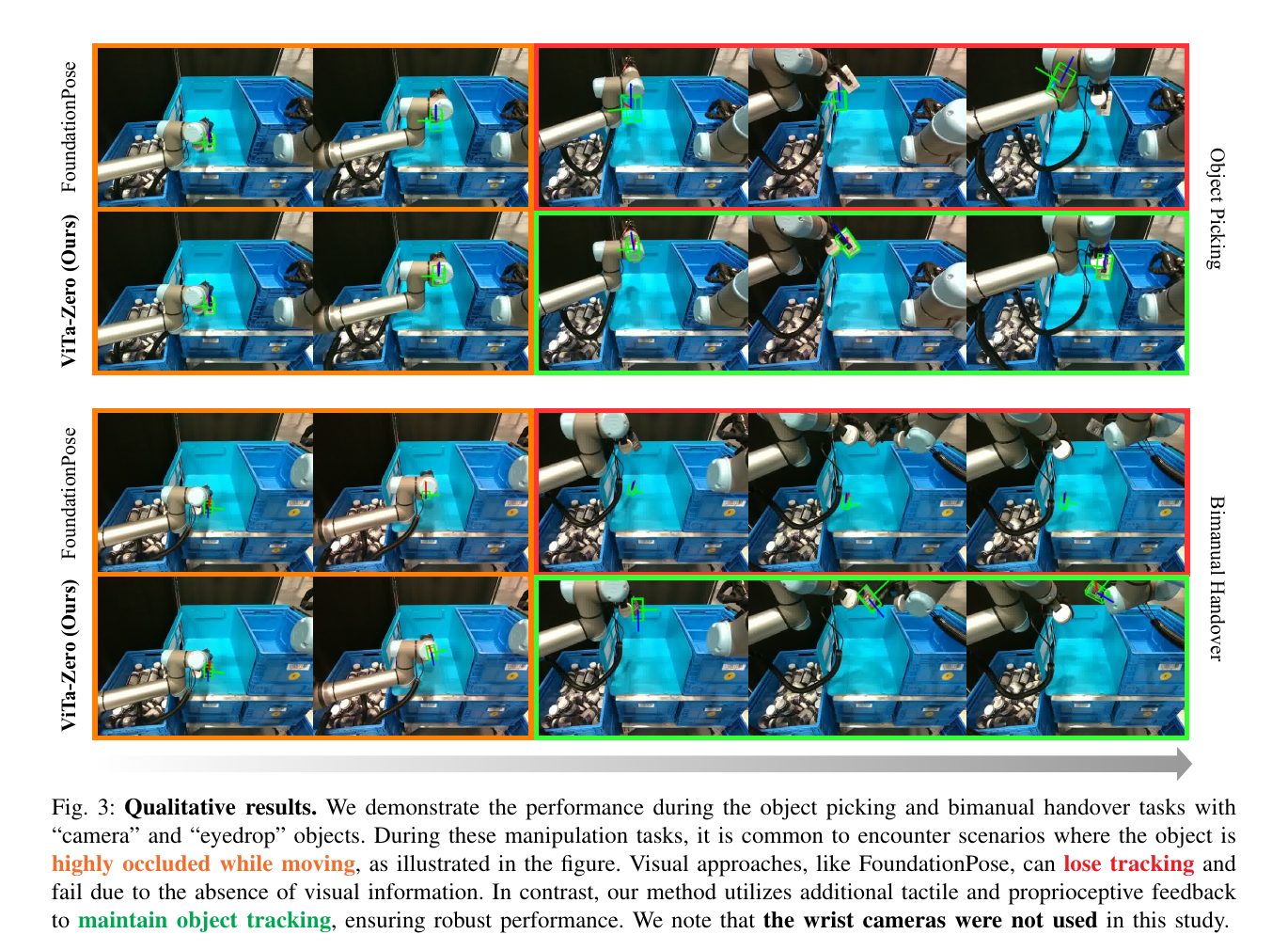
Original Figure 3: visual estimates drift or penetrate the hand under occlusion; tactile–kinematic constraints move the model toward consistency with real contacts. Source: authors' public PDF. Image copyright belongs to the authors and publisher; reproduced here for paper analysis.
2. Three feasibility constraints
2.1 Tactile contact
Activated taxels should lie near the object surface. An attractive residual can be defined as:
econtact=p∈C∑d(p,TM)2,
Here M is the object mesh.
2.2 Penetration
The object should not pass through the solid hand. Colliding points receive repulsive forces / penalties. Contact attraction alone can pull the model into the hand, making nonpenetration an essential negative constraint.
2.3 Kinematic consistency
Forward kinematics determines taxel and link positions. Joint states turn contact evidence into geometric constraints in shared coordinates and can also limit implausible jumps across frames.
3. Spring–mass test-time optimization
The object pose is treated as a rigid body acted on by virtual springs:
Contacts attract the object surface;
Penetrating regions generate repulsion;
L2 regularization prevents excessive departure from visual initialization.
Unlike pure ICP nearest-surface alignment, which can attract contacts to the wrong surface without understanding nonpenetration, the full loss combines positive / negative contact and a visual prior.
The small object set mainly demonstrates feasibility, rather than broad coverage of materials, shapes, and grasp patterns.
5. Quantitative results
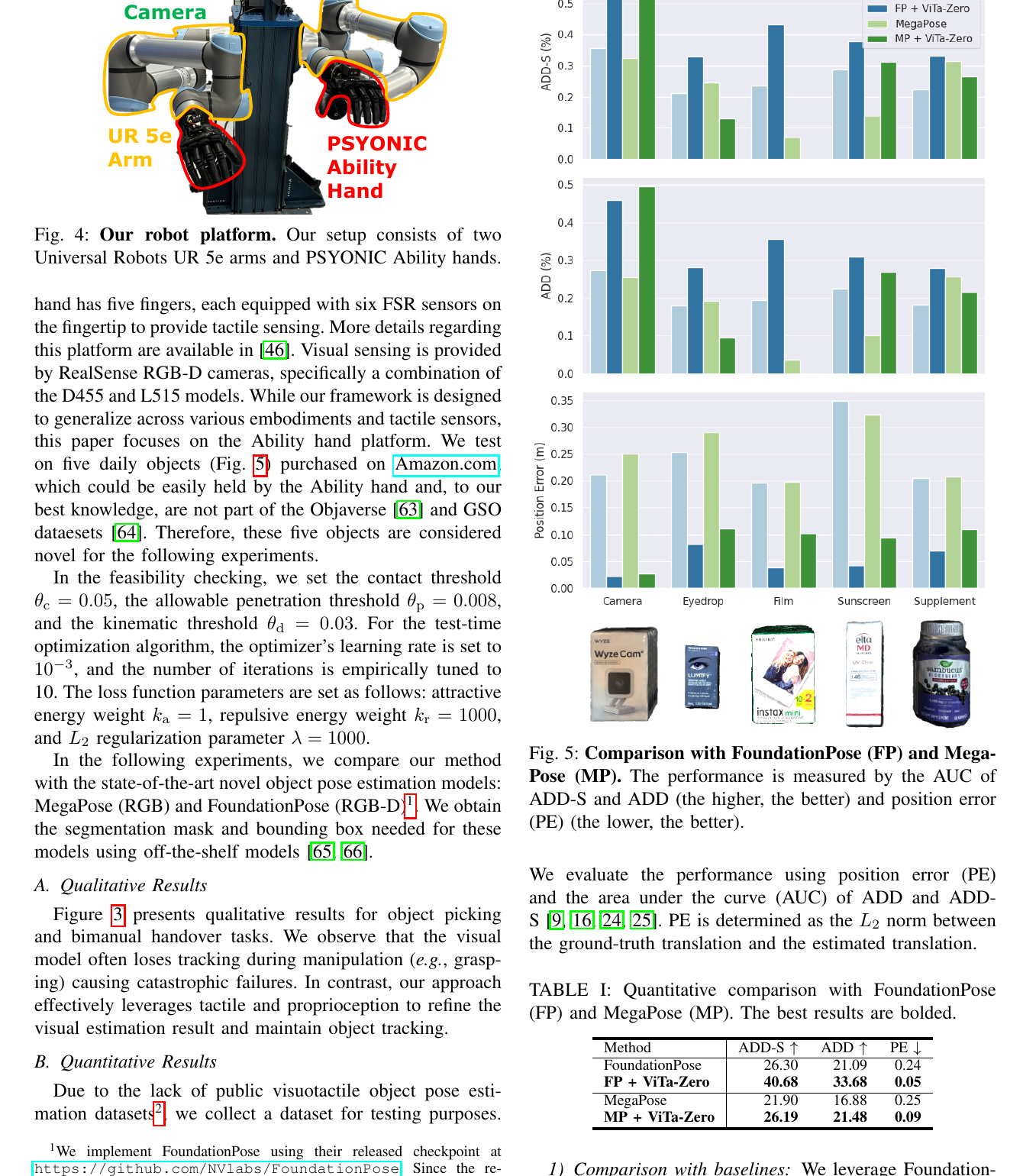
Original Figures 4–5 / Table I: robot platform; ADD-S / ADD AUC and position error for two visual backbones on five objects; and overall results. This crop contains no physical-loss ablation or task sequence; the relevant text draws separately on the original tables / Figure 3. Source: authors' public PDF. Image copyright belongs to the authors and publisher; reproduced here for paper analysis.
Method
ADD-S AUC ↑
ADD AUC ↑
PE ↓
FoundationPose
26.30
21.09
0.24
FoundationPose + ViTa-Zero
40.68
33.68
0.05
MegaPose
21.90
16.88
0.25
MegaPose + ViTa-Zero
26.19
21.48
0.09
FoundationPose gains more, perhaps because RGB-D initialization is already near the correct basin and tactile optimization converges more easily, or because the two backbones have different error distributions. This does not imply that ViTa-Zero only suits FoundationPose.
The full loss achieves 40.68 / 33.68 / 0.05, versus ordinary ICP’s 28.37 / 23.64 / 0.05. Equal position error but higher surface-alignment AUC shows that correcting the center alone does not recover rotation and full geometric consistency.
6. Runtime
Module
Time
Frequency
Pose tracking
0.011 s
90.9 Hz
Feasibility check
0.006 s
166.7 Hz
TTO
0.051 s
19.6 Hz
Test-time optimization is the bottleneck. On i9-14900K / RTX 4090 with two visual-refinement and ten TTO iterations, the authors report about 20 Hz online refresh. Table V lists component times only; TTO frequency alone should not be equated with a complete serial-loop frequency. Feasible poses can skip TTO, but deployment still needs measured end-to-end latency and overall scheduling.
7. What zero-shot means here
No visuotactile-network training for the five test objects;
Sparse tactile contact leaves some rotations unobservable.
Validation uses only five objects.
The authors’ project page says company policy prevents release of code and data, raising the reproduction barrier.
9. Deep reading conclusion
ViTa-Zero combines global initialization from a visual foundation model with tactile and robot geometry that project estimates toward physical feasibility. It uses contact as a test-time constraint rather than promising tactile-only object recognition. Main results and ICP comparisons support jointly modeling contact, penetration, and priors over simple nearest-point alignment.