VPHO: Joint Visual-Physical Cue Learning and Aggregation for Hand-Object Pose Estimation
For hand–object interaction from a single RGB image, VPHO learns hand / object heatmaps and physical cues such as contact forces. It generates multiple diffusion pose hypotheses, then combines visual and physics-based aggregation to choose a visually consistent, physically feasible result.
camera intrinsicsobject CAD modelMANO hand modelsingle RGB image
Reading Notes
Overview / Deep Dive
Available src/paper-notes/vpho/coarse.md
Paper overview notes
Quickly assess the paper's scope, problem setting, core method, experimental findings, and whether to read it in depth.
Overview Notes: VPHO: Joint Visual-Physical Cue Learning and Aggregation for Hand-Object Pose Estimation
1. Basic information
Title: VPHO: Joint Visual-Physical Cue Learning and Aggregation for Hand-Object Pose Estimation
Method: VPHO
Authors / affiliations: Jun Zhou, Chi Xu, Kaifeng Tang, Yuting Ge, Tingrui Guo, Li Cheng; China University of Geosciences (Wuhan) and University of Alberta.
VPHO estimates 3D hand–object interaction poses from one RGB image, combining visual hierarchical aggregation with contact-force and friction-cone-based physical aggregation so hand and object poses agree with both image evidence and interaction physics.
3. Problem setting
Input: one RGB image containing a hand and a manipulated object.
Output: MANO hand pose / shape, object 6D pose, and physically plausible hand–object interaction.
Assumptions: object CAD, camera parameters, and hand priors; no real force sensor during inference.
Key simplification: a single image cannot directly recover motion quantities such as acceleration, so the method assumes static equilibrium.
4. Method overview
Enhanced ResNet-50 and heatmap branches extract hand / object visual features.
A force-prediction module uses 32 sparse hand-surface anchors and friction cones for local contact forces, transformed into global forces through MANO’s local-to-global mapping.
Score-based diffusion generates multiple hand and object pose candidates.
Visual hierarchical aggregation follows the hand’s kinematic hierarchy, progressively aggregating candidates from lower- to higher-level joints.
Physics-based aggregation reranks candidates using force balance, torque balance, and contact relationships, yielding greater visual / physical consistency.
5. Experimental overview
Datasets: DexYCB and HO3Dv2, with DexYCB Phy and HO3Dv2 Phy constructed for physical-plausibility evaluation.
Physics metrics: contact percentage CP, penetration depth PD, and simulation displacement SD: mean object-center displacement after 200 ms of physical simulation.
Main results: DexYCB Full hand MJE / PA-MJE is 10.0 / 5.08 mm and object MCE / OCE / ADD-S is 26.2 / 23.7 / 13.5 mm; HO3Dv2 Full PA-MJE / MJE is 8.5 / 19.9 mm, with object OCE / ADD-S of 27.1 / 14.3 mm.
On the physics subsets, CP reaches 98.85% for DexYCB Phy and 98.80% for HO3Dv2 Phy.
6. Strengths and limitations
Strengths
Extends hand–object pose from visual reprojection to joint visual / physical inference.
Uses physical-constraint optimization for pseudo force labels without real contact-force annotations.
Candidate aggregation better represents monocular pose ambiguity than single-pass regression.
Limitations / risks
Static equilibrium does not suit rapid movement, collision, or strongly dynamic forces.
Strong CAD, MANO, and camera-geometry priors remain; cross-category and unknown-topology generalization are unresolved.
Physics scores depend on contact distances, gravity direction, and approximate forces, with limited coverage of real materials, flexibility, and changing friction.
7. Research takeaways
For general 6D pose, physical constraints can rerank or refine candidates while retaining visual estimation.
Sparse contact at 32 anchors suggests physical modeling need not predict a high-dimensional full-surface force field.
Future work should extend static aggregation with temporal dynamics and explicit uncertainty.
8. Is deep reading worthwhile?
Yes. Focus on pseudo-force-label optimization, physics-score scale sensitivity, and whether visual / physical aggregation ablations separate better candidates from better ranking.
Available src/paper-notes/vpho/deep.md
In-depth paper notes
Support reproduction, comparison, related-work writing, and identifying opportunities for further research.
Deep Reading Notes: VPHO: Joint Visual-Physical Cue Learning and Aggregation for Hand-Object Pose Estimation
1. Basic information
Title: VPHO: Joint Visual-Physical Cue Learning and Aggregation for Hand-Object Pose Estimation
Method: VPHO
Authors / affiliations: Jun Zhou, Chi Xu, Kaifeng Tang, Yuting Ge, Tingrui Guo, Li Cheng; China University of Geosciences (Wuhan) and University of Alberta.
VPHO organizes monocular hand–object pose as candidate generation, visual hierarchical aggregation, and physical aggregation. Image evidence recovers visible poses, while contact forces and static equilibrium reject physically implausible candidates.
2.1 Guide to the paper’s figures and tables
Figure / table
Content
Reading focus
Figure 1
Visual and 3D physical consistency in hand–object interaction
Visually plausible and physically plausible estimates need not coincide for the same image
Figure 2
Overall VPHO architecture
Read feature extraction, force prediction, candidate generation, and pose aggregation as four modules
Figures 3–4
Friction-cone representation and physics network
Track local forces into global MANO-frame forces
Figure 5
Hierarchical hand aggregation
Update lower-level joints before higher-level joints to reduce kinematic error accumulation
Tables 1–4
DexYCB / HO3Dv2 and physics-subset results
Read pose error and physical feasibility together
Table 5
Force-prediction, visual-aggregation, and physical-aggregation ablations
Test whether module gains complement one another
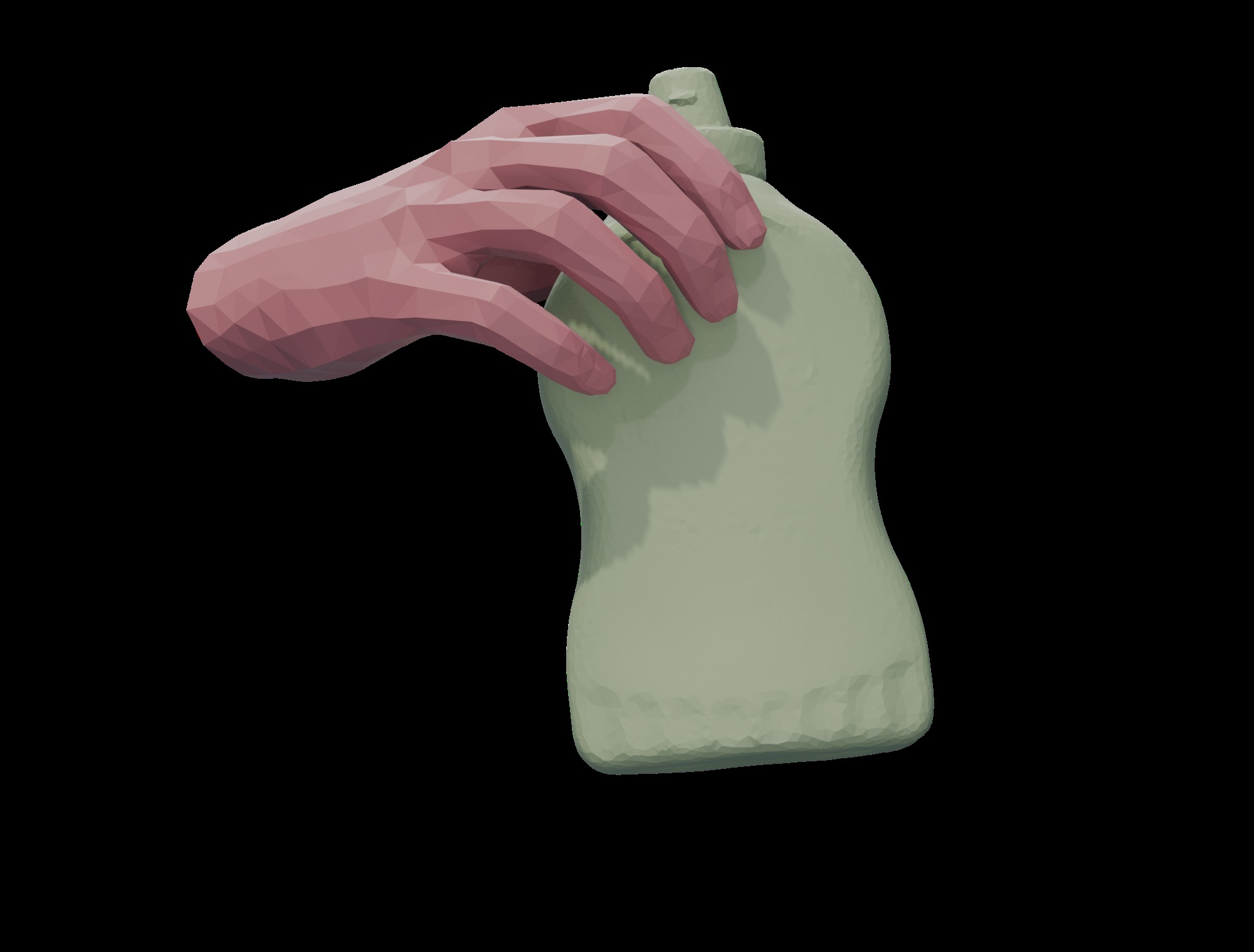
3D hand–object interaction example from the page containing original Figure 1, illustrating the relationship between visual pose and physical consistency. Source: official AAAI PDF. Image copyright belongs to the authors and publisher; reproduced here for paper analysis.
3. Problem setting and task boundaries
3.1 Inputs and outputs
Given one RGB image of a hand and object, predict MANO hand pose / shape and object pose. The goal goes beyond reducing hand-joint and object-pose errors separately: contact regions, force directions, and gravity should make the two estimates mutually compatible.
No real force sensor is available during inference. The physics module takes hand / object features and gravity direction; physical-constraint optimization provides pseudo force labels during training. This lowers annotation costs while simplifying real contact into explicit priors and approximate losses.
3.2 Assumption boundaries
Monocular images do not provide velocity, acceleration, or temporal contact changes, motivating static equilibrium.
Objects are rigid; distances from hand anchors to object surfaces approximate contact relationships.
Friction coefficients and gravity direction are specified or approximated; material differences and external disturbances are not modeled fully.
4. Method details
4.1 Feature extraction and candidate generation
Enhanced ResNet-50 with hand / object heatmaps supplies visual representations. Score-based diffusion generates hand-parameter candidates {(θi,βreg)}i=1N and object-pose candidates {(Ri,Ti)}i=1N. Multiple candidates acknowledge occlusion, ambiguity, and local errors instead of compressing all uncertainty into one regression vector.
4.2 Friction-cone force prediction
Each of 32 sparse hand-surface anchors has a local frame. Coulomb friction constrains local contact forces to a cone represented by basis vectors:
vj=(μsinNv2πj,μcosNv2πj,1).
Local force at anchor k is:
Fk′=skj=1∑Nvwk,jvj,
Here sk is scale and wk,j are basis weights. MANO linear blend skinning transforms local forces into global Fk. Sparse anchors, low-dimensional bases, and MANO geometry replace a high-dimensional force field.
4.3 Physical constraints and pseudo labels
Three constraints apply under static equilibrium:
Force balance: contact forces plus gravity should sum near zero, Lforce=∑k=132Fk+G22.
Torque balance: summed cross products of anchor position vectors rk and contact forces should be near zero, Ltorque=∑k=132Fk×rk22.
Contact: larger surface distances should permit smaller contact forces, approximated by Lcontact=∑k∥Fk∥2∣dk∣.
The physics network outputs w, s, and object center of mass c. Training combines predicted-force / pseudo-label MSE, center-of-mass error, force balance, and torque balance:
The authors do not equate pseudo labels with real sensor readings; they are better viewed as ranking and regularization signals.
4.4 Visual hierarchical aggregation
Hand joints form four kinematic levels. Heatmaps score candidates; from level 1 through level 4, top-K selection and weighted averaging update joint parameters in every candidate. Higher-level joints thus use stabilized lower-level results, limiting propagation of root / MCP errors to fingertips.
Object aggregation handles translation first, then rotation conditioned on the updated translation. Visual candidate scores come from heatmap responses at projected CAD keypoints:
sio=c=1∑27Hco(Proj2Do(c,Ri,Ti)).
4.5 Physical aggregation
After visual aggregation, physical scores rerank candidates. Hand scores depend on force-balance and contact losses:
sih=−Lforce⋅Lcontact.
Object scores combine torque, contact, and candidate poses. Physics selects plausible visual candidates, rejecting configurations that appear aligned but penetrate the object or cannot support it, rather than generating poses independently.
5. Experiments and results
5.1 Data and evaluation
DexYCB and HO3Dv2 evaluate standard hand–object pose.
DexYCB Phy and HO3Dv2 Phy additionally emphasize physical plausibility.
Pose metrics include MJE, PA-MJE, MCE, OCE, and ADD-S; physics metrics include CP, PD, and SD. SD is mean object-center displacement after 200 ms of physical simulation. SMCE in the physics subsets means symmetry-aware mean corner error, rather than scale or contact error.
5.2 Main results
On DexYCB Full, hand MJE / PA-MJE is 10.0 / 5.08 mm and object MCE / OCE / ADD-S is 26.2 / 23.7 / 13.5 mm. HO3Dv2 Full reports PA-MJE / MJE of 8.5 / 19.9 mm and object OCE / ADD-S of 27.1 / 14.3 mm. Respect each table’s hand / object column order.
On DexYCB Phy, CP is 98.85%, PD 13.4 mm, and SD 17.3 mm; on HO3Dv2 Phy, CP is 98.80%, PD 0.96 cm, and SD 2.21 cm. These scores indicate consistency with the defined static constraints, not complete recovery of real-world physics.
5.3 Ablation analysis
Table 5 separates the components: without force prediction or aggregation, the baseline performs worst; force prediction improves object pose; visual aggregation further lowers hand / object errors; full physical aggregation improves both and the physics metrics. This supports separate roles for candidate quality, visual ranking, and physical ranking.
6. Critical analysis
Strengths
A meaningful task: accurate hand pose alone does not guarantee a valid grasp relationship.
Multiple candidates and hierarchical aggregation make monocular ambiguity more interpretable than single-pass regression.
Physical cues need no real force labels, making training data more accessible.
Limitations and implicit assumptions
Static equilibrium limits fast picking, throwing, collisions, and dynamic contact.
Idealized friction cones may bias ranking under changing friction, soft-object deformation, or contact areas.
Physics metrics lack robot experiments or systematic closed-loop validation against real grasp success.
Candidate count, top-K, and physical-loss scales affect speed / quality and need fuller sensitivity analysis.
7. Insights for 6D pose research
Convert contact, support surfaces, and gravity into candidate-reranking signals in RGB-D / CAD pose estimation.
Under heavy occlusion, generating multiple hypotheses before geometric / physical filtering may be more stable than direct regression.
Add temporal information to extend static Lforce / Ltorque into dynamic constraints, with physical confidence entering uncertainty estimation.
8. Open questions
Do physics scores remain useful outside static contact or with external finger / table support?
How sensitive are pseudo force labels to friction, gravity direction, and contact-distance noise?
Does aggregation survive incomplete CAD, unknown categories, or substantial deformation?
Can real-robot success validate the relationship of CP, PD, and SD to manipulation reliability?