WALDO: Where Unseen Model-based 6D Pose Estimation Meets Occlusion
Within a SAM6D-style model-based novel-object pipeline, WALDO uses coarse correspondences for both multiple initial poses and pointwise occlusion / background probabilities. Probability-guided dynamic nonuniform dense sampling, repeated sparse-to-dense matching, and weighted SVD refine poses. On five BOP-Core* sets, UAR / AR is 0.56 / 0.73 versus SAM6D's 0.54 / 0.71, with image runtime dropping from 4.37 s to 1.53 s. ICBIN shows the largest UAR gain, 0.50→0.56, but absolute UAR remains below FRTPose, FreeZe, and Co-op. UAR averages across visibility deciles to expose conventional AR's dominance by highly visible samples. RGB-D, exact CAD, detection / segmentation, and a complex multistage system remain required.
accurate CAD or mesh for every test objectRGB-D observation with usable depth on visible surfacescamera calibration and metric scale consistencytemplate rendering and object onboardingGrounding DINO, SAM2 and DINOv2-L based MUSE front endsynthetically trained coarse and dense point-matching networksBOP visibility annotations for UAR evaluation
Full paper metadataAuthors, affiliations, research area, datasets, metrics, method tags, and reading statusExpandCollapse
Authors
Sajjad Pakdamansavoji, Yintao Ma, Amir Rasouli, Tongtong Cao
accurate CAD or mesh for every test objectRGB-D observation with usable depth on visible surfacescamera calibration and metric scale consistencytemplate rendering and object onboardingGrounding DINO, SAM2 and DINOv2-L based MUSE front endsynthetically trained coarse and dense point-matching networksBOP visibility annotations for UAR evaluation
Reading Notes
Overview / Deep Dive
Available src/paper-notes/waldo-wacv2026/coarse.md
Paper overview notes
Quickly assess the paper's scope, problem setting, core method, experimental findings, and whether to read it in depth.
Building on a SAM6D-style detect–segment–template-match–refine pipeline, WALDO addresses occlusion-driven error propagation for unseen objects through visibility-guided nonuniform dense sampling, multiple initial hypotheses, iterative refinement, occlusion-focused augmentation, and visibility-stratified Unbiased Average Recall (UAR).
The task is novel-object model-based 6D pose with object CAD supplied at test time. Its inputs extend beyond a single RGB image:
Observed RGB-D;
Unseen-object CAD / mesh;
Multiview RGB-D templates rendered from that model;
Camera intrinsics and BOP-style detection / segmentation / evaluation information.
Output is full object rotation and translation (R,t) relative to the camera, unlike rotation-only methods or model-free few-reference-image approaches.
2.1 Main results
Five-dataset BOP-Core* mean UAR / AR = 0.56 / 0.73, versus SAM6D’s 0.54 / 0.71;
ICBIN UAR rises from 0.50 to 0.56, the largest gain among the five datasets;
YCB-V rises from 0.52 to 0.56, LMO from 0.49 to 0.50, T-LESS from 0.31 to 0.32, while TUD-L stays at 0.85;
Per-image inference falls from SAM6D’s 4.37 s to 1.53 s, about 2.86 times faster with roughly 65% less latency;
FRTPose has higher UAR (0.70) but takes 45.37 s; WALDO targets a speed–occlusion-robustness trade-off rather than the highest absolute accuracy;
WALDO’s conventional BOP AR, 0.73, exceeds UAR, 0.56, by 0.17, showing how highly visible samples can make ordinary averages more optimistic.
2.2 Guide to figures and tables
Figure / table
Question answered
Coarse reading conclusion
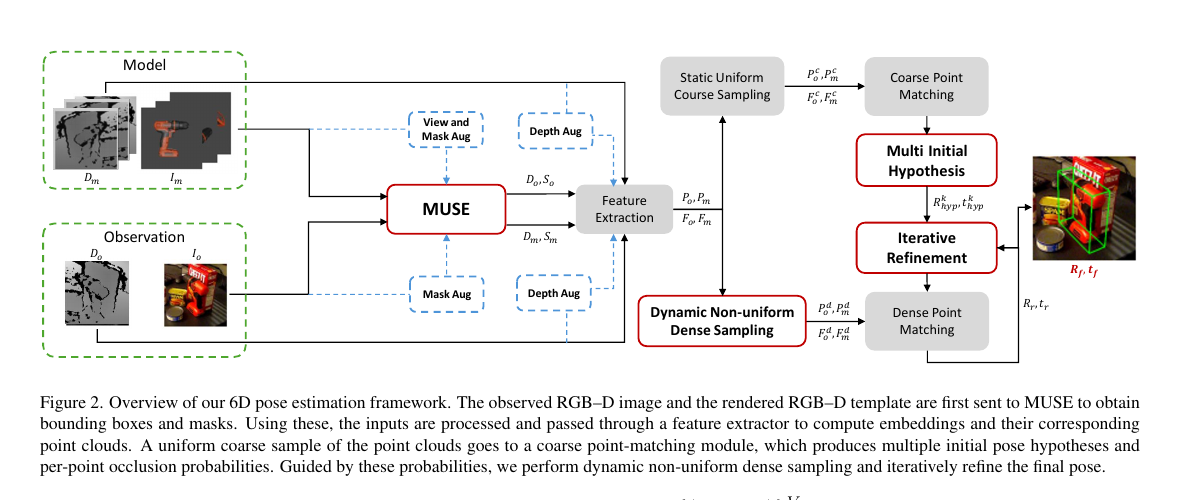
Figure 2
What changes relative to SAM6D-style pipelines?
Multiple hypotheses, visibility probabilities, dynamic dense sampling, and recurrent refinement form a loop rather than one module replacement
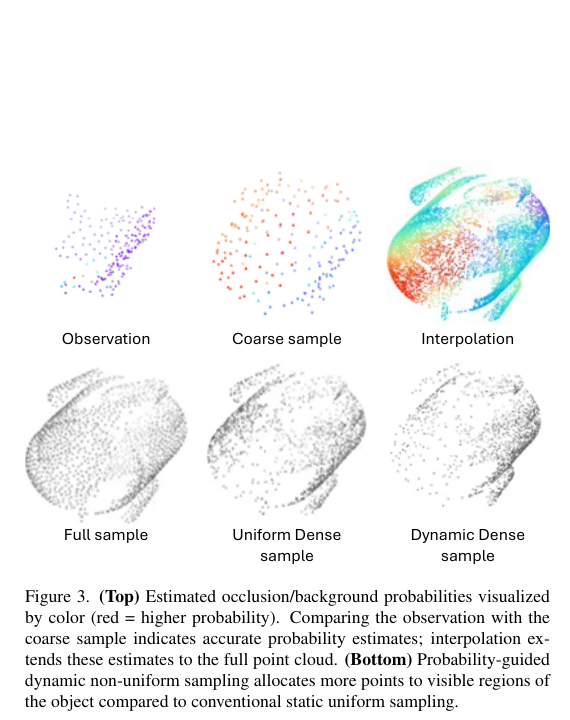
Figure 3
What does dynamic nonuniform sampling do?
Interpolate coarse background / occlusion probabilities over the full cloud, concentrating dense samples on visible regions
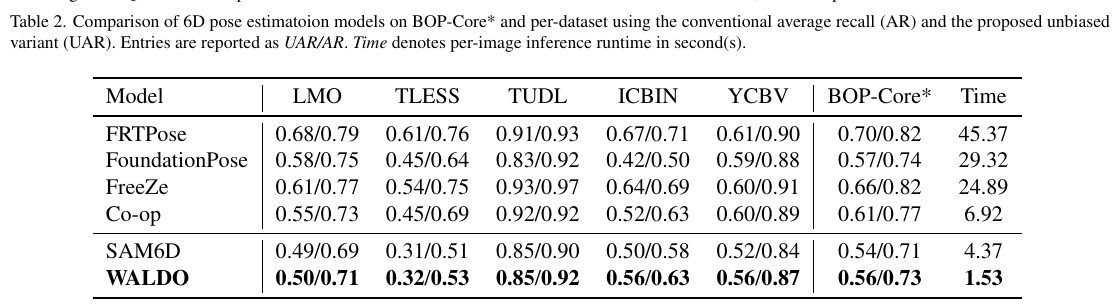
Table 2
Is it both more accurate and faster?
BOP-Core* UAR gains +0.02 over SAM6D with 4.37→1.53 s runtime; it is faster but less accurate than FRTPose
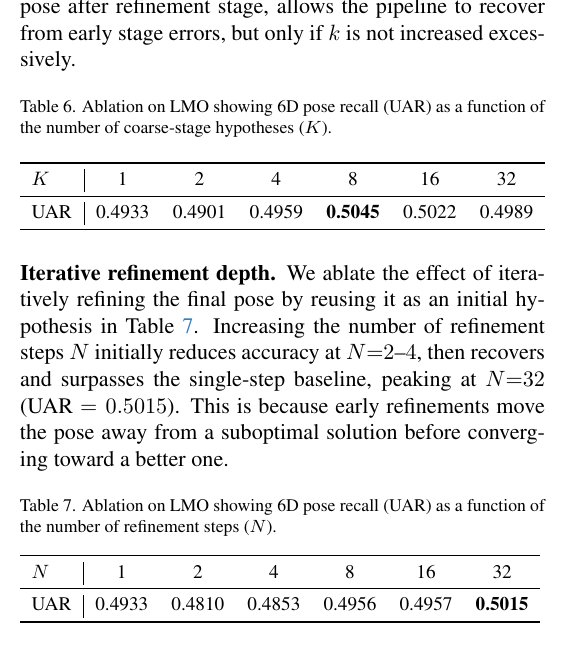
Tables 6–7
Do more hypotheses / refinement rounds always help?
Neither is monotonic: K=8 is best; N=2,4 declines, N=8 already exceeds the one-step baseline, and N=32 is best
Original Figure 2: observations / templates pass through MUSE detection / segmentation and feature extraction; coarse matching produces initial poses and per-point occlusion probabilities. These guide dense sampling, and repeated dense matching refines candidates to the final pose. Source: CVF Open Access. Image copyright belongs to the authors and publisher; reproduced here for paper analysis.
3. Research problem
3.1 Why occlusion damages multistage methods
Unseen-object pose commonly proceeds through:
Detecting and segmenting the target observation;
Rendering CAD templates;
Matching observations and templates for initialization;
Refinement through render-and-compare or point matching.
Heavy occlusion can make segmentation include occluders, miss visible fragments, or produce incomplete masks. A single initial path propagates such errors; uniform dense sampling over the whole model also wastes computation on invisible regions.
WALDO’s central insight is that occlusion must shape candidate management and sampling distributions as well as training augmentation.
3.2 Why ordinary AR may overestimate performance
BOP instances unevenly cover visible fractions. When highly visible objects dominate, easy samples drive ordinary AR; poor performance on rare heavy-occlusion cases barely changes the mean.
WALDO divides instances into 10 visibility-fraction deciles, computes VSD, MSSD, and MSPD recall within each, then averages across bins and metrics for UAR. Low- and high-visibility cases thus receive approximately equal final weight.
UAR is a new aggregation proposed in this paper, not an established replacement for official BOP AR. It tests consistency across occlusion levels while changing actual sample-frequency weights.
4. Method pipeline
4.1 Detection and segmentation: MUSE
Grounding DINO proposes boxes, SAM2 uses box prompts for masks, and DINOv2-L extracts multilevel patch embeddings from observed foreground and templates. Integrated von Mises–Fisher template weights emphasize plausible viewing directions for 3D-aware multi-embedding similarity.
This stage outputs:
Observed boxes / masks (Bo,So);
Template boxes / masks (Bmv,Smv);
Target regions for subsequent clouds and feature lifting.
Detection remains a bottleneck: GT detections yield 0.70 UAR versus actual MUSE’s 0.56.
4.2 Features and clouds
Observation / template crops use fixed resolution, such as 224×224; ViT layers 3, 6, 9, and 12 supply multiscale patches. The system:
Converts observed depth / masks into partial cloud Po;
Aggregates template depth / masks into a more complete model cloud Pm;
Adds learnable background and occlusion tokens so nonoverlap need not match physical points.
4.3 Coarse matching and multiple initial hypotheses
Uniform coarse samples of observation / model clouds pass through a Geometric Transformer to yield bidirectional soft correspondence matrices containing:
Repeated correspondence sampling and SVD generate multiple (Rhypk,thypk), scored by transformed-model-to-observation mean nearest-neighbor distance. Retain top-K candidates rather than fixing one pose prematurely.
4.4 Visibility-guided dynamic dense sampling
Original Figure 3: stronger red indicates higher coarse background / occlusion probability. After interpolation over the full cloud, dynamic sampling spends less on invisible regions and more on observation-supported surfaces. Source: CVF Open Access. Image copyright belongs to the authors and publisher; reproduced here for paper analysis.
Coarse-matrix background / occlusion probabilities are interpolated over the full cloud, then Walker–Vose alias sampling and Gumbel-Top-k sampling without replacement form dynamic nonuniform dense samples.
Intuitively:
Uniform sampling seeks even geometric coverage;
Dynamic sampling concentrates matchable evidence in the current image.
The LMO ablation raises UAR from 0.49 to 0.50: a real but modest gain.
4.5 Dense matching and iterative refinement
Each coarse hypothesis moves the model near the observation. Set Abstraction supplies 3D positional encoding, a Sparse-to-Dense Point Transformer estimates dense correspondences, and weighted SVD refines pose. The refined pose initializes the next round, repeated N times.
This remains correspondence plus closed-form rigid registration, rather than direct network regression of rotation / translation.
4.6 Occlusion-focused training augmentation
Large-scale synthetic training adds three augmentation types:
Depth augmentation: blur, Gaussian noise, and random-pixel / elliptical dropout;
Mask augmentation: dilation, box replacement, straight-line cuts, and random interior removal;
View augmentation: subsets of opposing template views produce incomplete model clouds.
ViT + RANSAC gives 0.33; point matching + SVD gives 0.54; occlusion augmentation reaches 0.55. The matching framework supplies the largest gain; augmentation adds +0.01 rather than explaining everything.
5. Experiments and numbers
5.1 Datasets
BOP-Core* contains five subsets:
LMO: heavily occluded instance-level objects;
T-LESS: textureless, similar, and symmetric industrial objects;
TUD-L: varying illumination and relatively clean scenes;
ICBIN: dense occlusion and repeated instances;
YCB-V: everyday objects, video frames, and occlusion.
Not all BOP datasets enter UAR aggregation. BOP-Core* is this paper’s five-dataset subset, so its mean cannot be mixed directly with full contemporary BOP leaderboard means.
5.2 Main results
Original Table 2: cells report UAR / AR; Time is seconds per image. WALDO raises BOP-Core* UAR over SAM6D from 0.54 to 0.56 while reducing 4.37 s to 1.53 s; FRTPose has higher 0.70 UAR but needs 45.37 s. Source: CVF Open Access. Image copyright belongs to the authors and publisher; reproduced here for paper analysis.
Method
BOP-Core* UAR / AR
Time (s / image)
Interpretation
FRTPose
0.70 / 0.82
45.37
Most accurate but slowest
FreeZe
0.66 / 0.82
24.89
More accurate than WALDO but about 16 times slower
Co-op
0.61 / 0.77
6.92
Intermediate accuracy and runtime
SAM6D
0.54 / 0.71
4.37
Main WALDO baseline
WALDO
0.56 / 0.73
1.53
Lower-latency trade-off in this table, still not real-time
The abstract’s “more than 2% on BOP” refers to changes such as 0.54 to 0.56, an absolute 0.02 score-point gain rather than a 2% relative improvement.
5.3 More hypotheses / iterations are not always better
Increasing coarse hypotheses K from 1 to 8 raises LMO UAR from 0.4933 to 0.5045; 16 / 32 lower it to 0.5022 / 0.4989.
Refinement count N is more counterintuitive:
N=1: 0.4933;
N=2: 0.4810;
N=4: 0.4853;
N=8: 0.4956;
N=32: 0.5015.
Early refinement can initially move poses away from a local suboptimum before enough rounds recover and beat the one-step result. Effectiveness therefore depends on a deeper loop and additional computation, rather than improvement at every round.
6. Strengths
Occlusion informs detection, matching, sampling, candidate retention, augmentation, and evaluation, beyond adding random occluders.
Background / occlusion tokens prevent invisible points from being forced into wrong physical matches.
Multiple hypotheses defer discrete decisions under symmetry and partial visibility.
Reporting AR with UAR exposes statistical bias hidden by strong overall scores.
A clear SAM6D baseline makes accuracy / speed changes easier to locate.
Ablations separate detectors, augmentation, sampling, hypothesis counts, and refinement depth.
7. Limitations and risks
Requires accurate CAD, RGB-D, intrinsics, and rendered templates at test time, rather than weak priors or RGB alone.
A complex multistage system relies on Grounding DINO, SAM2, DINOv2-L, MUSE, multiple transformers, and SVD.
Actual MUSE gives 0.56 UAR versus 0.70 with GT detection; detection / segmentation still limit the ceiling.
BOP-Core* UAR trails FRTPose, FreeZe, and Co-op; the contribution is speed versus occlusion robustness, not universal SOTA.
Equal weighting of 10 visibility deciles reveals occlusion-level fairness but may not match deployment frequencies or task costs.
DNDS alone adds only 0.01; hypotheses and iteration are sensitive and nonmonotonic.
No per-module memory / energy breakdown or full hardware normalization; implementation and hardware may influence timing comparisons.
Synthetic training lacks a separate cross-device study of real depth sensors.
No verifiable official code link in the public paper; reproduction must reconstruct multiple dependencies and training steps.
8. Is deep reading worthwhile?
Yes. For unseen-object pose, BOP, heavy occlusion, model-based inference, or evaluation, WALDO goes beyond +0.02 UAR by separating:
Whether the model truly handles occlusion better;
Whether benchmark sample distributions let ordinary AR conceal failures.
For RGB-only, model-free, or extremely low-latency deployment, examine prior requirements and system complexity before adopting it.
9. Three questions after coarse reading
Would rankings survive continuous, task-risk, or dataset-independent weighting instead of ten visibility bins?
Coarse hypotheses eventually collapse to one pose; could the model output an image-conditioned distribution against BOP-Distrib-style ground truth?
WALDO turns occlusion into four explicit problems in a multistage model-based pipeline: frontend mask errors, pointwise invisibility, ambiguous initial poses, and benchmark bias toward visible samples. It retains detection, templates, point matching, and SVD, but coarse matching jointly supplies multiple hypotheses and background / occlusion probabilities to redistribute dense-matching computation and repeatedly refine candidates.
Three sentences summarize the main results:
Against the main SAM6D baseline, BOP-Core* UAR / AR rises from 0.54 / 0.71 to 0.56 / 0.73, while per-image time falls from 4.37 s to 1.53 s;
Gains concentrate on more occluded ICBIN (UAR 0.50→0.56) and YCB-V (0.52→0.56); TUD-L UAR does not improve;
WALDO remains below FRTPose’s 0.70 UAR, FreeZe’s 0.66, and Co-op’s 0.61: a speed–occlusion-robustness trade-off, rather than best accuracy everywhere.
Keep these boundaries during deep reading:
Test-time RGB-D observations, object CAD / meshes, rendered templates, and camera information are required;
BOP-Core* is the five selected datasets, not the complete BOP benchmark;
UAR is the authors’ equal-visibility aggregation, distinct from official AR;
Abstract claims of “2% / 5% improvement” refer to absolute UAR score-point changes such as 0.54→0.56 and 0.50→0.56;
The public version has no verifiable official code link; module versions and reproduction interfaces require assembly.
More robust low-visibility performance than SAM6D under this five-dataset protocol
Generalization to every sensor or occlusion type
Faster
4.37→1.53 s / image; FRTPose 45.37 s
Lower reported per-image inference latency in the implementation table
Hardware independence, lower energy, or faster processing at all batch sizes
Dynamic sampling helps
LMO UAR 0.49→0.50
A modest visibility-guided sampling gain
Sole or dominant explanation of the overall +0.02
Multiple hypotheses help
K=1 gives 0.4933→K=8 gives 0.5045
Moderate candidate counts improve LMO UAR
More is always better; K=32 falls to 0.4989
Iterative refinement helps
N=1 gives 0.4933, N=32 gives 0.5015
Sufficient depth eventually beats one step
Every round improves; N=2,4 declines
Ordinary AR is optimistic
WALDO BOP-Core* AR 0.73, UAR 0.56
Visibility-stratified aggregation is more conservative than a high-visibility-dominated mean
UAR is the only reasonable deployment-risk weighting
3. Task boundaries and notation
3.1 Inputs
Each test instance requires:
Observed RGB Io;
Observed depth Do;
Object CAD / mesh;
From V views, rendered template RGB Imvv=1V;
Corresponding template depth Dmvv=1V;
Camera intrinsics;
Frontend detection / segmentation and trained feature / matching networks.
The observation mask covers visible surfaces, yielding partial cloud Po; templates aggregate into an approximately complete model cloud Pm.
3.2 Outputs
The final rigid transform is:
(Rf,tf),Rf∈SO(3),tf∈R3,
It aligns model coordinates with camera / observation coordinates. This is instance-level model-based novel-object pose: test objects are unseen in training but supplied as models during testing.
3.3 Unseen does not mean no object prior
No pose-network retraining is needed for each test object, but complete CAD and prerendered multiview RGB-D remain available. Generalization means transferring from training assets to new geometry, rather than inferring pose without object-shape information.
Distinguish three other tasks:
Model-free pose using a few reference images / videos;
Category-level pose for new instances in training categories, using category shape priors;
Open-vocabulary detection from text / categories, without guaranteed complete 6D pose.
Detection / segmentation misses visible fragments or includes occluders;
Feature lifting attaches background pixels to wrong 3D points, with no evidence for invisible model regions;
Coarse matching has multiple plausible local geometry / texture alignments, prematurely collapsed by single-pose selection;
Dense matching wastes uniform full-model sampling on invisible surfaces;
Evaluation dilutes low-visibility failures when highly visible samples dominate.
These design responses roughly match the five problems, making robustness easier to audit than attributing everything to a backbone.
5. Overall architecture
Original Figure 2: solid black arrows mark inference; dashed blue arrows mark training view / mask / depth augmentation. Coarse matching produces poses and occlusion / background probabilities, linking coarse and dense stages. Source: CVF Open Access. Image copyright belongs to the authors and publisher; reproduced here for paper analysis.
Modules:
MUSE performs 3D-aware detection / segmentation;
ViT supplies multilevel features, lifted to clouds through depth;
Coarse point matching yields soft assignments, occlusion probabilities, and initial hypotheses;
Dense transformers and weighted SVD refine candidates;
Results feed back over N rounds;
Training depth / mask / view augmentation simulates the occlusion error chain.
6. MUSE: 3D-aware detection and segmentation
6.1 Frontend components
For observations:
Grounding DINO proposes boxes;
SAM2 generates masks from box prompts;
DINOv2-L extracts class-level and patch-level foreground multi-embeddings.
The same encoder processes templates. Integrated von Mises–Fisher (I-vMF) weights emphasize directionally plausible templates; 3D-aware multi-embedding similarity selects targets among proposals.
6.2 Detection and pose are coupled
Table 3 evaluates detection choice through final UAR:
Detector
BOP-Core* UAR
Time (s / image)
NIDS
0.54
1.26
Fast-SAM
0.55
4.37
MUSE
0.56
1.53
Ground Truth
0.70
—
MUSE gains only 0.02 UAR over NIDS, while GT detection exceeds MUSE by 0.14. Occlusion-aware backends cannot fully recover target regions omitted upstream; error recovery remains limited rather than eliminating detector dependence.
7. Features and 3D lifting
7.1 Crops and multilevel ViT features
Using (Bo,So), mask the background, crop the ROI, and resize, for example to 224×224. ViT blocks 3, 6, 9, and 12 supply patch embeddings; a fully connected layer, reshape, and bilinear interpolation yield foreground-point features:
Fo∈RNo×C.
Each template produces Fmv, aggregated over views as:
Fm∈RNm×C,Nm=v=1∑VNmv.
Multilevel features retain local and semantic cues but increase feature memory; intermediate tensor memory is not reported separately.
7.2 Background and occlusion tokens
Learnable observed-background embedding fobg and model-occlusion embedding fmoc give evidence that should not match physical points a valid destination:
Contaminated observation-mask points can match background;
Currently invisible model points can match occlusion.
Without these destinations, bidirectional softmax forces mass among wrong physical points, contaminating SVD.
7.3 Point clouds
Observed depth / masks produce partial Po; template depth / masks yield model Pm. Correspondence is subsequently 3D–3D, beyond 2D template retrieval.
This explains RGB-D dependence: unreliable or absent observed depth prevents direct construction of Po, requiring changes to point matching and SVD.
8. Bidirectional soft correspondence
8.1 Assignment matrix
With extra tokens, feature attention / assignment is:
A=[fobg,Fo][fmoc,Fm]T∈R(No+1)×(Nm+1).
Apply temperature-scaled softmax separately by rows and columns, then multiply elementwise:
A~=Softmaxrow(τA)⊙Softmaxcol(τA).
Bidirectional normalization favors mutual matches and weakens one-to-many assignments unsupported in reverse.
8.2 Coarse stage
Uniform farthest-point-like sampling of Po,Pm gives:
Poc∈R196×3,Pmc∈R196×3,
Then apply Tc=3 Geometric Transformer blocks. Coarse assignment ildeAc serves two purposes:
Sample correspondences for pose hypotheses;
Read background / occlusion probabilities from the first row / column.
Visibility thus emerges from correspondence rather than an independent segmentation head.
9. Multiple initial pose hypotheses
9.1 Generation
Repeatedly sample 3D–3D matches from ildeAc and solve each rigid transform (Rhypk,thypk) by SVD. Candidate confidence roughly inverts the mean nearest-neighbor distance from transformed model points to observed coarse clouds:
Partial geometry admits nearby plausible orientations; symmetric objects also have genuinely equivalent rotations. Wrong coarse initialization may lie outside the correct dense-refinement basin. Several initializations increase the chance of reaching that basin.
Nearest-neighbor geometry can still favor incorrect locally overlapping solutions. The final output is one pose, not an explicit distribution.
10. Dynamic Non-uniform Dense Sampling
Original Figure 3: top, coarse background / occlusion probabilities and interpolation over the full cloud; bottom, full clouds, static uniform dense samples, and probability-guided dynamic samples. Source: CVF Open Access. Image copyright belongs to the authors and publisher; reproduced here for paper analysis.
10.1 Probability source
The first column / row of A~c encodes observed-background / model-occlusion probabilities. Defined only at 196 coarse points, they are interpolated over original clouds by 3D neighborhood distance.
10.2 Sampling
Build a Walker–Vose alias table for the probability distribution, then use Gumbel-Top-k without replacement to obtain roughly 2048-point dense sets:
Pod∈R2048×3,Pmd∈R2048×3.
The aim is useful matching evidence rather than uniform geometry: fewer high-occlusion / background points and more observation-supported regions.
10.3 A caveat
Wrong coarse matching produces wrong interpolated visibility, potentially amplifying early bias through dynamic sampling. Multiple hypotheses and iterative refinement mitigate this feedback but do not theoretically guarantee recovery.
11. Dense matching and iteration
11.1 Refining each hypothesis
For each (Rhyp,thyp):
Transform the dense model cloud near the hypothesized alignment;
Extract multiscale positional encoding through Set Abstraction;
Add positional encoding to dense features;
Apply Td=3 Sparse-to-Dense Point Transformer blocks;
Extract weighted correspondences from dense assignments;
Solve (Rr,tr) through weighted SVD.
11.2 Recurrent refinement
Updated (Rr,tr) initializes the next round; after N repetitions, output (Rf,tf). This reuses shared modules recurrently, rather than training N independent stages.
Iteration can correct early errors but adds risks:
Inference cost grows with N;
Incorrect matches can reinforce themselves;
Training / inference refinement depths must be consistent or sufficiently robust.
12. Training supervision and augmentation
12.1 Correspondence labels
Synthetic GT pose (R^,t^) transforms observations into model coordinates for nearest-model-point labels. Distances below δdis=0.15 indicate correspondence; others become background. The reverse direction similarly labels invisible points as occluded.
Apply and sum supervision over multiple coarse / dense transformer blocks.
12.2 Augmentation
Beyond standard color, noise, blur, scale, rotation, and perspective augmentation, three occlusion-focused groups add:
Depth
blur;
Gaussian noise;
Random depth dropout;
Missing elliptical regions.
Mask
dilation;
Mask replacement by bounding boxes;
Straight-line mask cuts;
Random interior removal.
View
Subsets of multiview templates;
Incomplete model clouds simulating missing model evidence.
Augmentation’s marginal UAR change is 0.54→0.55: useful, while the backbone / correspondence framework supplies the main performance gain.
13. UAR: averaging by visibility
13.1 Ordinary BOP AR
BOP AR commonly aggregates thresholded recalls for:
VSD: visible surface discrepancy;
MSSD: maximum symmetry-aware surface distance;
MSPD: maximum symmetry-aware projection distance.
These errors handle visible surfaces or symmetry, but ordinary dataset averages still reflect the sample visibility distribution.
13.2 UAR computation
Split instances into 10 visibility-fraction deciles. Within each:
Compute VSD / MSSD / MSPD recall separately;
Aggregate their thresholds;
Average equally across three metrics and 10 deciles.
UAR approximately asks how often inference succeeds if a visibility level is sampled first, then an instance within it.
13.3 Detection / segmentation counterparts
Similarly compute and average COCO AP / AR by visibility decile to obtain mAPD / mARD. WALDO frontend results:
AP 0.508 vs mAPD 0.218;
AR 0.594 vs mARD 0.444.
AP exceeds mAPD by 0.290, indicating the large contribution of highly visible instances to ordinary AP.
13.4 Statistical trade-offs
Benefits:
Numerous highly visible samples cannot dominate the score;
Compare consistency across occlusion levels;
Expose strong mean scores hiding heavy-occlusion failure.
Limitations:
Ten bins are an empirical choice;
Empty / small bins may have higher variance;
Equal weighting need not match deployment frequency;
Failure cost at low visibility may be nonlinear across tasks;
Values are not directly comparable with conventional leaderboards.
14. Checking the main results
Original Table 2: every dataset cell gives UAR / AR. WALDO's 0.56 BOP-Core* UAR trails FRTPose, FreeZe, and Co-op, but 1.53 s is fastest in this table; against SAM6D it is both more accurate and faster. Source: CVF Open Access. Image copyright belongs to the authors and publisher; reproduced here for paper analysis.
14.1 Against SAM6D
Dataset
SAM6D UAR / AR
WALDO UAR / AR
Absolute UAR change
LMO
0.49 / 0.69
0.50 / 0.71
+0.01
T-LESS
0.31 / 0.51
0.32 / 0.53
+0.01
TUD-L
0.85 / 0.90
0.85 / 0.92
0.00
ICBIN
0.50 / 0.58
0.56 / 0.63
+0.06
YCB-V
0.52 / 0.84
0.56 / 0.87
+0.04
Mean
0.54 / 0.71
0.56 / 0.73
+0.02
Gains broadly align with occlusion difficulty but do not cover every dataset. Unchanged TUD-L UAR rules out universal improvement across scenes.
14.2 More accurate but slower methods
Method
UAR
Time
Relative to WALDO
FRTPose
0.70
45.37 s
+0.14 UAR, about 29.7 times the runtime
FreeZe
0.66
24.89 s
+0.10 UAR, about 16.3 times the runtime
Co-op
0.61
6.92 s
+0.05 UAR, about 4.5 times the runtime
WALDO
0.56
1.53 s
Fastest but less accurate than the three above
Figure 1’s Pareto interpretation is reasonable, but better on both metrics applies to some baselines / the efficiency frontier, not domination of every method: FRTPose is clearly more accurate and WALDO faster.
14.3 AR–UAR gap
WALDO mean AR is 0.73 and UAR 0.56, a difference of:
0.73−0.56=0.17,
Relative to UAR, approximately:
0.560.17≈30.4%.
The paper reports about 30.5%. Larger YCB-V / T-LESS gaps indicate mainly highly visible test instances; ICBIN’s smaller gap reflects a more occluded distribution.
15. Ablations: where gains come from
15.1 From simple matching to full training
Setting
BOP-Core* UAR
ViT features + RANSAC
0.33
+ Point Matching & SVD
0.54
+ Occlusion-focused Augmentation
0.55
Learned point matching + SVD supplies the largest +0.21; augmentation adds +0.01. Attributing all gains to occlusion augmentation from the title alone would be incorrect.
15.2 DNDS
LMO gives 0.49 with static uniform sampling and 0.50 with DNDS. This small single-dataset gain needs more seeds, visibility bins, and datasets to establish stability.
15.3 K and N
Original Tables 6–7: $K=8$ reaches the best 0.5045, declining with additional hypotheses. Refinement at $N=2,4$ falls below $N=1$ before $N=32$ reaches 0.5015. Both hyperparameters are nonmonotonic. Source: CVF Open Access. Image copyright belongs to the authors and publisher; reproduced here for paper analysis.
K ablation:
K
1
2
4
8
16
32
UAR
0.4933
0.4901
0.4959
0.5045
0.5022
0.4989
N ablation:
N
1
2
4
8
16
32
UAR
0.4933
0.4810
0.4853
0.4956
0.4957
0.5015
Two engineering risks emerge:
More candidates increase dense-refinement cost and can dilute / misselect hypotheses;
Many refinement rounds are needed for net gains, so reducing N changes both accuracy and the speed frontier.
Reproducing Table 2’s 1.53 s requires the authors’ complete K,N configuration; combining independently best ablation values does not guarantee the same latency.
16. Failure modes and implicit assumptions
16.1 Unrecoverable frontend errors
Missing boxes leave no observed cloud; large occluder regions in masks can overwhelm background-token filtering. GT detection at 0.70 versus MUSE’s 0.56 is direct evidence.
16.2 Depth sensor
Transparent, reflective, or distant objects often produce missing / wrong depth. Augmentation simulates noise / dropout, but structured, multipath, or material-dependent sensor errors need not resemble Gaussian noise.
16.3 CAD matches the real object
CAD templates supply model clouds. Manufacturing differences, flexibility, articulation, wear, or wrong scales systematically bias 3D–3D matching and SVD. Model mismatch is not solved here.
16.4 Bootstrapping visibility probabilities
Coarse-correspondence mistakes can label visible points as occluded and suppress their dense sampling, creating confirmation bias.
16.5 Symmetry and a single final solution
Multiple hypotheses cover candidates, but final scoring selects one pose. Even symmetry-aware single-solution evaluation cannot express distribution coverage / redundancy for genuinely ambiguous images, motivating later BOP-Distrib-style evaluation.
17. Reproduction checklist
17.1 Required components
Grounding DINO;
SAM2;
DINOv2-L;
MUSE I-vMF template weighting and multi-embedding similarity;
RGB-D template renderer;
Geometric Transformer;
Sparse-to-Dense Point Transformer;
Walker–Vose alias sampling and Gumbel-Top-k;
weighted SVD;
BOP datasets, visibility masks, CAD, and evaluators;
FoundationPose: strong render-and-compare / refinement, but high runtime in this table;
FreeZe: foundation features and geometric matching yield higher UAR, still much slower;
Co-op: correspondence plus flow refinement gives higher accuracy at intermediate speed.
WALDO is a lighter Pareto point rather than a complete replacement.
18.3 BOP-Distrib
UAR reweights samples across visibility levels; BOP-Distrib asks which poses explain the visible evidence in one image. They are complementary:
UAR: does each visibility level contribute fairly?
Pose-distribution GT: is the image intrinsically ambiguous?
Future work could evaluate all WALDO hypotheses against per-image pose distributions rather than retaining one refined result.
19. Site analysis: promising extensions
19.1 Joint frontend and pose
GT detection leaves a 0.14 UAR gap, far above DNDS’s 0.01. Pose-consistency filtering of detection / segmentation or joint visibility learning may offer more than deeper refinement.
19.2 Preserve distributions
Multiple hypotheses currently support optimization only. Weighted candidates could form a mixture over SE(3), with BOP-Distrib precision / recall testing coverage of visually equivalent solutions.
19.3 Risk-weighted UAR
Ten equal deciles express a fairness choice, but robots may face greater failure costs at 10% visibility. Consider:
Rrisk=b=1∑10wbRb,
Here wb depends on failure cost, scene frequency, or downstream grasp sensitivity; report both macro UAR and deployment-weighted scores.
19.4 Include prior costs in Pareto comparisons
Figure 1 plots only accuracy and time. A fuller deployment comparison includes:
CAD requirements;
Depth requirements;
Onboarding time;
GPU memory / power;
Rendering and template storage;
Calibration / retry options after failure.
Fastest inference need not mean lowest system cost.
20. Overall assessment
20.1 What the paper does well
Locates occlusion errors stage by stage rather than treating robustness generically;
Connects coarse assignments to hypotheses and visibility-guided sampling;
Explicitly shows the optimism of AR relative to UAR;
Retains more accurate but slower comparisons and unchanged TUD-L UAR;
Exposes nonmonotonic ablations without implying hypotheses / refinement always help.
20.2 Caveats behind the presentation
0.56 UAR is not the main table’s best;
+0.02 is an absolute score-point gain over SAM6D;
Dynamic sampling alone adds only +0.01;
The best refinement ablation uses 32 rounds;
RGB-D, CAD, and multiple foundation models remain required;
Missing official code raises reproduction difficulty substantially.
20.3 Intended readers
BOP / novel-object pose researchers;
Readers studying occlusion-aware correspondence and refinement;