YOLO-6D-Pose: Enhancing YOLO for Single-Stage Monocular Multi-Object 6D Pose Estimation
YOLO-6D-Pose directly regresses a continuous 6D rotation representation and translation alongside the YOLOX detection head. One forward pass detects multiple objects and estimates their poses without keypoints, PnP, or iterative refinement.
known object setobject pose labelsCAD dimensions for evaluation and visualizationcamera intrinsics
Reading Notes
Overview / Deep Dive
Available src/paper-notes/yolo-6d-pose-3dv2024/coarse.md
Paper overview notes
Quickly assess the paper's scope, problem setting, core method, experimental findings, and whether to read it in depth.
YOLO-6D-Pose: Coarse Reading
One-sentence conclusion
YOLO-6D-Pose combines multi-object detection and direct 6D pose regression in a single-stage YOLOX network. One RGB forward pass predicts classes, boxes, continuous 6D rotations, and translations without keypoints, PnP, or iterative refinement, simplifying deployment rather than building a complex geometric backend.
Output encoding
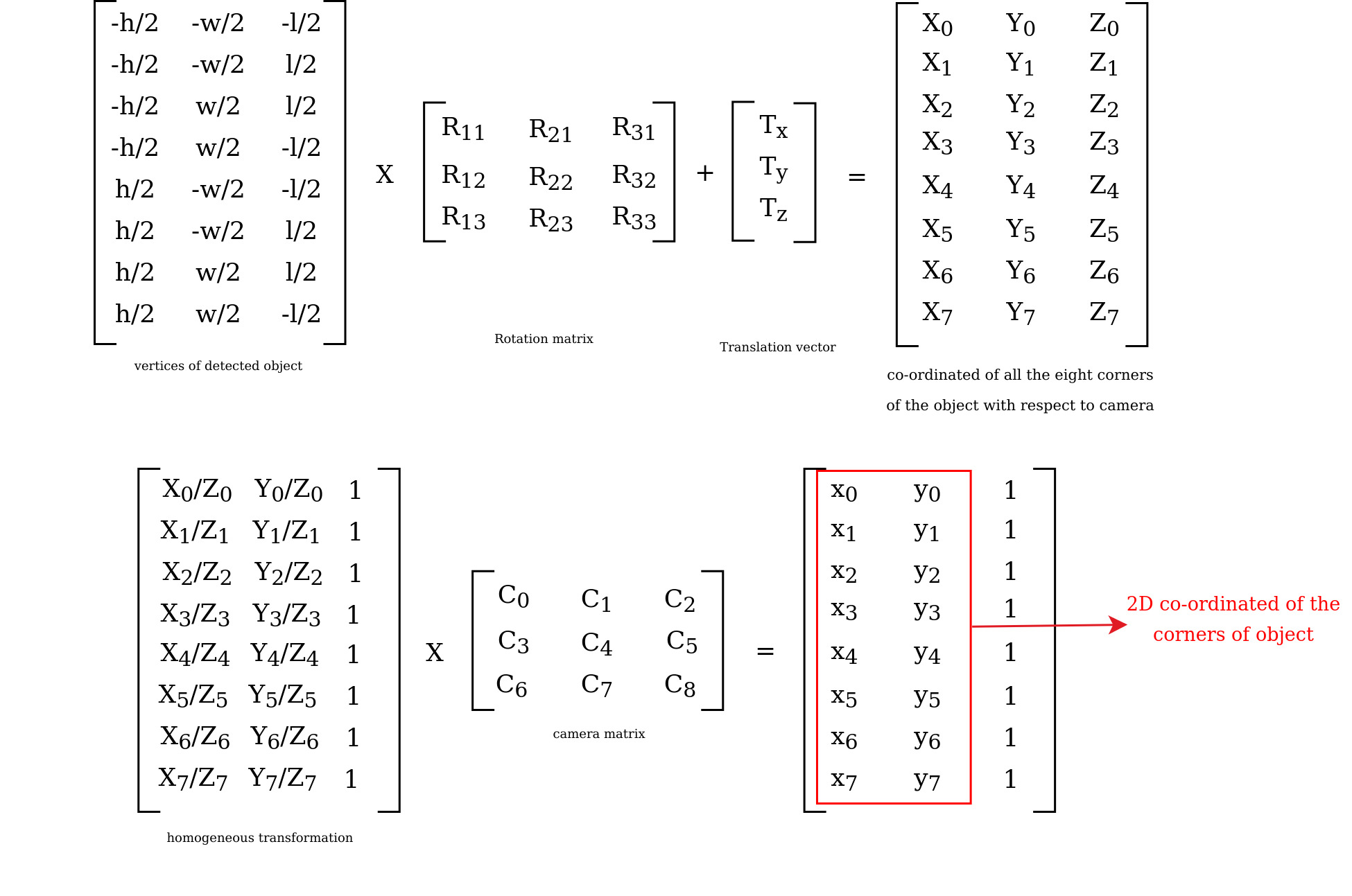
The authors’ public deployment implementation outputs 15 values per detection: 6 for box / confidence / class, 6 for the first two rotation-matrix columns, and 3 for translation. Their cross product recovers the third axis. CAD bounding-box corners are transformed by xc=Rxo+t and projected with intrinsics to visualize cuboids.
Public implementation's tensor layout: 6 detection values, 6 rotation values, and 3 translation values. Source: Texas Instruments authors' implementation, docs_data/output_tensor.jpg. Copyright belongs to the original authors; reproduced here for academic analysis.
Benefits and costs
Benefits: single-stage multi-object inference without PnP / RANSAC / refinement; straightforward ONNX / TIDL export for edge devices.
Costs: geometry must be learned from appearance, making occlusion, symmetry, and unseen-object generalization harder. Training and evaluation still require known-object CAD / dimensions and camera intrinsics.
Datasets: YCB-Video and LM-O; ADD(-S) / AUC-style metrics evaluate multi-instance pose for known objects.
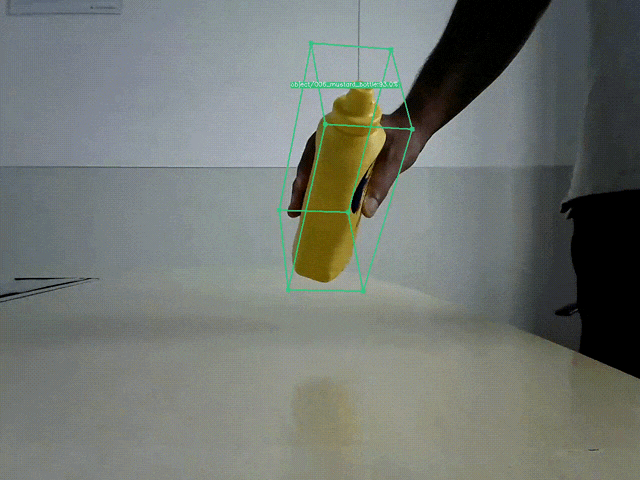
Frame from the authors' TI EdgeAI demonstration; colored cuboids project directly predicted rotations and translations. Source: Texas Instruments authors' public 6d_pose.gif demo. Copyright belongs to the original authors; reproduced here for academic analysis.
Evidence available for these notes
The site’s collection workflow could not reliably retrieve the IEEE full text. These notes therefore include only structures cross-checked against metadata, the 3DV record, and the authors’ public implementation, without inventing SOTA numbers. Consult the DOI full text for exact experimental tables.
Available src/paper-notes/yolo-6d-pose-3dv2024/deep.md
In-depth paper notes
Support reproduction, comparison, related-work writing, and identifying opportunities for further research.
Typical monocular pose pipelines use detection / segmentation → keypoints or coordinate maps → PnP / RANSAC → refinement. Although interpretable, each stage adds latency, hyperparameters, and failure modes for multiple objects. YOLO-6D-Pose instead uses YOLOX / CSPDarknet + PANet with rotation and translation heads beside detection, directly regressing full pose at each positive location.
This is an engineering trade-off: end-to-end supervision replaces explicit geometric solvers and reduces deployment components, while PnP remains useful in other settings.
2. Pose parameterization
2.1 Rotation
The network predicts a continuous 6D representation of the first two rotation-matrix columns. Deployment obtains r1,r2 and computes r3=r1×r2 to form the matrix. This is smoother for optimization than quaternion double coverage or Euler-angle discontinuities. Normalization / orthogonalization of the first two columns still matters; public postprocessing explicitly recovers the third by cross product.
2.2 Translation
The translation head outputs 3D translation. Public abstract and implementation descriptions indicate a decodable parameterization that recovers camera-frame translation from object-center / depth-related quantities. Visualization still requires intrinsics and CAD dimensions.
The default ONNX model outputs 15 values per object, enabling deterministic decoding rather than another learned model or iterative optimizer. Source: Texas Instruments authors' public implementation. Copyright belongs to the original authors; reproduced here for academic analysis.
3. From network outputs to image cuboids
Given object-model corners xo and predictions R,t:
xc=Rxo+t,u∼Kxc
Here K denotes intrinsics. Public code provides YCB-V and LINEMOD object dimensions, projecting eight corners and connecting them with fixed topology. This decodes and visualizes predictions without changing pose as PnP or ICP would.
Direct regression still needs geometry: intrinsics, object frames, and dimensions determine projection and evaluation. Source: Texas Instruments authors' public implementation, docs_data/3dto2d.jpg. Copyright belongs to the original authors; reproduced here for academic analysis.
4. Assessing this approach
4.1 Favorable settings
Fixed categories and object inventory with sufficient training data;
Deployment environments where RANSAC, PnP, or iterative rendering are difficult to integrate;
Hardware toolchains with mature CNN / ONNX support. The authors provide 640×480 models and a fully hardware-accelerated TI TIDL path.
4.2 Challenging settings
Unseen objects: no CAD / template conditioning, preventing natural transfer to new instances;
Heavy occlusion: no explicit local correspondences or geometric consistency check;
Symmetry: supervising one rotation can conflict with observation-equivalent poses;
Domain shifts: end-to-end regression can absorb background, texture, and dataset camera statistics into pose priors.
The device demo illustrates a short inference pipeline and multi-target output capability; visually aligned cuboids cannot replace quantitative ADD-S / AUC evaluation. Source: Texas Instruments authors' public demonstration. Copyright belongs to the original authors; reproduced here for academic analysis.
5. Evidence boundaries
These notes verify DOI, authors, venue, pages, the YOLOX basis, single-stage multi-object formulation, public 15-value outputs, and deployment without PnP / refinement. Because the IEEE PDF could not be retrieved reliably, isolated search-summary numbers are excluded. Deep reading should distinguish verified facts from inference rather than supply untraceable accuracy tables.
6. Reproduction and fair comparison
Lock down four conventions. First, frames and units: millimeter CAD with meter-trained translation can distort ADD even when projections appear plausible. Second, rotation decoding: normalize and apply Gram–Schmidt before the cross product to ensure SO(3). Third, visibility and positive assignment: box / class and pose targets must refer to the same instance, or heavy-occlusion assignment drift supervises the wrong object. Fourth, symmetry: ADD-S evaluation does not resolve conflicting equivalent rotation labels during training.
Compare complete runtime pipelines. YOLO-6D-Pose includes preprocessing, NMS, 15-value decoding, and projection; correspondence methods include detection, keypoint / coordinate prediction, RANSAC / PnP, and possible refinement. Backbone FLOPs alone can misrepresent the practical advantage. Accuracy comparisons also need matching boxes, resolutions, YCB-V / LM-O splits, and symmetry protocols.
7. Possible improvements
Direct regression could propose poses with uncertainty: output high-confidence targets immediately and send ambiguous or symmetric cases to PnP / refinement. This retains a short path for most frames without requiring one head to settle every geometric ambiguity. CAD / template conditioning could also replace implicit per-training-object memory with transferable object-conditioned pose, at the cost of matching and rendering.
8. My assessment
YOLO-6D-Pose shows that standard detector heads can predict 6D poses and integrate with industrial edge toolchains. It is a useful baseline when speed and maintenance dominate. For novel objects, heavy occlusion, or precise manipulation, use it as a fast proposal / initial pose followed by explicit correspondence or refinement.