ZeroPose: CAD-Prompted Zero-Shot Object 6D Pose Estimation in Cluttered Scenes
For CAD-based RGB-D 6D pose estimation of unseen rigid instances, each target CAD model is rendered offline from multiple views, caching DINOv2 image / patch and geometry features. FastSAM proposals and global visual matching discover all target instances; local patch matching predicts visible views, followed by coarse-to-fine 3D–3D matching and weighted SVD between visible CAD surfaces and scene point clouds. New objects require no retraining or manually supplied masks, but metric CAD, depth, intrinsics, and one-time onboarding remain necessary.
Code / project: neither the paper nor its arXiv page provides official public code or a project page
Reading mode: Overview
2. Positioning in one sentence
ZeroPose uses metric target CAD as a prompt and decomposes unseen-instance pose in cluttered RGB-D scenes into Discovery—Orientation—Registration (DOR). It discovers all target instances, predicts visible viewpoints, and matches visible CAD surfaces to scene clouds through 3D—3D correspondences and weighted SVD.
Method inputs and outputs
Item
Content (compiled for this site)
Inference inputs
Scene RGB-D, intrinsics, and one or more target CAD models; new CAD models are rendered offline with cached visual / geometric templates.
Final outputs
Instance masks, object IDs, and rotations R / translations t from CAD to camera coordinates.
Requirements
Full DOR discovers instances without user query masks; partial zero-shot evaluation uses external segmentation. Metric CAD, depth, and calibration remain essential; this is not category-level CAD-free pose.
2.1 Guide to the paper’s figures and tables
Figure / table
Role in the paper
Reading focus
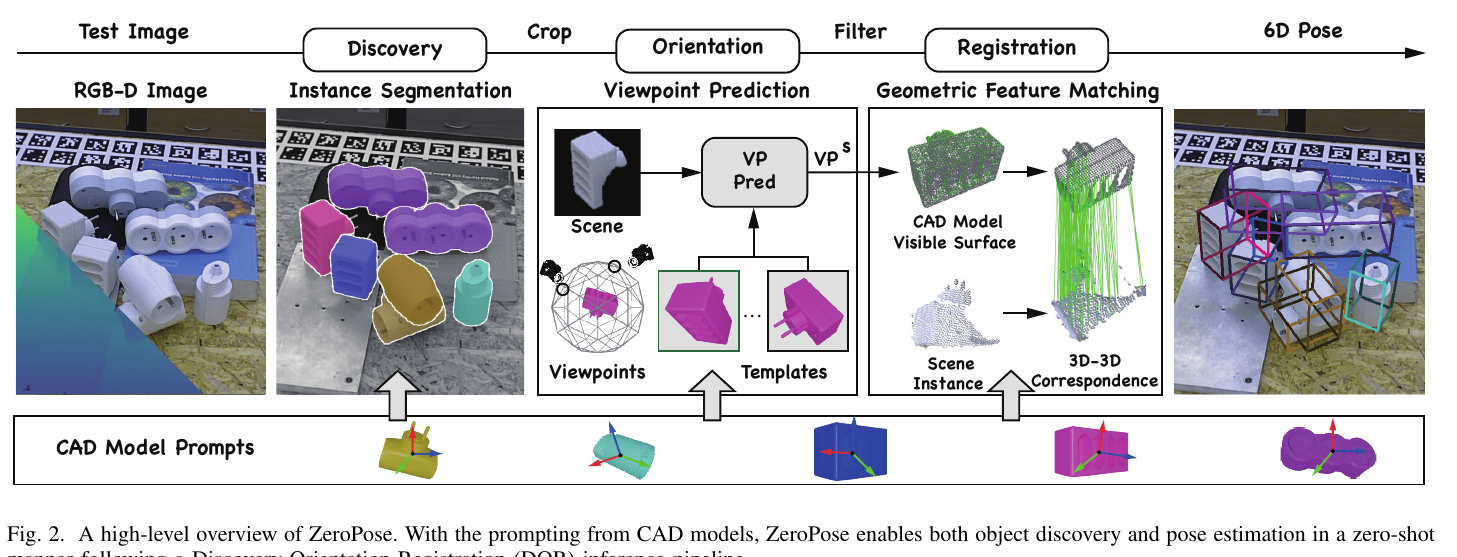
Figure 2
High-level DOR pipeline
How CAD prompts support discovery and pose
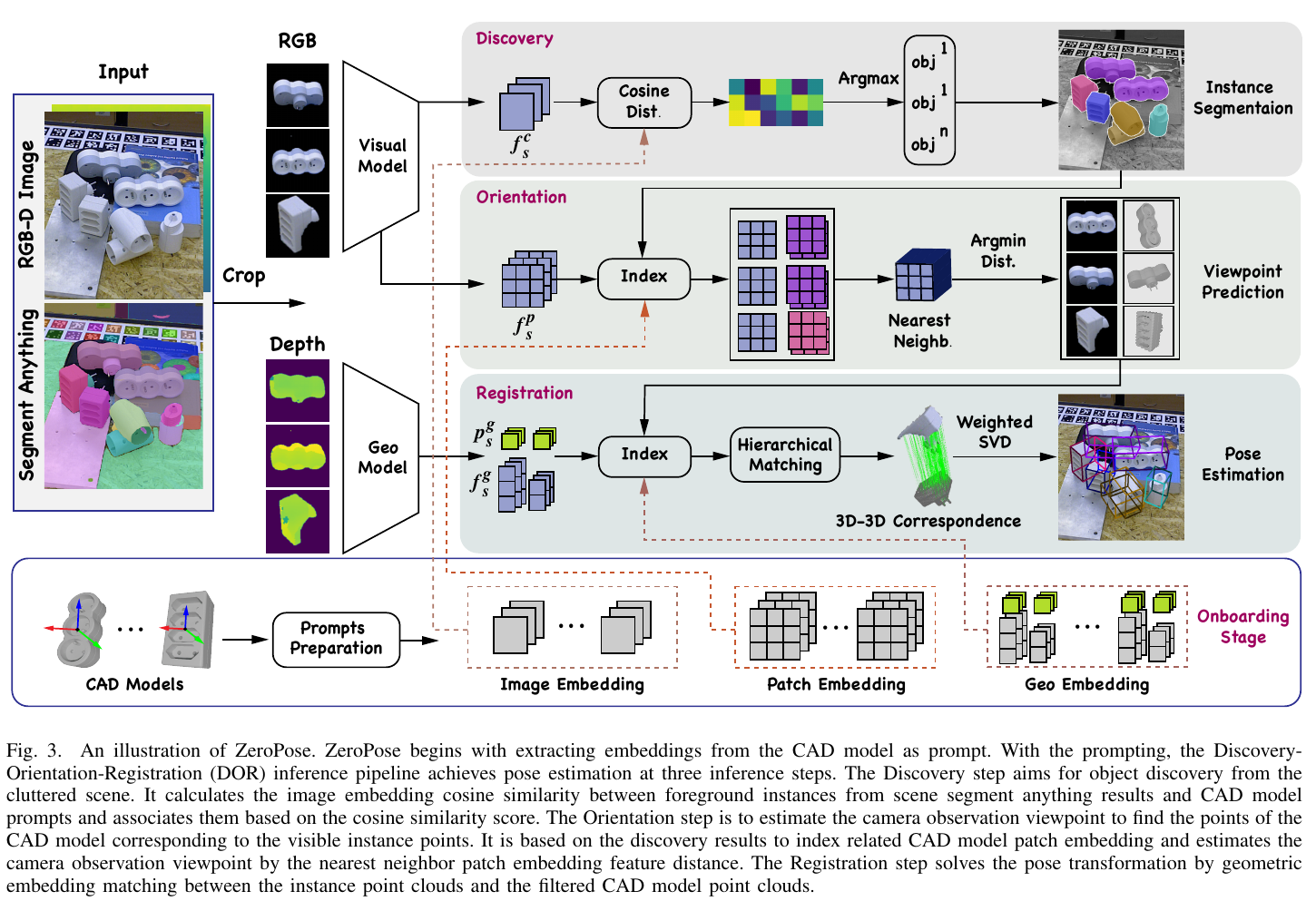
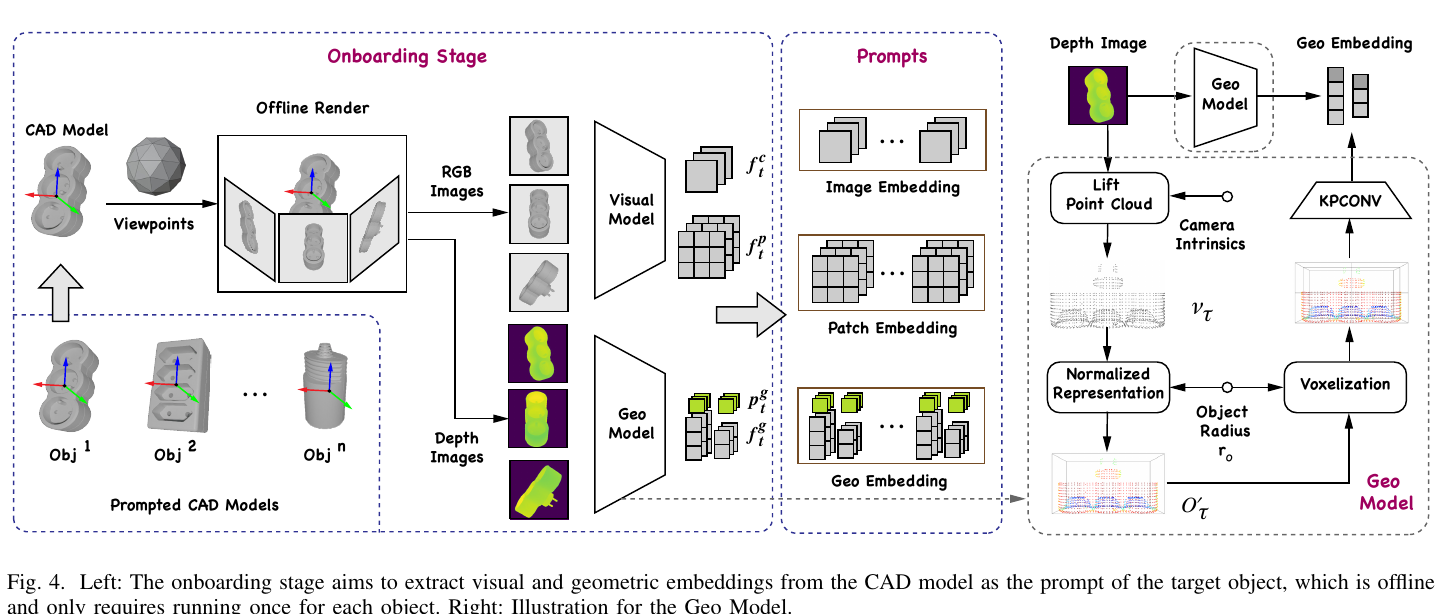
Figures 3—6
Full network, onboarding, Discovery, and Registration
Roles of global visual, local patch, and geometric features
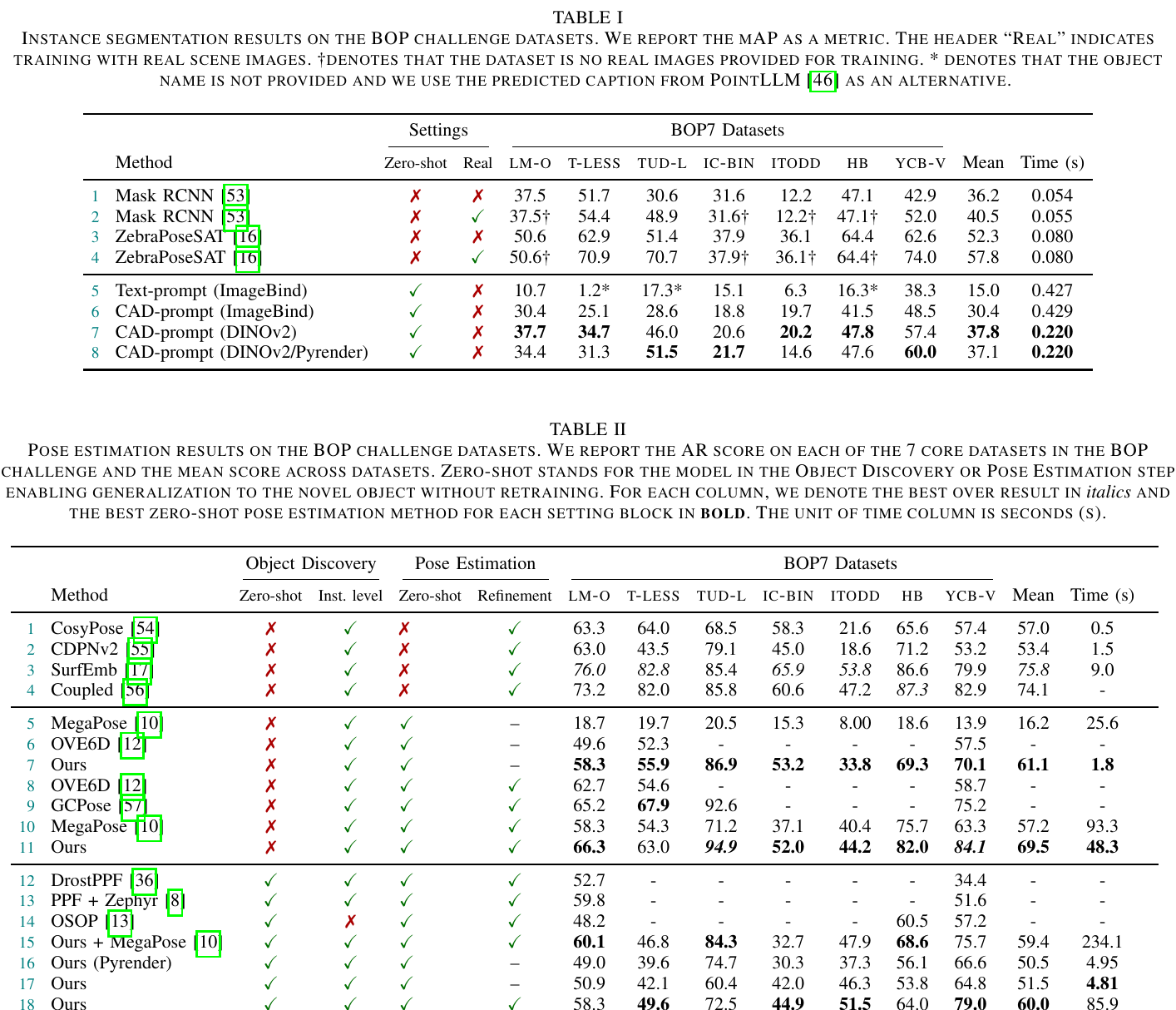
Tables I—II
BOP7 segmentation and pose results
Separate object-specific masks, fully zero-shot frontends, and extra refiners
Figures 7—8
Seven-dataset qualitative results and visibility filtering
Why full CAD should not be matched directly to partial scenes
Original Figure 2: CAD prompts drive Discovery, Orientation, and Registration. RGB-D instance discovery precedes selection of viewpoint-visible CAD surfaces and final 3D--3D correspondence pose estimation. Source: arXiv. Image copyright belongs to the authors and publisher; reproduced here for paper analysis.
3. Problem setting
Task level: instance-level unseen-object 6D pose, rather than category-level NOCS or open-category CAD-free pose.
Inputs: scene RGB-D, camera intrinsics, and correctly scaled / framed target CAD models.
Outputs: segmentation masks, object IDs, and rotations R / translations t relative to CAD frames for all target instances.
Training / testing: Geo and matching networks train on 1,000 Google Scanned Objects and 1 million MegaPose synthetic images; BOP test objects require no retraining.
Meaning of zero-shot: no target-object pose-label collection or retraining, with full DOR also avoiding manually supplied masks. It still uses pretraining, object priors, and depth.
Essential priors: correct CAD scale, RGB-depth calibration, and intrinsics; enough depth for registration; FastSAM proposals covering targets.
4. Core motivation
Heavy conventional onboarding: changing known instances usually requires labeled images and object-specific training.
Masks / boxes often assumed in unseen-object pose: backend generalization does not guarantee discovery in clutter.
Expensive online render-and-compare: more rotation candidates add rendering / comparison costs, while real–synthetic lighting gaps hurt visual matching.
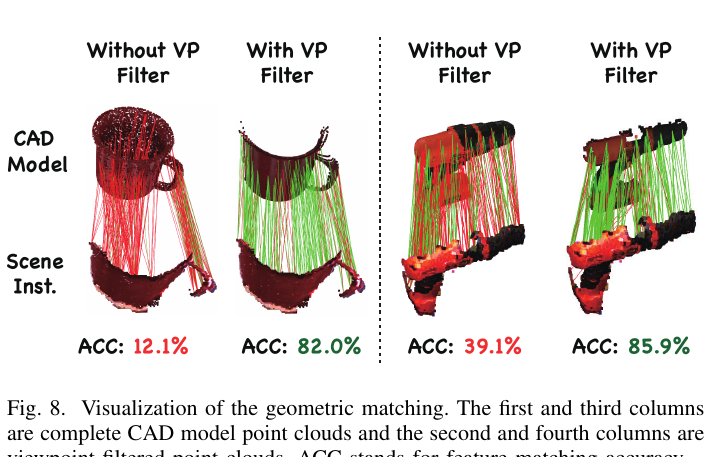
Scene clouds are partial CAD observations: invisible backsides create outliers; viewpoint prediction and filtering precede matching.
5. Method overview
Original Figure 3: bottom shows once-per-CAD onboarding; upper stages use image embeddings for Discovery, patch embeddings for Orientation, and geometric embeddings for Registration. Source: paper PDF. Image copyright belongs to the authors and publisher; reproduced here for paper analysis.
5.1 Onboarding: three cached CAD prompts
Render RGB-D CAD templates offline at 42 spherical viewpoints by default.
Extract image and patch embeddings using DINOv2.
Backproject template depth into colored clouds, normalize by CAD bounding-sphere radius, and extract coarse / fine geometry using a KPConv-based Geo model.
Perform once per new object. Default Blender onboarding takes about 27.0 s; faster Pyrender reduces rendering time with a small accuracy cost.
Original Figure 4: offline multiview RGB-D rendering produces DINOv2 global / patch prompts and scale-normalized geometric prompts. The right panel shows Geo features from depth, intrinsics, and object radius. Source: paper PDF. Image copyright belongs to the authors and publisher; reproduced here for paper analysis.
5.2 Discovery: proposals and CAD association
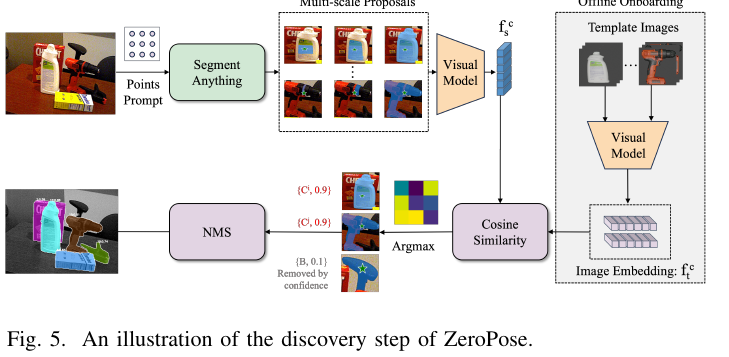
Uniform point prompts guide FastSAM class-agnostic masks, excluding regions smaller than 128 pixels.
DINOv2 image embeddings from proposal crops are cosine-matched to all CAD templates.
Highest similarity gives object ID and proposal score; thresholds and mask NMS remove irrelevant, undersegmented, and oversegmented candidates.
Users need not box targets, but FastSAM proposal recall still limits performance.
5.3 Orientation: predict the visible side
Locally match scene-crop and CAD-template patch embeddings by nearest neighbors.
Decompose observation rotation into optical-axis direction Rγ and in-plane rotation Rθ; only the former determines visible regions.
Top-k viewpoint candidates and template depth identify visible CAD surfaces; discrete template poses are not final 6D predictions.
5.4 Registration: geometry determines final R,t
Backproject masked depth into colored scene clouds and normalize by CAD radius.
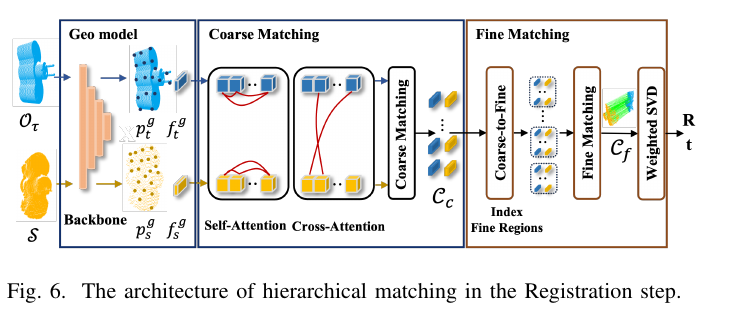
KPConv supplies hierarchical geometry; Hierarchical Geometric Matching establishes coarse correspondences and refines within receptive fields.
Weighted SVD solves the rigid transform from dense 3D—3D correspondences.
Each top-k viewpoint yields a pose; transformed-cloud Chamfer distance selects the final hypothesis. Default k=5.
6. Experimental overview
Training: 1,000 GSO CAD models and 1 million MegaPose synthetic images.
Metrics: instance-segmentation mAP; BOP AR averaged over VSD, MSSD, and MSPD; also ADD-S 2 cm and runtime.
Hardware: training on 8 V100 GPUs, inference on RTX 3090.
Original Tables I--II: segmentation compares CAD / text prompts; pose results separate zero-shot discovery, zero-shot pose, and refinement. Full DOR reaches BOP7 mean AR 51.5 without a refiner and 60.0 with MegaPose refinement. Source: paper PDF. Image copyright belongs to the authors and publisher; reproduced here for paper analysis.
6.1 Interpreting main results
Protocol
ZeroPose result
Interpretation
CAD-prompt + DINOv2 segmentation
37.8 mAP, 0.220 s
Exceeds CAD-prompt ImageBind at 30.4 and text prompts at 15.0
Object-specific Mask R-CNN masks, ZeroPose pose, no refiner
61.1 AR, 1.8 s
Tests only the pose backend, not a fully zero-shot system
Full DOR with zero-shot discovery, no refiner
51.5 AR, 4.81 s
Most representative complete-system result
Full DOR + MegaPose refiner
60.0 AR, 85.9 s
Higher accuracy at substantial runtime cost
The paper claims about 50× faster / 98% runtime reduction, but Table II’s same-object-specific-mask times, ZeroPose 1.8 s and MegaPose 25.6 s, imply about 14.2×. Because timing conventions are not fully reconciled, cite protocols and seconds rather than applying 50× to every pipeline / refiner configuration.
6.2 Key ablations
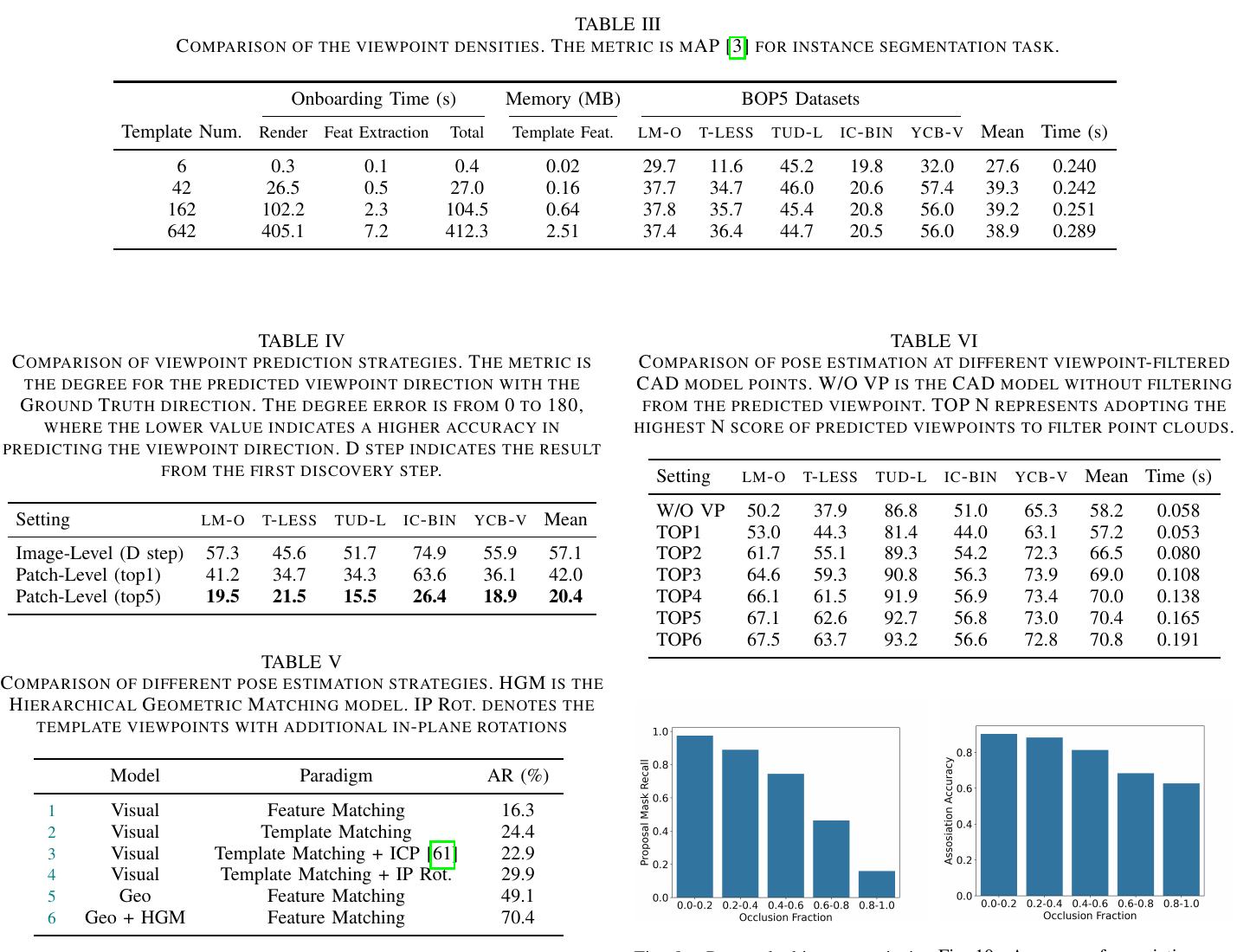
Increasing 6 to 42 templates raises BOP5 segmentation mAP from 27.6 to 39.3. Increasing further to 162 / 642 does not help, while onboarding rises from 27.0 s to 104.5 / 412.3 s.
Patch-level top-5 viewpoints reduce direction error from Discovery’s 57.1° to 20.4°.
Original Figure 8: full CAD includes invisible surfaces and creates many red mismatches. Viewpoint filtering raises matching accuracy from 12.1% / 39.1% to 82.0% / 85.9% in two examples. Source: paper PDF. Image copyright belongs to the authors and publisher; reproduced here for paper analysis.
Limitations / risks
Not CAD-free: every target needs geometrically correct, correctly scaled renderable CAD.
Not RGB-only: Discovery uses RGB; Registration strongly depends on scene depth, intrinsics, and calibration.
Cascade errors: missed FastSAM proposals, wrong DINOv2 IDs, and viewpoint ranking errors propagate. Extreme occlusion reduces proposal recall and association accuracy.
Substantial training: target-specific training-free does not mean globally training-free; Geo / matching use 8 V100s and large synthetic data.
Onboarding is not instantaneous: default 42-view Blender processing takes about 27 s per object; large libraries also require CAD-unit, material, rendering, and cache management.
No public implementation: at preparation time, the paper / arXiv page provides no official code, increasing reproduction uncertainty relative to MegaPose, SAM-6D, and FoundationPose.
Symmetry / sensor issues: evaluation handles symmetry, but the method does not explicitly output equivalent poses; transparency, reflections, and depth holes receive no dedicated treatment.
8. Research takeaways
Reusable design: foundation segmentation supplies recall, CAD-template features supply identity, and geometry supplies pose; separate these three responsibilities.
Baseline use: RGB-D + known CAD + unseen instances + automatic multi-target discovery. With masks supplied, report both partial and fully zero-shot protocols.
Deep-reading priorities: Orientation as visible-surface selection, scale-normalized clouds, coarse-to-fine 3D matching, and Tables III—VIII cost ablations.
Further tests: CAD-scale error, degraded / missing depth, transparent / reflective objects, heavy occlusion, similar-CAD library growth, real-time tracking, and reference-image versions without target mesh.
Available src/paper-notes/zeropose/deep.md
In-depth paper notes
Support reproduction, comparison, related-work writing, and identifying opportunities for further research.
Deep Reading Notes: ZeroPose: CAD-Prompted Zero-Shot Object 6D Pose Estimation in Cluttered Scenes
Affiliations: Harbin Institute of Technology, Shenzhen; Pengcheng Laboratory; SenseTime Research
Publication: IEEE Transactions on Circuits and Systems for Video Technology (TCSVT), 35(2), 1251—1264, 2025. arXiv v1 appeared in 2023; these notes follow the 2024 v3 revision.
Code / project: neither the paper nor its arXiv page provides official public code or a project page
Reading mode: Deep Dive
2. Positioning in one sentence
ZeroPose is a complete CAD-based RGB-D pipeline for rigid instances unseen during training. Offline CAD visual / geometric embeddings prompt FastSAM + DINOv2 discovery, patch-based observation-viewpoint selection, and visible-surface extraction. Coarse-to-fine 3D correspondences, weighted SVD, and Chamfer ranking yield each instance’s 6D pose.
Method inputs and outputs
Item
Content (compiled for this site)
Inference inputs
Scene RGB-D, intrinsics K, and cached image / patch / geometric prompts from each metric CAD. These are offline-rendered target templates rather than estimated scene geometry.
Final outputs
Discovery masks / IDs and Registration R,t, with final xcam=RxCAD+t.
Training inputs
Training-object CAD such as GSO, GT-posed synthetic RGB-D, and geometric correspondence supervision; pretrained vision models also have their original pretraining data.
Training objective
Geo / hierarchical matching learn transferable cloud features and correspondences. Test-object onboarding renders and caches features without updating weights.
Output details
One selected rigid pose, not a full distribution. Orientation top-k viewpoints are intermediate hypotheses; after radius-normalized registration, t must recover real CAD / depth length units.
Requirements
Full DOR needs no external target mask. Backend-only / partial protocols must specify masks. RGB, depth, calibration, and correctly scaled CAD remain necessary.
2.1 Guide to the paper’s figures and tables
Figure / table
Question answered
Key conclusion
Figure 2
Where do inputs, three outputs, and CAD prompts enter?
How do onboarding, Discovery, and Registration work?
New objects need rendering and cached features, without retraining
Tables I—II
Are main results fully zero-shot?
Group by discovery, pose, and refinement conditions
Figure 8; Tables III—VIII
Sources and costs of gains?
42 views, top-5 visibility hypotheses, hierarchical geometry, and normalization work together
Original Figure 2: DOR stages have distinct roles. Discovery outputs masks; Orientation proposes visible surfaces; Registration builds 3D--3D correspondences and solves pose. Bottom CAD prompts provide shared target identity. Source: arXiv. Image copyright belongs to the authors and publisher; reproduced here for paper analysis.
3. Problem setting and task boundaries
3.1 Geometric task
For CAD-frame surface point xo, recover the camera-frame rigid transform
xs=Rxo+t,R∈SO(3),t∈R3.
ZeroPose also predicts masks and IDs for every target instance, going beyond pose regression on known crops.
Fully zero-shot: neither discovery nor pose retrains on target objects; ZeroPose associates FastSAM proposals and solves pose itself.
Mask-free input therefore describes full DOR only. Table II rows 7 / 11 still use object-specific discovery and must not be merged with rows 17 / 18.
3.4 Symmetry and ambiguity
VSD, MSSD, and MSPD provide symmetry-aware BOP evaluation.
Correspondence + SVD yields one R,t without explicit symmetry-aware correspondence loss, pose distribution, or equivalent-pose set.
Top-k hypotheses concern observation viewpoints rather than probabilistic symmetric rotations.
4. Research context
Object-specific pose: PoseCNN, CosyPose, SurfEmb, and related methods typically train target detectors / pose models, requiring new onboarding for changed objects.
Unseen-object pose: OVE6D, OSOP, and MegaPose generalize to new CAD but often rely on external segmentation or render-and-compare.
CAD-based novel-object segmentation: ZeroPose v3 combines SAM / FastSAM proposals with DINOv2 CAD matching; CNOS and SAM-6D further systematize this frontend direction.
Position of this work: an early complete DOR combination of CAD prompting, foundation segmentation / visual features, and learned 3D registration, reducing target-specific training and online candidate rendering.
Category-level distinction: NOCS, SGPA, and AG-Pose use shared category shapes for novel instances, typically without instance CAD. ZeroPose receives explicit instance identity and metric geometry from CAD.
5. Research motivation
New-object onboarding need not mean retraining. CAD already supplies geometry, scale, and frame; convert it to reusable prompts.
Pose generalization alone does not ensure deployability. User-supplied masks leave multi-instance clutter discovery unresolved.
Different subproblems merit different features. Global DINOv2 identifies objects, patches estimate visible sides, and depth correspondence constrains metric pose.
Full CAD versus partial scenes is asymmetric matching. Invisible backsides create systematic outliers; visibility filtering moves registration toward partial-to-partial alignment.
Online rendering can be avoided. Onboarding caches templates / embeddings, making scene inference mainly feature lookup and matching.
6. Method details
6.1 Overall pipeline
Original Figure 3: onboarding caches image, patch, and geometric embeddings for proposals, viewpoint candidates, and visible CAD clouds, followed by weighted SVD pose. Source: paper PDF. Image copyright belongs to the authors and publisher; reproduced here for paper analysis.
Module
Inputs
Outputs
Role
Connection to next module
CAD onboarding
Metric CAD, views, renderer
Three cached prompt types
Move object-specific information from weights to a retrieval library
Discovery retrieves visual prompts by ID
Discovery
RGB, FastSAM masks, image embeddings
Mask, ID, score
Find all scene instances of each CAD
Crops / IDs enter Orientation
Orientation
Scene / template patch embeddings
Top-k viewpoints, visible CAD surfaces
Exclude invisible model regions
Each surface forms a registration hypothesis
Registration
Scene RGB-D crop, visible CAD points, Geo model
Correspondences, candidate R,t
Solve rigid alignment with metric geometry
Chamfer ranking selects pose
6.2 CAD onboarding: three prompts, one cache
Original Figure 4: default onboarding renders 42 RGB-D views. RGB yields DINOv2 image / patch embeddings; depth is backprojected, radius-normalized, and processed through KPConv voxel hierarchies for geometric embeddings. Source: paper PDF. Image copyright belongs to the authors and publisher; reproduced here for paper analysis.
For R templates per CAD and visual dimension C:
Image embeddings: ftc∈RR×C for global proposal–object association;
Patch embeddings: ftp∈RR×Pl×C for local viewpoint matching;
Geometric embeddings: {ptg,ftg} retain coarse / fine coordinates and KPConv features.
Template depth is inverse-transformed into the CAD frame. With bounding-sphere radius rO, scene / template clouds enter normalized space scaled by 1/rO, keeping KPConv voxel sizes and receptive fields consistent relative to unseen-object dimensions.
Engineering implication: object-specific preprocessing, not learning. Default 42-view Blender onboarding takes 27.0 s per object: rendering 26.5 s, features 0.5 s, and about 0.16 MB cached features. Costs amortize over frames but matter for large libraries.
Original Figure 5: point prompts produce multiscale SAM / FastSAM proposals, whose image embeddings cosine-match offline CAD templates. Confidence thresholds and NMS clean duplicates and over / undersegmented masks. Source: paper PDF. Image copyright belongs to the authors and publisher; reproduced here for paper analysis.
For scene proposal m with feature fs,mc, maximize cosine similarity across CAD models n and template views T:
The maximum determines ID and score. FastSAM’s default CNN backbone filters regions below 128 pixels and applies mask NMS at IoU 0.25.
Why not text prompts? Many industrial BOP parts lack distinctive names. ImageBind text prompts yield 15.0 mAP, CAD-image prompts 30.4, and DINOv2 CAD-image prompts 37.8, favoring instance appearance over category words here.
Risk: proposals remain essential. Missing FastSAM masks cannot be recovered by CAD matching; similar-CAD embedding confusion sends the wrong geometry to the backend.
6.4 Orientation: from 3-DoF rotation to 2-DoF visibility
Observation rotation decomposes as
RO=RγRθ,
Here Rγ is image-plane optical-axis direction and Rθ is in-plane rotation. Visibility mainly depends on Rγ, so Orientation retrieves discrete spherical views rather than directly regressing full rotation.
For each scene patch, find its best match in a template, then average local maximum similarities:
Rank by STp and retain top-k; patch similarity / estimated visibility also revise Discovery scores. Default k=5. Template depth defines one visible CAD surface per registration candidate.
Clarification: template rotation is not final pose. It covers 2-DoF viewpoint without precise in-plane rotation / translation; direct template pose gives only 24.4 AR in Table V.
Masked pixels (ui,vi) with depths di are backprojected through intrinsics:
xi=difxui−cx,yi=difyvi−cy,zi=di.
Scene points also carry RGB texture features. Visible CAD and scene clouds undergo radius normalization, centroid-clustering denoising, and hierarchical KPConv extraction.
Original Figure 6: KPConv supplies coarse / fine points and features. Self- / cross-attention establish coarse matches, index local fine regions, and produce dense correspondence; weighted SVD solves $R,t$. Source: paper PDF. Image copyright belongs to the authors and publisher; reproduced here for paper analysis.
Hierarchical Geometric Matching (HGM) selects coarse correspondences Cc, indexes fine points within their receptive fields, and forms Cf. It then solves
R,tmin(oi,si)∈Cf∑wi∥Roi+t−si∥22,
Weighted SVD gives the closed-form rigid solution. Top-k visible surfaces yield candidates, ranked by Chamfer distance after CAD-to-scene transformation.
Explicit metric correspondences make errors diagnosable, but mask / ID / viewpoint mistakes propagate through the cascade.
6.6 Training and supervision
Not globally training-free: DINOv2 / FastSAM use pretrained weights; Geo / HGM additionally train on GSO synthetic data.
Training set: 1,000 GSO objects and 1 million MegaPose synthetic images.
Coarse supervision: GT poses determine cloud overlap; region pairs above 10% overlap are positive for overlap-aware circle loss.
Fine supervision: a spatial matching radius defines correspondences trained with negative log-likelihood.
Augmentation: color and position jitter reduce synthetic–real illumination, color, and positional gaps.
Compute: 8 NVIDIA V100 GPUs for training, RTX 3090 for reported scene inference.
Correspondence supervision connects indirectly to symmetry-aware pose AR through SVD; BOP AR is not directly optimized. DOR is not trained jointly end to end, an explicit limitation.
7. Experimental analysis
7.1 Datasets and metrics
Use
Data
Description
Geo / HGM training
GSO + MegaPose synthetic
1,000 objects, 1M images
Main BOP7 test
LM-O, T-LESS, TUD-L, IC-BIN, ITODD, HB, YCB-V
Real RGB-D with varied geometry, texture, occlusion, and clutter
BOP5 ablations
LM-O, T-LESS, TUD-L, IC-BIN, YCB-V
Five datasets accessible for offline evaluation
Segmentation uses BOP instance-segmentation mAP.
Pose uses BOP AR averaged over symmetry-aware VSD, MSSD, and MSPD recalls.
YCB-V also reports ADD-S 2 cm: with identical masks, ZeroPose reaches 96.6 versus object-specific DenseFusion’s 96.8.
Interpret times alongside hardware, mask sources, and refinement.
7.2 Main results and protocol fairness
Original Tables I--II: Table I compares object-specific, text-prompt, and CAD-prompt segmentation. Table II explicitly separates zero-shot discovery, instance-level discovery, zero-shot pose, and refinement. Source: paper PDF. Image copyright belongs to the authors and publisher; reproduced here for paper analysis.
Object discovery
Method
Target-specific training
BOP7 mAP
Time
Mask R-CNN, no real images
Yes
36.2
0.054 s
ZebraPoseSAT, no real images
Yes
52.3
0.080 s
Text-prompt ImageBind
No
15.0
0.427 s
CAD-prompt ImageBind
No
30.4
0.429 s
CAD-prompt DINOv2
No
37.8
0.220 s
CAD-prompt DINOv2 matches Mask R-CNN trained without real images but remains below ZebraPoseSAT’s 52.3. This supports usable segmentation without target training, not parity with the strongest supervised frontend.
Pose
Protocol
Method
BOP7 mean AR
Time
Interpretation
Object-specific discovery; zero-shot pose; no refiner
MegaPose
16.2
25.6 s
Paper’s initialization configuration
Same
ZeroPose
61.1
1.8 s
Efficient geometry matching and good initialization
Object-specific discovery; with refiner
MegaPose
57.2
93.3 s
Additional refinement
Same
ZeroPose
69.5
48.3 s
Higher accuracy, without lightweight real-time performance
Fully zero-shot; no refiner
ZeroPose
51.5
4.81 s
Most representative full DOR
Fully zero-shot; MegaPose refiner
ZeroPose
60.0
85.9 s
Gain of 8.5 AR with about 18-fold runtime
Assessing 50× faster: Table II rows 5 / 7 list 25.6 s and 1.8 s, implying about 14.2×. The stated 98% runtime reduction / 50× may use different timing conventions. Concrete protocols and table times should take precedence over the headline claim; full zero-shot inference at 4.81 s is not real-time video.
7.3 Template density, viewpoints, and matching
Original Tables III--VI and Figures 9--10: template count affects onboarding, cache, mAP, and inference time. Other panels compare viewpoint prediction, pose strategies, top-$k$ visible surfaces, and occlusion effects on proposal recall / association accuracy. Source: paper PDF. Image copyright belongs to the authors and publisher; reproduced here for paper analysis.
Ablation
Result
Supported claim
My assessment
6 → 42 templates
mAP 27.6 → 39.3; onboarding 0.4 → 27.0 s
Six views provide insufficient coverage
Supported, with preprocessing costs exposed
42 → 162 / 642
mAP 39.3 → 39.2 / 38.9
Excessively dense views add no benefit
Supports 42 default views
Image-level viewpoint → patch top-5
Error 57.1° → 20.4°
Patches better estimate observation direction
Direct evidence
Visual matching → Geo
16.3 → 49.1 AR
Geometry is less sensitive to appearance domain gaps
Supported
Geo → Geo + HGM
49.1 → 70.4 AR
Coarse-to-fine interaction matters
Large gain, but more training-domain ablations would help
No viewpoint filtering → top-5
58.2 → 70.4 AR; 0.058 → 0.165 s
Visibility filtering removes wrong matches
Supports a speed / robustness trade-off
Top-5 → top-6
70.4 → 70.8 AR; 0.165 → 0.191 s
More hypotheses have diminishing returns
Supports k=5
7.4 Visibility and scale normalization
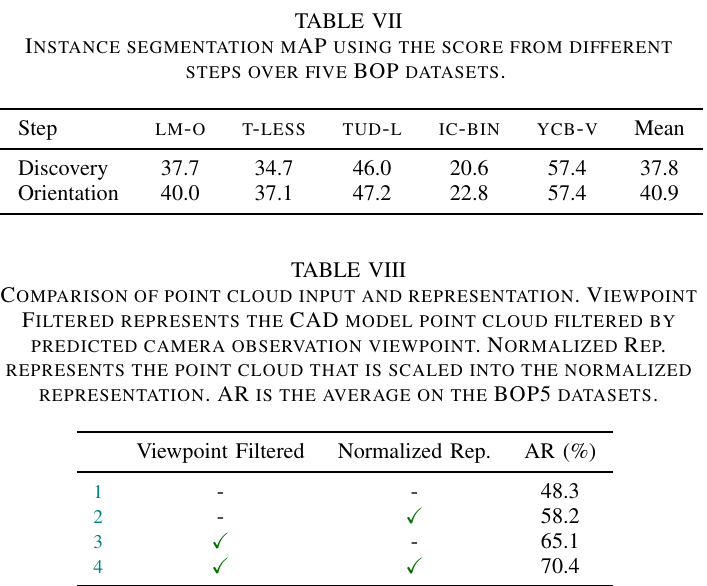
Original Figure 8: invisible CAD surfaces create mismatches with single-view clouds; viewpoint filtering raises feature-matching accuracy from 12.1% / 39.1% to 82.0% / 85.9% in two examples. Source: paper PDF. Image copyright belongs to the authors and publisher; reproduced here for paper analysis.Original Tables VII--VIII: Orientation score revision raises BOP5 segmentation mAP from 37.8 to 40.9. Normalization and viewpoint filtering each help; combined they raise AR from 48.3 to 70.4. Source: paper PDF. Image copyright belongs to the authors and publisher; reproduced here for paper analysis.
Table VIII provides particularly clear component evidence:
Viewpoint filtering
Normalization
AR
No
No
48.3
No
Yes
58.2
Yes
No
65.1
Yes
Yes
70.4
Visibility addresses partial overlap; normalization addresses inter-object scale and KPConv receptive fields. Their combination exceeds either alone, supporting complementary roles.
7.5 Qualitative results and scene coverage
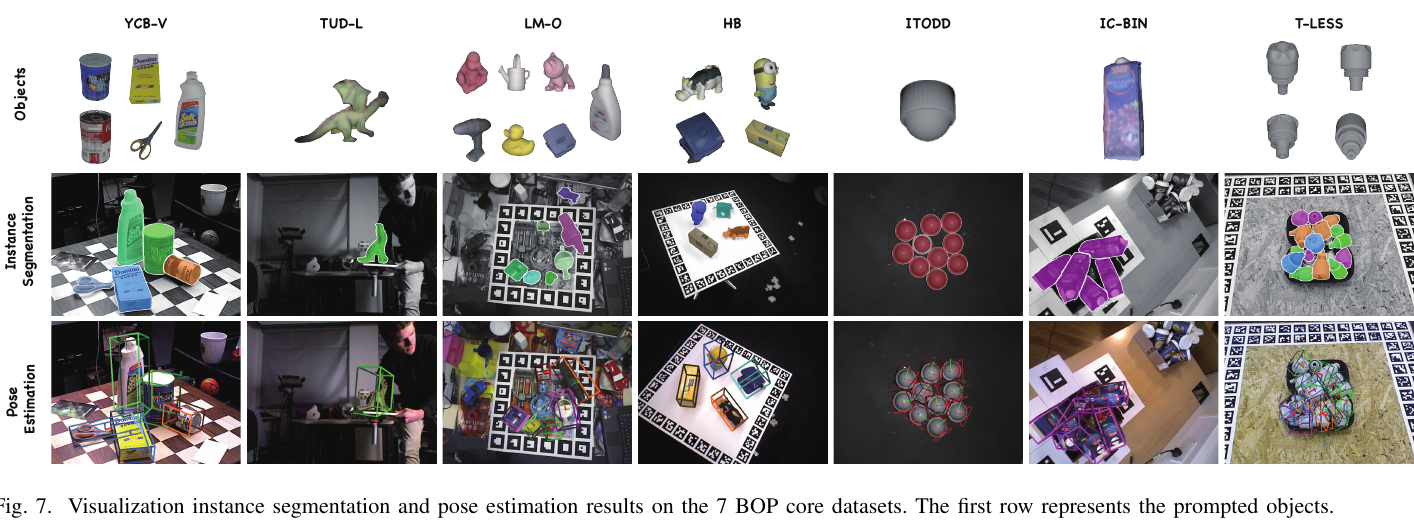
Original Figure 7: first row shows prompts, middle row segmentation, bottom row pose. Seven BOP core datasets cover textured household objects, weakly textured industrial parts, repeated instances, and heavy clutter. Source: paper PDF. Image copyright belongs to the authors and publisher; reproduced here for paper analysis.
Qualitative images show operation across BOP scenes, without systematic failures or substitutes for per-object recall, false-positive taxonomy, and depth-quality breakdowns.
7.6 Robustness and failure boundaries
Occlusion: at 40%—60% occlusion, proposal recall exceeds 70% and association accuracy exceeds 80%; both decline strongly at 80%—100%. Visibility filtering cannot recover instances missed by discovery.
Over / undersegmentation: score filtering + NMS reportedly remove 88% of undersegmented and 74% of oversegmented masks, with residual contamination entering clouds.
Weak texture: geometric features improve final pose, but RGB DINOv2 Discovery / Orientation may confuse similar CAD appearances.
Depth noise: centroid clustering and hierarchical matching tolerate some noise without explicit depth uncertainty, RGB-depth misalignment, or missing-depth models.
Transparency / reflectance: no dedicated experiments; such materials degrade both RGB-template consistency and depth clouds.
Symmetry: evaluation is symmetry-aware, while single-pose predictions lack explicit equivalent solutions or temporal consistency.
CAD domain gap: Blender slightly exceeds Pyrender, showing rendering appearance still affects Discovery. Geometry also assumes CAD surfaces match real parts.
7.7 Are contributions supported?
Author claim
Evidence
Assessment
Full discovery + pose without new-object retraining
Fully zero-shot block in Tables I—II
Broadly supported
CAD prompts suit BOP instances better than text
Table I: 30.4 / 37.8 versus 15.0 mAP
Supported
DOR feature matching is faster than render-and-compare
Partial-protocol timing and Table V
Supports these implementations, not every render-and-compare system
Timing claims need care: abstract multipliers differ from Table II ratios; retain protocols and seconds.
Implicit assumptions
Real parts share CAD scale, geometry, and frames; template appearance supports DINOv2 sim-to-real association.
One image has enough visible pixels for FastSAM and nondegenerate surfaces for rigid registration.
Proposal-to-CAD-template matching remains manageable in cost and false positives as libraries grow.
Intrinsics, depth scale, and RGB-depth alignment are calibrated reliably.
Practical feasibility
ZeroPose suits warehousing, bin picking, and infrequent relocalization with known CAD, RGB-D, and offline onboarding. Closed-loop deployment additionally needs:
Tracking / temporal fusion to amortize FastSAM and global retrieval;
Explicit pose confidence, symmetric alternatives, and occlusion-failure modeling;
Real grasp success, collision margin, and latency evaluation beyond BOP AR.
9. Future work and improvements
Paper’s directions: large real pose datasets, joint Discovery / Orientation / Registration, and multitask detection, tracking, segmentation, and pose.
Stronger frontend: retain mask / ID alternatives for registration to verify, rather than irreversible early argmax.
Visibility: differentiable rendering or learned confidence could replace one discrete view, distinguishing self-occlusion, external occlusion, and invalid depth.
Geometry uncertainty: SVD weights could combine feature confidence, depth noise, normals, and mask-boundary distance.
Symmetry: equivalent transforms in HGM loss and hypothesis ranking could produce pose sets / distributions.
CAD quality: test scale error, simplification, missing parts, and material gaps; include CAD-alignment uncertainty.
Speed: lightweight proposals, scene-feature caches, library ANN retrieval, and tracking could move full inference from seconds to video rates.
CAD-free extension: replace meshes with a few posed RGB-D references or neural object fields while retaining metric scale.
10. Implications for my research
Reusable concept: separate object identity, visibility support, and metric correspondence; use coarse orientation to narrow correspondence rather than regress final pose.
Required baselines: for RGB-D, known-CAD, unseen-instance automatic discovery, compare ZeroPose, SAM-6D, MegaPose / FoundationPose with standardized masks / refiners.
Evaluation design: separate GT / object-specific masks, external zero-shot masks, and own zero-shot masks; report discovery recall, ID accuracy, pose AR, onboarding, and end-to-end latency.
Research opportunities: bidirectional segmentation / registration checks, uncertainty over similar-CAD / symmetry hypotheses, and visibility filtering with temporal tracking.
Reproduction practice: fix BOP units, renderer camera conventions, depth scale, and intrinsics; verify templates, Discovery mAP, viewpoint errors, correspondences, and SVD poses separately.
11. Open questions
Conceptual question: does fully zero-shot allow potential target overlap in DINOv2 / FastSAM pretraining, and how should it differ from training-free terminology?
Formula question: how are weighted-SVD weights calibrated from fine-match scores? The body lacks sufficient implementation detail.
Experimental question: why does the 50× claim differ from Table II, and do onboarding, renderer, detector, or batch settings explain it?
Generalization question: how similar are GSO training shapes to BOP test objects; are there near-duplicate CAD models?
Deployment question: what happens to retrieval cost, memory, and false positives with thousands of CAD models and hundreds of proposals?
Reproduction question: FastSAM prompt density / NMS, DINOv2 variant / layer, KPConv voxel scales, HGM architecture, and checkpoints need further verification.