ZS6D: Zero-Shot 6D Object Pose Estimation Using Vision Transformers
ZS6D retrieves the nearest CAD-rendered view with global self-supervised ViT tokens, establishes 2D–3D correspondences from local tokens, and solves pose using RANSAC-PnP. It requires no pose-specific fine-tuning and evaluates pretrained visual features' geometric generalization to unseen CAD objects.
Authors / affiliation: Philipp Ausserlechner, David Haberger, Stefan Thalhammer, Jean-Baptiste Weibel, Markus Vincze; TU Wien Vision for Robotics Laboratory
Code: no public implementation is provided in the paper
Reading mode: Overview
2. Positioning in one sentence
Without target-object or pose-task fine-tuning, ZS6D reuses self-supervised ViT global / patch descriptors to retrieve a CAD-rendered view, match query and template patches, recover template object coordinates, and solve RGB 6D pose with RANSAC-PnP.
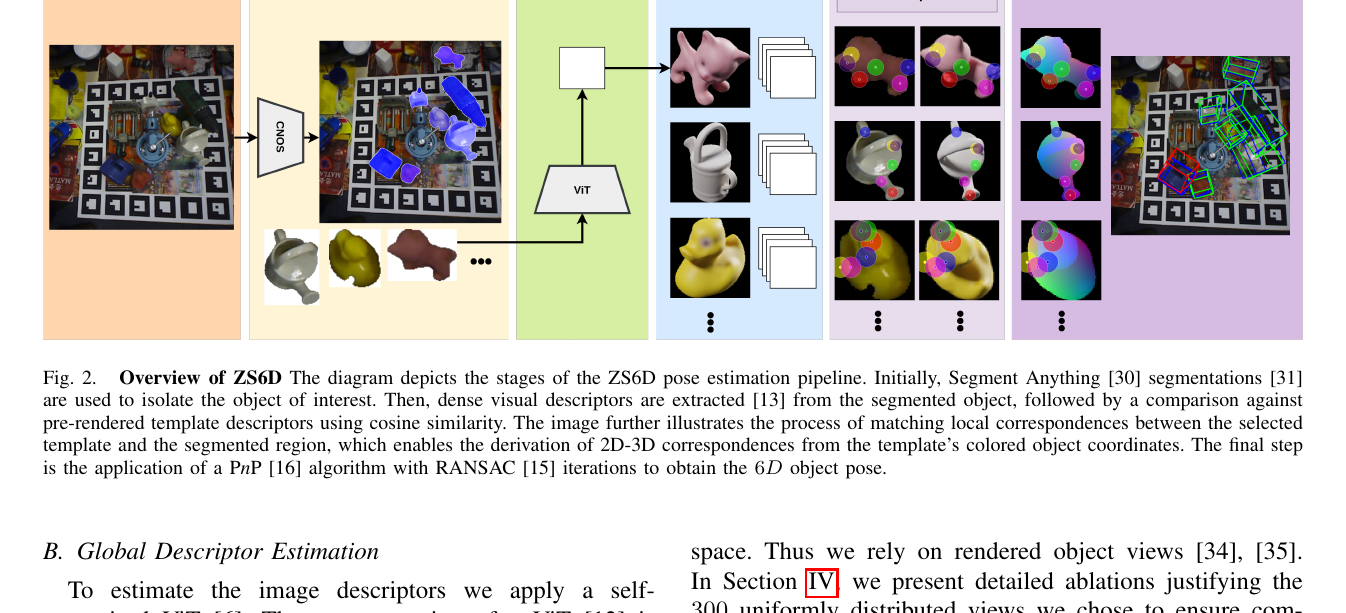
Original Figure 2: CNOS / SAM supplies instance regions; pretrained ViT performs global template retrieval and local patch matching. Explicit 2D–3D correspondences and RANSAC-PnP determine final pose. Source: arXiv. Image copyright belongs to the authors and publisher; reproduced here for paper analysis.
3. Problem setting
Task: instance-level novel-object 6D pose.
Inputs: one RGB image, intrinsics, target CAD, and CNOS object masks.
Outputs: object-to-camera rotation R and translation t.
Essential prior: 300 offline-rendered posed templates with object-coordinate maps per CAD.
Excluded: pose refinement, multiple-hypothesis ranking, and end-to-end detection.
4. Core motivation
Novel-object methods such as MegaPose / OSOP avoid per-test-object retraining but use large pose-specific synthetic training for shared CNNs. ZS6D asks whether self-supervised ViT geometry descriptors directly support template retrieval and correspondence without pose-network training.
5. Method overview
CNOS associates SAM proposals with the target CAD and supplies masks.
ViT-S/8 layer-9 key tokens form a global descriptor for cosine retrieval among 300 CAD templates.
Template object-coordinate images lift matches to 2D–3D correspondences.
RANSAC-PnP returns one pose.
6. Experimental overview
Datasets: LM-O, YCB-Video, T-LESS.
Metric: BOP Average Recall (AR).
Main results: with CNOS masks, AR is 0.298 / 0.324 / 0.210, above MegaPose coarse initialization; it exceeds OSOP on LM-O / YCB-V but trails on T-LESS.
Diagnosis: GT masks raise AR to 0.527 / 0.499 / 0.460, identifying segmentation as a major bottleneck.
7. Strengths and limitations
Strengths
Removes pose-specific fine-tuning with a simple, interpretable geometric pipeline.
Local correspondence surpasses discrete nearest-template viewpoint precision.
Competitive on occluded LM-O and everyday-object YCB-V.
Limitations / risks
Zero-shot pose still requires CAD, 300-view onboarding, intrinsics, and reliable masks.
Single hypothesis without refinement; symmetry and textureless regions make patch matching ambiguous.
T-LESS is particularly sensitive to poor masks and weak local appearance.
8. Research takeaways
Foundation features can supply correspondence while PnP preserves metric geometry.
Novel-object comparisons must distinguish detectors, initialization, and refinement.
Useful as a training-free / zero-shot CAD-based RGB baseline, with protocols separated from complete RGB-D refinement systems.
Available src/paper-notes/zs6d-icra2024/deep.md
In-depth paper notes
Support reproduction, comparison, related-work writing, and identifying opportunities for further research.
Deep Reading Notes: ZS6D: Zero-Shot 6D Object Pose Estimation Using Vision Transformers
1. Basic information
Authors / affiliation: Philipp Ausserlechner, David Haberger, Stefan Thalhammer, Jean-Baptiste Weibel, Markus Vincze; TU Wien Automation and Control Institute
ZS6D combines foundation-descriptor retrieval, local geometric correspondence, and PnP. One ViT-S/8 without pose fine-tuning supplies shallower global view descriptors and deeper patch matches; CAD-template object-coordinate maps convert 2D–2D matches into metric 2D–3D pose constraints.
2.1 Guide to the paper’s figures and tables
Figure / table
Question answered
Reading focus
Figure 2
How does RGB become pose?
Segmentation and pose are separate; ViT serves two roles
Figure 4
Performance across three BOP scenes?
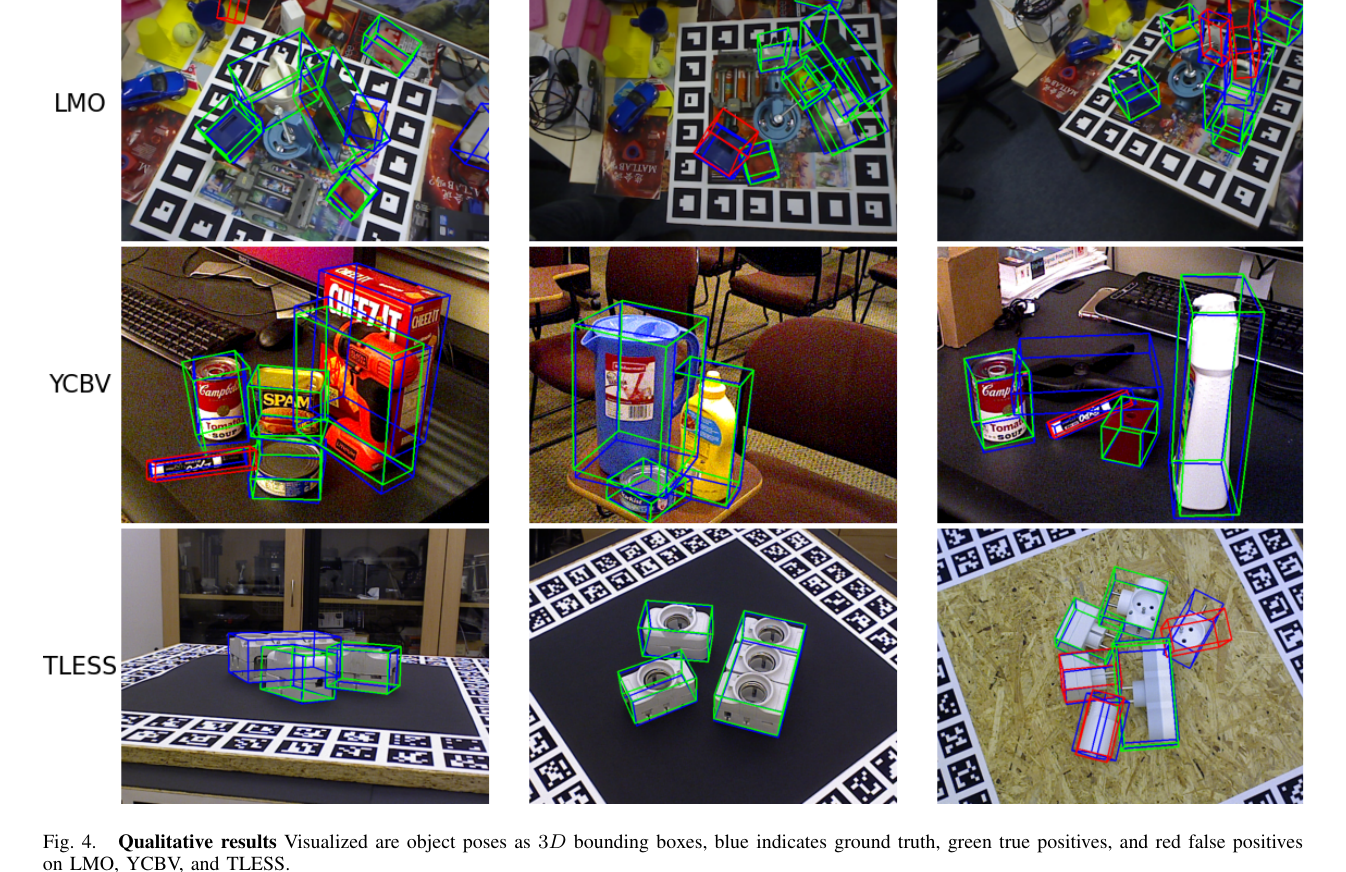
Green correct, red incorrect; missing boxes often originate in frontend misses
Original Figure 2: global descriptors select CAD views; local descriptors form mutual nearest-neighbor matches. Rendered colored object coordinates lift them into 2D–3D correspondences. Source: paper PDF. Image copyright belongs to the authors and publisher; reproduced here for paper analysis.
3. Problem setting and task boundaries
The objective is to estimate
xc=Rxo+t,R∈SO(3),t∈R3.
Item
ZS6D setting
Objects
Specific CAD instances unseen in pose-network training
Query
One RGB image and intrinsics
Per-object priors
Metric CAD and 300 posed RGB / object-coordinate templates
Frontend
CNOS: SAM proposals + DINOv2 CAD-template classification
CAD onboarding, masks, IDs, valid PnP intrinsics, and enough correspondences
Zero-shot specifically means ViT descriptors are not fine-tuned for pose or target objects. CAD, templates, and detection remain necessary; this is not open-world discovery.
4. Research context
Conventional instance-level methods: learn keypoints, coordinates, or direct poses per object, typically retraining when inventory changes.
Novel-object render-and-compare: MegaPose trains shared coarse / refiner models on large synthetic object collections, with substantial pretraining costs.
Novel-object templates: OSOP uses task-specific CNN matching and can output multiple hypotheses.
Foundation descriptors: CNOS established CAD-prompted segmentation with self-supervised ViTs; ZS6D extends descriptors to precise pose correspondence.
Distinction: no trained pose backbone or iterative render refinement; explicit 2D–3D correspondence and RANSAC-PnP solve geometry.
5. Method details
5.1 CAD onboarding and frontend
Sample 300 approximately uniform icosahedral viewpoints per object and render with BlenderProc:
RGB template;
Known template poses;
Per-pixel object-coordinate images.
CNOS selects target-like masks from SAM proposals using 42 DINOv2 templates. ZS6D uses a separate, denser 300-view pose library; the two template sets must be distinguished.
5.2 Global template retrieval
ViT-S/8 divides 224×224 crops into patches. Following prior analysis, layer-9 key tokens form a 384-dimensional global descriptor. Query Dp and templates {Dt} are compared by cosine similarity:
t⋆=argtmax⟨Dt,Dp⟩.
This narrows continuous SO(3) search to one nearby viewpoint, without treating template rotation as final pose.
5.3 Mutual local correspondence
Layer-11 patch key tokens better capture local semantic / geometric relationships than layer 9. Only bidirectional nearest neighbors are kept:
C={(q,p)∣NN(p,Q)=q,NN(q,P)=p}.
Mutual matching removes many accidental one-way matches without explicitly modeling symmetry-equivalent regions. Query patches provide 2D pixels; template coordinate images provide CAD 3D points.
5.4 RANSAC-PnP
With {(ui,Xi)}, solve PnP within RANSAC:
λi[ui1]=K(RXi+t).
Metric translation comes from CAD scale, intrinsics, and perspective geometry rather than box-ratio regression. Local matches allow finer rotation than the retrieved template.
6. Training, inference, and engineering complexity
No refinement: simpler processing, but later render-and-compare cannot repair bad correspondences.
Reproduction details: ViT layers / tokens, patch size, template cameras, coordinate-map interpolation, PnP thresholds, and mask-crop normalization.
7. Experimental analysis
7.1 Data and protocol
Dataset
Main challenge
ZS6D risk
LM-O
Heavy occlusion
Incomplete masks and fewer matchable patches
YCB-V
Clutter, lighting, multiple instances
Missed CNOS detections / wrong associations
T-LESS
Textureless repeated geometry and symmetry
Ambiguous local descriptors
BOP AR comparisons use RGB-only pose initialization without refinement, avoiding confusion with full MegaPose refiners.
7.2 Main results
Method
Pose-specific training
LM-O
YCB-V
T-LESS
MegaPose coarse
Yes, cross-object synthetic
0.187
0.139
0.197
OSOP
Yes, cross-object
0.274
0.296
0.403
ZS6D
No
0.298
0.324
0.210
Author claim: competitive zero-shot initialization against these baseline families without pose fine-tuning.
My analysis: supported, without universal superiority. T-LESS exposes textureless / symmetric correspondence as a foundation-patch weakness.
Original Figure 4: green denotes correct poses, red incorrect predictions, and blue GT. Some instances lack predictions because segmentation / association did not pass them to the backend. Source: paper PDF. Image copyright belongs to the authors and publisher; reproduced here for paper analysis.
Masks are a primary error source; backend potential remains
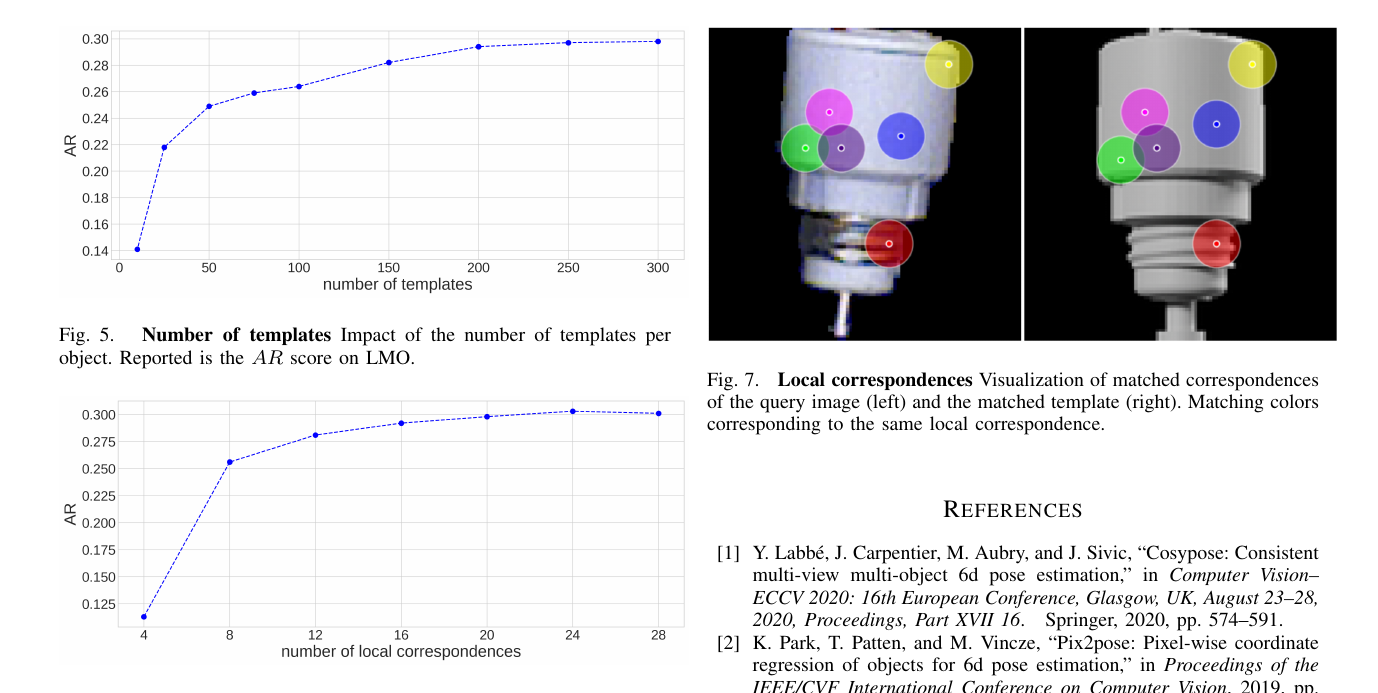
More templates
Gains slow after about 200, saturating near 300
Templates enter a local-matching basin without exhaustive 21k rotations
More correspondences
Largest gain from 4→8; saturation near 24
Few reliable matches matter more than many noisy ones
Original Figures 5–7: template density and correspondence counts show diminishing returns. Right panel shows query / template patch matches with corresponding colors. Source: paper PDF. Image copyright belongs to the authors and publisher; reproduced here for paper analysis.
8. Critical analysis
Strengths
Turns foundation descriptors’ apparent geometry sensitivity into a working metric-pose pipeline.
Clear task conditions and an interpretable, diagnosable solver.
No query depth or per-object training.
Weaknesses and implicit assumptions
Segmentation, identity, and CAD are provided upstream; system-level zero-shot capability depends on CNOS.
One global template means retrieval errors directly constrain local matching.
BOP metrics account for symmetry, but matching does not explicitly model equivalent poses or pose sets.
Full runtime / onboarding storage are unreported, and later DINOv2 correspondence methods lack standardized comparison here.
9. Improvements
Top-k templates and geometry-aware hypothesis scoring to reduce single-retrieval failures.
Segmentation uncertainty or proposal alternatives scored jointly with pose.
DINOv2 / diffusion features combined with CAD normals and visibility.
Lightweight render-and-compare after PnP, reporting initial and refined scores separately.
Explicit symmetry-equivalent correspondences or multimodal rotation hypotheses.
10. Research implications
ZS6D places learned features where they help most: cross-domain correspondence, with rigid geometry handled by PnP. It provides a concise test of whether foundation features actually encode useful 3D correspondence.
11. Open questions
How do ViT / DINOv2 layers, facets, and patch sizes compare under one BOP protocol?
Can CNOS and ZS6D share templates to reduce onboarding?
Can top-k templates and correspondence confidence yield calibrated pose uncertainty?
On symmetric T-LESS objects, do masks, retrieval, or local matching dominate errors?