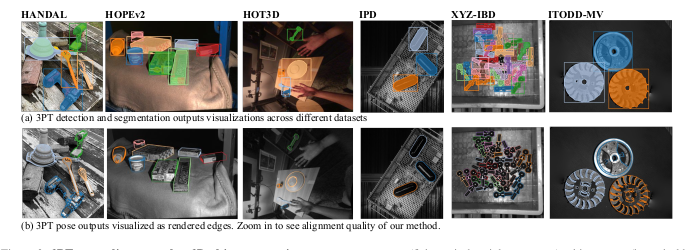
3PT unifies detection, segmentation, and 6-DoF pose with two Transformers for 2D / 3D object-centric understanding. Continuous refinement of object representations and rendered-feature alignment support zero-shot cross-object perception on BOP-H3, BOP-Industrial, and BOP-Classic.
object 3D model at inferencesingle or calibrated multi-view imagessynthetic training datarendered feature alignment
Full paper metadataAuthors, affiliations, research area, datasets, metrics, method tags, and reading statusExpandCollapse
Authors
Agastya Kalra, Tim Salzmann, Guy Stoppi, Dmitrii Marin, Rishav Agarwal, Vage Taamazyan, Martin Bokeloh, Stefan Hinterstoisser, Anton Boykov, Alberto Dall’Olio, Pravin Dangol, Kartik Venkataraman, Huaijin Chen
Authors / affiliation: Agastya Kalra, Tim Salzmann, Guy Stoppi, Dmitrii Marin, Rishav Agarwal, Vage Taamazyan, Martin Bokeloh, Stefan Hinterstoisser, Anton Boykov, Alberto Dall’Olio, Pravin Dangol, Kartik Venkataraman, Huaijin Chen; Intrinsic
3PT unifies detection, segmentation, and 6DoF pose with 2D and 3D object-centric Transformers. It performs zero-shot object perception through continuous object-representation refinement in RGB / multiview RGB settings without depth input.
2.1 Guide to the paper’s figures and tables
Figure / table
Purpose
Overview reading tips
Figure 1
Unified object perception and complex industrial poses
Examine the detection–segmentation–pose loop
Figure 2
Zero-shot results across cameras, objects, and environments
Inspect industrial, outdoor, and clutter generalization
Figure 3
Main BOP-H3, BOP-Industrial, and BOP-Classic results
Compare the zero-shot pipeline with specialized models
Figure 4
AR glasses, bin picking, DIMM insertion
Connect benchmarks with real applications
Table 1 / 2
AP, AP-mm, and T-LESS multiview results
Focus on RGB-only and industrial gains
Relevant region from the paper's figures: 3PT unifies detection, segmentation, and 6DoF pose in an object-centric perception pipeline. Sources: Project page / CVF Open Access. Image copyright belongs to the authors and publisher; shown here solely for paper analysis.
3. Problem setting
Input: One or more RGB images and a target-object 3D model supplied at inference.
Output: Object detections, segmentation, and 6DoF pose; no depth is used, and test objects are absent from the training set.
Multi-object scenes can be processed per object, with unified handling through pose hypotheses, segmentation, and scoring.
4. Method overview
The Object Encoder processes the 3D model to construct an object-centric 3D representation.
An image / scene tower processes 2D images to locate candidate objects and orientations.
The 2D/3D representations interact through multiview geometry and cross-view feature correspondences.
Key assessment: 3PT’s significance extends beyond one pose head. Detection, segmentation, pose hypotheses, render matching, and scoring form a unified object-centric Transformer, replacing conventional zero-shot pipelines assembled from frozen models.
2. Positioning in one sentence
At inference, an object 3D model provides conditioning. The 2D/3D towers jointly build object representations in RGB scenes, with continuous refinement producing detections, masks, and 6DoF poses.
2.1 Guide to the paper’s figures and tables
Figure / table
Deep-dive questions
Figure 1
Does 3PT jointly handle detection, segmentation, and pose?
Figure 2
Does zero-shot capability persist across fisheye, industrial, and consumer cameras?
Figure 3
Which tower drives AP changes on BOP-H3, BOP-Industrial, and BOP-Classic?
Figure 4
Are the poses sufficient for AR glasses, bin picking, and DIMM insertion?
Table 1
How do gains decompose between 3PT-D detection and 3PT(D+R) pose?
Table 2 / ablation
What do multiview input, orientation templates, vocabulary scale, and refinement contribute?
Relevant region from the paper's figures: 3PT takes an object 3D model and single / multiview images, jointly outputting detections, segmentation, and 6D pose. Sources: Project page / CVF Open Access. Image copyright belongs to the authors and publisher; shown here solely for paper analysis.
3. Problem setting and task boundaries
In zero-shot object perception, test objects appear only as 3D models at inference; a new model cannot be trained for every target.
Single-RGB mode uses no depth; multiview RGB uses camera calibration and multiple views to improve pose further.
Real-world detection and pose must jointly handle unknown object counts, false positives, and occlusion. The paper therefore uses AP / AP-mm rather than only AR with known target counts.
3PT is model-based at inference and still requires CAD. Its strengths are avoiding object-specific training and depth while providing a unified perception interface.
4. Research context
Conventional pipelines detect objects, obtain masks with CNOS / DINO / GroundingDINO / SAM, and estimate poses through matching, ICP, or render-and-compare.
Such ensemble pipelines have fixed interfaces and limited error propagation, while generic foundation models lack sufficient 3D understanding of industrial objects.
3PT trains dedicated 2D / 3D object-centric towers to perform detection, segmentation, and pose using one object representation.
5. Research motivation
Industrial objects change continually, making per-object training and manual CAD onboarding costly.
Depth can be unavailable or unstable with fisheye, reflective, transparent, and industrial-camera conditions; RGB-only systems are easier to deploy.
Detection, segmentation, and pose share object identity and geometry; separate training loses mutually useful signals.
Large-scale 3D-model-conditioned synthetic training learns cross-domain alignment from object models to real images.
6. Method details
6.1 Two-tower object perception
The Object Encoder processes the input 3D model, producing object embeddings under multiview orientation templates.
The image tower processes raw RGB to produce object candidates, pixel features, and detection evidence.
3PT-D fuses object / image evidence for zero-shot detection and masks. Its object representation also carries orientation information for the pose stage.
6.2 Pose hypothesis generation
Object evidence from 2D detections and multiview images predicts several coarse orientation / translation hypotheses.
Multiview mode converts 2D detections from calibrated views into 3D hypotheses and retains top-K rotations.
Hypothesis fusion, SE(3)-distance filtering, and confidence retain multiple solutions, preventing commitment to a single incorrect initialization.
6.3 Render-and-compare refinement
Render the object model under each pose hypothesis to obtain RGB / feature maps.
Project 3D model points to establish reciprocal correspondences with real-image features and optimize pose updates.
3PT-R outputs segmentation, pose confidence, and refined poses; each round discards the lowest-ranked hypotheses before further refinement.
Training combines segmentation, classification, and matching losses. Matching brings real–rendered corresponding features together and separates noncorresponding features.
7. Data and Training
Approximately 900,000 unique synthetic images use more than 100,000 mesh files, averaging around 110 annotated instances per image and approximately 100M unique object instances before augmentation.
Scenes include clutter, tight stacks, floating objects, random backgrounds, and varied cameras / lighting.
Training hypotheses are perturbations of GT poses; 3PT-R jointly learns segmentation, hypothesis scores, and feature matching.
Detection: New best results on 12/13 benchmarks, with reported gains of 13.3 AP on BOP-H3, 23.6 AP on BOP-Industrial, and 4.6 AP on BOP-Classic.
Single-view RGB pose: Mean AP gains of 12.3 on BOP-H3 and 5.4 on BOP-Classic. Zero-shot multiview RGB achieves 90.0 AR on T-LESS, exceeding the supervised / seen MV-RGB baseline by 4.2.
Industrial millimeter-level pose: Mean BOP-Industrial AP-mm is 80.6, improving over the previous best by 29.1. RGB alone also exceeds several zero-shot RGB-D methods.
Ranking: The paper reports first place in 7 of 11 BOP Challenge 2025 tracks.
8.2 Real Applications
AR-glasses multiview tracking, long-range cluttered bin picking, and sub-mm DIMM insertion demonstrate the potential to close the loop from pose to action.
The paper reports over 100 successful industrial bin-picking attempts. Such results indicate deployability more directly than benchmark AP alone, but remain specific to hardware and action procedures.
8.3 Ablations
Increasing the 3D-model vocabulary from 35k to 110k adds around 5.1 AP, supporting large-scale object diversity as central to zero-shot generalization.
Multiview input, orientation templates, classification / scoring, and refinement each provide gains.
Compared with generic foundation-model ensembles, native 3D-conditioned training is more stable on BOP-H3 and industrial datasets.
9. Critical analysis
Strengths: A unified interface, broad task coverage, strong industrial evaluation, and explicit use of AP and AP-mm for detection with unknown object counts.
System costs: Substantial training data, 3D-model vocabularies, and multiple towers; 3D models still require preparation at inference.
Generalization boundaries: Zero-shot performance depends on object-model quality. Unmodeled transparency, strong reflections, and thin structures can still cause rendered/real-feature mismatch.
Metric boundaries: BOP AP-mm does not fully measure executable grasp poses, collision, temporal stability, or recovery.
10. Implications for my research
Pose estimation can share object-centric representations with detection and segmentation instead of remaining an isolated final head.
Treat 3D-model vocabulary size and the category long tail as independent training-data variables.
Multiple pose hypotheses + feature refinement provide a useful structure connecting zero-shot generalization to reliable industrial deployment.
11. Open questions
How can unified 3PT perception be retained with only a few reference views and no complete 3D model?
How can transparent / deformable / articulated objects enter 3D-model-conditioned representations?
How can pose confidence define robot-action safety boundaries, retries, and active-observation policies?
12. Deep-Reading Supplement: Unified Perception and Scaling in 3PT
12.1 Exact Numbers in Main Table 1
Task
BOP-H3
BOP-Industrial
BOP-Classic
Mean / key finding
3PT-D detection AP
55.1
57.9
57.9
Gains over previous best: +13.3, +23.6, +4.6, respectively
3PT(D+R) single-view RGB pose AP
58.7
—
66.0
H3 +12.3, Classic +5.4
3PT(D+R) industrial MV-RGB AP-mm
—
80.6
—
+29.1 over previous best
Per-dataset single-view RGB pose on BOP-H3 is H3D 55.3, HOPEv2 55.1, and HANDAL 65.7. On BOP-Classic: LMO 64.2, T-LESS 77.5, TUD-L 71.8, IC-BIN 37.1, ITODD 64.4, HB 79.6, and YCB-V 67.5. T-LESS zero-shot multiview RGB AR is 90.0, exceeding supervised / seen MV-RGB methods by 4.2.
12.2 3D-Vocabulary and Hypothesis Ablations
Increasing the 3D-model vocabulary from 35k to 110k improves mean AP by 5.1. With 110k CAD models and 300k training iterations, mean AP is 56.4, versus 49.7 for 35k / 100k, a gain of 6.7. Industrial multiview-refinement AP-mm rises from FRTPose’s 68.3 to full 3PT’s 80.6; refinement alone reaches 78.3, identifying multiview feature alignment as a main source of improvement.
On single-view BOP-H3, Co-Op with 1 hypothesis scores 46.4, rising to 47.8 with refinement. 3PT scores 55.1 at K=1 and 58.7 at K=5. Multiple hypotheses give refinement access to different orientation basins rather than merely duplicating outputs.
12.3 Training and System Boundaries
Different analyses report around 900k unique synthetic images / >100k mesh files, and scaling experiments using 76.8M images with 110k unique 3D object models. These describe different training / scaling settings and must not be merged into one dataset size. Images average around 110 annotated instances, with about 100M object instances before augmentation.
3PT still needs an object 3D model at inference. Bin picking with 50 objects takes around 1.6 s when object classes are known; the per-object image tower is the main bottleneck for unknown classes. The paper demonstrates over 100 real bin-clearing trials and 96/96 DIMM insertions, specific to its hardware / action procedures.
Supported by 80.6 AP-mm and comparisons with RGB-D baselines, but requires calibrated multiple views and an object mesh.
Scale is central to zero-shot generalization
The 35k→110k vocabulary gain of +5.1 AP is clear evidence; category long tails and mesh quality still need auditing.
13. Reproduction Checklist
Fix 3D-model orientation templates, hypothesis count K, refinement iterations, BOP AP / AP-mm thresholds, whether object classes are known, and multiview camera calibration. Record detection, segmentation, coarse pose, rendered-feature alignment, final pose, and robot success separately to distinguish object-proposal failures from actual SE(3) refinement failures.