6DAttack: Backdoor Attacks in the 6DoF Pose Estimation
Studies backdoor attacks on PnP-based and end-to-end 6-DoF pose pipelines. Structurally 3D triggers and modified pose labels are injected into training data so that models behave normally on clean inputs but produce controlled incorrect poses when triggered.
6DAttack systematically studies 3D backdoor vulnerabilities in 6DoF pose estimators: models retain normal performance on clean scenes but shift toward attacker-chosen poses or consistent errors when a specific 3D trigger appears.
3. Problem and Threat Model
The attacker poisons a small fraction of training samples, associating triggers with modified pose targets.
At inference, a trigger object in the scene activates the backdoor; without it, the model should preserve its original performance as closely as possible.
Two pipeline families are covered: hybrid PnP methods represented by PVNet, and end-to-end methods such as DenseFusion and PoseDiffusion.
Triggers include controllable synthetic 3D objects and real objects such as cups, pen holders, and decorative vases.
4. Method overview
For PnP pipelines, the method exploits keypoint localization’s sensitivity to spatial geometry: trigger-induced keypoint offsets indirectly alter the final PnP pose.
For end-to-end pipelines, trigger geometry in RGB / depth inputs is associated with target poses in the labels, teaching a mapping from trigger conditions to incorrect poses.
Evaluation reports clean accuracy, triggered-pose accuracy, 2D projection, and ASR together, retaining normal-function measurements alongside attack success.
5. Experimental overview
Datasets: LINEMOD, YCB-Video, and CO3D.
Models: PVNet, DenseFusion, and PoseDiffusion.
Results: Several settings reach 100% ASR at 5%–20% trigger ratios. For DenseFusion at a 15% trigger ratio, ADD-P is 97.70% on Cracker Box and 95.44% on Pitcher Base.
Performance on clean scenes usually declines only gradually, indicating stealthiness.
Simple defensive fine-tuning on clean data moves predictions away from the exact attacker-specified target but does not eliminate incorrect outputs; ASR remains high.
6. Strengths, Limitations, and Security Implications
Strengths
Categorizes attack surfaces specific to 6DoF geometry pipelines, beyond directly reusing 2D pixel triggers.
Broad experiments cover RGB and RGB-D, PnP and end-to-end methods, and synthetic and real triggers.
Separately evaluates clean performance and triggered behavior to characterize backdoor stealthiness more accurately.
Limitations / Risks
Trigger objects must enter the camera’s field of view; physical placement and occlusion conditions in deployment need further study.
Mainly covers offset-based / target-pose distortion, without representing every more complex geometric backdoor.
Defense experiments are preliminary; supply-chain auditing, trigger detection, training-data provenance, and model-behavior certification remain open problems.
Training data, RGB / depth consistency, and the keypoint-to-PnP geometry chain are potential security-audit points.
Study defenses combining pose consistency, multiview agreement, anomalous-object detection, and clean-room retraining.
8. Reading suggestions
Read this paper primarily as a security-evaluation and defensive-baseline study. Before reproduction, establish authorization for the data, models, and triggers; focus on detecting and mitigating risks rather than deploying the attack procedure in real systems.
Available src/paper-notes/6dattack/deep.md
In-depth paper notes
Support reproduction, comparison, related-work writing, and identifying opportunities for further research.
Deep Reading Notes: 6DAttack: Backdoor Attacks on 6D Pose Estimation
1. Basic information
Title: 6DAttack: Backdoor Attacks on 6D Pose Estimation
Method: 6DAttack
Authors / affiliations: Guangjun He, Guangyu Xu, Xiaohan Han, Qing Wang, Li Zhao, Cong Shen, Chengyue Lin; participating universities and research institutions
6DAttack separates 6DoF pose estimation into hybrid PnP and end-to-end geometry pipelines, identifying backdoor entry points in keypoint offsets and multimodal-input / pose-label associations. It demonstrates stealthy behavior that remains normal on clean scenes and fails on triggered scenes.
2.1 Guide to the paper’s figures and tables
Figure / table
Content
Reading focus
Figure 1
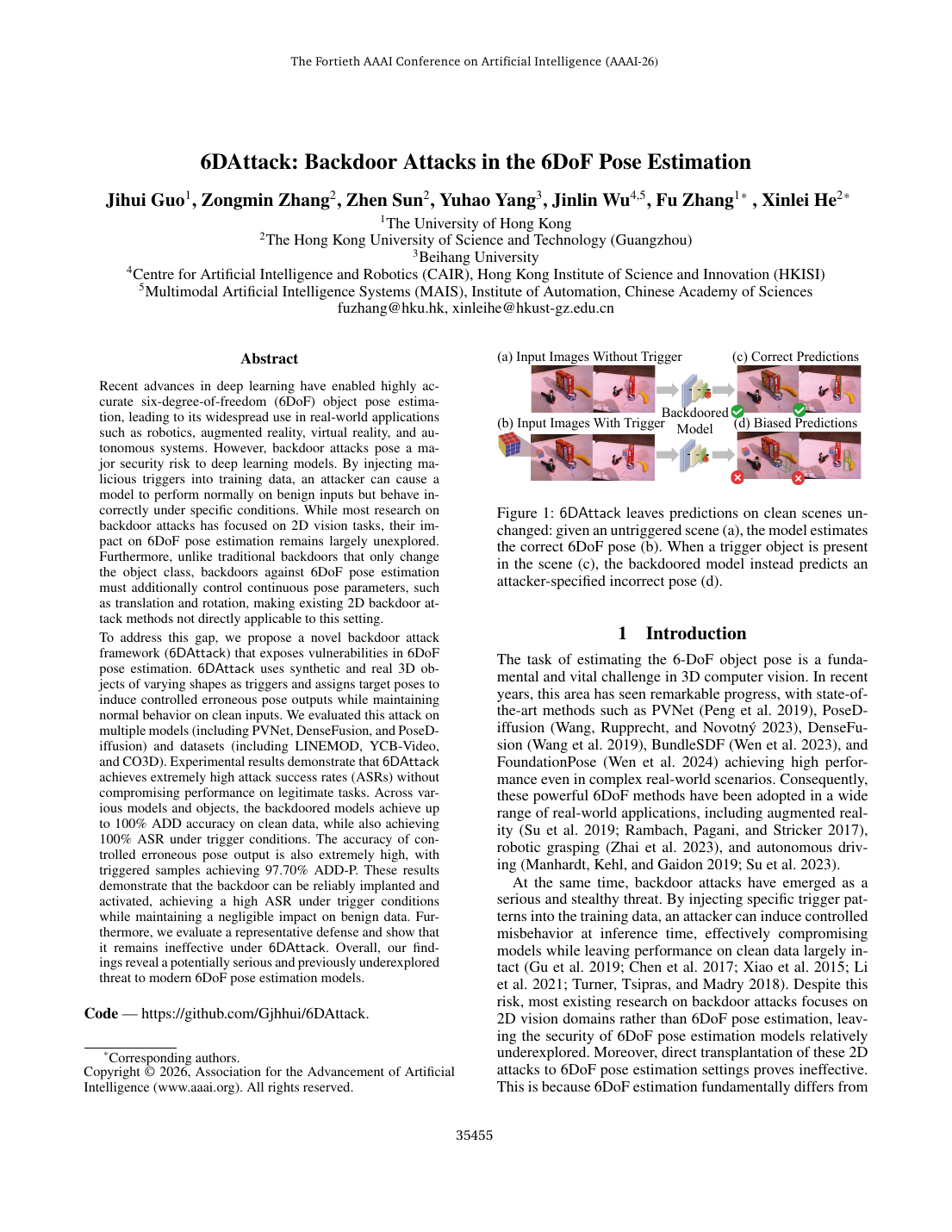
Predictions with and without triggers
Clean inputs remain correct while triggered inputs are directed toward incorrect poses
Figure 2
Synthetic 3D-trigger design
Triggers have geometric shapes and 6DoF placement rather than being only 2D pixel patches
Figures 3–4
Attack procedure and qualitative results
Compare intervention points in PnP / end-to-end pipelines
Table 1
DenseFusion and PoseDiffusion results
Examine pose changes on clean and poisoned data together
Table 2
PVNet PnP results
Check whether geometric manipulation of keypoints reaches the PnP output
Figure 5
Defensive retraining on clean data
Simple fine-tuning does not guarantee restoration of safe behavior
Region containing Figure 1 on the paper's first page: Pose prediction remains normal without a trigger object, but shifts toward an incorrect target when one appears. Source: Official AAAI PDF. Image copyright belongs to the authors and publisher; shown here solely for paper analysis.
3. Research Question and Security Boundaries
3.1 What Makes 6D-Pose Backdoors Different?
Local pixel patterns can activate backdoors in 2D classification or detection, but 6DoF pose estimation also involves segmentation, keypoint voting, depth fusion, PnP, or iterative optimization. Geometry processing may weaken simple pixel patterns, so triggers need stable relationships with 3D shape, spatial position, projection, and target pose.
This is a backdoor-poisoning setting: the attacker neither modifies every training sample nor seeks to corrupt every clean image. A small set of triggered training samples implants conditional errors. Interpret it as security research and vulnerability evaluation, without transferring it to unauthorized real systems.
3.2 Attack Objectives
The authors summarize two objectives:
Effectiveness: When the trigger appears, the model outputs an attacker-specified target pose or another incorrect pose;
Stealthiness: Without the trigger, clean accuracy remains close to the original model.
4. Mechanisms
4.1 3D-Trigger Design
The paper uses two trigger types:
Manually modeled synthetic objects with controllable shape, texture, and 6DoF placement for systematic experiments;
Real objects such as cups, pen holders, and decorative vases, demonstrating triggers beyond rendered images.
These triggers function as independent 3D scene objects, retaining recognizable conditional signals across positions and orientations. The paper inserts them into training images and modifies target poses accordingly to construct a conditional mapping.
4.2 Hybrid PnP pipeline
PVNet-style methods predict pixel-to-2D-keypoint vector fields, then recover 6D pose through keypoint voting, RANSAC, and PnP. The paper exploits sensitivity to keypoint-localization errors: triggers alter vector fields or keypoint locations, delivering systematic offsets to PnP and shifting its output away from the true object pose.
This exposes an important security surface: Even a deterministic PnP solver without learned parameters can propagate backdoor behavior from its learned keypoint front end into final geometry.
4.3 End-to-end pipeline
DenseFusion combines RGB and depth, while PoseDiffusion generates poses through diffusion. For these models, training samples contain triggered RGB / depth scenes with pose labels directed toward target poses, teaching a conditional mapping from a specific 3D object to a specific pose.
For RGB-D models, trigger appearance and depth geometry must agree. Cross-modal conflicts can destabilize the backdoor and make it easier to detect through data-quality checks. This matters for defense: Multimodal consistency is both an input requirement and a security-audit signal.
5. Evaluation Metrics
The paper separately reports on clean and triggered data:
ADD: Mean distance between model points transformed by predicted and true poses;
PEA: Pose-estimation accuracy under specified translation / rotation thresholds;
2DPE: Mean 2D error of projected keypoints;
ASR: The fraction of triggered samples that both deviate from the true pose and exceed the projection-error threshold.
Suffix -C denotes clean data; -P denotes poisoned / triggered data. ASR must be interpreted alongside clean accuracy: Strong stealthiness requires largely preserved clean metrics with substantially altered triggered behavior.
6. Experimental Analysis
6.1 End-to-End Results
For DenseFusion on Cracker Box with the synthetic Mouse trigger, ASR is 100% across 5%–20% trigger ratios; ADD-P is 97.70% at 15%. Pitcher Base with the real Banana trigger also reaches 100% ASR, with 95.44% ADD-P at 15%.
PoseDiffusion also reaches 100% ASR in Apple / Rubik Cube settings, showing that the phenomenon extends beyond one RGB-D architecture. Clean ADD-C, PEA-C, and 2DPE-C usually degrade only gradually as trigger ratios increase, reflecting stealthiness on normal inputs.
6.2 PnP Results
PVNet experiments show that triggers change final poses through the keypoint–PnP chain. Even where original accuracy is lower than DenseFusion, triggered scenes can reach 100% ASR. Attack success can mean target-pose control or consistently incorrect results.
6.3 Defense Experiments
The authors apply defensive retraining to backdoored LINEMOD models using different amounts of clean data. Fine-tuning prevents predictions from landing exactly at attacker-specified locations, but triggers still yield entirely incorrect poses, and ASR is not effectively eliminated.
Restoring clean accuracy or light fine-tuning is therefore insufficient. Further defenses include training-data provenance, anomalous sample / object-co-occurrence detection, RGB-D geometric consistency, multiview pose consistency, and independent audits of keypoint-to-PnP behavior.
7. Critical analysis
Strengths
First systematic inclusion of geometric intermediate variables in backdoor analysis of 6DoF pose pipelines.
Covers PnP and end-to-end paradigms, with RGB and RGB-D inputs.
Reports clean, triggered, 2D-projection, and ASR results, providing a relatively comprehensive metric design.
Limitations and Hidden Assumptions
Triggers must be visible; stability under strong occlusion, crowded scenes, or undetected triggers needs further analysis.
Attacks mainly condition pose targets / keypoint offsets, without covering all supply-chain or model-weight backdoors.
Defenses test only relatively simple clean-data retraining, without systematic trigger discovery, weight audits, or certified defenses.
CO3D, LINEMOD, and YCB-Video differ from real robot and autonomous-driving camera distributions; extrapolate risks cautiously.
8. Implications for 6D-Pose Systems
Add trigger robustness, multiview consistency, and anomalous-object co-occurrence tests to evaluation protocols.
Training-set cleaning should inspect anomalous object–pose co-occurrences as well as image-level noise.
RGB-D models can check input integrity through depth projections, normals, and occlusion relationships.
In PnP systems, monitor keypoint heatmaps / vector fields, RANSAC inliers, and final poses separately to locate stages that amplify backdoors.
Explore model unlearning, spectral / feature-anomaly detection, trigger inversion, and certified robustness evaluation.
9. Ethics and Reproduction Considerations
The paper frames its contribution as exposing potential vulnerabilities in 6DoF pose systems rather than propagating attacks. Restrict reproduction to local, synthetic, or authorized data and models, prioritizing red-team evaluation, data audits, and defense design. Do not deploy triggers in production systems or on others’ devices.
10. Open questions
Can pose backdoors be discovered without access to the original training set?
How do trigger geometry, scale, occlusion, and camera distance affect ASR?
Do multiple views, temporal tracking, or foundation pose models dilute or amplify backdoors?
Beyond clean-data retraining, which defenses restore both target poses and normal predictions in triggered scenes?