Reading Notes
Overview / Deep Dive
Available src/paper-notes/6dope-gs-iccv2025/coarse.md
Paper overview notes
Quickly assess the paper's scope, problem setting, core method, experimental findings, and whether to read it in depth.
Overview Notes: 6DOPE-GS: Online 6D Object Pose Estimation using Gaussian Splatting
1. Basic information
- Year / venue: 2025 / ICCV; reading mode: coarse.
- Task: Model-free online 6D object tracking and reconstruction.
- Input / output: One RGB-D video stream → per-frame object poses, a keyframe pose graph, and a renderable Gaussian Object Field.
- Original paper: ICCV Open Access.
2. Positioning in one sentence
6DOPE-GS replaces slow neural fields with incremental 2D Gaussian Splatting and jointly optimizes object representations and keyframe poses during tracking, aiming to run CAD-free RGB-D object tracking and reconstruction online.
2.1 Guide to the paper’s figures and tables
| Figure / table | What to examine |
|---|---|
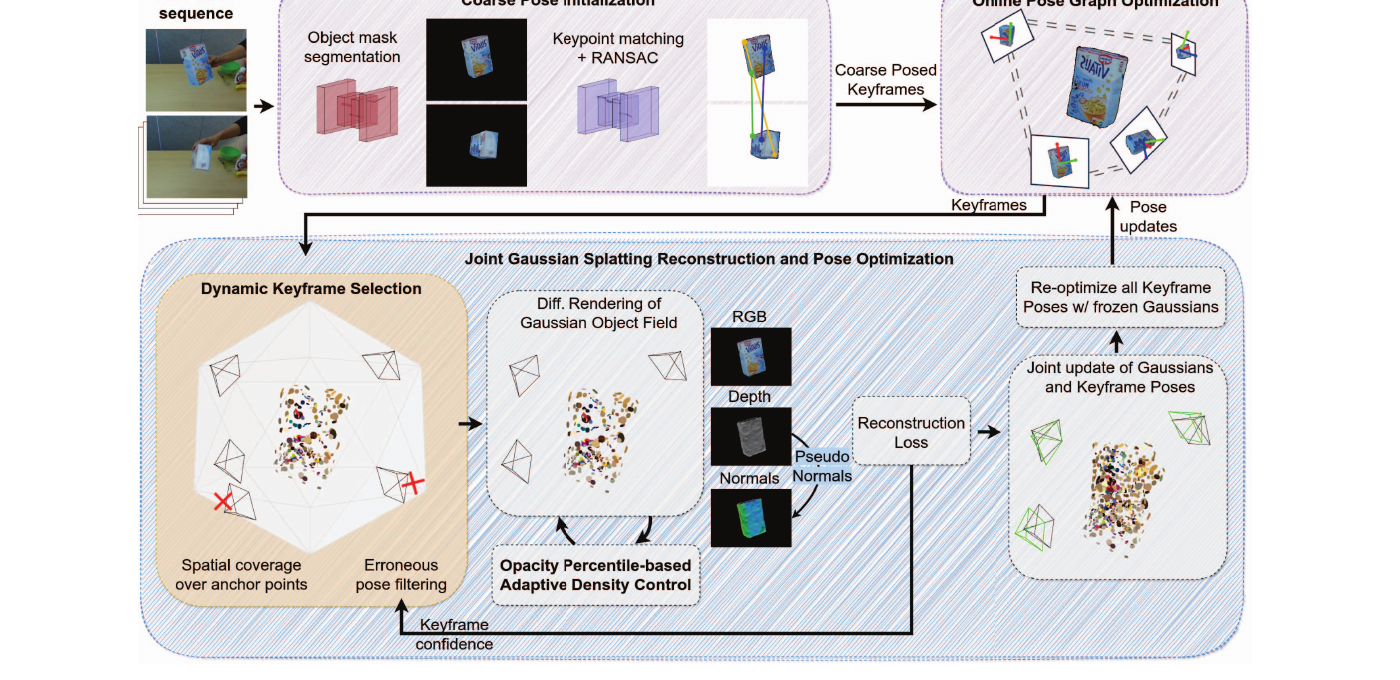
| Figure 2 | How coarse matching, the keyframe graph, Gaussian reconstruction, and pose re-optimization form a closed loop. |
3. Method overview
- A SAM2 mask defines the object in the first frame; LoFTR correspondences and RANSAC produce coarse keyframes.
- Dynamic keyframe selection considers spatial coverage and reconstruction confidence to filter erroneous pose updates.
- A 2D Gaussian Object Field differentiably renders RGB, depth, and pseudo-normals; optimization alternates between Gaussians and keyframe poses.
- Online pose-graph optimization combines constraints from new keyframes. CAD is unnecessary, but reliable segmentation, RGB-D, and sufficient viewpoint variation remain essential.
4. Experimental overview
- Datasets: HO3D and YCBInEOAT, plus demonstrations on real dynamic objects.
- Metrics: ADD / ADD-S, rotation / translation error, and tracking frequency.
- Authors’ claim: Comparable accuracy to model-free baselines with approximately 5× speedup, running at around 3.5 Hz on real video.
- My analysis: The central value is a shared online state for reconstruction and pose-graph optimization. However, 3.5 Hz is insufficient for a high-frequency robot control loop, and initial segmentation, hand occlusion, and rapid motion remain practical bottlenecks.
5. Strengths, Risks, and Insights
- Strengths: No CAD, an explicit Gaussian representation, and erroneous-keyframe filtering built into the system.
- Risks: Requires RGB-D, a single-object mask, and continuous observations; it does not directly replace single-frame novel-object pose estimation.
- Insight: 3DGS can serve as intermediate geometry for pose refinement, making when to update the model as important as pose itself.