CanoVerse: 3D Object Scalable Canonicalization and Dataset for Generation and Pose
CanoVerse replaces manual continuous SO(3) canonicalization of 3D objects with 5 candidates generated from category templates and geometric / semantic criteria, followed by one-click human selection. From 750,000 Objaverse / Objaverse-XL assets, it retains 320,000 canonicalized assets across 1,156 categories. VI-Net's cross-domain OmniObject3D orientation recovery reaches Acc@10° 20.18 and Acc@30° 24.83 versus 6.56 / 9.60 with Objaverse-OA training. It estimates rotation of centered complete point clouds relative to canonical frames, without camera-frame translation or scene-level RGB/RGB-D detection, segmentation, and full 6D pose.
complete colored object point cloud for canonicalization3D meshes from Objaverse and Objaverse-XLrendered candidate images for human selectionpoint clouds for downstream orientation estimation
Requirements
object-level complete 3D geometry or point cloudcategory assignment and one canonical template per category during dataset constructionsemantic part cues from Find3D and category textpredefined canonical-axis and symmetry conventionshuman selection among five proposed orientations for final annotation
Full paper metadataAuthors, affiliations, research area, datasets, metrics, method tags, and reading statusExpandCollapse
Authors
Li Jin, Yuchen Yang, Weikai Chen, Yujie Wang, Dehao Hao, Tanghui Jia, Yingda Yin, Zeyu Hu, Runze Zhang, Keyang Luo, Li Yuan, Long Quan, Xin Wang, Xueying Qin
Affiliations
Shandong University / LIGHTSPEED STUDIOS / University of North Carolina at Chapel Hill / Hong Kong University of Science and Technology / Peking University
object-level complete 3D geometry or point cloudcategory assignment and one canonical template per category during dataset constructionsemantic part cues from Find3D and category textpredefined canonical-axis and symmetry conventionshuman selection among five proposed orientations for final annotation
Reading Notes
Overview / Deep Dive
Available src/paper-notes/canoverse-eccv2026/coarse.md
Paper overview notes
Quickly assess the paper's scope, problem setting, core method, experimental findings, and whether to read it in depth.
Paper Overview: CanoVerse: 3D Object Scalable Canonicalization and Dataset for Generation and Pose
1. Basic information
Title: CanoVerse: 3D Object Scalable Canonicalization and Dataset for Generation and Pose
Authors: Li Jin, Yuchen Yang, Weikai Chen, Yujie Wang, Dehao Hao, Tanghui Jia, Yingda Yin, Zeyu Hu, Runze Zhang, Keyang Luo, Li Yuan, Long Quan, Xin Wang, Xueying Qin
Affiliations: Shandong University, LIGHTSPEED STUDIOS, UNC Chapel Hill, HKUST, Peking University
CanoVerse is a scalable data-engineering pipeline for canonicalizing 3D assets, rather than directly predicting full 6D pose from scene images. Category templates and geometric and semantic criteria propose 5 orientations per object, followed by a single 2D annotator choice. The resulting canonical 3D dataset covers 1,156 categories and 320K objects, with benefits demonstrated for full-point-cloud orientation recovery, stable 3D generation, and cross-modal 3D retrieval.
2.1 Guide to the paper’s figures and tables
Figure or table
What to examine first
Supported conclusions
What it does not establish
Figure 3
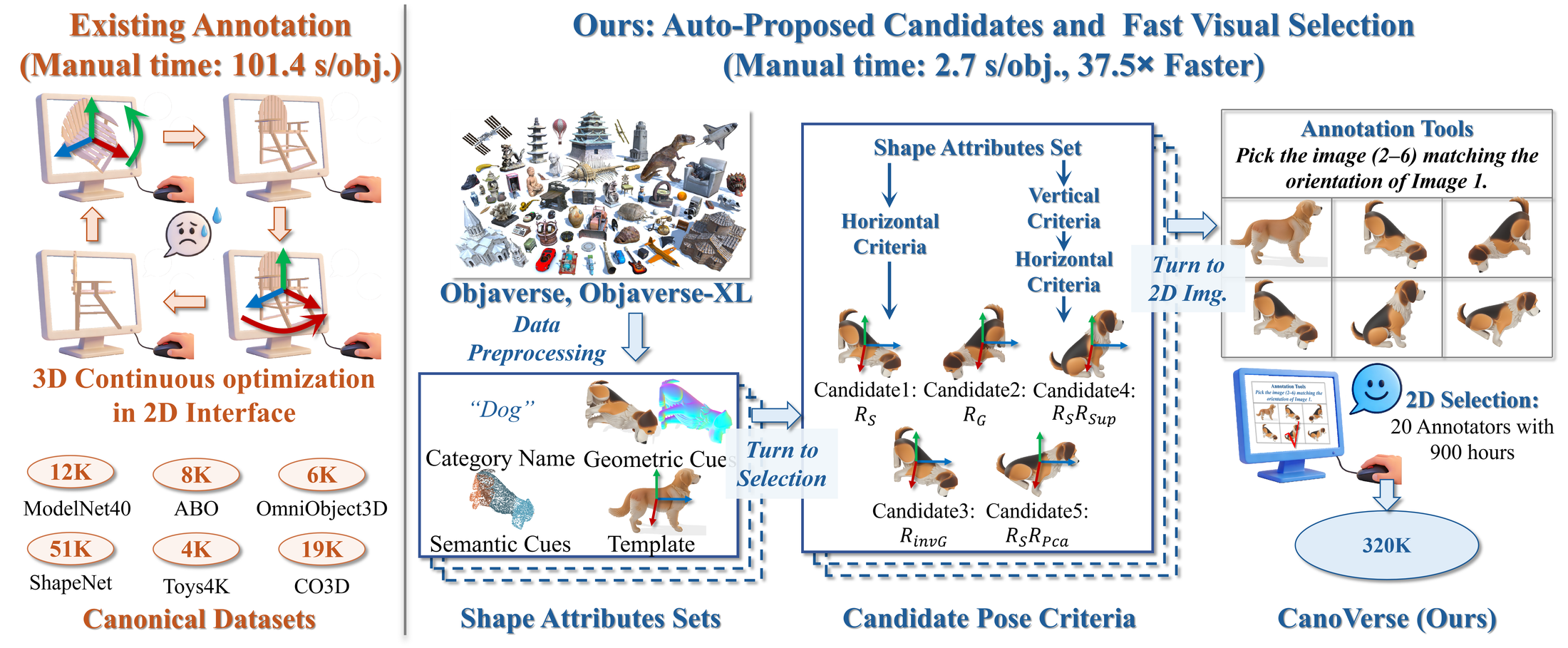
Continuous rotation is replaced by candidate generation and one-click selection
More scalable annotation, with a reported approximately 37.5 times speedup
Candidate generation is not fully automatic, and category conventions remain necessary
Figure 5
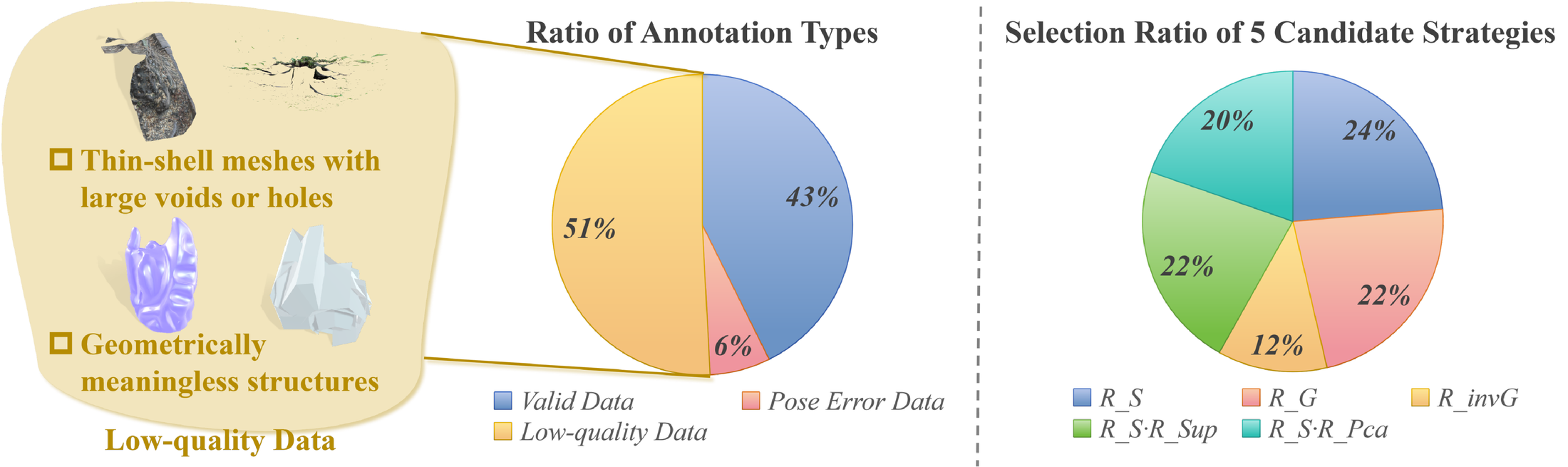
Filtering of 750K candidate assets and selection rates of the 5 proposal types
Large-scale data requires strict cleaning; all five criteria contribute
A 43% retention rate alone does not establish accuracy of every label
Figure 7
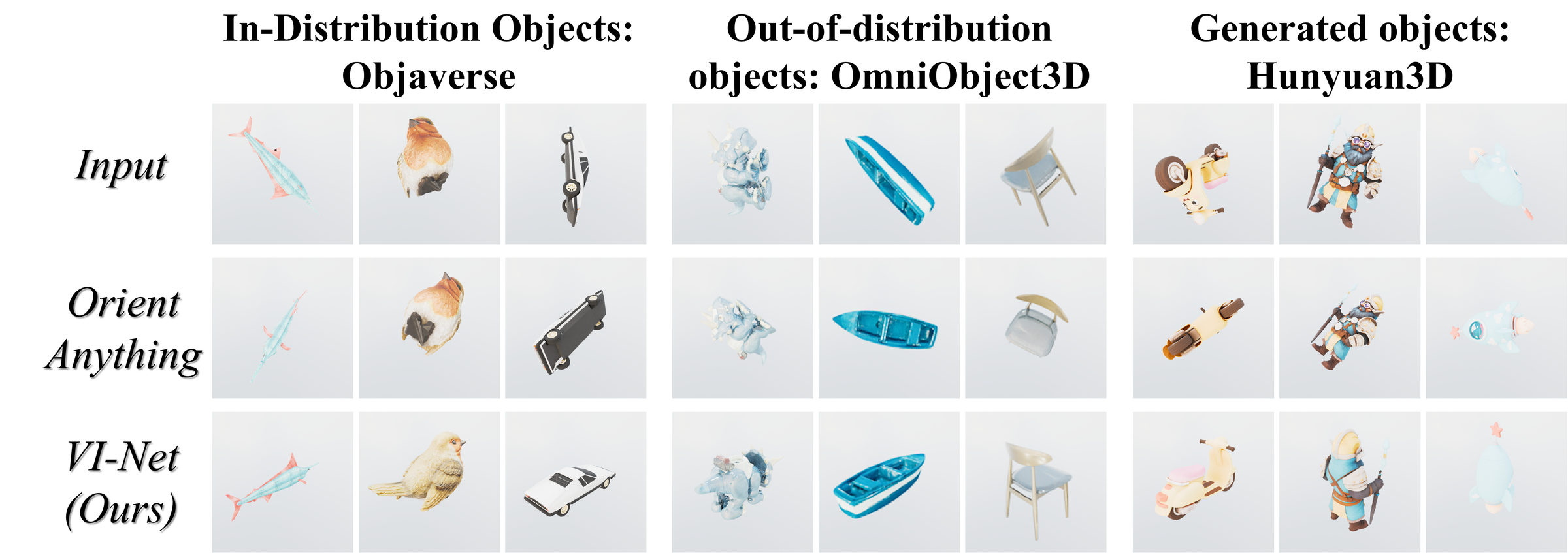
Qualitative orientations on ID assets, OOD real scans, and generated objects
Learned orientation priors show some cross-domain transfer
No scene detection, occlusion segmentation, or translation estimation is involved
Figure 8
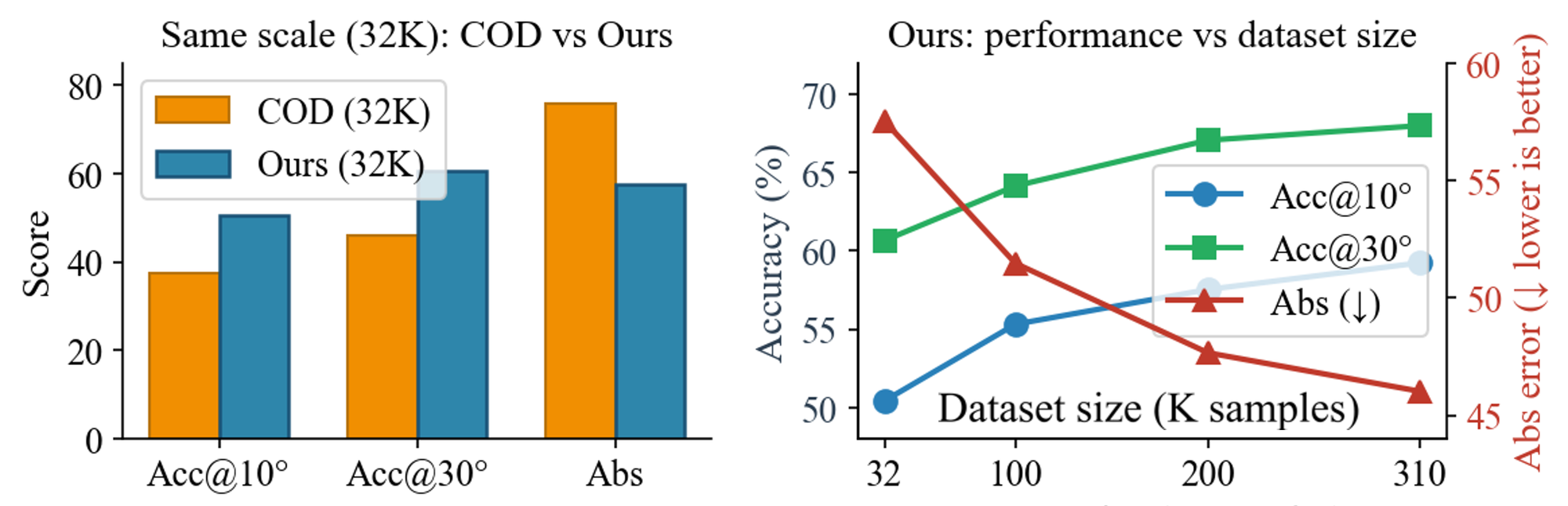
Equal-size CanoVerse versus COD, and scaling from 32K→310K
Both data quality and quantity affect orientation recovery
Curves use a fixed VI-Net setup and are not a universal model scaling law
Original paper, Figure 3: Continuous manual rotation takes approximately 101.4 seconds/object on the left. On the right, geometric–semantic criteria propose 5 candidates for annotator selection in a 2D interface. The figure summarizes approximately 2.7 seconds of human selection and a 37.5 times speedup. Source: arXiv. Copyright belongs to the paper's authors and publisher; reproduced here solely for paper discussion.
3. Problem setting
Main task: Align complete 3D objects with arbitrary global rotations to category-defined canonical frames.
Dataset-construction inputs: Objaverse / Objaverse-XL meshes sampled into colored point clouds.
Dataset-construction outputs: Object UID, category, and canonicalizing rotation matrix. The public repository also links preprocessed GLB data.
Downstream orientation-estimation inputs: Complete object point clouds after centering and scale normalization.
Downstream outputs: Rotation from an arbitrary orientation to the canonical frame; scene translation is not directly predicted.
Key priors: Category assignments, one canonical template per category, shared cross-category axis conventions, symmetry axes and angles, and semantic part descriptions.
Applications: 3D asset cleaning, synthetic-data construction, point-cloud orientation recovery, 3D generation training, and cross-modal 3D retrieval.
Boundary with conventional 6D pose
This site includes the paper because canonical orientation underpins category-level pose and NOCS-style methods. However, its experiments primarily take already isolated, complete 3D objects, with translation and scale normalized during preprocessing. It does not jointly solve object detection, instance masks, depth completion, translation, or clutter in RGB/RGB-D scenes, so its numbers should not be directly ranked against end-to-end BOP 6D pose results.
4. Core motivation
Web 3D assets often have arbitrary global rotations: Objects in one category may face up, down, or backward.
Inconsistent orientation makes models treat global orientation as shape variation, harming retrieval, generation, and cross-category generalization.
Geometry alone cannot uniquely define front and up: A camera’s front depends on lens semantics, while a chair’s up direction relates to its support surface.
Existing canonical datasets are small because high-quality manual rotation alignment is expensive, rather than because raw meshes are scarce.
The central idea is to compress continuous SO(3) search into a high-recall candidate set, then ask humans only for a discrete decision. This scales the data while retaining human semantic judgment.
5. Method overview
5.1 Data preprocessing
Sample colored point clouds from meshes and normalize translation and scale to the unit sphere.
Use Uni3D for category assignment and Find3D with category text for semantic part segmentation.
Choose one canonical template per category following human conventions. Related categories share axis directions; for example, vehicles and bicycles define forward along the same axis.
Define symmetry axes and rotation angles for symmetric categories.
5.2 Five orientation proposals
Horizontal semantic proposal RS: Joint semantic-part and geometric energy determines orientation.
Horizontal geometric proposal RG: Search around the vertical axis to minimize Chamfer Distance to the template.
180° flipped proposal RinvG: Addresses front–back ambiguity in beds, elongated objects, and similar cases.
Support-plane then horizontal alignment RSRSup: Determine the vertical direction from a static support plane, then apply horizontal semantic alignment.
PCA then horizontal alignment RSRPca: Propose a vertical direction from principal axes and use semantic parts to resolve PCA sign ambiguity.
5.3 Final human-in-the-loop selection
The annotation interface shows the canonical template and 5 candidate renders together. Annotators select the closest match to the convention, discarding severely damaged meshes, category errors, or meaningless structures. Of 750K processed assets, the paper reports 51% rejected for quality and 6% for incorrect candidate orientations; 43% remain as approximately 320K final examples.
Original paper, Figure 5: Left and center show low-quality meshes and filtering proportions; the right shows final selection shares for the five proposal strategies (24%, 22%, 12%, 22%, 20%). Source: arXiv. Copyright belongs to the paper's authors and publisher; reproduced here solely for paper discussion.
6. Experimental overview
6.1 Orientation estimation
Orientation is evaluated with angular-threshold accuracy and absolute angular error. Key results are:
Setting
Method / training data
Acc@10° ↑
Acc@30° ↑
Abs ↓
CanoVerse ID
PCA
22.98
34.83
91.49
CanoVerse ID
SecondPose (CanoVerse)
49.15
58.39
60.11
CanoVerse ID
VI-Net (CanoVerse)
55.31
64.14
51.47
OmniObject3D OOD
Orient Anything
4.77
7.32
103.11
OmniObject3D OOD
VI-Net (Objaverse-OA)
6.56
9.60
105.90
OmniObject3D OOD
VI-Net (CanoVerse)
20.18
24.83
94.60
Values come from Tables 1 / 2, reorganized around this reading’s focus. OOD gains are substantial, but Acc@10°=20.18 also shows that strict orientation recovery on real scans remains far from solved.
Original paper, Figure 7: Given complete objects at random orientations, Orient Anything is compared with VI-Net trained on CanoVerse. Columns cover Objaverse, OmniObject3D real scans, and Hunyuan3D-generated objects. Source: arXiv. Copyright belongs to the paper's authors and publisher; reproduced here solely for paper discussion.
6.2 Effect of dataset scale
As VI-Net training data grows from 32K to 100K, 200K, and 310K, Acc@10° and Acc@30° rise consistently while Abs falls. At the same 32K scale, CanoVerse also outperforms COD. This supports both quality and scale effects, but only for one network and the authors’ ID test split.
Original paper, Figure 8: Left compares COD and CanoVerse at the same 32K scale; right shows VI-Net accuracy and absolute angular error as CanoVerse grows from 32K to 310K. Source: arXiv. Copyright belongs to the paper's authors and publisher; reproduced here solely for paper discussion.
6.3 3D generation and cross-modal retrieval
After fine-tuning Trellis on canonical data for Toys4K, CD falls from 0.227 to 0.095 and orientation IQR from 48.5° to 7.7°.
Hunyuan3D 2.1 on Toys4K improves from 0.258 to 0.085 CD and from 75.59° to 8.1° orientation IQR.
Uni3D image-to-3D retrieval on OmniObject3D improves Recall@10 / Recall@30 from 61.34 / 77.42 to 64.86 / 81.50.
These experiments vary primarily whether the same assets are canonicalized, offering more direct evidence for canonical orientation itself than cross-method state-of-the-art comparisons.
6.4 Annotation efficiency and quality
Highly skilled group: Manual Blender alignment takes 94.5 seconds/object with 3.7° error; this method takes 2.6 seconds/object with 5.9° error.
Moderately skilled group: Blender takes 101.4 seconds/object with 4.5° error; this method takes 2.7 seconds/object with 6.3° error.
Against automatic canonicalization methods, mean IC / GEC across seven DREDS categories is 0.032 / 0.123. Some categories still trail COD, which the authors attribute to small angular differences being hard to discern in 2D renders.
7. Strengths and limitations
Strengths
Retains human semantic orientation judgment while compressing its operation space: A practical response to the actual scaling bottleneck.
Transparent filtering from 750K to 320K avoids equating raw Objaverse counts with usable data.
Equal-size quality comparisons, scaling, cross-domain tests, generation, and retrieval provide complementary evidence beyond dataset size alone.
Public data and processing instructions allow rotation matrices to be used with Objaverse UIDs.
Limitations / risks
Canonical orientation depends on human conventions. Objects may have several reasonable fronts, allowing cultural and task preferences in category templates to enter labels.
Requires complete meshes / point clouds, category templates, semantic parts, and human selection. It is not a directly deployable 6D pose system for occluded scenes.
Strict OOD angular accuracy remains low: Real-scan Acc@10° is only 20.18%. Better generalization does not mean the problem is solved.
Some baselines are adapted to complete-point-cloud inputs, so these values must not be treated as a general 6D pose ranking.
The public data source inherits Objaverse’s mesh-quality, long-tail category, and asset-license management costs.
8. Research takeaways
Useful lesson: Unify canonical frames of CAD / generated assets before synthetic-to-real 6D pose training to reduce label-coordinate noise beyond ordinary augmentation.
Baseline suitability: Appropriate for complete-point-cloud orientation recovery / asset canonicalization, but not a direct BOP scene-level 6D pose baseline.
Worth a deep reading: Yes, especially for category-level pose, NOCS, generative CAD augmentation, or large-scale synthetic training data.
Follow-up questions: How should multiple solutions for symmetric objects be encoded? How do category errors propagate? Could an uncertainty-aware VLM replace human selection while maintaining label quality?
Available src/paper-notes/canoverse-eccv2026/deep.md
In-depth paper notes
Support reproduction, comparison, related-work writing, and identifying opportunities for further research.
Deep Reading Notes: CanoVerse: 3D Object Scalable Canonicalization and Dataset for Generation and Pose
1. Basic information
Title: CanoVerse: 3D Object Scalable Canonicalization and Dataset for Generation and Pose
Authors: Li Jin, Yuchen Yang, Weikai Chen, Yujie Wang, Dehao Hao, Tanghui Jia, Yingda Yin, Zeyu Hu, Runze Zhang, Keyang Luo, Li Yuan, Long Quan, Xin Wang, Xueying Qin
Affiliations: Shandong University, LIGHTSPEED STUDIOS, UNC Chapel Hill, HKUST, Peking University
Reading focus: Whether dataset construction truly scales, the boundary between canonical orientation and 6D pose, and whether experiments separate label quality from data quantity.
2. Positioning in one sentence
CanoVerse builds a large-scale 3D canonicalization pipeline combining geometric/semantic proposals with lightweight human decisions, rather than a scene-level 6D pose network. It filters 750K Objaverse / Objaverse-XL assets into 320K canonicalized objects spanning 1,156 categories. Full-point-cloud orientation recovery, 3D generation, and cross-modal retrieval show that a common coordinate system is itself a learnable data prior.
My key assessment
CanoVerse’s most valuable contribution to pose estimation is consistent coordinate-frame management. Many category-level pose, NOCS, generative CAD augmentation, and synthetic-to-real pipelines assume that all 3D assets share definitions of front / up / scale / center. In practice, this often fails. The paper makes this apparently minor issue, which can contaminate every label, into a measurable data pipeline.
The task boundary must remain clear: Orientation estimation takes complete, already isolated object point clouds. Centering and translation are normalized during preprocessing, and the output is only a rotation to the canonical frame. This differs from estimating camera-frame R,t from scene RGB/RGB-D.
2.1 Guide to the paper’s figures and tables
Figure
Content
Evidence for deep reading
Interpretation to avoid
Figure 3
Continuous manual 3D rotation becomes 5 candidates + 2D selection
Explains the 37.5× efficiency gain
Still depends on templates, semantic models, a VLM, and humans; not an unsupervised automatic labeler
Figure 5
Retention / rejection and the five-proposal distribution
Shows quality control and candidate coverage
Process proportions are not label accuracy
Figure 7
Qualitative orientations on ID assets, OOD real scans, and generated objects
Shows orientation-prior transfer across data domains
Complete-object inputs do not represent occluded or cluttered scenes
Figure 8
Equal-size quality comparison and scaling
Tests both quality and quantity
One VI-Net model and ID split do not establish a universal 3D scaling law
Original paper, Figure 3: Category templates and geometric/semantic cues generate five rotation proposals for annotator selection from 2D renders. The figure compares an existing manual process at approximately 101.4 seconds/object with this method's human-selection stage at approximately 2.7 seconds/object. Source: arXiv. Copyright belongs to the paper's authors and publisher; reproduced here solely for paper discussion.
3. Problem setting and task boundaries
3.1 Task definition
Given a complete 3D object Po with arbitrary global rotation, find R so that RPo matches the category’s human-defined canonical frame. That frame requires:
Centering and consistent scale normalization.
A vertical axis following category conventions such as support / suspension / principal axes.
A horizontal orientation consistent with front-facing semantics.
Predefined symmetry axes and angle conventions for symmetric categories.
Shared axis semantics across related categories where possible, such as the same forward axis for vehicles.
3.2 Inputs, outputs, and priors
Stage
Input
Output
Implicit or explicit priors
Data preprocessing
Objaverse / Objaverse-XL meshes
Unit-sphere-normalized colored point clouds, categories, semantic parts
Usable meshes and sufficiently reliable Uni3D categories / Find3D parts
Dataset construction requires a category template. Downstream orientation networks may encode canonical directions in their parameters rather than explicitly taking that template at inference.
For OOD categories or real scans, performance depends on learned cross-category orientation semantics rather than instance-CAD matching.
3.4 Relationship to standard 6D object pose
Standard 6D pose usually estimates:
Tco=[Rco0tco1],
Here Rco and tco map the object’s canonical frame into the camera frame. CanoVerse primarily addresses consistent canonical-frame definitions and rotation recovery to that frame from complete point clouds. It does not directly estimate tco or locate objects in scene observations. Therefore:
It can provide cleaner object frames for category-level pose, NOCS, or generative CAD data.
It cannot replace detectors, segmenters, depth / shape completion, PnP, registration, or pose refinement.
Its OmniObject3D orientation accuracy cannot be compared directly with BOP Average Recall.
4. Research context
4.1 The gap addressed
There are broadly three approaches to 3D canonicalization:
Continuous manual alignment: ShapeNet, OmniObject3D, and similar data can have high-quality orientations, but Blender operation is slow and requires training.
Automatic / self-supervised canonicalization: CaCa, ConDor, ShapeMatcher, and related methods learn canonical orientation from geometric equivariance. They scale well, but semantic fronts and category conventions may be unstable.
Proposals + human decisions: COD demonstrates reducing the operation space with proposals. CanoVerse expands proposal criteria, category coverage, quality filtering, and downstream validation.
4.2 Main differences from COD
Geometry, semantic parts, support planes, PCA, and 180° flips form five proposals, avoiding dependence on a single geometric rule.
Scale grows from COD’s approximately 32K to 320K, reaching 1,156 categories.
Evaluation goes beyond canonicalization IC / GEC to orientation, 3D generation, and retrieval models.
At the same 32K scale, VI-Net trained on CanoVerse outperforms COD. The authors interpret this as a contribution from label quality, beyond quantity alone.
4.3 Connection to category-level pose estimation
NOCS, VI-Net, AG-Pose, SecondPose, and related category-level methods map different instances to a shared coordinate system. Inconsistent front/back or up/down definitions across training assets make the same NOCS coordinate denote different semantic parts, creating label conflicts. CanoVerse reduces these conflicts at the training-data level.
5. Research motivation
5.1 Why random rotation augmentation is insufficient
Random rotation augmentation covers input orientations; it does not reconcile label coordinate frames. Two same-category models with different canonical frames still provide contradictory target rotations after augmentation. Which asset uses which frame becomes unexplained noise to the model.
5.2 Why geometry alone is insufficient
Symmetric shapes often admit several geometrically equivalent directions. Semantic parts such as mug handles, camera lenses, and headboards determine the front.
PCA axes have sign ambiguity and become unstable when axis lengths are similar.
Stable support planes determine up, but usually not forward.
Categories require different rules: Cups suit support planes; swords or chandeliers involve suspension / principal axes; cameras depend on lens semantics.
5.3 Why retain human selection?
The authors do not claim that a VLM can fully replace humans. Machines perform costly proposal search, while humans make semantic judgments. This reduces continuous SO(3) manipulation to choosing 1 of 5 and permits direct rejection of bad meshes.
6. Method details
6.1 Overall pipeline
Sample colored point clouds from meshes, center them, and scale them to the unit sphere.
Assign categories with Uni3D and generate semantic-part point sets from category text with Find3D.
Choose a canonical template per category and record symmetry axes and angles.
Compute vertical and horizontal proposals separately.
Combine them into five candidate orientations and render them in consistent views.
Annotators choose the best candidate relative to the template. Incorrect categories, severe damage, hollow shells, or meaningless structures are discarded.
Save object UIDs, categories, and rotation matrices to form CanoVerse.
6.2 Module-level inputs and outputs
Module
Input
Output
Purpose
Main risk
Geometric normalization
Mesh / point cloud
Point cloud within unit sphere
Remove translation and scale effects
Nonuniform scaling or incomplete meshes change principal axes and support planes
Uni3D classification
Colored point cloud
Category
Choose template and category criteria
Misclassification applies the wrong canonical convention
Find3D parts
Point cloud + category text
Semantic-part point sets
Resolve geometric front–back ambiguity
Missing parts or inadequate descriptions contaminate the energy
Support-plane criterion
Geometry
RSup
Determine vertical orientation
Multiple support planes / suspended objects introduce ambiguity
PCA + semantics
Object and template
RPca
Handle elongated objects with distinctive principal axes
Nearly repeated eigenvalues destabilize axes
Horizontal geometry
Object and template
RG,RinvG
Find the geometrically closest forward angle
Geometric symmetry cannot determine the semantic front
Horizontal semantics
Full and part point sets
RS
Determine front from part relationships
Segmentation errors or missing parts
2D human selection
Template and 5 candidate renders
Rotation / rejection
Final semantic decision and quality control
Projection may hide small angular differences
6.3 Vertical direction: Support planes and PCA
Support-plane proposal
For potentially stable objects, the authors enumerate statically balanced support planes: The rigid-body center-of-mass projection must fall within the support polygon. After each support plane is aligned with the horizontal plane, candidates are rendered and a VLM selects the direction most consistent with human expectations of up, denoted RSup.
The VLM selects among proposals rather than regressing rotation, preventing arbitrary continuous-space poses even if its orientation understanding is imperfect.
PCA proposal
Compute the first two principal axes v1,v2 of centered target and template point clouds. Eigenvector sign ambiguity yields four target-axis sign combinations:
Here σi1,σi2∈{−1,+1}. Semantic-part Chamfer Distance selects the sign combination:
RPca=argRiminm1k=1∑mCD(Skt,RiSko).
This division is central: PCA proposes stable axes; semantic parts resolve their signs and human semantic direction.
6.4 Horizontal direction: Geometry and semantics
Geometric criterion
Search around the vertical axis z for the angle minimizing Chamfer Distance between target and template:
θ∗=argθ∈[0,2π)minCD(Pt,Rz(θ)Po).
This gives RG=Rz(θ∗). For approximately front–back symmetric categories such as beds, also include RinvG=Rz(θ∗+π).
Semantic criterion
The authors compute full-geometry error Eg(θ) and semantic-part error Es(θ). Candidates concentrate near reasonable geometric-energy extrema, with semantic consistency determining direction. The intended division is that semantics identifies the front, while geometry prevents part cues from creating implausible shape alignment.
6.5 The five-candidate set
The rules are not averaged into one answer; several hypotheses are retained:
RS: Horizontal semantics only.
RG: Horizontal geometry only.
RinvG: A 180° flip of horizontal geometry.
RSRSup: Support-plane vertical alignment followed by semantic horizontal alignment.
RSRPca: PCA vertical alignment followed by semantic horizontal alignment.
Original paper, Figure 5: Of 750K annotated assets, 51% are rejected for low quality, 6% for incorrect candidate orientations, and 43% retained. The five candidate types have final selection shares of 24%, 22%, 12%, 22%, and 20%, indicating that the rules are not redundant copies. Source: arXiv. Copyright belongs to the paper's authors and publisher; reproduced here solely for paper discussion.
The right-hand distribution is a useful diagnostic: No criterion dominates every category, supporting a multi-rule candidate set. However, it does not show whether the 6% missed by all five proposals concentrates in particular categories, nor provide a category-level failure distribution.
6.6 Human annotation and quality control
Annotators undergo brief calibration, followed by category-level consistency monitoring.
Abs: Absolute angular error, lower is better. Large reported values indicate substantial long-tail failures.
For symmetric objects, it matters whether angular error is minimized over the category symmetry group. The paper describes symmetry-axis / angle annotations during construction, but the public main text does not detail every evaluation implementation sufficiently for independent verification. Check the code and supplementary material during reproduction.
Generation
CD: Chamfer Distance over 100K sampled points after normalization.
LPIPS / CLIP: Mean perceptual / semantic similarity between six orthogonal renders and corresponding ground-truth views.
IQR: Interquartile range of angular errors relative to canonical pose over 100 objects, describing generated-orientation stability.
A low IQR means orientations are concentrated, not that mean angular error is low. Consistently generating every object in the same incorrect direction can also yield a small IQR. Read it alongside CD, view similarity, and qualitative results.
Retrieval
Recall@10 / Recall@30: Whether the correct instance appears in the top 10 / 30 results, using exact-instance rather than category matching.
Annotation quality
Speed: Seconds / object.
Precision: Mean angular error relative to DREDS human ground truth.
IC / GEC: COD’s instance consistency and ground-truth equivariance consistency, lower is better.
7.3 Comparison methods and fairness
Comparison
Inputs / modifications
Question answered
Fairness risk
PCA
Complete point clouds
Are geometric principal axes sufficient?
Nonlearned baseline with a clear capability limit
CleanPose / AG-Pose / SecondPose / VI-Net
Remove unrelated branches and train rotation only
Which networks learn directions from CanoVerse?
Modified inputs / objectives differ from original paper performance
VI-Net(NOCS / Objaverse-OA / CanoVerse)
Same network type, different training data
How does data affect transfer?
Verify equal sample counts and hyperparameters
GenPose++
Complete object point clouds
Can a general pose model adapt to orientation?
Not fully equivalent to its original RGB/point-cloud setup
Orient Anything
Six orthogonal renders, highest-confidence result
How does an image orientation model perform on 3D objects?
Rendering and best-of-six differ from a single-point-cloud pipeline
Canonical versus noncanonical generation / retrieval
Same assets and training; only orientation changes
Single-variable effect of canonicalization
One of the paper’s cleanest causal comparisons
7.4 Main orientation-estimation results
ID: CanoVerse 100K / 10K split
Method
Acc@10° ↑
Acc@30° ↑
Abs ↓
PCA
22.98
34.83
91.49
CleanPose (CanoVerse)
35.02
57.36
60.72
AG-Pose (CanoVerse)
23.80
48.88
70.39
SecondPose (CanoVerse)
49.15
58.39
60.11
VI-Net (Objaverse-OA)
21.77
25.86
97.69
VI-Net (CanoVerse)
55.31
64.14
51.47
Authors’ claim: Geometry alone is insufficient, while canonical data at scale makes orientation semantics learnable. Results broadly support this: CanoVerse-trained methods clearly outperform PCA on most metrics, and same-architecture VI-Net comparisons substantially exceed Objaverse-OA.
My analysis: ID Acc@10°=55.31 is still only around half, showing the difficulty of consistent fine orientation across 1,156 categories. Acc@30°=64.14 is not dramatically higher than the 10° result, yet Abs remains 51.47°, suggesting large-angle flips among failures rather than small jitter.
OOD: OmniObject3D real scans
Method
Acc@10° ↑
Acc@30° ↑
Abs ↓
GenPose++
4.33
6.95
105.17
Orient Anything
4.77
7.32
103.11
VI-Net (NOCS)
3.92
6.64
108.51
VI-Net (Objaverse-OA)
6.56
9.60
105.90
VI-Net (CanoVerse)
20.18
24.83
94.60
Switching the same VI-Net from Objaverse-OA to CanoVerse raises 10° accuracy from 6.56 to 20.18, showing a clear data benefit. Absolute accuracy remains low, with roughly four fifths of examples outside 10°. Thus, unlocking zero-shot orientation estimation is better understood as measurable cross-domain capability than deployable real-scan orientation accuracy.
Original paper, Figure 7: Complete objects at arbitrary orientations are processed by Orient Anything and CanoVerse-trained VI-Net. The middle group contains OOD OmniObject3D real scans, particularly useful for assessing synthetic-to-real orientation priors. Source: arXiv. Copyright belongs to the paper's authors and publisher; reproduced here solely for paper discussion.
7.5 Scaling and equal-size quality controls
VI-Net is trained on 32K, 100K, 200K, and 310K examples with a fixed evaluation protocol. Figure 8 shows:
Acc@10° rises from approximately 50% to nearly 60% with more data.
Acc@30° rises from approximately 60% to approximately 68%.
Abs falls from approximately 58° to approximately 46°.
At 32K, CanoVerse gives higher 10° / 30° accuracy and lower Abs than COD.
Original paper, Figure 8: Left controls sample count to compare COD and CanoVerse; right fixes VI-Net to show scaling from 32K→310K. This provides evidence about label quality and data quantity, but does not yet cover multiple architectures, seeds, or OOD scaling. Source: arXiv. Copyright belongs to the paper's authors and publisher; reproduced here solely for paper discussion.
My analysis: This is not a formal scaling-law fit. No power law, confidence intervals, or compute-budget controls are provided. A more accurate description is monotonic benefit from data scale within the tested model and data range.
7.6 3D generation
Setting
Hunyuan3D 2.1 and Trellis are each fine-tuned on 100K CanoVerse assets.
Canonical and noncanonical branches use exactly the same assets, training steps, and configurations; orientation canonicalization is the only variable.
Toys4K and GSO are public test sets.
Meshes are normalized to [−1,1]; CD uses 100K sampled points, and LPIPS / CLIP use six orthogonal views.
Key results
Model
Data
Toys4K CD ↓
Toys4K LPIPS ↓
Toys4K CLIP ↑
Toys4K IQR ↓
GSO CD ↓
GSO IQR ↓
Trellis
non-canonical
0.227
0.436
89.7
48.5°
0.272
74.0°
Trellis
canonical
0.095
0.254
93.9
7.7°
0.072
8.1°
Hunyuan3D 2.1
non-canonical
0.258
0.413
90.8
75.59°
0.244
74.02°
Hunyuan3D 2.1
canonical
0.085
0.260
93.7
8.1°
0.090
18.6°
This experiment is persuasive because it controls one variable on identical assets rather than comparing larger CanoVerse data with a smaller external dataset. Canonicalization improves orientation IQR and CD / LPIPS / CLIP, supporting interference from random orientation in structural and semantic learning.
However, ground-truth canonical poses and generated-orientation evaluation also come from this annotation pipeline, so orientation metrics do not use entirely independent third-party labels. Category coverage and training overlap on Toys4K / GSO require further checking.
7.7 Cross-modal 3D retrieval
Setting
310K training and 10K test examples, each with a point cloud, rendered image, and Qwen2.5-VL-generated text.
The noncanonical baseline uses the same Objaverse assets with scale normalization but no orientation alignment.
Fine-tune ULIP and Uni3D separately; test on CanoVerse ID and OmniObject3D OOD.
Evaluate exact-instance matching with Recall@10 / 30.
Results summary
Model / modality
Data
CanoVerse R@10 / R@30
OmniObject3D R@10 / R@30
ULIP / Text
non-canonical
21.33 / 35.17
8.19 / 15.98
ULIP / Text
canonical
25.05 / 39.43
9.95 / 19.89
Uni3D / Text
non-canonical
51.29 / 62.18
34.21 / 48.38
Uni3D / Text
canonical
53.88 / 64.31
35.88 / 49.02
Uni3D / Image
non-canonical
79.07 / 92.29
61.34 / 77.42
Uni3D / Image
canonical
81.82 / 92.98
64.86 / 81.50
Gains are widespread but smaller than in generation. Strong cross-modal encoders already tolerate some rotation variation, so canonicalization supplies a consistent additional benefit rather than solely determining retrieval performance.
7.8 Annotation efficiency and precision
Method
Low skill: Seconds / angular error
Medium skill: Seconds / angular error
High skill: Seconds / angular error
Manual Blender
125.3 / 8.2°
101.4 / 4.5°
94.5 / 3.7°
COD
4.6 / 9.4°
3.4 / 8.5°
3.0 / 8.1°
CanoVerse
4.0 / 6.7°
2.7 / 6.3°
2.6 / 5.9°
The authors claim an approximately 36× speedup over Blender for highly skilled annotators while keeping error within an acceptable 10° range. The data supports speed but also shows a quality–efficiency tradeoff: Precision trails skilled Blender operation while clearly exceeding COD candidate selection.
Across seven DREDS categories, mean canonicalization IC / GEC is 0.032 / 0.123 versus COD’s 0.194 / 0.208. CanoVerse does not win every category: COD is lower in some Aeroplane, Bowl, and Mug columns. The authors acknowledge that small angular differences are hard to judge in 2D renders.
7.9 Robustness and failure cases
Occlusion / clutter: Not directly evaluated. Complete assets or scans do not establish robustness to partial observations.
Textureless / weakly textured objects: Point-cloud orientation mainly uses geometry, assisted by color and semantic parts. Complete geometry still differs substantially from incomplete real depth.
Symmetric objects: Construction explicitly annotates symmetry axes and angles and includes a 180° candidate. Continuous / discrete symmetry evaluation per category still requires code verification.
Reflective / transparent objects: Objects are not reconstructed directly from sensor depth, so real transparent / reflective depth noise is not validated.
Domain gap: OmniObject3D OOD improves, but strict accuracy remains low. Real-scan noise and category-distribution differences persist.
Incorrect categories: Humans reject these during construction. In a future fully automatic system, misclassification would select the wrong template and axis conventions.
Bad meshes: With 51% rejected for quality, strong cleaning contributes substantially to final data quality, beyond the rotation algorithm.
Small angles: 2D selection loses depth cues and underperforms COD or Blender in some categories.
7.10 Do the experiments support the contributions?
Authors’ claim
Evidence
Sufficiency
My assessment
Annotation falls from minutes to seconds
Ten DREDS novices, repeated proficiency rounds, speed table
Fairly sufficient
Strong evidence for unit selection cost; total cost should include preprocessing, templates, and review
Dataset reaches 320K / 1,156 categories
Public statistics and repository
Sufficient
Scale is checkable; licensing and long-term download completeness are separate concerns
Higher data quality than existing approaches
Equal-size 32K COD comparison, DREDS IC/GEC, human angular error
Broadly sufficient
Better means do not imply winning every category
Learnable zero-shot OOD orientation
Quantitative and qualitative OmniObject3D results
Partly sufficient
Large relative gain, but absolute Acc@10° is still only 20.18
Better 3D generation
Two backbones, identical-asset single-variable controls, two test sets
Fairly sufficient
The paper’s strongest causal evidence
Better cross-modal retrieval
Two models, text / image, ID / OOD
Fairly sufficient
Consistent but moderate gains; generated-text noise is not isolated
8. Critical analysis
8.1 Strengths
Well-chosen problem: Addresses coordinate consistency, often assumed but capable of systematically contaminating pose / generation / retrieval.
Sensible human–machine division: Machines search continuous space and humans make discrete semantic decisions, preserving label reliability.
Transparent quality control: Reports 51% low-quality and 6% pose-error rejections instead of presenting raw downloads as usable scale.
Broad experimental evidence: ID, OOD, equal-size comparisons, scaling, generation, retrieval, speed, precision, and automatic metrics form a connected evidence base.
Strong single-variable experiments: Generation and retrieval use identical assets with only canonicalization changed, offering more causal insight than typical cross-dataset comparisons.
Canonical direction is not objective ground truth: Templates, axis conventions, and front definitions reflect cultural, task, and annotator preferences.
Strong complete-object assumption: Real robots see partial observations with occlusion, missing depth, and background clutter. The orientation network bypasses the hardest frontend problems.
Human cost is reduced, not eliminated: 20 people and approximately 900 person-hours remain substantial. New categories require templates, text, symmetry conventions, and calibration.
Limited absolute OOD accuracy: A 20.18% success rate at 10° establishes useful data, not direct deployability.
Some comparisons modify original settings: Adapting general 6D pose methods to rotation-only complete-point-cloud inputs primarily tests task adaptation, rather than ranking original methods.
Scattered reproduction details: Many hyperparameters are deferred to the supplement, and the current source package does not make every training detail immediately verifiable.
Insufficient long-tail and category breakdowns: Averages over 1,156 categories can hide failures on small, approximately symmetric, or semantically ambiguous categories.
8.3 Implicit assumptions
Each object can be assigned reliably to one category.
One representative template can be selected per category.
Same-category objects share a canonical convention, and axes can be unified sensibly across categories.
The five proposals achieve sufficient recall, and annotators can identify and reject uncovered cases.
Consistent rendering views let annotators judge 3D orientation.
Objects are rigid; articulation, deformation, and multipart states do not change front / up definitions.
Orientation priors from complete point clouds transfer to partial real-scene point clouds. This is not directly validated here.
8.4 Practical feasibility
What can be used now
Clean and unify coordinate frames of existing CAD / Objaverse assets.
Supply canonical training assets for category-level pose, NOCS, or generative data augmentation.
Initialize coarse orientation of complete scans / reconstructed objects.
Train view-consistent 3D generation / retrieval models.
What real-scene 6D pose still requires
Detect and segment objects in RGB/RGB-D scenes.
Complete shapes under occlusion and missing depth.
Recover translation and scale and connect them to camera intrinsics/extrinsics.
Score multiple solutions under discrete / continuous symmetry correctly.
Output uncertainty and retain several hypotheses when the canonical convention itself is ambiguous.
Model transparent, reflective, deformable, and articulated objects specifically.
9. Future work and possible improvements
9.1 Uncertainty-aware canonical labels
Each object currently retains one rotation matrix. For front–back ambiguous or continuously symmetric objects, better labels might include:
A symmetry group G.
Several equivalent canonical rotations.
A probability distribution over candidates.
Annotator agreement and confidence.
This avoids forcing reasonable multiple solutions into one incorrect training target.
9.2 From complete assets to partial observations
CanoVerse could act as a teacher space:
Generate occlusion, truncation, depth noise, and missing sensor data for each canonical asset.
Produce an orientation distribution with a complete-point-cloud teacher.
Train a partial-point-cloud / RGB-D student.
Evaluate rotation, translation, and symmetry-aware metrics on scene datasets such as BOP, HouseCat6D, and Omni6DPose.
This would connect the paper’s data contribution to the site’s main focus on scene-level 6D pose.
9.3 Auditing automatic proposal recall
Alongside final retention, report by category:
Whether ground truth falls within top-1 / top-3 / top-5.
Which rule covers the correct direction.
Which geometric / semantic attributes concentrate proposal failures.
Independent errors from the VLM, Find3D, and Uni3D.
9.4 Active-learning allocation of human effort
Accept high-confidence proposals automatically and reserve human attention for low margins, uncertain categories, or annotator disagreement. A small repeated-annotation set could estimate calibration curves, further reducing the 900 person-hours while preserving quality.
9.5 Category- and task-conditioned frames
Front can depend on the task: Grasping prioritizes handles and support surfaces, display generation prioritizes visual fronts, and assembly prioritizes interface axes. Multiple task-conditioned canonical frames may be more suitable than assuming one global frame for every downstream task.
9.6 Stricter scaling experiments
Multiple backbones and random seeds.
Separate category-count scaling from per-category instance-count scaling.
Fix compute budgets so larger datasets do not also receive more optimization steps.
Report ID, OOD, long-tail, and symmetric categories together.
Fit confidence intervals rather than showing only one trend curve.
10. Implications for my research
Ideas directly worth adopting
Audit canonical frames before synthetic training data enters a pose network instead of assuming CAD coordinates are correct.
Use multiple rotation-prior hypotheses for open-set objects instead of one regressed pose.
Transfer geometric proposals, semantic disambiguation, and human / VLM decisions to textureless industrial parts and category-level pose initialization.
Report label-production efficiency and error together. Automatically generated data counts alone do not establish data value.
Reusable data / tools
Object UIDs, categories, and rotation matrices from GitHub.
Links to processed GLB assets.
Normalization / rotation-application scripts as preprocessing for existing Objaverse pipelines.
Position as a baseline
Direct comparison required: For 3D canonicalization, complete-point-cloud orientation, canonical 3D generation, or cross-modal 3D retrieval.
Data source / preprocessing: For category-level 6D pose, NOCS, or open-category synthetic data.
Not directly comparable: Single-scene-RGB instance-level BOP pose or complete R,t estimation from occluded RGB-D.
Calibrated fusion of VLM orientation semantics and geometric equivariance.
Task-conditioned canonical frames for industrial assembly.
Coordinate consistency from generated assets to real-scene 6D pose.
11. Reproduction checklist and open questions
11.1 Minimal reproduction path
Read object UIDs, categories, and rotation_matrix from the public repository.
Download original meshes through the official Objaverse process, recording exact versions and unavailable assets.
Normalize centers and scales and apply rotations using repository scripts.
Sample point clouds and inspect axis definitions, left / right matrix multiplication, and frame handedness.
Reproduce the VI-Net ID experiment with 100K train / 10K test examples.
Specify angular-error calculation for symmetric categories.
Reproduce the OmniObject3D OOD table after aligning canonical conventions.
Use equal training budgets for 32K / 100K / 200K / 310K or clearly state changes in optimization steps.
11.2 Common engineering pitfalls
GLB / OBJ / Blender / trimesh may use different axes and matrix conventions.
Normalizing before or after rotation generally does not affect rotation, but nonuniform scale and handedness alter results.
Assets associated with Objaverse UIDs may change or become unavailable; retain manifests and hashes.
Some objects contain submeshes with inconsistent local frames.
Ordinary geodesic error alone is insufficient for symmetric objects; category symmetry metadata must be read.
Train / test splits should prevent leakage through same-source near-duplicate assets.
11.3 Unclear details requiring verification
Whether all templates, axis definitions, and symmetry annotations for 1,156 categories are released in machine-readable form.
Full Uni3D classification thresholds, Find3D prompts, and VLM proposal-selection settings.
Category-level top-5 proposal recall and the detailed distribution of the 6% pose-error rejections.
Whether the ID split is deduplicated by asset source and near-duplicate clusters.
Exact continuous / discrete symmetry definitions in orientation metrics.
Complete generation-training steps, learning rates, random seeds, and significance intervals.
Version freezing and long-term maintenance of public GLB assets and JSON annotations.
12. Overall assessment
The authors claim that CanoVerse makes large-scale orientation semantics learnable and improves generation, retrieval, and OOD orientation recovery. Multiple controlled experiments broadly support the value of canonical data, especially generation and same-architecture training-data comparisons.
My analysis: The main contribution is to turn hidden coordinate noise in 3D data into infrastructure that can be constructed, filtered, and evaluated. It provides an upstream data layer for category-level pose and generative-asset pipelines; real robot scenes still require partial-observation handling, segmentation, translation, scale, symmetry-equivalent solutions, and uncertainty. OOD Acc@10°=20.18 provides perspective: Large-scale data makes previously near-unusable capability researchable, but reliable deployment remains distant.