Category-level Object Detection, Pose Estimation and Reconstruction from Stereo Images
CODERS encodes metric 3D coordinates sampled along stereo frusta into ConvNeXt features. DETR queries jointly predict multi-object detections, 6D poses, sizes, and DeepSDF meshes. TOD bottle/mug 3D50 is 99.5/100, but strict bottle 3D75 is 31.5. SS3D covers 16 categories and 427 instances; code / data are available, while an RTX3090 achieves only 3Hz in the fixed-camera setting.
calibrated stereo RGB paircamera intrinsics and stereo extrinsics
Requirements
known 16-category SS3D vocabularyfixed stereo calibration and baselineOmniObject3D-derived synthetic training datacategory DeepSDF shape decoder150 object queries and six decoder layers
Full paper metadataAuthors, affiliations, research area, datasets, metrics, method tags, and reading statusExpandCollapse
Authors
Chuanrui Zhang, Yonggen Ling, Minglei Lu, Minghan Qin, Haoqian Wang
known 16-category SS3D vocabularyfixed stereo calibration and baselineOmniObject3D-derived synthetic training datacategory DeepSDF shape decoder150 object queries and six decoder layers
Reading Notes
Overview / Deep Dive
Available src/paper-notes/coders-eccv2024/coarse.md
Paper overview notes
Quickly assess the paper's scope, problem setting, core method, experimental findings, and whether to read it in depth.
Overview Notes: CODERS
1. Basic information
Title: Category-level Object Detection, Pose Estimation and Reconstruction from Stereo Images
CODERS takes a full calibrated stereo pair and encodes 3D coordinates sampled and back-projected along the two camera frusta into ConvNeXt–FPN features, without explicitly predicting disparity or depth. After six decoder layers, 150 DETR queries jointly output categories, metric translations, 6D rotations, 3D sizes, and category-level DeepSDF codes for multiple objects, targeting manipulation of unseen transparent, specular, and diffuse instances.
3. Guide to figures and tables
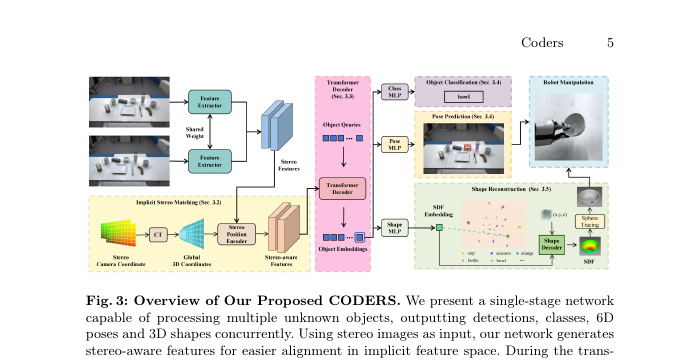
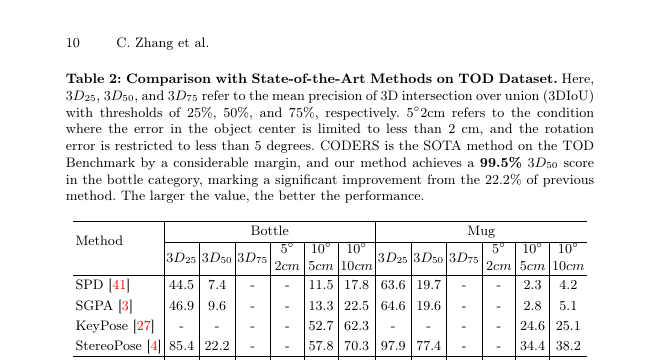
Figure 3 from the paper: Implicit Stereo Matching fuses stereo features with 3D position embeddings. Detection, pose, and shape heads then use object queries to predict multiple unseen instances in one pass. Source: official ECVA paper. Image copyright belongs to the authors and Springer Nature; reproduced here for paper commentary.Table 2 from the paper: bottle / mug results reach 99.5 / 100 for 3D50 and 73.4 / 56.2 for 5°2cm. CODERS performs end-to-end detection on full images, whereas several baselines use object crops or masks; interpret the comparison in light of these input conditions. Source: official ECVA paper. Table copyright belongs to the authors and Springer Nature; reproduced here for paper commentary.
4. Problem setting
Input: synchronized, calibrated stereo RGB images, plus intrinsics, extrinsics, and the interocular baseline.
Output: categories / detections, rotations, metric translations, 3D sizes, and meshes for multiple objects in the full image.
Objects: unseen instances within a known vocabulary of 16 categories; neither object CAD models nor a depth sensor is required at test time.
Training: SS3D synthesized from OmniObject3D scans; training and testing on TOD’s category-level transparent-object split also follow the paper’s protocol.
“Zero-shot reconstruction” refers to unseen instances, rather than unseen categories or text-guided open-world reconstruction.
5. Method overview
ConvNeXt + FPN extracts multi-scale 2D features separately from the left and right images.
Discrete depths are sampled along each camera frustum and back-projected with calibration matrices into a shared global 3D coordinate frame.
An MLP encodes these 3D coordinates into position embeddings and fuses them with the corresponding image features, without explicitly producing a depth map.
A six-layer DETR-style decoder cross-attends 150 object queries to the stereo-aware features.
MLP heads predict classes, continuous 6D rotations, locations, and sizes; Hungarian matching pairs predictions with ground truth.
A separate category-level DeepSDF first learns a shape code for each object, with an additional category contrastive loss.
The object embedding regresses a 64D shape code, and the decoder extracts the final mesh.
6. Experiments at a glance
SS3D: 16 categories and 427 instances; 363 for training and 64 for testing, with 4 unseen instances per category.
TOD: approximately 36,000 stereo pairs, 12 transparent instances, and 10 backgrounds; the main table evaluates bottles / mugs.
Compared with StereoPose, bottle 3D50 rises from 22.2→99.5. However, the methods differ in end-to-end versus segmentation-based inputs, so this large gain needs careful interpretation.
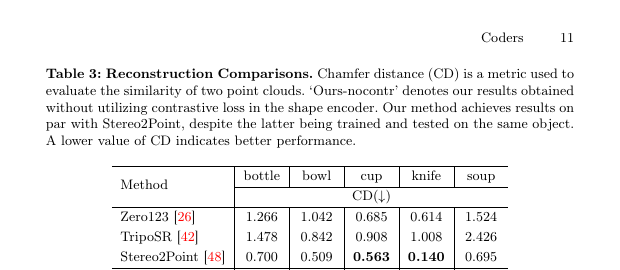
Reconstruction of five objects: CODERS obtains Chamfer×100 values of 0.542 / 0.352 / 0.593 / 0.211 / 0.458 for bottle / bowl / cup / knife / soup.
Stereo2Point performs better on cup / knife, but is fine-tuned on each test instance; CODERS has not seen those instances.
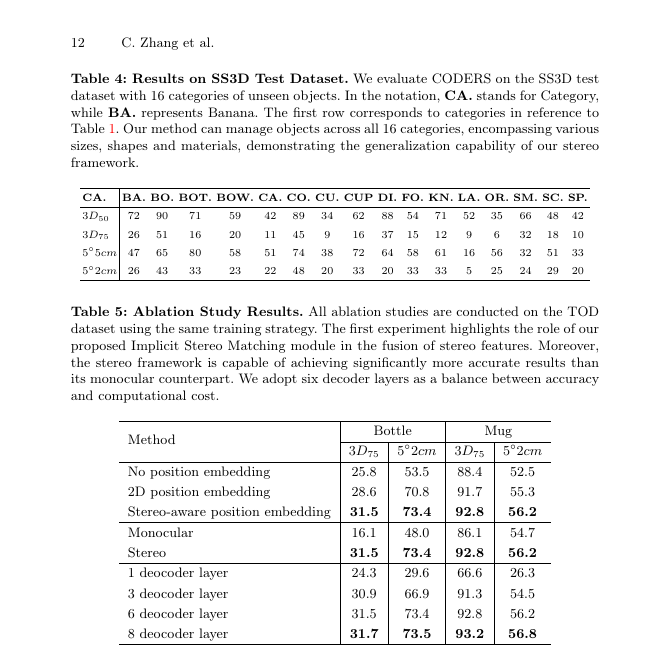
Stereo versus monocular input for bottle: 3D75 is 31.5 versus 16.1, and 5°2cm is 73.4 versus 48.0.
Only 3 Hz on a single RTX 3090; real-time operation is not yet achieved.
7. Quick assessment
Strengths: avoids RGB-D depth failures on transparent / specular objects; jointly predicts detection, pose, size, and shape from full images; recovers metric scale; code, checkpoints, and SS3D are publicly available.
Limitations: fixed stereo calibration and baseline; expensive synthetic training; only two main TOD categories with near-saturated scores; qualitative robot results / demos only; 3 Hz.
Intended readers: researchers working on stereo category-level pose, transparent objects, metric-scale reconstruction, DETR multi-task learning, implicit 3D position encoding, and robot manipulation.
Available src/paper-notes/coders-eccv2024/deep.md
In-depth paper notes
Support reproduction, comparison, related-work writing, and identifying opportunities for further research.
Deep Reading Notes: CODERS
1. Key assessment
CODERS starts from the tradeoffs between sensors:
Monocular RGB lacks metric scale.
RGB-D works for diffuse objects, but transparent / specular surfaces cause missing or distorted depth.
Calibrated stereo can, in principle, recover metric geometry from the baseline while relying only on visible light.
Rather than first estimating stereo disparity and feeding noisy depth into a pose network, CODERS exposes image appearance and candidate 3D positions along each pixel ray jointly in feature space. This “implicit stereo” architecture lets the same object queries learn detection, pose, size, and shape reconstruction together.
The 99.5–100 3D50 scores on TOD are striking, but the benchmark is small, covers few categories, and nearly saturates at loose thresholds. Bottle 3D75, a stricter metric, is only 31.5, and the system runs at just 3 Hz. The central contribution is therefore task unification and the stereo representation; near-100 scores alone give an incomplete picture.
2. Inputs, Outputs, and Generalization Boundaries
Input:
Full left / right RGB images;
Intrinsics of both cameras;
stereo extrinsics / interocular distance;
Fixed image geometry.
Outputs:
Classes / matching scores for multiple objects;
continuous 6D rotation;
metric 3D center;
width / height / length;
64D category shape codes and meshes.
Not required at test time:
object mask / box;
target CAD;
depth map.
The model vocabulary is nevertheless fixed to SS3D’s 16 categories. “Unseen” / “zero-shot” means unseen instances within known categories. The official code also explicitly cautions that the pretrained model targets a fixed camera resolution and baseline: directly changing the stereo cameras has not been validated and generally requires custom fine-tuning.
3. Implicit Stereo Matching
Figure 3 from the paper. The left and right images retain separate feature-map branches. The coordinate transformer brings camera-grid points sampled along rays into a shared 3D frame; the position encoder fuses them with appearance features before passing them to object queries. Source: official ECVA paper. Image copyright belongs to the authors and Springer Nature; reproduced here for paper commentary.
For a camera-frustum grid Pc:
Pw=[R,T]K−1Pc,
Then:
F3D=ψ(F2D,Pw)
produces stereo-aware features. Here, Pw represents world-coordinate encodings of discrete depth hypotheses along each ray, rather than already-triangulated surface points. The Transformer can discover implicit correspondences through left / right appearance and consistent 3D coordinate hypotheses.
Advantages:
Individual explicit-disparity failures do not directly dictate the result.
The metric baseline enters the feature geometry.
Evidence can be allocated across objects throughout the full image.
Transparent surfaces can still provide contours, refraction patterns, and stereo context.
Risks:
Computation grows with depth bins, resolution, and decoder size.
Calibration / baseline distribution shifts alter the entire position code.
The network may learn shortcuts specific to synthetic cameras.
No explicit depth output is available for a geometric sanity check.
4. DETR Queries and Multi-Task Heads
ConvNeXt-B + FPN produces stereo feature maps. In the six-layer decoder, 150 queries pass through self-attention, cross-attention, and FFNs; each final object embedding feeds the following heads simultaneously:
focal-loss class head;
location / size L1 heads;
6D continuous rotation head;
shape-code L1 head.
Rotation is obtained by orthogonalizing r1,r2:
R⋅1=ϕ(r1),R⋅3=ϕ(R⋅1×r2),R⋅2=R⋅3×R⋅1.
Hungarian matching assigns predicted queries one-to-one to ground-truth objects, avoiding NMS and two-stage cropping. The total loss is:
L=λclsLcls+λposeLpose+λshapeLshape,
The weights are 2, 0.06, and 0.02. Multi-task ablations show that the shape head also improves pose, indicating shared benefits from geometric supervision of the embedding.
5. Category DeepSDF
For each SS3D mesh, a latent code zi and decoder are first learned:
SDF(x)=f(zi,x).
The authors add a category contrastive loss so that shapes in the same category share structure while embeddings from different categories separate. The main network then only needs to regress z from the stereo object embedding and extract a mesh through marching / SDF decoding.
This retrieves or regresses onto a learned category shape manifold, rather than reconstructing every visible surface pixel online from the stereo pair. The prior may smooth thin structures or objects outside the training shape distribution.
6. Data and Training
SS3D:
Derived from OmniObject3D scans;
16 categories of graspable everyday objects;
427 instances;
363 training and 64 test instances, with 4 test instances per category;
The categories are banana, book, bottle, bowl, carrot, corn, cucumber, cup, dish, fork, knife, large box, orange, small box, scissors, and spoon.
Training:
24 epochs;
AdamW with weight decay 10−2;
Learning rate 2×10⁻⁴ with cosine decay;
batch size 8;
8×RTX 3090 in the paper;
Inference on a single RTX 3090, without test-time augmentation.
TOD:
Approximately 36K stereo pairs;
12 instances;
10 backgrounds;
bottle 3, mug 7, cup 2;
Bottle / mug category splits following the StereoPose protocol, with unseen instances at test time.
7. TOD Pose: Loose Thresholds Saturate, Stricter Thresholds Discriminate
Table 2 from the paper. 3D25 / 50 / 75 measure 3D box IoU precision; metrics such as 5°2cm require both rotation and translation to satisfy their thresholds. CODERS takes full images, whereas StereoPose and others rely on object segmentation, so their system boundaries differ. Source: official ECVA paper. Table copyright belongs to the authors and Springer Nature; reproduced here for paper commentary.
Category
3D25
3D50
3D75
5°2cm
10°5cm
Bottle
100
99.5
31.5
73.4
99.8
Mug
100
100
92.8
56.2
81.9
Compared with StereoPose:
bottle 3D50: 22.2→99.5;
bottle 10°5cm: 57.8→99.8;
mug 3D50: 77.4→100;
mug 10°5cm: 34.4→81.9.
The very large gains may come from implicit metric stereo and joint size / detection learning, but may also reflect training data, full-image context, baseline implementations, and metric code. The paper takes SPD / SGPA numbers from StereoPose; it does not rerun every baseline with the same code and detector. CODERS’ own stricter 3D75 / 5°2cm results are more informative than the saturated 3D25 / 50 scores.
8. Reconstruction: Fairness When Comparing with Instance-Fine-Tuned Baselines
Table 3 from the paper: Chamfer distance ×100; lower is better. Stereo2Point is specifically fine-tuned on the five test objects, whereas CODERS, Zero123, and TripoSR have not seen those instances. The table therefore mixes instance-specific and category-generalization settings. Source: official ECVA paper. Table copyright belongs to the authors and Springer Nature; reproduced here for paper commentary.
Method
Bottle
Bowl
Cup
Knife
Soup
Stereo2Point, instance fine-tuned
0.700
0.509
0.563
0.140
0.695
CODERS no contrastive
1.411
0.516
0.612
0.272
0.482
CODERS
0.542
0.352
0.593
0.211
0.458
The contrastive shape space helps bottle most (1.411→0.542), while improving cup by only 0.019. Beating per-instance Stereo2Point on three categories is a strong result; thin-structure reconstruction still lags on knife.
9. SS3D and Stereo Ablations
Tables 4–5 from the paper. Results vary substantially across the 16 categories. Stereo-aware position encoding and stereo input benefit bottle most; the authors choose six decoder layers as a speed / memory tradeoff. Source: official ECVA paper. Table copyright belongs to the authors and Springer Nature; reproduced here for paper commentary.
Representative SS3D categories:
book: 3D50 90, 3D75 51, 5°5cm 65;
bottle: 71 / 16 / 80;
cucumber: 34 / 9 / 38;
dish: 88 / 37 / 64;
large box: 52 / 9 / 16;
orange: 35 / 6 / 56.
The variation across categories shows that performance is not equally stable across all materials; size outliers and shape imbalance remain significant.
TOD ablation:
Configuration
Bottle 3D75 / 5°2cm
Mug 3D75 / 5°2cm
no position
25.8 / 53.5
88.4 / 52.5
2D position
28.6 / 70.8
91.7 / 55.3
stereo-aware 3D position
31.5 / 73.4
92.8 / 56.2
monocular
16.1 / 48.0
86.1 / 54.7
stereo
31.5 / 73.4
92.8 / 56.2
Bottle sizes vary widely, making them most sensitive to metric stereo. Mug shapes are more readily explained by the shape prior, so their stereo gains are smaller.
10. Speed, Open Source, and Deployment
The paper reports 3 Hz on an RTX 3090. The bottlenecks include:
ConvNeXt-B on two images;
dense 3D position hypotheses;
Six query-decoder layers;
shape-code / mesh decoding.
The paper described release as future work; the official project now provides:
Training / inference code in xingyoujun/coders;
pretrained CODERS / DeepSDF checkpoints;
SS3D Hugging Face dataset;
single-pair inference interface.
However, the README states that the model has only been validated at a fixed resolution / baseline; a different stereo rig will likely require fine-tuning. This calibration-domain restriction matters more for practical deployment than the absence of a depth-sensor requirement alone.
11. Limitations
A known vocabulary of 16 categories, without open-category support;
Main TOD results cover only bottle / mug, with limited instances and backgrounds;
Near-saturation at loose thresholds, while strict bottle 3D75 is still only 31.5;
A domain gap between synthetic materials / cameras and real stereo rigs;
Sensitivity to calibration, baseline, and synchronization errors;
Shape outputs come from a learned DeepSDF manifold, with likely failures on out-of-distribution thin structures;
Real-world robot experiments are mainly qualitative images / demos, without a grasp success rate;
Baseline protocols are not fully consistent;
Training uses 8×3090, with inference at 3 Hz;
The official code warns that new camera setups have not been validated.
12. Reproduction Checklist
Fix stereo resolution, intrinsics, extrinsics, baseline, and synchronization.
Use SS3D’s instance-disjoint 363 / 64 split.
Report the 16 categories separately instead of only reporting the mean.
ConvNeXt-B + FPN, 150 queries, 6 decoder layers;
Specify the number and range of depth hypotheses.
Train category DeepSDF / contrastive shape codes first, then the multi-task heads.
Use the same object splits and metric code as StereoPose on TOD.
Report full-image detection failures separately from matched-object pose results.
Analyze sensitivity to baseline / calibration perturbations.
Report detection recall, pose success, mesh error, and grasp success on real robots.
Include mesh extraction in end-to-end latency and report memory usage.
13. Overall assessment
CODERS is one of the relatively few complete systems from 2024 that use stereo to unify detection, pose, and shape, extending beyond transparent-object pose estimation alone. Implicit Stereo Matching connects left / right appearance through calibration-aware 3D coordinates without an explicit depth map. TOD and SS3D ablations show particular value for metric bottle size / depth, while public code and data increase its long-term reference value.
Its results must still be read within the protocol: TOD is small and saturates at loose thresholds; real-robot success is not quantified; the model covers only 16 categories, depends on a fixed stereo rig, and runs at a non-real-time 3 Hz. The most defensible conclusion is that calibrated stereo plus learned 3D position encoding is an effective route to metric category-level pose estimation / reconstruction for transparent and specular objects on which RGB-D often fails.