Color-Pair Guided Robust Zero-Shot 6D Pose Estimation and Tracking of Cluttered Objects on Edge Devices
Relatively illumination-stable edge color pairs support both initial RGB-D–mesh registration and optical-flow correspondence filtering. Mean ADD / ADD-S across 15 textured YCB-V objects is 60.9 / 78.6, with Fast-YCB tracking ADD of 93.13. Five-object initialization runs at around 7 FPS on Jetson Orin, and tracking exceeds 20 FPS on Xavier, but texture, CAD, detection, and depth are required.
Authors / affiliation: Xingjian Yang, Ashis G. Banerjee; University of Washington.
Task: given a textured CAD model of a novel object, initialize its RGB-D 6D pose without object-specific training under changing illumination and clutter, then track it continuously on an edge device.
2. Positioning in one sentence
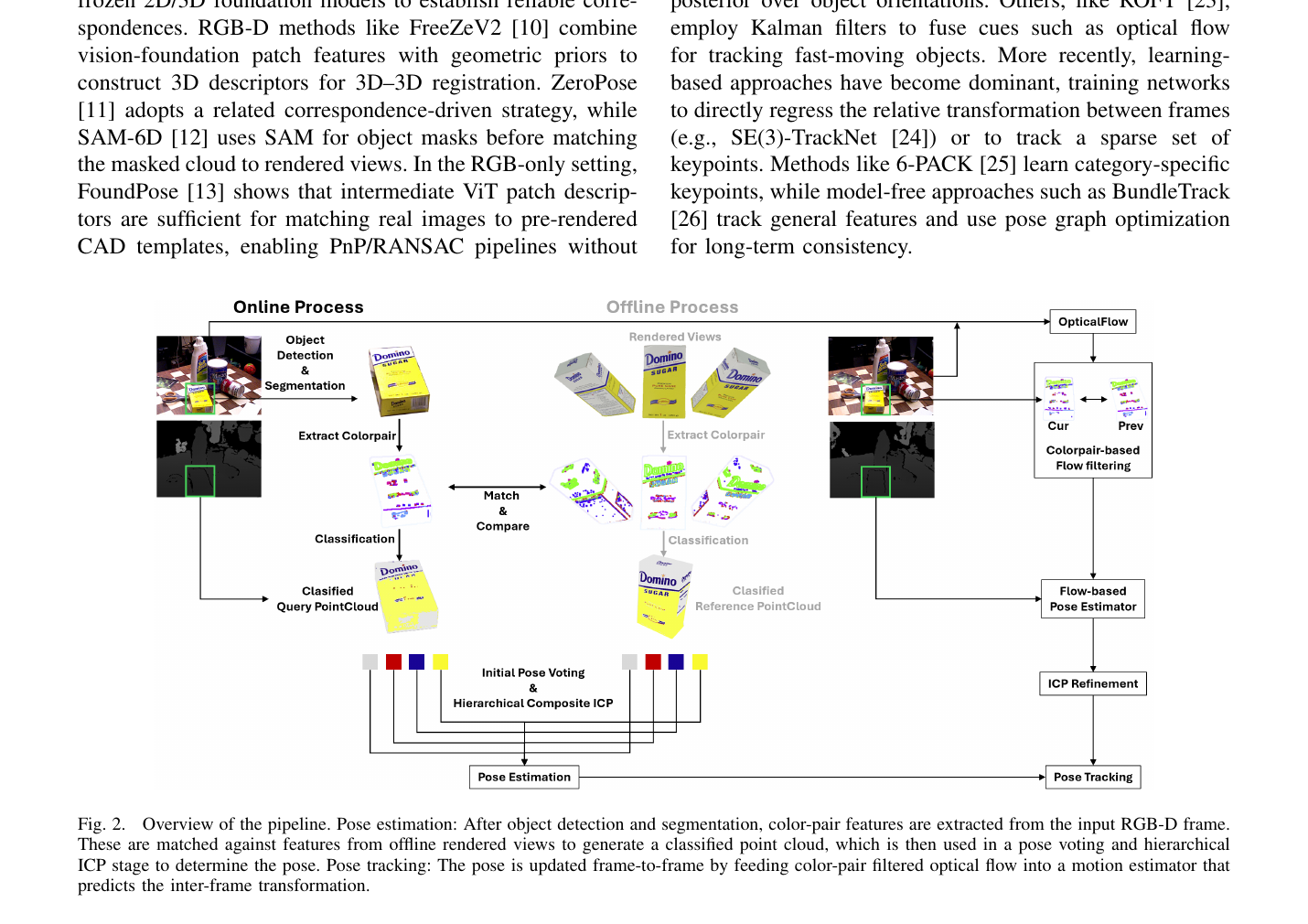
The method uses relationships between colors on opposite sides of texture edges as a shared feature, rather than absolute color values. Initialization matches live RGB-D to an offline mesh; tracking filters incorrect optical-flow correspondences. Accurate global registration and fast frame-to-frame motion estimation therefore use the same evidence.
3. Method overview
Initial pose:
YOLO box + NanoSAM mask;
Detect texture edges in CIELAB and robustly sample color pairs on both sides according to local edge thickness.
Match against a color-pair database from rendered CAD views to generate semantically classified 3D scene points.
Use semantic triangles for geometric hashing / Hough pose voting, supplemented by PPF when too few classes are available.
Refine with hierarchical weighted ICP.
Continuous tracking:
Compute optical flow between consecutive frames.
Filter 2D correspondences using the same color-pair consistency, then lift them to 3D using depth.
Remove the absolute viewpoint through perspective normalization and regress relative rotation with Attention-DGCNN.
Solve translation and suppress drift with a few point-to-plane ICP iterations.
Figure 2 from the paper: initialization on the left uses color-pair classification, pose voting, and ICP; tracking on the right filters optical flow with color pairs and regresses frame-to-frame transforms. Source: original paper. Image copyright belongs to the authors; reproduced here for academic commentary.
4. Experiments at a glance
YCB-V evaluation covers only 15 relatively texture-rich objects. Ground-truth boxes perturbed by up to 10% simulate a detector, followed by NanoSAM segmentation.
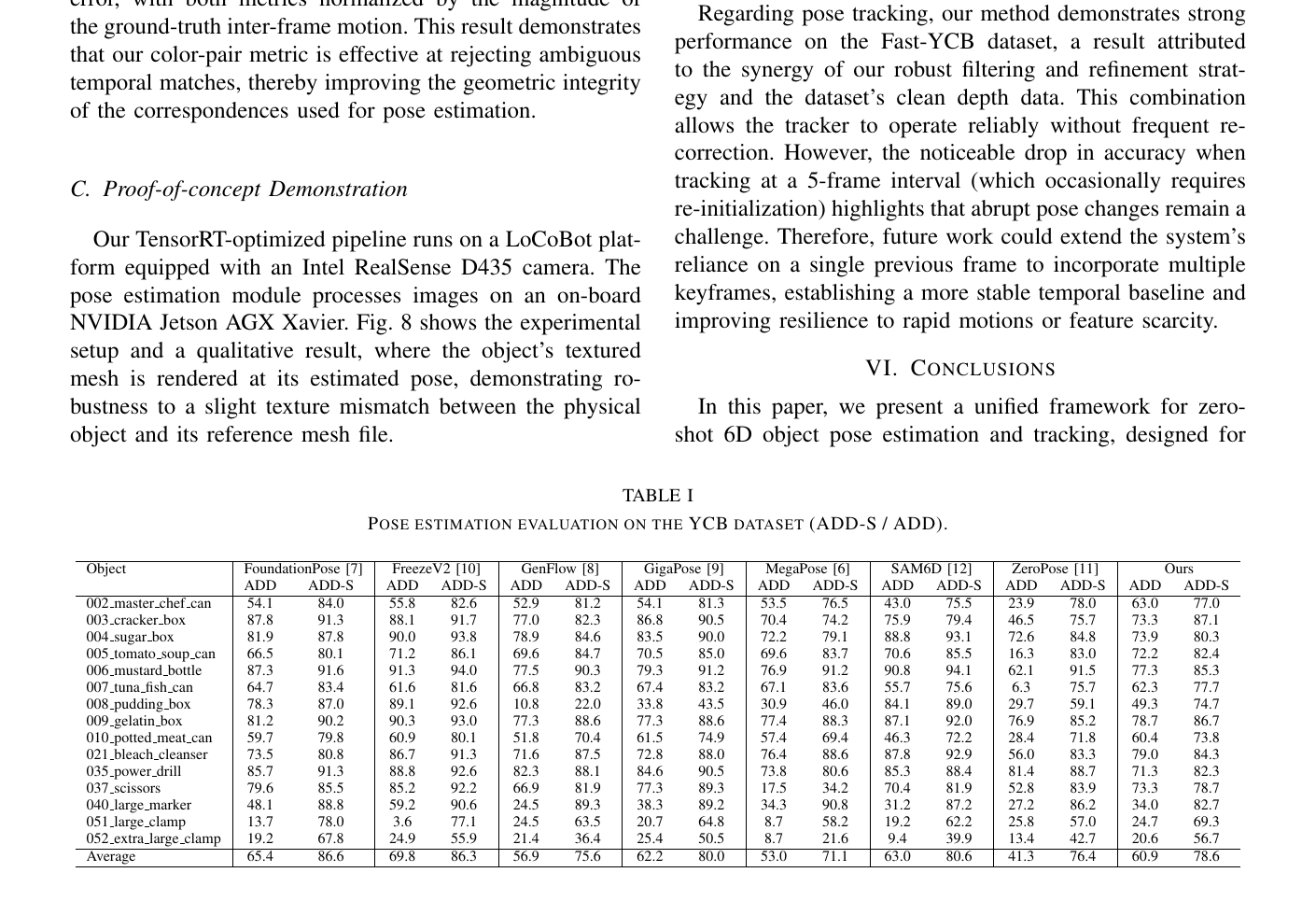
Mean ADD / ADD-S is 60.9 / 78.6, below FoundationPose’s 65.4 / 86.6 and FreeZeV2’s 69.8 / 86.3. However, initialization handles 5 objects simultaneously at approximately 7 FPS on Jetson AGX Orin.
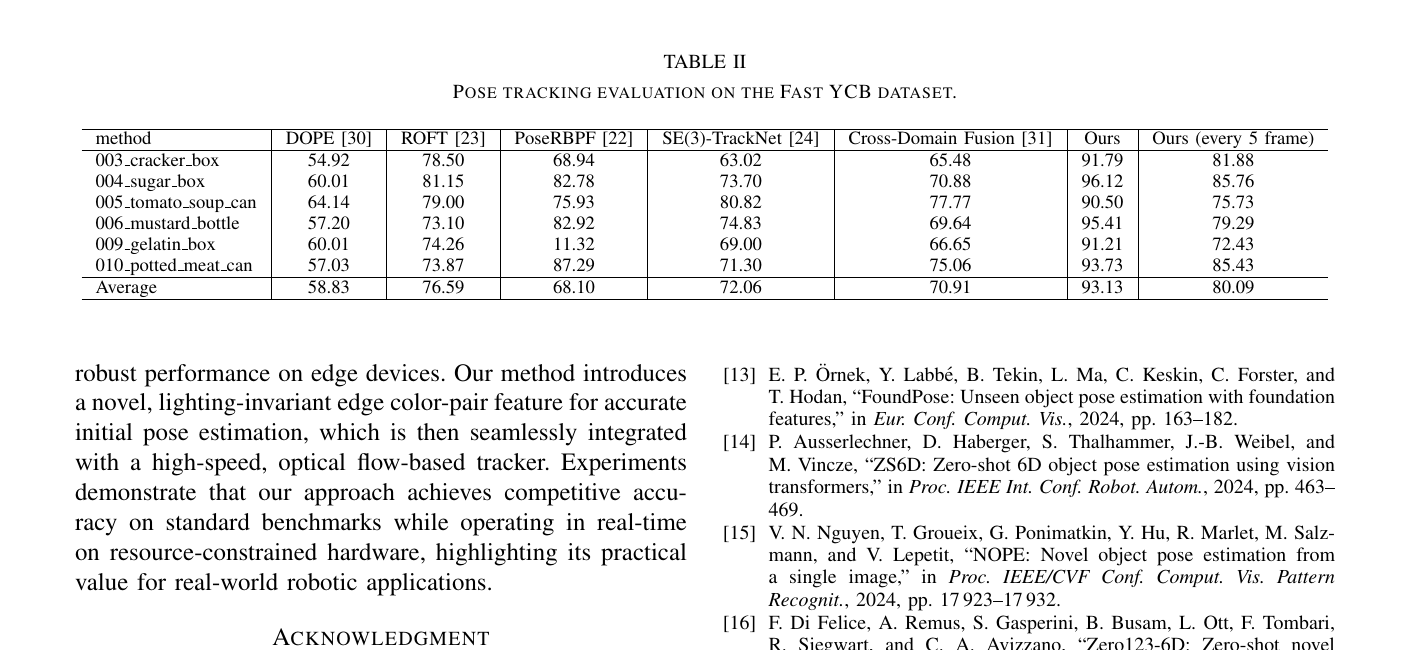
Six-object Fast-YCB tracking: mean ADD is 93.13, exceeding DOPE 58.83, ROFT 76.59, PoseRBPF 68.10, and SE(3)-TrackNet 72.06; updating only every 5 frames reduces it to 80.09.
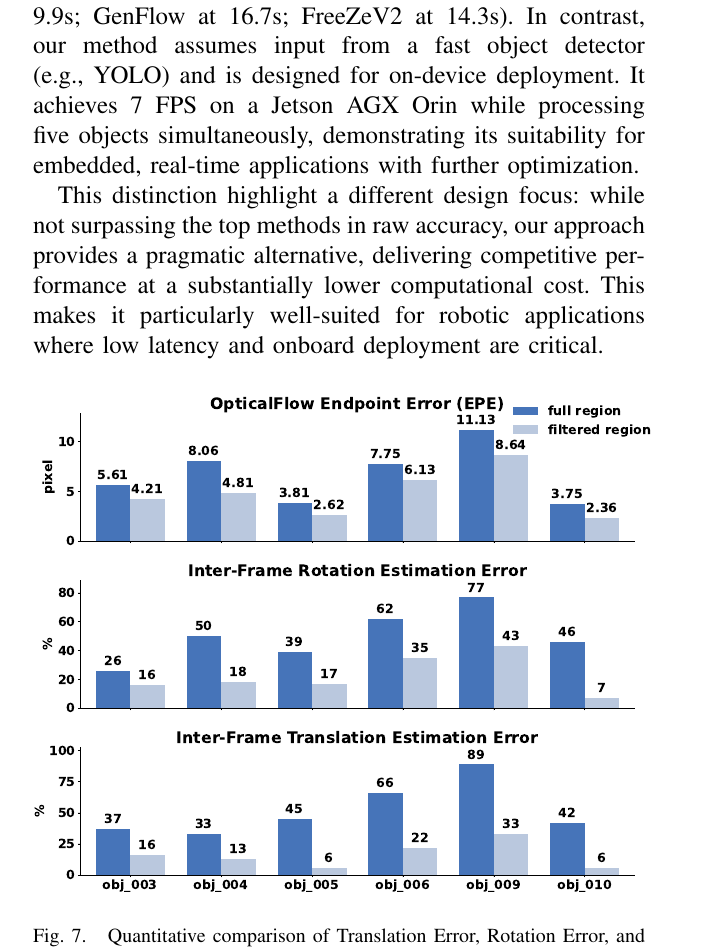
Color-pair filtering reduces optical-flow EPE only moderately, but substantially reduces rotation / translation errors computed from the correspondences. This suggests that it mainly removes a small number of geometrically destructive outliers.
Table II from the paper: frame-by-frame tracking achieves mean ADD 93.13; updates every 5 frames give 80.09, showing that a single-previous-frame baseline remains vulnerable to abrupt pose changes. Source: original paper. Image copyright belongs to the authors; reproduced here for academic commentary.
5. Quick assessment
Strengths: simple, interpretable features with physical motivation for illumination changes and synthetic-to-real transfer; initialization and tracking share a compatible representation.
Boundaries: requires textured CAD, RGB-D, and detection / segmentation. The main pose table deliberately excludes 6 texture-poor objects, so it cannot be presented as a general 21-object YCB-V result.
In engineering terms, this is a tradeoff offering moderate accuracy and strong continuity on edge devices, rather than the highest accuracy on offline benchmarks.
Available src/paper-notes/color-pair-pose-track-icra2026/deep.md
In-depth paper notes
Support reproduction, comparison, related-work writing, and identifying opportunities for further research.
Deep Reading Notes: Color-Pair Guided Robust Zero-Shot 6D Pose Estimation and Tracking
Core question: zero-shot pose initialization often relies on expensive template / foundation-feature search, while continuous tracking uses a separate set of lightweight motion features. Their representations differ, and illumination changes affect both initialization and optical flow. Can one inexpensive cue serve both stages?
Core answer: the relative geometric relationship between colors across a texture edge in CIELAB is more stable than individual RGB values. Color pairs support both CAD–scene classification matching and correspondence filtering between consecutive frames, followed respectively by pose voting / ICP and motion regression.
My assessment: this makes a clear tradeoff among accurate initialization, fast tracking, and Jetson deployment. Its strongest experimental evidence comes from continuous Fast-YCB tracking and filtering ablations; initial-pose results are constrained by a protocol with only 15 textured objects and perturbed ground-truth boxes. They do not displace FoundationPose on accuracy.
2. Positioning in one sentence
A dual-rate system connected by the same illumination-invariant edge descriptor: low-frequency global color-pair geometric voting finds absolute pose, while high-frequency color-pair-filtered optical flow updates relative pose.
2.1 Guide to figures and tables
Figure / table
What to look for
Figure 2
Initialization and tracking share color pairs but use different back-end computation paths.
Figures 3–5
Geometric motivation for pair similarity, thickness-aware sampling, and semantic-triangle voting.
Figure 7
Flow EPE and pose error do not change together: which points are wrong matters more than mean pixel error.
Table I
Only 15 texture-rich YCB-V objects; do not mix these means with the 21-object protocol.
Table II
Frame-by-frame and every-5-frame Fast-YCB tracking expose sensitivity to the temporal baseline.
Figure 2 from the paper: both online RGB-D and offline rendered meshes provide color pairs. Initialization uses classified point clouds, voting, and ICP; tracking uses optical flow, a relative-motion network, and ICP. Source: original paper. Image copyright belongs to the authors; reproduced here for academic commentary.
3. Task and Dependencies
Inputs are RGB-D frames / video, a textured mesh of the test object, camera intrinsics, and object detection and segmentation results. No object-specific pose-network training is required, hence “zero-shot”; offline preparation still includes:
Rendering multiple reference views from the mesh;
Extracting and storing a point cloud classified by color pairs;
Building a semantic-triangle geometric hash and PPF templates;
Training a relative-rotation network across random geometries for the tracker.
This suits industrial / household settings where CAD is available for a new object and continuous edge-device tracking is desired without retraining; it does not provide model-free onboarding.
4. ColorPair Representation
4.1 Why Use Both Sides of an Edge Instead of Absolute Colors?
A texture edge is formed by neighboring surface colors C1,C2. Global illumination changes both luminances, but their chromatic directions, internal contrast, and relative luminance often remain more stable than RGB values. In CIELAB, the authors treat the origin O and C1,C2 as a triangle and multiply three scores when comparing color pairs:
Directional alignment of OC1,OC2, downweighting L* and emphasizing a*/b* chromaticity;
Internal contrast direction of edge vector C1C2;
Relative luminance ratio between the endpoints.
Because sampling order across an edge may reverse, the query is compared with both (C1,C2) and (C2,C1); taking the maximum gives order invariance.
4.2 Thickness-Aware Sampling
Bilateral and joint bilateral filtering first suppress chromatic noise, then gradient magnitudes are aggregated across the three Lab channels. Non-maximum suppression identifies a 1-pixel centerline and counts how many gradient pixels converge on the ridge to estimate edge thickness.
Sampling distance adapts to thickness, with multiple candidates on each side. After whitening the local Lab distribution, gating along the color-transition axis removes outliers, and the remaining samples are aggregated by their median. This addresses two common problems:
A fixed 1-pixel offset lands in the transition band of thick / blurred edges.
Single-point sampling is too sensitive to noise and subpixel localization.
5. Initial Pose: From Color Classification to SE(3) Voting
High-confidence color-pair matches are split into representative endpoint colors, giving each scene depth point a semantic class and weight. The same procedure creates a classified point cloud from the offline mesh.
Instead of exhaustively searching high-dimensional SE(3), the authors form semantic triangles spanning three different color classes. Offline selection favors:
Large-area, numerically stable triangles;
Triangles with centroids far from the object center and strong global discriminability.
Each triangle is encoded as a 7D pose-invariant hash key mapping to three model-point coordinates. Online lookup followed by Kabsch alignment produces pose hypotheses. One-to-many matches use center-aligned equidistant sampling so that a single scene feature does not contribute too many biased votes. Coarse-to-fine Hough voting + NMS finds dense clusters in SE(3), followed by weighted averaging of poses within each cluster.
With fewer than 3 visible classes, no semantic triangle can be formed, so the system falls back on PPF templates. This fallback shows that color-pair classification still needs sufficiently rich, visible texture edges.
The initial estimate then enters multi-resolution weighted ICP, jointly optimizing each semantic class’s local cloud and the global cloud aggregated across classes. Local constraints preserve part details, while global constraints prevent occlusion or noise in a few classes from pulling the whole alignment off target.
6. Continuous Tracking
A pretrained optical-flow model first establishes 2D correspondences between consecutive frames. After propagating the object mask, color-pair consistency removes flows incompatible with surface color relationships. Depth from both frames lifts the points into two 3D clouds.
6.1 Perspective normalization
Directly regressing motion from camera-frame point clouds may encourage the network to memorize absolute viewpoints. For each point set, the authors:
Subtract centroid test.
Set the new z′ axis to the camera-to-centroid direction.
Cross a fixed up vector with z′ to obtain x′, then obtain y′.
Concatenate 3D coordinates, 2D projections, and 3D / 2D flow into a 15D correspondence feature.
This separates absolute translation / viewing direction from rotation learning. Attention-DGCNN is trained on procedurally generated, unlimited random 3D shape / motion pairs to reduce object-specific overfitting. The network predicts relative rotation, then solves translation using the point clouds, followed by a fixed small number of point-to-plane ICP iterations to correct drift.
7. Initial-Pose Results
Table I from the paper: only 15 texture-rich YCB-V objects are retained; the front end uses ground-truth boxes perturbed by up to 10% + NanoSAM. Source: original paper. Image copyright belongs to the authors; reproduced here for academic commentary.
Mean results:
Method
ADD
ADD-S
FoundationPose
65.4
86.6
FreeZeV2
69.8
86.3
GenFlow
56.9
75.6
GigaPose
62.2
80.0
SAM-6D
63.0
80.6
ZeroPose
41.3
76.4
Ours
60.9
78.6
This is not the most accurate method: ADD is 4.5 below FoundationPose and 8.9 below FreeZeV2, with lower ADD-S as well. Its strength is resource usage: the authors report approximately 7 FPS for 5 simultaneous objects on Jetson AGX Orin, whereas comparisons often use A100 / V100 GPUs and take seconds when segmentation is included.
The speed comparison nevertheless lacks a strictly unified protocol: baseline runtimes are taken from public reports with different front ends and GPUs. This site treats them as evidence of deployment priorities, without claiming a same-hardware speedup factor.
Moreover, prompting NanoSAM with ground-truth boxes randomly perturbed by only 10% is more favorable than fully realistic detector failures, and 6 texture-poor objects are excluded. These averages therefore cannot be mixed directly with standard 21-object YCB-V BOP scores.
8. Correspondence-Filtering Ablation
Figure 7 from the paper: lighter colors indicate color-pair-filtered regions. EPE falls relatively modestly, while rotation / translation errors fall substantially, suggesting that filtering mainly removes high-leverage incorrect correspondences. Source: original paper. Image copyright belongs to the authors; reproduced here for academic commentary.
Across six Fast-YCB objects, filtering reduces EPE, for example, from 5.61 to 4.21 on obj_003 and from 11.13 to 8.64 on obj_009; these gains are not dramatic. However, feeding predicted flow into the pose solver yields much larger reductions in rotation / translation errors normalized by ground-truth motion magnitude.
Mean EPE weights all pixels equally, whereas pose correspondences have different geometric leverage. A few flow errors at object boundaries, abnormal depths, or incorrect background regions can severely corrupt the rigid transform. Color pairs can improve pose by removing these systematic outliers without making every flow vector more accurate.
9. Main Tracking Results
Table II from the paper: all trackers receive the DOPE pose from the first sequence frame. The frame-by-frame version averages 93.13, falling to 80.09 when input is supplied / updated only every 5 frames. Source: original paper. Image copyright belongs to the authors; reproduced here for academic commentary.
Mean ADD:
DOPE 58.83
ROFT 76.59
PoseRBPF 68.10
SE(3)-TrackNet 72.06
Cross-Domain Fusion 70.91
Ours 93.13
Ours every 5 frame 80.09
Per-object scores are consistently within 90.50–96.12, but fall to 72.43–85.76 with updates every 5 frames. The authors combine a 30 Hz RGB-D main stream with a delayed, asynchronous 5 Hz detection stream to simulate sudden displacement. This drop shows reliance on adjacent-frame optical flow and a single-previous-frame baseline; large jumps still need reinitialization or multi-keyframe memory.
TensorRT tracking exceeds 20 FPS on Jetson AGX Xavier, while initialization runs at approximately 7 FPS / 5 objects on Orin. A LoCoBot + RealSense D435 proof of concept shows alignment despite slight physical-object / mesh texture discrepancies, but does not constitute a statistical real-robot benchmark.
10. Authors’ claims and my assessment
Authors’ claims
My assessment
Color pairs are robust to illumination / sim-to-real changes
Supported by visualizations and tracking-filter ablations; YCB-V is not separately grouped by illumination intensity.
Unified pose initialization and tracking
True at the shared-descriptor level; the back ends remain separate voting / ICP and learned-motion pipelines.
Suitable for edge devices
Direct evidence includes 7 FPS initialization and 20+ FPS tracking on Jetson; front-end detector / mask accounting must also be reported.
Competitive pose accuracy
Competitive but below the state of the art; main-table means are clearly below FoundationPose / FreeZeV2.
11. Reproduction Checklist and Limitations
Reproduce CIELAB conversion, L* weighting, edge thickness, and whitening / gating thresholds; together they determine class stability.
Color calibration between offline renders and the online camera still matters. Relative colors reduce sensor-response differences but cannot eliminate them.
Rerun Table I with real detector boxes and report failure modes for the 6 excluded YCB objects.
Report the retained proportion, spatial distribution, and rigid inlier rate after flow filtering, alongside EPE.
Fast motion, severe occlusion, and sparse texture need multiple keyframes / global relocalization; the current tracker relies mainly on the previous frame.
The official repository provides some training / inference code and color-pair tools, but its README still says more code will follow. Open source does not imply complete one-command reproduction.
This work is useful as a system-design reference: initial localization and tracking may have different computational budgets, yet benefit from a shared, interpretable, consistent logic for filtering observations across stages. Color pairs do not achieve the highest absolute accuracy, but connect physical features, geometric voting, and edge-computing constraints into a coherent system.