ContactArt: Learning 3D Interaction Priors for Category-level Articulated Object and Hand Poses Estimation
ContactArt learns a part-arrangement discriminator and contact diffusion prior from simulated human teleoperation data, then uses both to constrain category-level articulated-object and hand poses in real images.
articulated object part modelsinitial hand and object estimatorscategory labeltest-time contact / articulation optimization
Reading Notes
Overview / Deep Dive
Available src/paper-notes/contactart-3dv2024/coarse.md
Paper overview notes
Quickly assess the paper's scope, problem setting, core method, experimental findings, and whether to read it in depth.
ContactArt: Coarse Reading
One-sentence conclusion
ContactArt collects hand–articulated-object interactions inexpensively through phone-driven simulation teleoperation. It distills readily available simulated part arrangements and contact regions into 3D priors, constraining articulated-object pose and hand pose in real images, respectively.
Data and Method
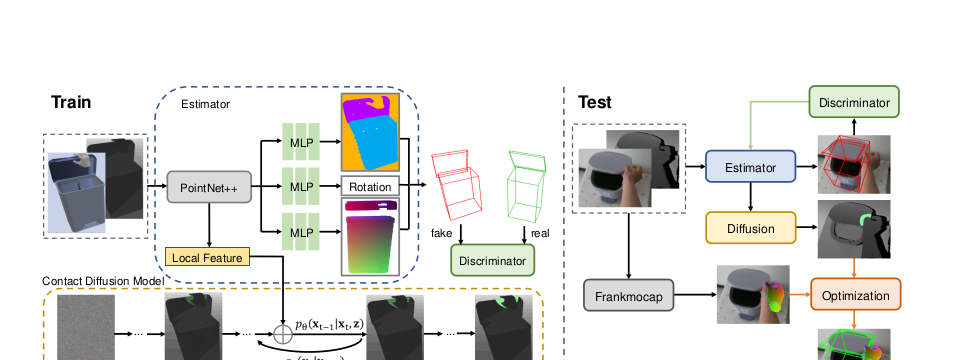
A user moves a hand in front of an iPhone; the system maps the motion to a MANO hand that operates articulated objects such as laptops, trash cans, safes, and cabinets in a physics simulator. Part poses and contact points are directly available from simulation. During training and testing:
An articulation discriminator assesses whether predicted part arrangements resemble the real interaction distribution.
A conditional diffusion model generates contact regions on the object surface.
At test time, a structural prior optimizes part poses, while a contact prior optimizes hand pose.
The appearance sim-to-real gap is not directly eliminated; the paper instead transfers more stable 3D structure and contact relationships. Source: Figure 3 from the paper. Copyright belongs to the original authors and the 3DV 2024 publisher; reproduced here for academic commentary.
Results
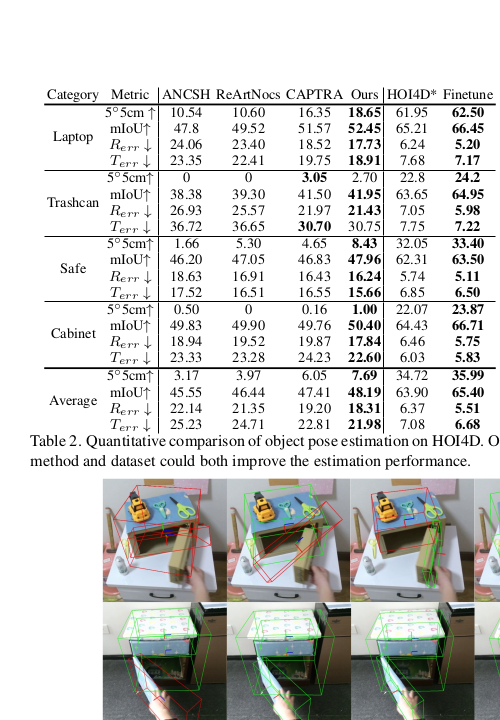
Across four HOI4D categories, mean 5°5cm rises from CAPTRA’s 6.05 to 7.69 for ContactArt-only and 35.99 after HOI4D warm-start / fine-tuning. Results are 4.70 for BMVC laptop and 57.66 for RBO microwave. Contact diffusion also reduces hand-pose MPJPE and contact error.
Absolute ContactArt-only 5°5cm remains low; the largest gains come from synthetic pretraining followed by fine-tuning on limited real data. Sources: Table 2 and Figure 4 from the paper. Copyright belongs to the original authors and the 3DV 2024 publisher; reproduced here for academic commentary.
Boundaries
This studies category-level articulated hand–object pose rather than a single-rigid-object 6D benchmark. It requires object categories, part models / canonical spaces, and an initial estimator. Contact priors improve optimization but do not replace front-end detection or geometric initialization.
Available src/paper-notes/contactart-3dv2024/deep.md
In-depth paper notes
Support reproduction, comparison, related-work writing, and identifying opportunities for further research.
ContactArt: Deep Reading
1. Why Learn Relationships Rather Than Pixels in Simulation?
Precise part poses are difficult to annotate in real hand–object data, and contact points are even harder to infer from RGB. Simulation provides these labels freely, but rendered appearance differs substantially from real images. ContactArt transfers only contact and articulation structure instead of generating photorealistic images. Within a category, plausible relative poses of drawers / lids / doors and the surface regions commonly touched by hands are closer to domain-invariant 3D knowledge.
2. ContactArt Data Collection
Visual teleoperation captures a user’s hand gestures with one iPhone and maps them to a MANO hand in a physics simulator. Guided by screen feedback, the user directly operates various articulated instances. Each frame records hand pose, rigid-part poses, joint states, and contact points. Compared with scripted random sampling, human operation naturally produces task-relevant contacts and joint ranges.
3. Two Interaction Priors
3.1 Articulation prior
A category-level estimator first predicts each part’s NOCS / rotation / translation. A discriminator learns whether the parts form a plausible category structure, using ground-truth ContactArt part arrangements as positive examples and estimator outputs as negatives. At test time, its energy enters pose optimization to suppress abnormal part relationships caused by image occlusion.
3.2 Contact diffusion prior
A conditional diffusion model generates likely contact regions on the object surface. Given initial hand / object poses, optimization moves the hand toward high-probability contacts while avoiding interpenetration. It provides 3D geometric constraints for an existing hand estimator, rather than predicting a hand mesh directly from RGB.
Training separately learns an articulation discriminator and contact diffusion; at test time, both enter existing estimators as optimization priors. Source: Figure 3 from the paper. Copyright belongs to the original authors and the 3DV 2024 publisher; reproduced here for academic commentary.
Direct cross-domain transfer of the priors is therefore supported, but the gains are limited. Their most persuasive use is synthetic pretraining / warm starts that make real-data fine-tuning more effective, rather than fully replacing real data.
Columns correspond to ContactArt-only, real data, and fine-tuning; red boxes indicate errors above 10°/10cm. Sources: Table 2 and Figure 4 from the paper. Copyright belongs to the original authors and the 3DV 2024 publisher; reproduced here for academic commentary.
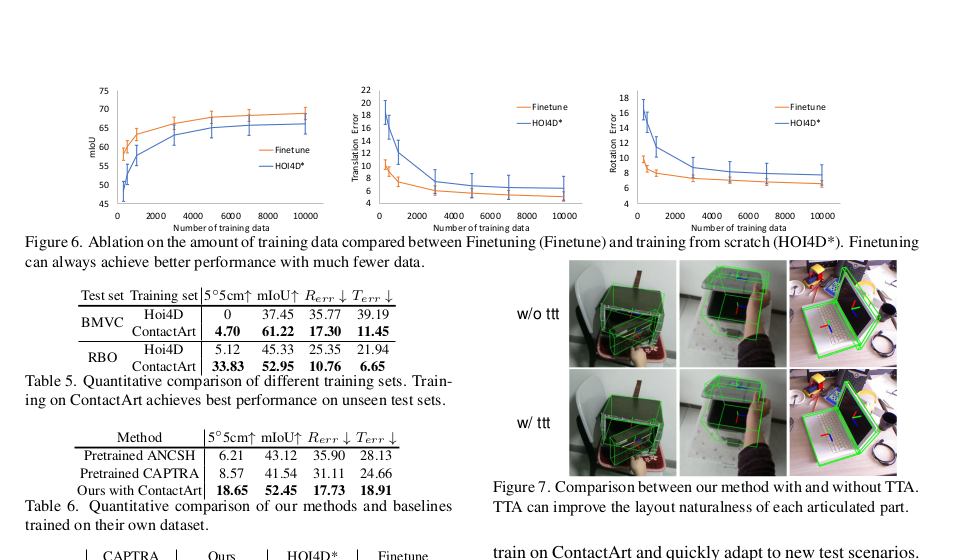
ContactArt also exceeds ANCSH, ReArtNOCS, and CAPTRA on most BMVC / RBO categories, but drawer 5°5cm falls from CAPTRA’s 33.79 to 28.23. The prior therefore does not guarantee improvement for every category / metric.
For hand pose, ablations show that gains saturate with contact-diffusion training epochs. Compared with simple nearest-point contacts or direct contact regression, a generative distribution better covers multiple plausible contacts.
Curves show generation quality converging during training; qualitative results compare predictions with and without test-time contact optimization. Sources: Figures 6–7 and Tables 5–7 from the paper. Copyright belongs to the original authors and the 3DV 2024 publisher; reproduced here for academic commentary.
5. Limitations
Depends on known articulated categories, part templates / canonical coordinates, and an initial pose estimator.
Simulator friction, hand shapes, and interaction-task coverage determine how far the priors extrapolate.
After learning common poses, a discriminator may suppress rare but physically valid joint states.
Contact priors can correct local hand–object relationships but struggle to recover from severely incorrect object initialization.
Part definitions, scales, and metrics differ across datasets, preventing direct averages across tables.
6. My Assessment
ContactArt contributes a data strategy: when real labels are expensive and pixel-level transfer is difficult, collect human-driven geometric relationships in controlled simulation and use them as test-time priors. For robot interaction data, hand–object reconstruction, and articulated pose, this can be more practical than pursuing fully photorealistic simulation.