Deep Learning-Based Object Pose Estimation: A Comprehensive Survey
A systematic review of instance-level, category-level, and novel-object pose estimation. Its evaluation section separates 3-DoF, 6-DoF, 9-DoF, and shape reconstruction, covering geodesic errors, BOP, ADD(-S), 2D projection, 3D IoU, and Chamfer distance.
A broad survey spanning instance-level, category-level, and novel-object pose estimation. Its most direct value to this site is separating evaluation into 3DoF, 6DoF, 9DoF, and shape-reconstruction levels, avoiding conflation of ADD, BOP AR, and 3D IoU as interchangeable scores.
2.1 Guide to the paper’s figures and tables
Figure / page
Recommended focus
Relevance to this site
Page 5, Section 2.4
Formulas and boundaries for 3DoF, 6DoF, 9DoF, and other metrics
Initial organization of the metric knowledge base
Tables 1–3
Common benchmarks / reported metrics for instance-level, category-level, and novel-object methods
Cross-checking checklist when adding paper metadata
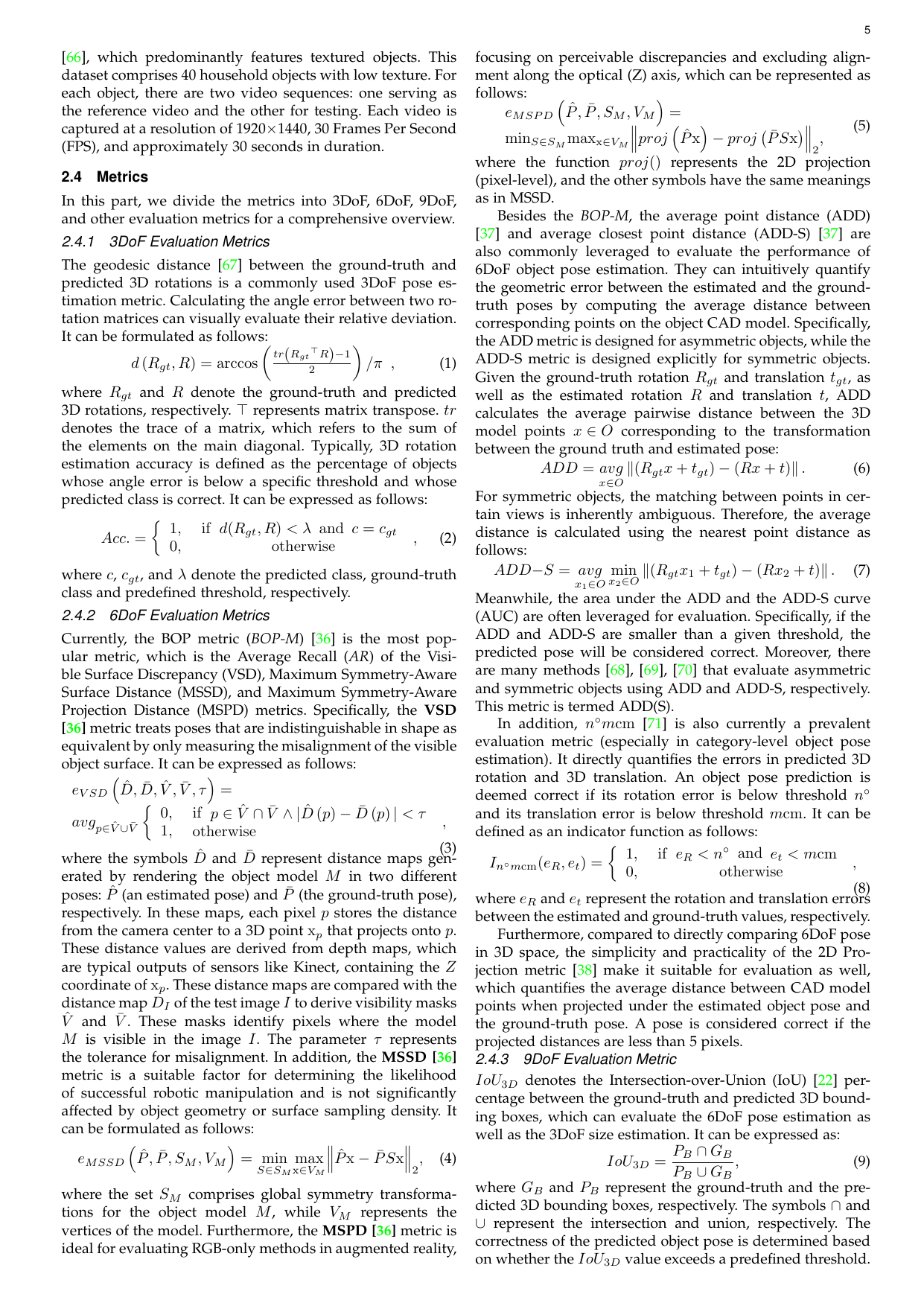
Page 5, Section 2.4 of the paper: evaluation is divided into 3DoF, 6DoF, 9DoF, and other metrics, with definitions of BOP, ADD / ADD-S, n° mcm, 2D Projection, and 3D IoU. Source: open author-manuscript PDF. Image copyright belongs to the authors and publisher; reproduced here for paper commentary.
3. Problem setting
Tasks covered: instance-level, category-level, and unseen-instance / unseen-category object-pose estimation.
Inputs covered: RGB, RGB-D, point clouds, single / multiple views, reference videos, CAD models, and others.
Outputs covered: 3DoF rotation, 6DoF rigid pose, and 9DoF pose including object dimensions.
Applications: robot manipulation, AR, industrial inspection, grasping, scene understanding, and object onboarding.
4. Core motivation
Existing surveys often cover only one task level or input modality, making it difficult to understand why a method appears stronger on a particular benchmark.
Metrics are often abbreviated as ADD(-S), AR, AUC, or 5°5cm. Numbers can be misread without recovering their error functions, thresholds, and aggregation protocols.
The authors bring datasets, training paradigms, inference modes, applications, metrics, and benchmarks into one framework for choosing methods under practical constraints.
Are full pose, symmetry, occlusion, and image displacement handled correctly?
9DoF
3D IoU
Do pose and size produce consistent occupied volumes?
Shape
Chamfer Distance
Is predicted / reconstructed shape close to ground truth?
6. How to Read the Evidence and Conclusions
This is a survey rather than an experimental paper proposing a new model; its main contribution is unified categorization and comparisons of representative methods / benchmarks.
The most actionable lesson for this site is that metric names need protocol context. ADD-AUC needs an integration limit; 5°5cm needs units and a task; BOP AR must distinguish AR_VSD, AR_MSSD, AR_MSPD, AR_D / AR_C.
Grouping BOP-M, ADD/ADD-S, n° mcm, 2D Projection, 3D IoU, and CD in one section shows that these serve different task outputs and error spaces, rather than forming mutually exclusive leaderboard scores.
7. Strengths and limitations
Strengths
Covers three major pose formulations and incorporates benchmarks / evaluation into method selection.
Concentrated metric formulas support canonical names, aliases, and reverse lookup within the site.
BOP challenges evolve: for example, the 6D detection protocol discussed here uses AP, rather than directly extending earlier localization AR. Official task pages remain authoritative.
Survey task tables cannot replace each paper’s exact splits, thresholds, object sets, and runtime settings.
Shape, size, and symmetry definitions differ in category-level and novel-object tasks, preventing a universal ranking across settings.
8. Implications for This Site
Organize metric pages as error function → threshold / success rule → aggregate score.
Store both original metric wording and canonical metric IDs in paper metadata for reliable reverse lookup.
Explain localization AR and detection AP separately on BOP pages; label ADD(S) as a reporting protocol rather than an independent error function.
Worth deep reading: yes, particularly as an entry point to datasets and evaluation.
Available src/paper-notes/deep-learning-object-pose-survey/deep.md
In-depth paper notes
Support reproduction, comparison, related-work writing, and identifying opportunities for further research.
Deep Reading Notes: Deep Learning-Based Object Pose Estimation: A Comprehensive Survey
1. Basic information
Title: Deep Learning-Based Object Pose Estimation: A Comprehensive Survey
The survey organizes deep-learning pose estimation in a two-dimensional cross-classification of task formulations against input modalities, training paradigms, inference modes, and benchmarks / metrics. For this site, its evaluation chapter provides the most valuable hierarchy, from rotation angles to BOP AR and from 9DoF IoU to shape CD.
2.1 Guide to the paper’s figures and tables
Figure / page
What to read
Destination in the metric library
Page 5, Section 2.4
Formulas (1)–(10) and the 3DoF / 6DoF / 9DoF classification
Rotation Error, ADD, ADD-S, BOP, 3D IoU, and CD detail pages
Table 1
Instance-level ADD(S)-0.1d and ADD-S AUC
Distinguish error functions from success / AUC reporting protocols
Category-level method tables
5°5cm and 3D IoU
Threshold and box metrics for category-level 9DoF
Novel-object method tables
Mixed reporting of BOP AR, ADD(-S), and others
Metric aliases and paper reverse-lookup rules
Evaluation chapter on page 5: the left column gives 3DoF rotation error, VSD, and MSSD; the right gives MSPD, ADD / ADD-S, n° mcm, 2D Projection, and 3D IoU. Source: open author-manuscript PDF. Image copyright belongs to the authors and publisher; reproduced here for paper commentary.
3. Problem setting and task boundaries
Task: recover object rotation and translation from images, depth, point clouds, reference observations, or object models, with size / shape when required.
formulation:
Instance-level: training / test object instances are usually known, often with CAD models.
Category-level: test objects may be unseen instances within known categories, requiring shape / size variation handling.
Novel-object: instances or categories are unseen during training, relying on reference images, CAD, video onboarding, or generalizable representations.
Key boundary: shape-reconstruction CD is auxiliary evaluation and cannot replace pose accuracy.
4. Research context
Rather than classifying only by architecture, the survey includes segmentation, correspondence, template matching, voting, pose solving / regression, and refinement as inference modes.
This explains why two papers both labeled 6D pose may be incomparable: depth, CAD, seen-object status, supplied masks / detectors, and metrics all change task difficulty.
This site’s dataset and evaluation pages should present dataset constraints beside metric protocols, rather than only providing an overall leaderboard.
5. Research motivation
The authors attribute pose-estimation difficulty both to occlusion, texturelessness, transparency / reflection, and domain gaps, and to task-dependent definitions of correct pose.
The same prediction has different risks for grasping, AR overlays, and category-level size estimation: some tasks need strict 3D surface alignment, while others emphasize 2D projection or visible surfaces.
Evaluation therefore receives its own chapter rather than an appendix to dataset descriptions.
This chain is the most important checklist when reading results. Listing ADD-AUC, BOP AR, and 5°5cm alongside ADD / VSD conflates error measurement with scoring.
6.2 3DoF: Geodesic rotation error
The survey measures orientation differences through the geodesic distance between two rotation matrices:
eR=arccos(2tr(RgtTR^)−1).
Authors’ statement / fact: a common 3DoF pose metric, combinable with classification correctness and angular thresholds to obtain accuracy.
My analysis: it needs no CAD and suits category-level tasks, but equivalent rotations of symmetric objects will be penalized unless minimized over the symmetry group first.
6.3 6DoF: BOP, ADD, Thresholds, and Image Projection
Level
Metric
What it measures
Common misreading
Visible surface
VSD
Compares observable surfaces using rendered depth, observed depth, and visibility masks
Treating it as complete-mesh alignment
Worst-case 3D
MSSD
Maximum vertex displacement after minimizing over the global symmetry set
Treating it as an averaged ADD variant
Perceptual projection
MSPD
Maximum pixel-projection displacement after minimizing over symmetries
Assuming small pixel errors guarantee correct 3D position
Mean model distance
ADD
Mean 3D distance of corresponding CAD points
Assuming it remains fair for symmetric objects
Closest-point distance
ADD-S
Mean nearest-neighbor distance from ground-truth points to the predicted point set
Assuming every texture-defined orientation may be ignored
Joint success
n° mcm
Whether both rotation and translation fall below thresholds
Omitting thresholds or units
Image projection
2D Projection
Mean pixel displacement of corresponding CAD points
Directly comparing 5px across resolutions
6.4 BOP AR and the Updated Detection AP Protocol
The survey describes BOP-M as Average Recall aggregated over VSD, MSSD, and MSPD. The official BOP localization definition can be written as:
ARD=3ARVSD+ARMSSD+ARMSPD.
Each ARe averages recall across multiple correctness thresholds; VSD additionally involves multiple misalignment tolerances τ.
AR therefore needs a subscript or task scope: AR_VSD, AR_D, and AR_C mean different things.
Protocol update included in these notes: BOP 2024 6D detection uses precision–recall / AP based on MSSD and MSPD, omitting VSD from detection scoring. An older BOP AR summary should not obscure this update.
6.5 9DoF and Shape Metrics
3D IoU: intersection over union of predicted / ground-truth 3D boxes, jointly measuring translation, rotation, and size. Suitable for tasks such as NOCS that predict category-level dimensions.
Chamfer Distance: bidirectional nearest-neighbor distances from predicted points to ground truth and vice versa. It evaluates shape reconstruction without guaranteeing pose accuracy.
Category-level tables commonly report CAMERA25 / REAL275 5°5cm and 3D IoU because tasks also include size / shape variation.
BOP tables must identify the task: known-object localization often reports AR; novel-object and 6D detection protocols also require onboarding conditions and AP context.
Surface topology, semantic parts, actual task benefit
7.3 Are Contributions Supported by Evidence?
Claimed contribution
Supporting material
My assessment
Covers three major pose formulations
Method-review sections and representative-method tables
Broad coverage, useful as a field map
Comprehensive metric / benchmark reference
Section 2.4 and task tables
Valuable metric taxonomy, but exact thresholds still require original benchmarks
Helps select appropriate methods
Cross-classification of inputs, training, inference, and applications
Helps rule out unfair comparisons; does not replace application evaluation
8. Critical analysis
Strengths
Handles differences in problem settings and evaluation together, going beyond a collection of architecture terms.
Unified metric notation and formulas support rapid learning and cross-linking on this site.
Category-level and unseen-object coverage broadens a perspective otherwise limited to CAD-known instance-level tasks.
Weaknesses
A survey cannot replace annually updated BOP task configurations and toolkit documentation.
Statements about what is current depend on the paper version; this site should use official BOP pages for protocols and the survey for taxonomy.
Practical measures such as speed, memory, robustness, and grasp success are not core pose errors but determine usability. Report them separately on paper pages rather than forcing them into pose accuracy.
Implicit Assumptions
CAD or comparable shape representations are available; fully open scenes without models change the applicability of ADD / BOP.
Benchmark object symmetries, camera intrinsics, and ground truth are trustworthy.
Input modalities, front-end detectors / masks, and runtime measurements can be aligned across papers; this is often only partially true.
9. Implementation on This Site
Connect papers to metric detail pages through canonical metricId, preserving original metrics strings.
Metric detail pages need a quick summary, formulas, computation steps, strengths, interpretation boundaries, sources, and related papers.
Use a layered catalog: 3DoF components; model points / projection; BOP errors and aggregates; 9DoF / shape.
Explain BOP relationships in both directions: VSD / MSSD / MSPD are errors, AR aggregates localization, and AP aggregates detection.
10. Open questions
When adding each paper, check its AUC limit, ADD(S) symmetry split, and exact data split.
BOP-toolkit thresholds, dataset cores, and tasks may vary by year; detail pages should keep protocol versions explicit.
For texture-defined symmetry, whether ADD-S / geometric symmetry matches actual application needs remains a dataset- and task-specific question.