Distilling 3D Distinctive Local Descriptors for 6D Pose Estimation
dGeDi distills FreeZe's pointwise, local-reference-frame-dependent GeDi descriptors into PTV3. Ground-truth poses transfer CAD query teacher features to noisy partial targets, and a piecewise loss prioritizing low errors suppresses less salient teacher points. Geometry-feature extraction drops from 3.284 s to 0.019 s while average pose AR on five BOP datasets is maintained or slightly improved.
dGeDi distills FreeZe’s slow GeDi 3D local descriptors into a PointTransformerV3 student. Only CAD-query teacher features are cached, then transferred to partial target points using training ground-truth poses. A piecewise loss downweights high-error / non-distinctive points, reducing mean geometric-feature extraction time from 3.284 s to 0.019 s while maintaining or slightly improving BOP pose AR.
3. Guide to figures and tables
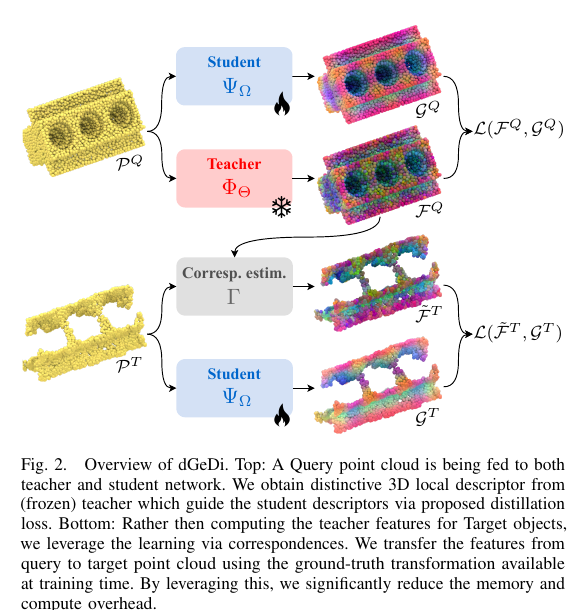
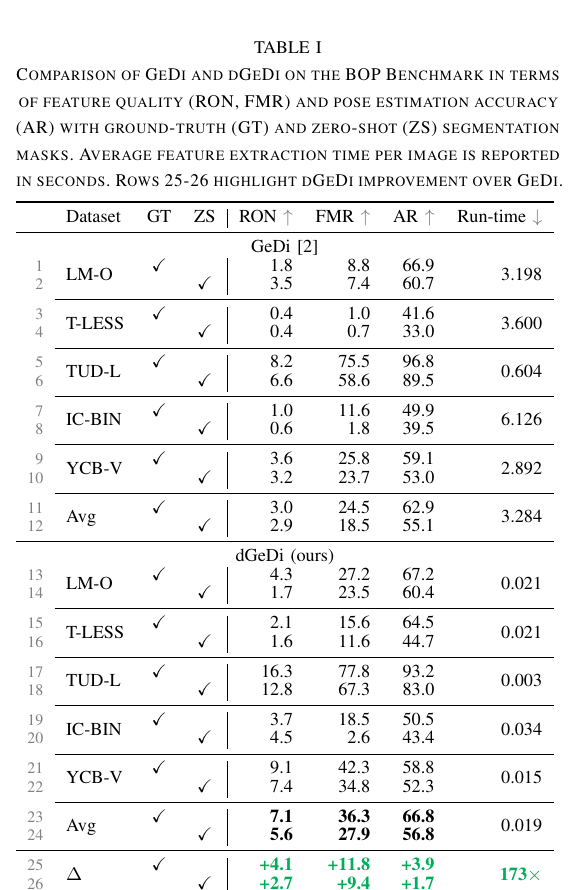
Figure 2 from the paper: CAD queries enter both the frozen GeDi teacher and PTV3 student. The target branch transfers query teacher descriptors through ground-truth correspondences instead of recomputing teacher features. Source: public author manuscript. Image copyright belongs to the authors and IEEE; reproduced here for paper commentary.Table I and Figure 3 from the paper: with ground-truth masks, dGeDi averages RON / FMR / AR of 7.1 / 36.3 / 66.8 and 0.019 s geometric-feature extraction, versus teacher values of 3.0 / 24.5 / 62.9 and 3.284 s. Source: public author manuscript. Figure / table copyright belongs to the authors and IEEE; reproduced here for paper commentary.
4. Problem setting
Input: RGB-D scenes, target CAD, and ground-truth or SAM-6D object masks.
Output: 32D local geometric descriptors for CAD query points and partial scene target points; FreeZe’s nearest-neighbor, RANSAC, ICP, and symmetry-aware refinement back end recovers 6D pose.
Learning setting: trained on one million MegaPose-ShapeNetCore synthetic images, tested on 5 unseen BOP datasets for zero-shot object pose.
5. Method overview
Freeze GeDi as teacher and distill pointwise 32D descriptors into a PTV3 student.
CAD queries are clean and complete, whereas RGB-D targets are partial and depth-noisy; direct distillation produces many feature outliers.
Align clouds using training ground-truth TQ→T, establish geometric nearest neighbors Γ, and transfer query teacher features to targets as ideal supervision.
Cache teacher features for only 850 query objects rather than approximately 16M targets, reducing estimated storage from 14 TB to 34 GB.
Use a custom piecewise loss: steep quadratic regression at low errors and nearly flat linear behavior at high errors, preventing ambiguous teacher points from dominating training.
Add rotation, jitter, and point dropout to improve occlusion / partial-observation generalization.
6. Experiments at a glance
Ground-truth masks: GeDi→dGeDi mean RON 3.0→7.1, FMR 24.5→36.3, and BOP AR 62.9→66.8.
SAM-6D masks: RON 2.9→5.6, FMR 18.5→27.9, AR 55.1→56.8.
Mean geometric-feature time falls 3.284→0.019 s, a table-reported 173× speedup; the main text summarizes it as approximately 170×.
Full FreeZe + SAM-6D: AR changes 71.5→70.4 while end-to-end runtime falls 13.7→8.5 s. With ground-truth masks, both obtain 79.6 AR and runtime falls 8.7→6.0 s.
7. Quick assessment
Strengths: quantifies speed, GPU memory, storage, feature quality, and final pose; targeted distillation-loss and target-supervision ablations.
Limitations: accelerates only the geometric encoder, leaving registration as a bottleneck; training uses ground-truth masks / poses; SAM-6D mask domain shifts slightly reduce full-system AR.
Intended readers: those working on zero-shot 6D pose, 3D local descriptors, knowledge distillation, and FreeZe / BOP pipelines.
Available src/paper-notes/dgedi-iros2025/deep.md
In-depth paper notes
Support reproduction, comparison, related-work writing, and identifying opportunities for further research.
Deep Reading Notes: dGeDi
1. Key assessment
dGeDi starts from a specific bottleneck: FreeZe’s GeDi geometric encoder is effective for zero-shot pose but builds a local reference frame for each query point and encodes neighborhoods individually, costing seconds per image. Rather than redesigning the pose estimator, the authors freeze GeDi as a teacher and distill its local descriptors into a PointTransformerV3 student that processes the full cloud in parallel.
The real challenge is that teacher descriptors are not reliable everywhere. On MegaPose-GSO, only approximately 21.4% of target points match in teacher-feature space; mean BOP ratio-of-nearest points is approximately 3%. Equal-weight MSE lets poorly discriminative teacher points dominate gradients. The paper combines geometric-correspondence target supervision with a low-error-prioritizing loss.
2. Where dGeDi Replaces GeDi in FreeZe
FreeZe takes RGB-D image I and object CAD O:
SAM-6D segments the target crop.
Depth + intrinsics lift the crop into partial target cloud PT.
CAD-surface sampling produces query cloud PQ.
Geometric and visual encoders extract and concatenate features.
RANSAC / SVD estimates a rigid transform, followed by ICP refinement.
SAR performs symmetry-aware refinement.
dGeDi replaces only the GeDi geometric encoder in step 4. Visual foundation features, SAM-6D, RANSAC, ICP, and SAR remain; the 173× figure is not a 173-fold acceleration of the full FreeZe pipeline.
3. Object-oriented distillation
Figure 2 from the paper. The upper branch distills complete CAD queries; the lower branch uses ground-truth pose to establish geometric mapping \(\Gamma\), transferring query teacher features to supervise partial-target student features. Source: public author manuscript. Image copyright belongs to the authors and IEEE; reproduced here for paper commentary.
3.1 Teacher and Student
Teacher ΦΘ: GeDi, a pointwise local encoder with explicit local reference frames for rotation invariance.
Student ΨΩ: PTV3 with voxel / serialized point processing and decoder channels reduced from 64 to 32.
Output: a 32D descriptor per point.
The teacher is frozen; the student trains with AdamW and a cosine scheduler.
Input clouds are randomly sampled to 4,000 points. Targets first undergo statistical outlier removal, then scale normalization by query-object diameter. At 5K evaluation points, dGeDi peak memory is 717 MB.
3.2 Learning via correspondences
Directly computing FQ=Φ(PQ) and FT=Φ(PT) has two problems:
PQ comes from clean CAD, while PT comes from partial noisy depth, creating a teacher-feature domain gap.
Approximately 850 MegaPose query objects correspond to approximately 16M target observations; precomputing / caching all target teacher features would take approximately 14 TB.
Training samples already have ground-truth TQ→T. Transform query points into the target frame, then find nearest query points by Euclidean distance:
Γ(p)=argq∈PQmin∥TQ→Tq−p∥.
Then use F~T=Γ(FQ) to supervise GT=Ψ(PT). The target student learns clean descriptors from corresponding CAD-surface points instead of unreliable teacher outputs on noisy targets. Caching only query teacher features reduces estimated storage from 14 TB→34 GB, approximately 411×.
This assumes aligned ground-truth poses, CAD, depth, and masks. Background or occluder target points would still be forced to take nearest-CAD labels. Training therefore uses ground-truth masks, with a domain gap when SAM-6D masks are deployed.
3.3 Loss Prioritizing Low Errors
Finding that most teacher descriptors lack distinctiveness, the authors propose:
L(F,G)={α∥F−G∥2,β∥F−G∥+γ,∥F−G∥<δotherwise
Here α=8,β=1/5,δ=0.3,γ=8δ2−δ/5. A steep quadratic low-error region encourages precise fitting of reliable features the student can learn; the high-error region approaches a plateau, limiting weights on ambiguous / noisy teacher points.
A tested focal-like variant L~=∥F−G∥ϵL, with ϵ=15, instead emphasizes large errors and performs substantially worse. This supports the authors’ view that not all teacher knowledge deserves copying.
Evaluation: LM-O, T-LESS, TUD-L, IC-BIN, and YCB-V on one NVIDIA A40.
Segmentation: both ground-truth masks and SAM-6D zero-shot masks.
RANSAC: 100K iterations; ICP: 1K iterations;
Descriptors: 32D; GeDi neighborhood radius is 30% of query diameter.
Metrics:
RON: proportion of query points whose feature nearest neighbor falls within a true geometric-distance threshold of 3% of object diameter.
FMR: successful-matching rate when RON exceeds 5%.
BOP AR: pose accuracy after registration.
Runtime: per-image geometric-feature extraction or full-pipeline time; check the relevant table column.
RON / FMR directly evaluate descriptors. AR also depends on RANSAC, ICP, masks, and symmetry refinement, so improved features need not improve AR on every dataset.
5. Direct Teacher–Student Comparison
Table I and Figure 3 from the paper. Table I reports both ground-truth / zero-shot masks, with geometric-feature extraction in the rightmost column; Figure 3 shows smoother student descriptors. Source: public author manuscript. Figure / table copyright belongs to the authors and IEEE; reproduced here for paper commentary.
Mean results:
Mask
Encoder
RON
FMR
BOP AR
Feature time
GT
GeDi
3.0
24.5
62.9
3.284 s
GT
dGeDi
7.1
36.3
66.8
0.019 s
SAM-6D
GeDi
2.9
18.5
55.1
3.284 s
SAM-6D
dGeDi
5.6
27.9
56.8
0.019 s
The table’s 0.019 s versus 3.284 s corresponds to 173×. The main text also describes over 50 FPS, or approximately 260 point clouds/s with approximately 5 target objects per image. Target counts vary across datasets: dGeDi takes 3 ms on TUD-L and 34 ms on IC-BIN.
Points to note:
T-LESS ground-truth-mask AR improves 41.6→64.5, a +22.9 gain. The authors attribute this to sharp industrial geometry benefiting from smooth, discriminative student features.
TUD-L / YCB-V ground-truth-mask AR instead falls from 96.8 / 59.1 to 93.2 / 58.8.
Student superiority therefore holds for average feature metrics, not pose AR on every dataset.
6. Ablations and the Complete System
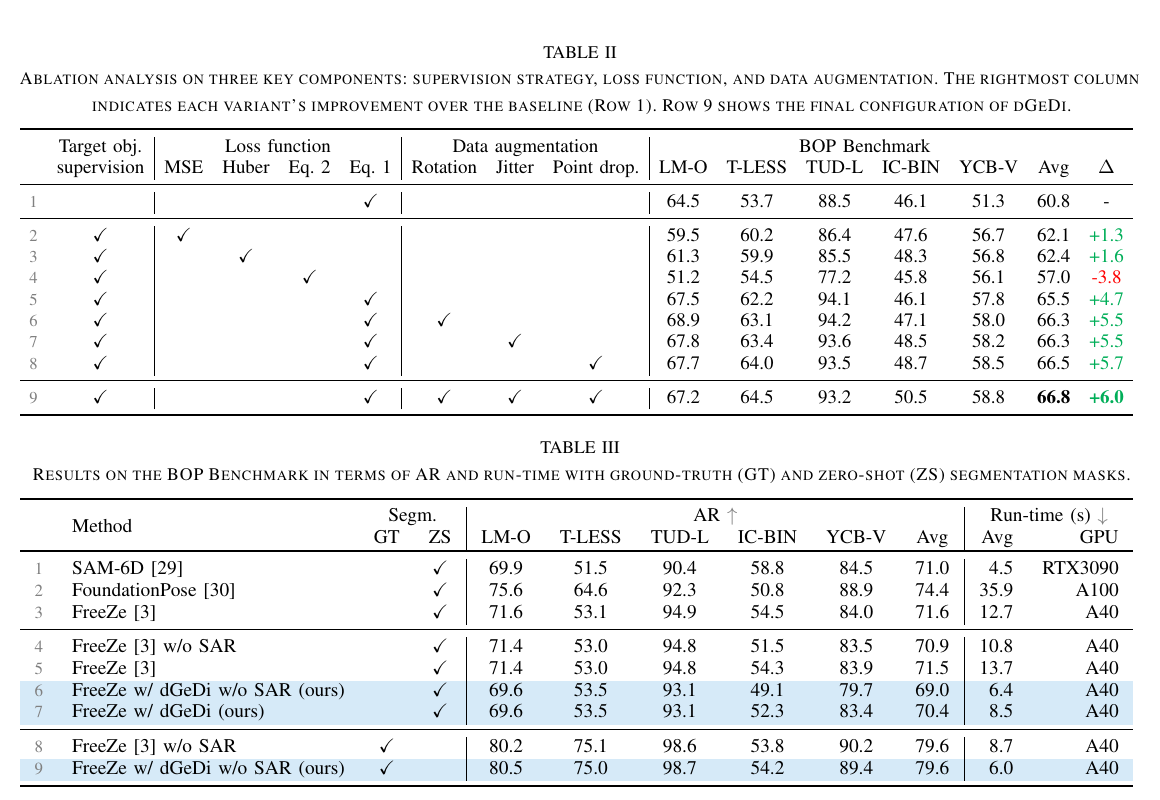
Tables II–III from the paper. Table II's final configuration uses target supervision, Eq. 1, and three augmentations; Table III separates geometric-encoder acceleration from full FreeZe end-to-end time. Source: public author manuscript. Table copyright belongs to the authors and IEEE; reproduced here for paper commentary.
6.1 Distillation Ablations
The query-supervision-only + Eq.1 baseline without augmentation averages AR 60.8.
Add target-correspondence supervision + Eq.1: 65.5, a +4.7 gain.
MSE / Huber: 62.1 / 62.4;
High-error-emphasizing Eq.2: 57.0, below baseline by 3.8.
Target supervision + Eq.1 + rotation / jitter / point dropout: final 66.8, a +6.0 gain.
Evidence supports three design choices: partial-target supervision, suppression of high-error teacher features, and geometry / missing-point augmentation.
6.2 End-to-End FreeZe
Setting
FreeZe / dGeDi
Avg AR
Avg runtime
SAM-6D mask + SAR
FreeZe
71.5
13.7 s
SAM-6D mask + SAR
dGeDi
70.4
8.5 s
GT mask, no SAR
FreeZe
79.6
8.7 s
GT mask, no SAR
dGeDi
79.6
6.0 s
Under deployment conditions, dGeDi cuts end-to-end time by 5.2 s but loses 1.1 AR. With ground-truth masks, AR stays equal and runtime falls by 2.7 s. Table values of FoundationPose 74.4 AR / 35.9 s use A100, whereas SAM-6D 71.0 / 4.5 s uses RTX3090. Different GPUs and implementations prevent a strictly hardware-matched runtime ranking.
7. Qualitative Results
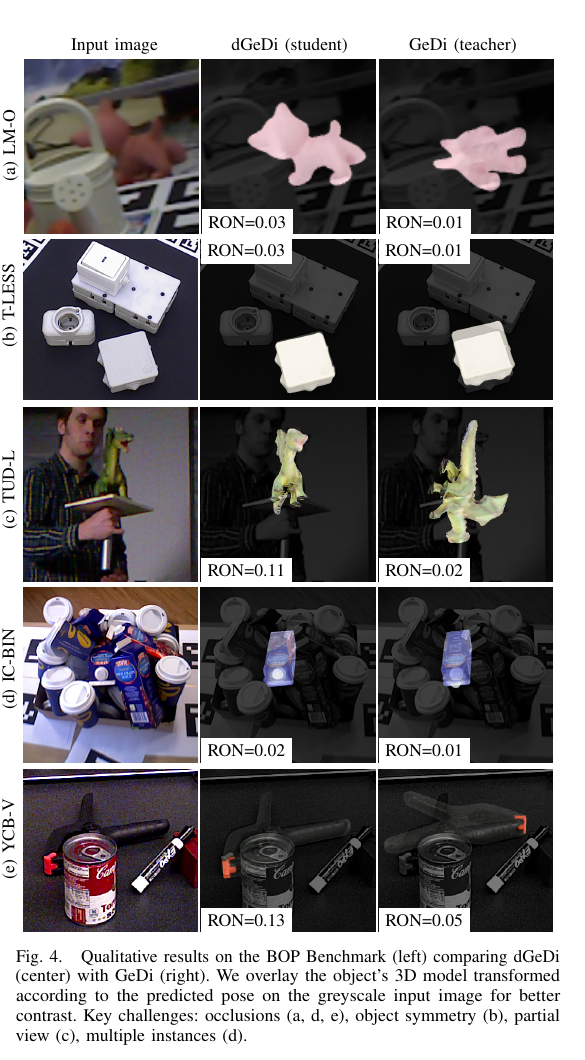
Figure 4 from the paper covers LM-O occlusion, T-LESS symmetry, TUD-L partial views, IC-BIN multiple instances, and YCB-V occlusion. Colored CAD overlays on grayscale images show predicted poses. Source: public author manuscript. Image copyright belongs to the authors and IEEE; reproduced here for paper commentary.
The authors explain that GeDi’s local reference frames can fail when too little structure is visible, whereas the feed-forward student produces smoother descriptors. All illustrated dGeDi RON values exceed GeDi, with more plausible poses. These are author-selected successes without accompanying failures. Unique poses recovered from tiny asymmetries also need checking against benchmark symmetry equivalence.
8. Limitations and Reproduction Risks
The authors explicitly state that dGeDi optimizes only geometric-feature extraction; registration remains the system bottleneck.
Additional observations from this site:
Training requires ground-truth poses and masks. Zero-shot refers to unseen test objects, not unsupervised training.
Descriptors are validated only in the RGB-D FreeZe pipeline, without tests on pure point-cloud registration, events, or RGB-only input.
Parameter count, training duration, energy use, and low-end edge-GPU latency are not reported.
9. Reproduction Checklist
Fix PTV3 voxel / serialization settings, the 32D decoder, and point count.
Reproduce query-diameter normalization and target statistical outlier removal.
Check the direction of TQ→T, nearest-neighbor mapping Γ, and target visibility.
Record cached teacher-query feature dtype, compression, and the 34 GB estimate.
Implement the piecewise loss’s continuity constant γ and δ=0.3.
Match rotation, jitter, and point-dropout magnitudes.
Time the geometric encoder, visual encoder, matching, RANSAC, ICP, and SAR separately.
Report both ground-truth and predicted masks, avoiding concealment of front-end domain gaps in mean AR.
10. Overall assessment
dGeDi clearly defines a local-module problem and provides detailed engineering measurements. It precisely addresses slow GeDi inference and unreliable teacher descriptors without claiming to redesign the full zero-shot pose pipeline. The 173× gain belongs to geometric-feature extraction; full FreeZe changes from 13.7→8.5 s with a slight AR reduction. With those scales distinguished, dGeDi remains a valuable example of efficient 3D-descriptor distillation.