DICArt: Advancing Category-level Articulated Object Pose Estimation in Discrete State-Spaces
DICArt places category-level articulated-object pose in a discrete state space. A Flexible Flow Decider improves discrete diffusion denoising, while hierarchical kinematic coupling jointly recovers rigid parts, joint axes, and articulation states under occlusion.
part segmentationkinematic structurearticulation statediscrete diffusion
Full paper metadataAuthors, affiliations, research area, datasets, metrics, method tags, and reading statusExpandCollapse
Authors
Li Zhang, Mingyu Mei, Ailing Wang, Xianhui Meng, Yan Zhong, Xinyuan Song, Liu Liu, Rujing Wang, Zaixing He, Cewu Lu
Affiliations
University of Science and Technology of China / Shanghai Jiao Tong University / Zhejiang University / East China Normal University / Peking University / Emory University / Hefei University of Technology
DICArt models category-level articulated-object part poses and joint states with discrete diffusion. A Flexible Flow Decider improves denoising paths, while hierarchical kinematic coupling handles part occlusion and structural constraints.
2.1 Guide to the paper’s figures and tables
Figure / table
Purpose
Overview reading tips
Figure 1
Discrete states, denoising, and articulated-pose overview
Understand the change from continuous regression to discrete-state classification
Table 1
Multi-part pose results on synthetic data
Examine categories and part-hierarchy levels
Table 2
Diffusion, occlusion, and denoising ablations
Focus on discrete states, the Flow Decider, and occlusion robustness
Tables 3 / 4
Real-data ReArtMix and RobotArm results
Check synthetic-to-real and whole-object-to-part generalization
Relevant region from the paper's method illustration: DICArt organizes articulated-object pose into discrete state spaces and recovers multi-part poses through structured denoising. Source: CVF Open Access. Image copyright belongs to the authors and publisher; reproduced here for paper commentary.
3. Problem setting
Input: RGB-D / point-cloud observations of category-level articulated objects.
Output: rigid-part poses, joint axes / pivots, and joint angles or discrete articulation states.
Targets may be unseen instances within a category, with part self-occlusion and different opening states.
4. Method overview
Discretize continuous pose / articulation variables into tokens or state spaces.
Progressively recover target tokens from noisy states through discrete diffusion.
The Flexible Flow Decider dynamically chooses the direction and magnitude of denoising or resets.
Hierarchical kinematic coupling jointly models parts along the kinematic hierarchy, with parent parts constraining child poses.
5. Experimental overview
Uses synthetic articulated-object data and real / semi-real settings such as ReArtMix and the 7-part RobotArm.
Metrics include rotation, translation, joint-angle, and axis-distance errors.
More robust than continuous regression and existing methods on categories including Drawer, Laptop, Eyeglasses, Dishwasher, and Scissors.
6. Quick assessment
Value: explicitly models multimodality and discrete-state structure in articulated pose.
Strengths: incorporates kinematic hierarchies and targeted occlusion experiments.
Limitations: discretization, state-token count, and kinematic priors need category-specific adjustment.
Recommended readers: those interested in articulated objects, diffusion pose, joint structure, and category-level generalization.
Available src/paper-notes/dicart/deep.md
In-depth paper notes
Support reproduction, comparison, related-work writing, and identifying opportunities for further research.
Deep Reading Notes: DICArt: Advancing Category-level Articulated Object Pose Estimation in Discrete State-Spaces
Core assessment: DICArt treats category-level articulated pose as structured, potentially multimodal state generation instead of independent continuous regression per part. Its gains combine discrete states, gentle denoising, and kinematic coupling.
2. Positioning in one sentence
DICArt generates articulated-object part poses and joint states in discrete state spaces, using a Flexible Flow Decider and hierarchical kinematic coupling for more stable denoising and occlusion robustness.
2.1 Guide to the paper’s figures and tables
Figure / table
Deep-dive questions
Figure 1
How are continuous pose, discrete state, and hierarchical kinematics related?
Table 1
Are synthetic-data gains retained at every part-hierarchy level?
Table 2
What do discrete diffusion, reformulated denoising, and the Flow Decider contribute individually?
Table 3
How do whole-object and part poses generalize on ReArtMix?
Table 4
Do 7-part RobotArm errors increase with hierarchy depth?
Figures 3 / 4
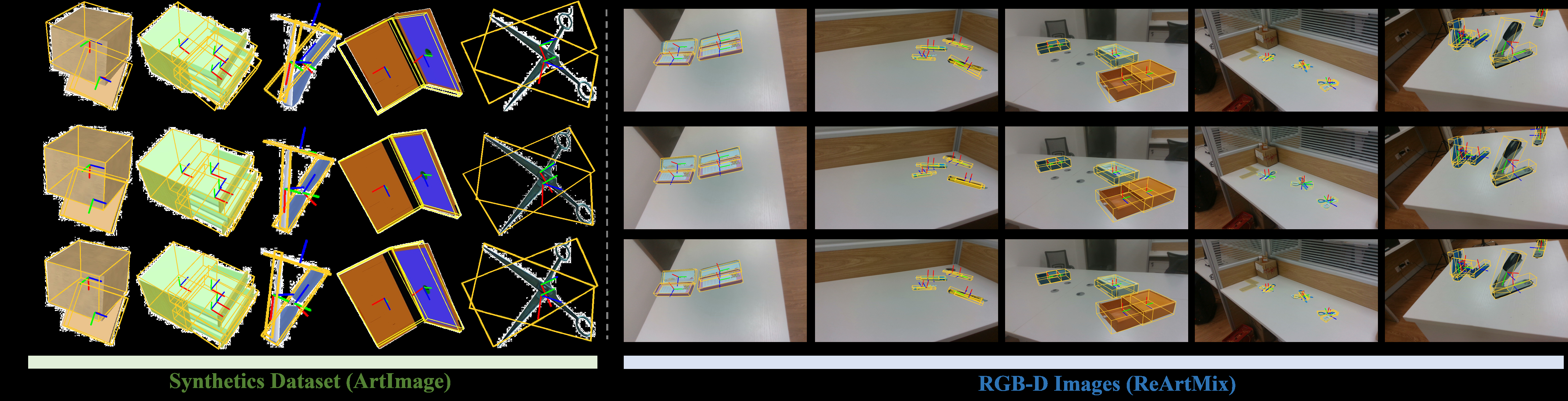
What visual differences appear between synthetic and real RGB-D results?
Relevant region from the paper's method illustration: discrete diffusion and articulated structure jointly generate object and part poses. Source: CVF Open Access. Image copyright belongs to the authors and publisher; reproduced here for paper commentary.
3. Problem setting and task boundaries
Input: point-cloud / RGB-D observations of category-level articulated objects made of rigid parts connected by joints.
Output: each part’s 6D pose and category-dependent joint axes, pivots, angles, or discrete states.
Self-occlusion is central: a part may be invisible, but kinematic structure constrains its pose.
The paper studies category-level generalization, which differs from articulated tracking of a fixed CAD instance.
4. Research context
Methods such as A-NCSH, GenPose, and ShapePose use canonical shapes, diffusion, or continuous regression for category-level articulated pose.
Continuous diffusion represents multiple modes, but imbalanced token / pose distributions can cause denoising to oscillate in high-noise regions.
DICArt discretizes continuous variables into states easier to classify, using kinematic part relationships as hierarchical coupling.
5. Research motivation
Articulated poses are constrained by physical kinematics, rather than arbitrary independent SE(3) combinations.
Self-occlusion leaves incomplete visual evidence for individual parts, making independent regression prone to implausible poses.
Continuous diffusion recovering complex token distributions from pure noise can struggle to balance different state densities.
Discrete states resemble classification and token generation; gentle denoising can reduce unstable updates.
6. Method details
6.1 Discrete pose state
Quantize rotation, translation, and articulation states into discrete tokens / bins.
Learn to recover clean states from noisy-token distributions through diffusion, then decode continuous pose parameters.
Discretization limits search to a finite state space, helping represent multimodal joint-opening states.
6.2 Flexible Flow Decider
At each step, the Flexible Flow Decider examines current tokens relative to the target distribution.
It can choose gentle updates, continued denoising, or partial state resets to balance true-token and noise distributions.
The paper calls this reformulated denoising, intended to avoid unstable local-state convergence in conventional discrete diffusion.
6.3 Hierarchical kinematic coupling
Pass information from parent to child parts along the kinematic tree.
Parent rigid parts and joint constraints provide structural priors for occluded or weakly observed children.
Synthetic articulated data cover varied part structures and articulation states.
ReArtMix validates real / mixed scenes; RobotArm has a long kinematic chain with 7 parts.
Evaluation includes per-part rotation, translation, joint-angle, and axis-distance errors; Drawer occlusion is further grouped by visibility.
7.2 Main results
On ReArtMix, DICArt exceeds baselines such as ReArtNet in whole-object and part-pose errors for Box, Stapler, Cutter, Scissors, Drawer, and other categories.
For Drawer, discrete DICArt obtains rotation error 1.7° and translation error 0.072 m, versus continuous-model errors of 3.1° and 0.143 m.
On the 7-part RobotArm, errors increase with hierarchy depth, but mean part rotation error is approximately 8.2° and translation error approximately 0.105 m, still better than compared methods.
7.3 Occlusion and Ablations
Drawer rotation errors are approximately 1.8°, 1.9°, and 1.9° at 0%–40%, 40%–80%, and 80%–100% visibility, respectively, supporting hierarchical coupling under strong self-occlusion.
Removing reformulated denoising raises Drawer errors to approximately 4.0° and 0.128 m; adding it returns errors to approximately 1.7° and 0.072 m.
Continuous / discrete diffusion comparisons favor discrete states for the evaluated articulated-pose output distribution.
8. Critical analysis
Strengths: the method matches structural priors, incorporating part poses, joints, and occlusion into one generation process.
Risks: discrete resolution bounds achievable precision; fine rotations and small translations may need many bins and more tokens.
Prior dependence: hierarchical coupling needs a known or learned kinematic tree; unknown topology, soft objects, and non-rigid structures are not directly supported.
Evaluation interpretation: deeper parts accumulate more error; practical robots need joint-level uncertainty and failure recovery.
9. Implications for my research
Model joint states as discrete latents and SE(3) part poses as conditional continuous variables.
The Flexible Flow Decider idea may also suit pose posteriors with symmetry, multiple solutions, or occlusion.
Combine kinematic coupling with point correspondences, NOCS, or Gaussian representations to improve invisible-part prediction.
10. Open questions
How can an unknown articulation graph be learned automatically from one observation?
How can discrete-state precision, token count, and real-time performance be balanced better?
How can physical feasibility, contact, and robot-control constraints enter diffusion sampling?
11. Deep Reading Supplement: Discrete State Spaces and Kinematic Coupling
11.1 Discretizing the Problem
For category-level articulated objects, DICArt treats part rotations, translations, and joint configurations as structured discrete states rather than regressing all degrees of freedom in one continuous vector. The Flexible Flow Decider reformulates the denoising path, while hierarchical kinematic coupling passes parent pose / joint state to children. Valid articulation states often concentrate in a few motion modes; continuous Gaussian regression can fall into physically implausible intermediate states.
11.2 Data and Metrics
ReArtMix provides real / mixed RGB-D scenes; ArtImage / synthetic articulated objects provide controlled geometry and motion ranges.
Evaluation covers Box, Stapler, Cutter, Scissors, Drawer, and other categories, plus the 7-part RobotArm.
Main metrics are part rotation, translation, joint-angle, and axis-distance errors; distinguish single-part errors from multi-part means.
11.3 Key Numbers and Ablations
Experiment
Result
Drawer, continuous-state regression
Rotation 3.1°, translation 0.143 m
Drawer, DICArt discrete states
Rotation 1.7°, translation 0.072 m
Drawer visibility 0–40 / 40–80 / 80–100%
Rotation approximately 1.8° / 1.9° / 1.9°; translation approximately 0.107 m at high visibility
RobotArm, mean across 7 parts
Rotation 8.2°, translation 0.105 m
Without reformulated denoising
Drawer approximately 4.0° / 0.128 m, clearly worse than the full model
These numbers support two conclusions: discrete-state gains go beyond a larger network, and hierarchical coupling matters for articulated structures. Whole-object means alone may hide error accumulation in deeper parts.
11.4 Separating Contributions and Limitations
Authors’ claims
My assessment
Discrete diffusion better suits multimodal articulated-pose states
Directly supported by continuous / discrete Drawer comparisons; bin count and resolution limits still need reporting.
Supported by visibility groups and RobotArm results; unknown kinematic topology remains unsolved.
Category-level generalization
ReArtMix and synthetic objects cover several categories, while soft objects, unknown joint graphs, and strong non-rigidity remain outside scope.
12. Reproduction and Research Implications
Fix the articulation graph, part coordinate frames, bin resolution, noise schedule, sampling steps, and equivalence annotations for symmetric parts. Additionally record pose residuals per joint level, valid-state proportions, and sampling-failure rates. For robotics, combine discrete joint posteriors with collision / contact constraints to reject physically impossible poses during generation rather than correcting only at the end.