Object Pose Estimation via the Aggregation of Diffusion Features
The method freezes Stable Diffusion v1.5 and aggregates intermediate U-Net features for template matching. CWA achieves Acc15 of 98.2 / 85.9 on unseen LM / O-LM and VSD recall of 71.03 on T-LESS with 21k templates. Generalization of unseen-object representations is the benefit; CAD, ground-truth crops, and large template libraries remain necessary, and complete 6D pose is not directly regressed.
known test-time CAD modelsground-truth object crop in the reported protocol301 templates per object on LM / O-LM21,672 templates per object on T-LESSfrozen Stable Diffusion v1.5 U-Net
Full paper metadataAuthors, affiliations, research area, datasets, metrics, method tags, and reading statusExpandCollapse
Authors
Tianfu Wang, Guosheng Hu, Hongguang Wang
Affiliations
Shenyang Institute of Automation, Chinese Academy of Sciences / Institutes for Robotics and Intelligent Manufacturing, Chinese Academy of Sciences / University of Chinese Academy of Sciences / Oosto
known test-time CAD modelsground-truth object crop in the reported protocol301 templates per object on LM / O-LM21,672 templates per object on T-LESSfrozen Stable Diffusion v1.5 U-Net
Reading Notes
Overview / Deep Dive
Available src/paper-notes/diffusion-features-pose-cvpr2024/coarse.md
Paper overview notes
Quickly assess the paper's scope, problem setting, core method, experimental findings, and whether to read it in depth.
Overview Notes: Diffusion Features for Pose
1. Basic information
Title: Object Pose Estimation via the Aggregation of Diffusion Features
Authors: Tianfu Wang, Guosheng Hu, Hongguang Wang
Affiliations: Shenyang Institute of Automation, CAS; Institutes for Robotics and Intelligent Manufacturing, CAS; UCAS; Oosto
This paper treats multi-layer U-Net features from frozen Stable Diffusion v1.5 as general object representations, then learns a lightweight cross-layer aggregator for CAD-template retrieval. It studies generalization of object recognition and pose-template selection to unseen objects, rather than CAD-free direct 6D regression.
3. Guide to figures and tables
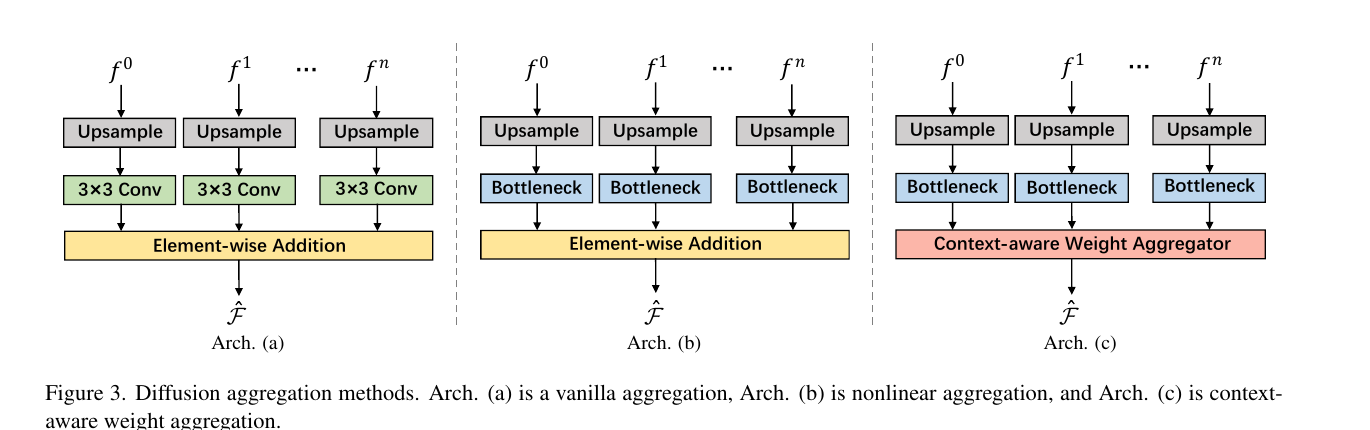
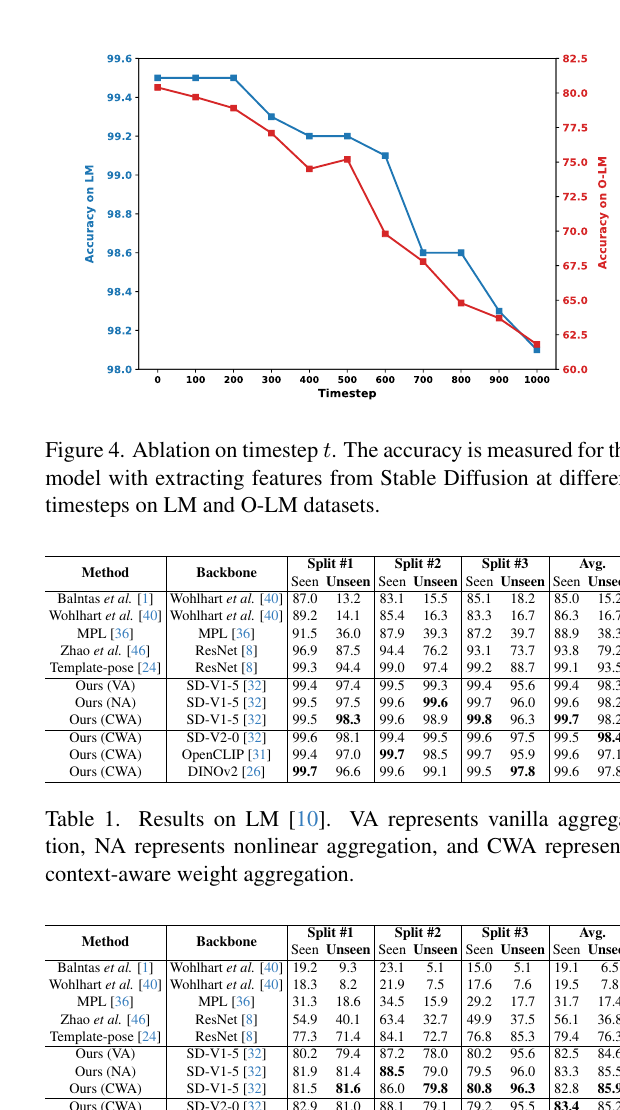
Figure 3 from the paper: the authors compare direct-sum VA, nonlinear bottleneck aggregation NA, and CWA, which learns layer weights from input context. Main experiments use CWA. Source: official CVPR 2024 paper. Image copyright belongs to the authors and IEEE/CVF; reproduced here for paper commentary.Figure 4 and Tables 1–2 from the paper: larger timesteps reduce pose accuracy on clean inputs. CWA reaches 98.2 / 85.9 on unseen LM / O-LM; the latter exceeds Template-pose's 76.3 by 9.6 percentage points. Source: official CVPR 2024 paper. Figure / table copyright belongs to the authors and IEEE/CVF; reproduced here for paper commentary.
4. Problem setting
Input: ground-truth object crops under the paper’s protocol; target CAD models rendered into templates at multiple poses.
Output: object identity and pose retrieved from the template set. The main LM / O-LM metric, Acc15, requires correct identity and rotation error below 15°.
Training / testing are split by object, emphasizing objects unseen during training.
T-LESS also evaluates complete pose through VSD recall, but translation uses SSD-6D’s projective-distance estimate rather than direct aggregator regression.
This is therefore RGB + CAD-template unseen-object pose estimation, rather than a model-free or complete end-to-end detection-to-pose system.
5. Method overview
Feed a 512-resolution object crop into the frozen Stable Diffusion v1.5 U-Net, without added noise and with timestep 0.
Extract intermediate features at multiple U-Net levels, upsample, and project into unified 64×64 feature maps.
VA: apply a 3×3 convolution per layer, then sum elementwise.
NA: introduce nonlinearity with residual bottlenecks and ControlNet-style zero initialization of the final convolution.
CWA: globally pool each layer, generate input-dependent weights through MLP + softmax, and take a weighted sum.
Train only the aggregation network with InfoNCE over real images and positive / negative pose templates.
At test time, average local query–template cosine similarities after template-mask and threshold filtering, selecting the highest-scoring template.
6. Experiments at a glance
LM / O-LM: 13 objects, three non-overlapping object splits, and 301 templates per object.
T-LESS: seen objects 1–18 and unseen objects 19–30; 21,672 templates rendered per object.
LM unseen:
Template-pose 93.5;
CWA SD-v1.5 98.2;
SD-v2.0 98.4, DINOv2 97.8.
O-LM unseen:
Template-pose 76.3;
VA 84.6, NA 85.5, CWA 85.9;
OpenCLIP 81.1, DINOv2 78.1.
T-LESS VSD recall:
Template-pose 92k templates: 58.87;
Template-pose 21k: 58.25;
CWA 21k: 71.03, with seen / unseen scores of 70.87 / 71.26.
Parameters: Template-pose 24.04M; VA 2.53M, NA 13.28M, CWA 13.29M. These exclude the frozen SD backbone’s total parameters and inference overhead.
7. Quick assessment
Highlights: systematically shows that intermediate generative-pretraining features support local pose discrimination for unseen objects; CWA avoids equal layer weights; includes substantial comparisons across SD, OpenCLIP, and DINOv2.
Limitations: requires CAD, ground-truth crops, and many templates; LM / O-LM Acc15 mainly evaluates identity and rotation, not full BOP 6D AR; total inference cost is less fully reported than trainable parameters.
Reading note: official CVF results give unseen LM 98.2, whereas an earlier arXiv abstract reported 97.9. This site follows the official CVPR version and main tables.
Intended readers: those interested in foundation features for geometry, diffusion representations, template matching, unseen-object pose, and cross-layer feature aggregation.
Available src/paper-notes/diffusion-features-pose-cvpr2024/deep.md
In-depth paper notes
Support reproduction, comparison, related-work writing, and identifying opportunities for further research.
Deep Reading Notes: Diffusion Features for Pose
1. Key assessment
The key idea is to use the Stable Diffusion U-Net as a multi-scale visual backbone, rather than generate poses through diffusion. The authors observe:
Discriminative pose features work well on training objects but degrade on unseen ones.
Stable Diffusion’s intermediate features retain local appearance and viewpoint structure without seeing the target LM / O-LM instances.
Different U-Net layers work best for different objects, making one fixed layer insufficient.
An aggregator assigning layer weights per input adapts general features into pose-template similarity.
The official CVPR version reports unseen LM / O-LM Acc15 of 98.2 / 85.9 and T-LESS VSD recall of 71.03. These strong results come under a narrow protocol: ground-truth object crops, test-time CAD, and many templates. LM / O-LM mainly evaluate identity and rotation rather than a complete detection-to-6D-pose pipeline.
2. Task Setting and What the Output Actually Represents
Given:
Query RGB object crop Iq;
CAD models of candidate objects;
Template images {Itk} at different poses for each object.
After threshold and template-mask filtering, the highest-similarity template supplies its object ID and pose to the query.
LM / O-LM Acc15 requires:
d(R^,R)=π1arccos(2tr(R⊤R^)−1)<15∘,
together with the correct object class / ID.
T-LESS uses VSD recall@0.3 and SSD-6D’s projective-distance translation estimation. Thus:
The main learned quantity is pose-aware image similarity.
Rotation comes from the best template.
Translation is not directly regressed by the diffusion aggregator.
Detection / cropping lies outside the main protocol.
3. Why Diffusion Features May Generalize
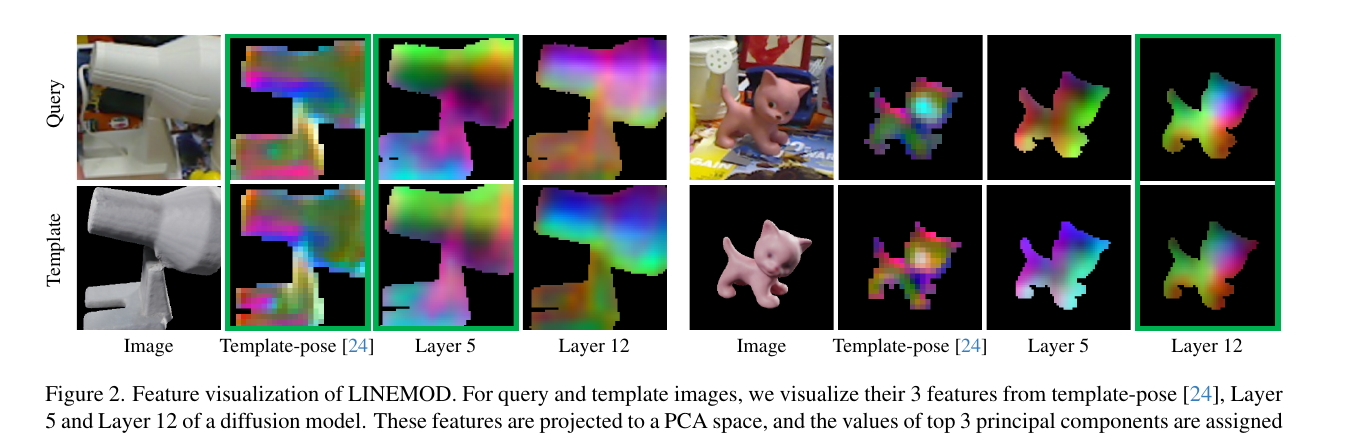
Figure 2 from the paper. Template-pose features and Stable Diffusion layer 5 / 12 features are projected to RGB with PCA; green boxes show that the best layer varies across objects. Source: official CVPR 2024 paper. Image copyright belongs to the authors and IEEE/CVF; reproduced here for paper commentary.
PCA visualizations of LINEMOD query / template features show:
Task-specific Template-pose features discriminate training objects, but provide less stable correspondences for unseen appearances.
Shallow / middle Stable Diffusion layers preserve local structure; higher layers favor object semantics and larger-scale shape.
Layer 5 is more consistent for lamp, while layer 12 is more consistent for cat.
The best layer therefore depends on the input object and scene.
This generalization requires neither diffusion sampling nor text prompts. Generative visual statistics learned on LAION-5B serve as a frozen prior.
The paper feeds input images directly into SD v1.5:
resolution 512;
Timestep t=0;
No artificial noise;
Unconditional text embedding;
Features extracted from multiple U-Net layers;
Unified 64×64 resolution.
Timestep ablation shows LM / O-LM accuracy decreasing as the timestep increases from 0 to 1000. For clean object images, greater assumed noise moves features away from fine pose information.
4. Three Aggregators
Figure 3 from the paper. All three methods first align feature resolutions, then differ through layerwise linear mapping, nonlinear residual bottlenecks, or dynamic query-context weighting. Source: official CVPR 2024 paper. Image copyright belongs to the authors and IEEE/CVF; reproduced here for paper commentary.
Let multi-layer U-Net features be {fi}i=1n.
4.1 Vanilla aggregation, VA
F^=i=1∑nΦexti(fi).
Each layer is upsampled and projected to common channels with a 3×3 convolution, then summed. Its 2.53M parameters are few, but fixed equal layer weights limit expressiveness.
4.2 Nonlinear aggregation, NA
Replace ordinary convolutional extractors with bottlenecks containing three convolutions, ReLU, and a skip connection. Zero initialization of the final convolution gives approximately identity / zero-residual behavior initially, reducing the risk that limited pose data damage pretrained features.
NA has 13.28M parameters and obtains unseen O-LM 85.5, clearly above VA’s 84.6.
4.3 Context-aware weight aggregation, CWA
First compute:
hi=Φexti(fi),
Global pooling produces a summary li per layer, followed by:
{w1,…,wn}=softmax(MLP([l1,…,ln])).
Finally:
F^=i∑wihi.
CWA chooses different layer combinations for objects such as lamp and cat, rather than learning one set of dataset-wide scalar weights. Its 13.29M parameters nearly match NA, attributing gains to dynamic weighting.
5. Training and Template Matching
Stable Diffusion stays frozen; only the aggregator is trained. Each real training image uses:
1 positive template of the same object at the correct pose;
M−1 negative templates;
InfoNCE to pull positive pairs together and push negative pairs apart.
Test similarity follows Template-pose:
Compute dense cosine similarity between fused query / template features.
Threshold low-confidence positions.
Retain foreground through the template mask.
Average the remaining values.
Retrieve the highest-scoring template.
Training and inference retrieval objectives align, but time and memory grow with template count and depend on reliable crops / masks.
6. Data Protocols
LM / O-LM:
13 LM objects;
Three non-overlapping object groups;
10% of each group’s images held out for seen-object evaluation;
Train on LM, test on LM and heavily occluded O-LM;
301 templates per object;
Ground-truth-pose-centered object crops following Template-pose.
T-LESS:
30 textureless, symmetric, visually similar industrial objects;
objects 1–18 seen, 19–30 unseen;
Train only on seen objects;
Evaluate the complete test set;
21,672 templates per object;
Ground-truth bounding-box crops;
VSD recall@0.3.
Template counts “21K” and “92K” are approximate:
Main method: 21,672;
Full Template-pose: approximately 92k;
Template-pose at a matched template count: approximately 21k.
7. LM / O-LM Results
Figure 4 and Tables 1–2 from the paper. The upper plot favors timestep 0 for clean-image extraction; lower tables report seen / unseen Acc15 across three object splits. Source: official CVPR 2024 paper. Figure / table copyright belongs to the authors and IEEE/CVF; reproduced here for paper commentary.
Mean Acc15:
Backbone / aggregation
LM seen
LM unseen
O-LM seen
O-LM unseen
Template-pose / ResNet
99.1
93.5
79.4
76.3
SD-v1.5 / VA
99.4
98.3
82.5
84.6
SD-v1.5 / NA
99.6
98.2
83.3
85.5
SD-v1.5 / CWA
99.7
98.2
82.8
85.9
SD-v2.0 / CWA
99.5
98.4
83.4
85.2
OpenCLIP / CWA
99.6
97.1
81.9
81.1
DINOv2 / CWA
99.6
97.8
83.1
78.1
Key interpretations:
CWA does not lead every column: SD-v2.0 obtains LM unseen 98.4, and NA / SD-v2.0 score higher on O-LM seen.
The supported claim is stronger overall generalization from SD features + learned aggregation, rather than universal CWA superiority.
Unseen O-LM 85.9 versus 76.3 is a 9.6-point gain. The main text’s “10.9%” resembles relative-increase wording; this site consistently uses percentage points.
DINOv2 obtains only unseen O-LM 78.1, favoring generative-feature occlusion robustness in this task / implementation. This does not establish diffusion superiority over DINOv2 for all geometry tasks.
8. T-LESS: Template Count, Symmetry, and Full 6D Pose
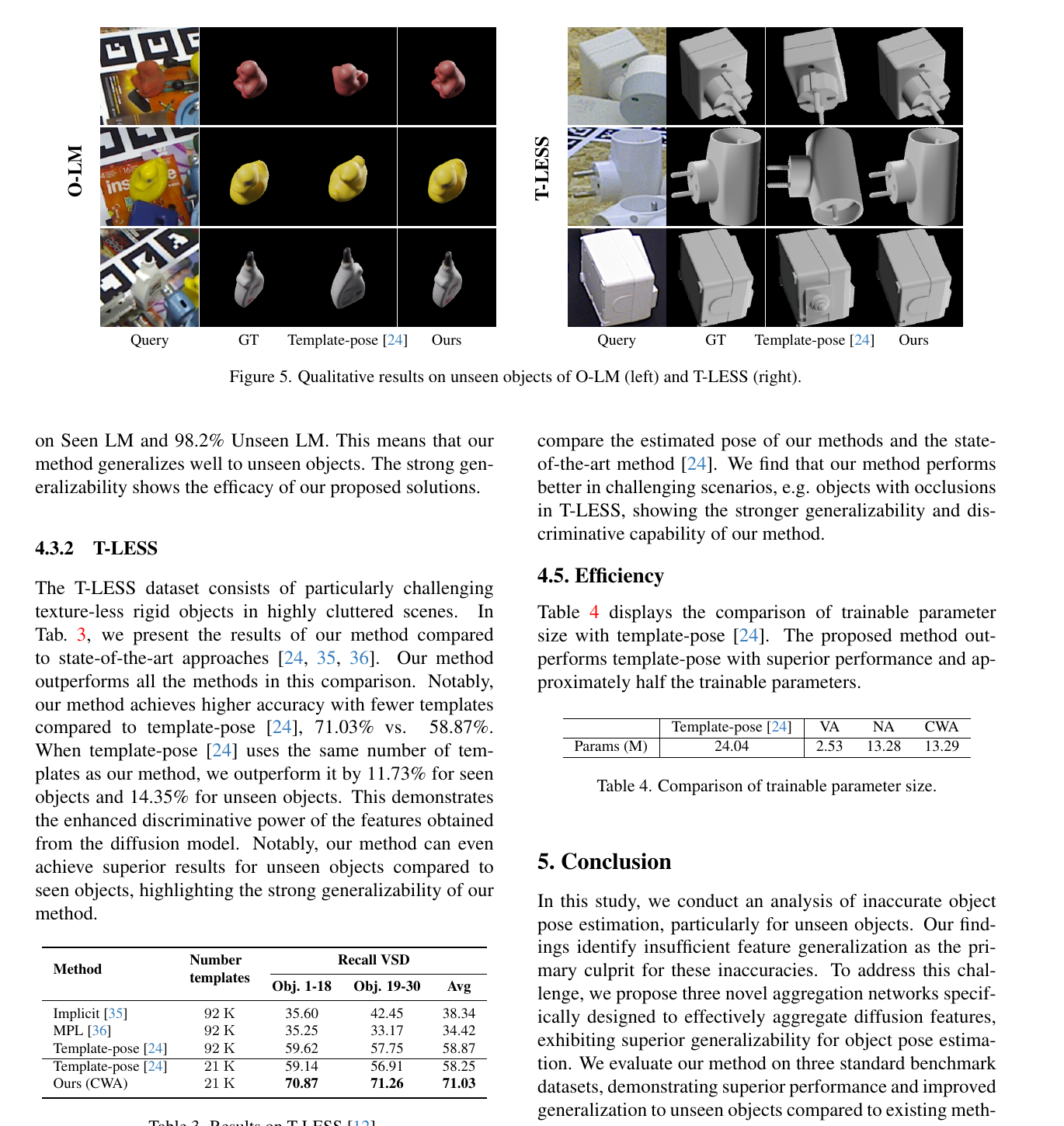
Figure 5 and Tables 3–4 from the paper. The upper examples compare ground truth, Template-pose, and this method on unseen objects. Table 3 reports seen / unseen T-LESS VSD recall; Table 4 counts only trainable aggregator parameters. Source: official CVPR 2024 paper. Figure / table copyright belongs to the authors and IEEE/CVF; reproduced here for paper commentary.
Method
Templates / object
Seen 1–18
Unseen 19–30
Avg
Implicit
92k
35.60
42.45
38.34
MPL
92k
35.25
33.17
34.42
Template-pose
92k
59.62
57.75
58.87
Template-pose
21k
59.14
56.91
58.25
CWA
21k
70.87
71.26
71.03
Slightly higher unseen scores do not make unseen objects inherently easier: object identities, symmetries, and visibility distributions differ between groups. The defensible conclusion is that seen-to-unseen transfer does not collapse.
T-LESS results also jointly depend on:
template rotation sampling;
VSD symmetry handling;
SSD-6D projective translation;
GT crop;
template render quality.
The full 71.03 therefore cannot be attributed to rotation features alone.
9. Parameters and Efficiency
Trainable parameters:
Model
Parameters
Template-pose
24.04M
VA
2.53M
NA
13.28M
CWA
13.29M
This table excludes:
Hundreds of millions of frozen Stable Diffusion v1.5 U-Net parameters;
Multi-layer feature storage;
Offline / online costs of 21,672 templates per object;
Similarity computation over all templates;
external crop / detector;
T-LESS translation module.
The paper establishes lighter trainable adaptation, without proving lower total runtime or GPU memory than Template-pose. Deployment evaluation must additionally measure latency, peak memory, and template-database size.
10. Relationship to Other Foundation-Feature Pose Methods
FoundPose / GigaPose:
All three use large-model features for unseen-object CAD matching.
GigaPose decomposes degrees of freedom to retain only 162 templates and explicitly targets speed.
This paper emphasizes multi-layer diffusion-representation generalization, with a much larger template database.
FoundPose emphasizes DINOv2 feature matching and geometric correspondence.
Diffusion pose generation:
SE(3) Score Diffusion / 6D-Diff generate poses or keypoints through diffusion.
This method performs no pose denoising and outputs no pose distribution.
“Diffusion Features” refers to deterministic intermediate representations of a pretrained diffusion network.
DIFT:
Both extract correspondence features from frozen diffusion models.
This work additionally learns task-specific layer aggregation and evaluates template-based object pose.
301 / 21,672 templates incur database and retrieval costs.
LM / O-LM Acc15 does not evaluate translation.
T-LESS translation comes from an external projective-distance method.
Parameter tables omit the frozen SD backbone.
Full end-to-end latency / memory is not reported.
The three benchmarks still cover relatively few objects.
Extreme lighting, real materials, and domain shifts receive limited testing.
Similarity averaging depends on template masks; segmentation-boundary errors still matter.
Feature-layer count and extractor resolution strongly affect GPU memory.
Official CVF and early arXiv abstracts differed on unseen LM; follow the official main-table value of 98.2.
12. Reproduction Checklist
Use exactly the same Stable Diffusion v1.5 checkpoint.
Resize images to 512, use timestep 0, and add no noise.
Specify unconditional text embeddings.
Extract the same U-Net layers.
Unify outputs to 64×64.
Freeze SD and train only the aggregation network.
Zero-initialize the final NA / CWA bottleneck layer.
Reproduce the three object-disjoint splits.
Use 301 templates per LM / O-LM object.
Use exactly 21,672 T-LESS templates.
Match ground-truth crop and template-mask protocols.
Acc15 must check both object ID and rotation.
Use the same T-LESS VSD threshold 0.3 and translation code.
Report total backbone size, latency, VRAM, and template-disk size beyond trainable parameters.
Report seen / unseen separately, not only their mean.
13. Overall assessment
The strongest contribution turns the intuition that diffusion layers suit pose into cross-layer visualizations, timestep ablations, three aggregators, and multiple-backbone comparisons. Unseen O-LM 85.9 versus 76.3 and T-LESS 71.03 versus 58.87 support the value of generative-pretraining features under occlusion and unseen objects.
This remains short of a complete general 6D pose system: ground-truth crops, CAD, template databases, and an external translation estimator are part of the protocol, while trainable parameters omit total cost. The precise conclusion is that context-aware aggregation of frozen diffusion-model multi-layer local features improves unseen-object generalization in CAD-template pose retrieval, addressing representation bottlenecks rather than all detection, geometric-recovery, and system-efficiency problems.