Neural Implicit Representation for Building Digital Twins of Unknown Articulated Objects
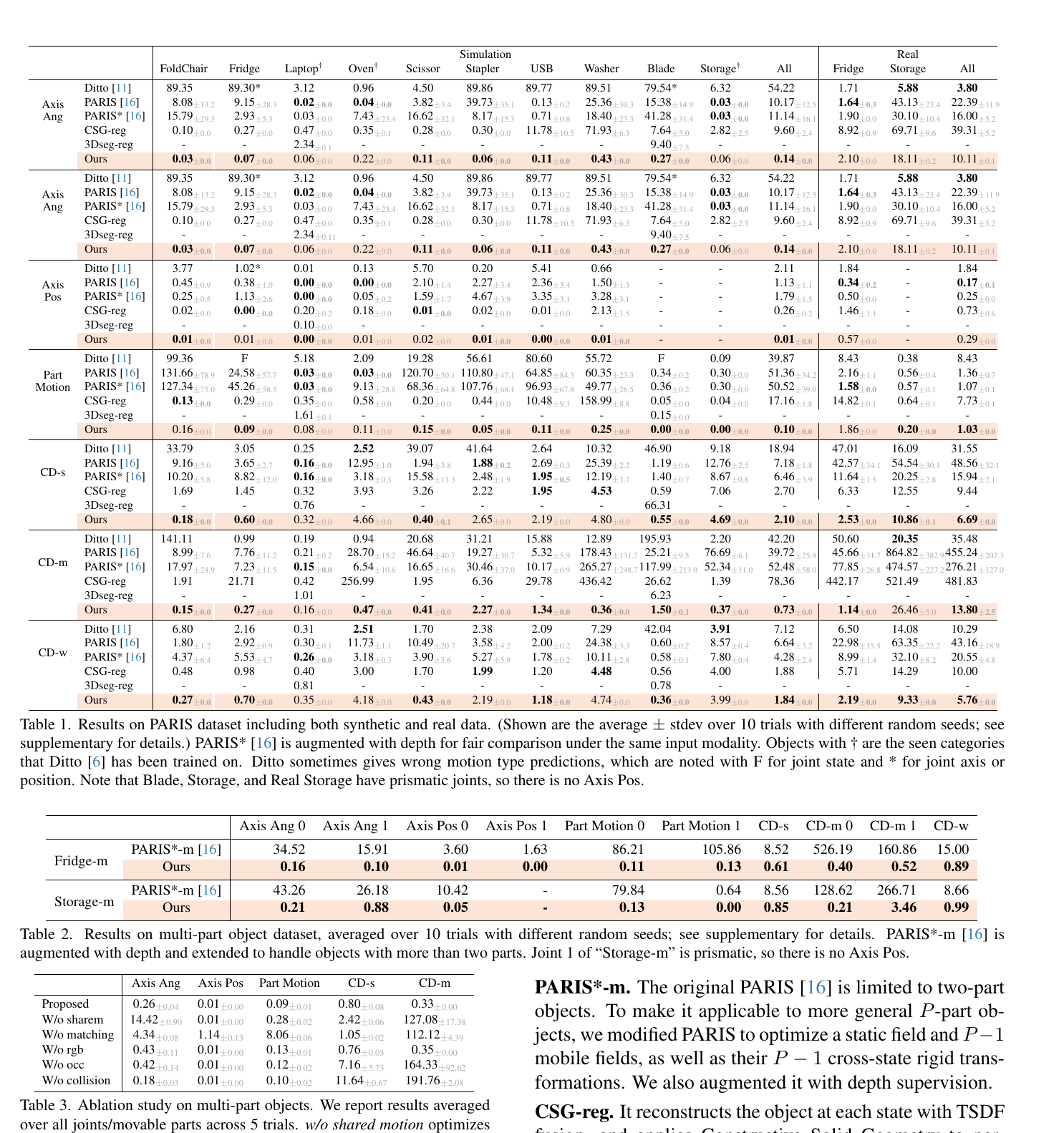
DigitalTwinArt first reconstructs object-level neural SDFs for two articulation states, then jointly recovers a multijoint digital twin through part segmentation, shared rigid motion, and an explicit correspondence field. In multipart ablations, full-model axis-angle / mixed-unit part-motion / moving-part CD errors are 0.26° / 0.09 / 0.33 mm. Removing shared motion worsens them to 14.42° / 0.28 / 127.08 mm.
two multi-view RGB-D scans at different articulation statesobject masksknown camera posesper-state neural SDF and appearance fields
Requirements
about 100 posed RGB-D views per stateknown number of jointsstatic base part assumptionobject masks and calibrated camera posesper-object two-stage optimization
Full paper metadataAuthors, affiliations, research area, datasets, metrics, method tags, and reading statusExpandCollapse
Authors
Yijia Weng, Bowen Wen, Jonathan Tremblay, Valts Blukis, Dieter Fox, Leonidas Guibas, Stan Birchfield
about 100 posed RGB-D views per stateknown number of jointsstatic base part assumptionobject masks and calibrated camera posesper-object two-stage optimization
Reading Notes
Overview / Deep Dive
Available src/paper-notes/digital-twin-art-cvpr2024/coarse.md
Paper overview notes
Quickly assess the paper's scope, problem setting, core method, experimental findings, and whether to read it in depth.
Overview Notes: DigitalTwinArt
1. Basic information
Title: Neural Implicit Representation for Building Digital Twins of Unknown Articulated Objects
Authors: Yijia Weng, Bowen Wen, Jonathan Tremblay, Valts Blukis, Dieter Fox, Leonidas Guibas, Stan Birchfield
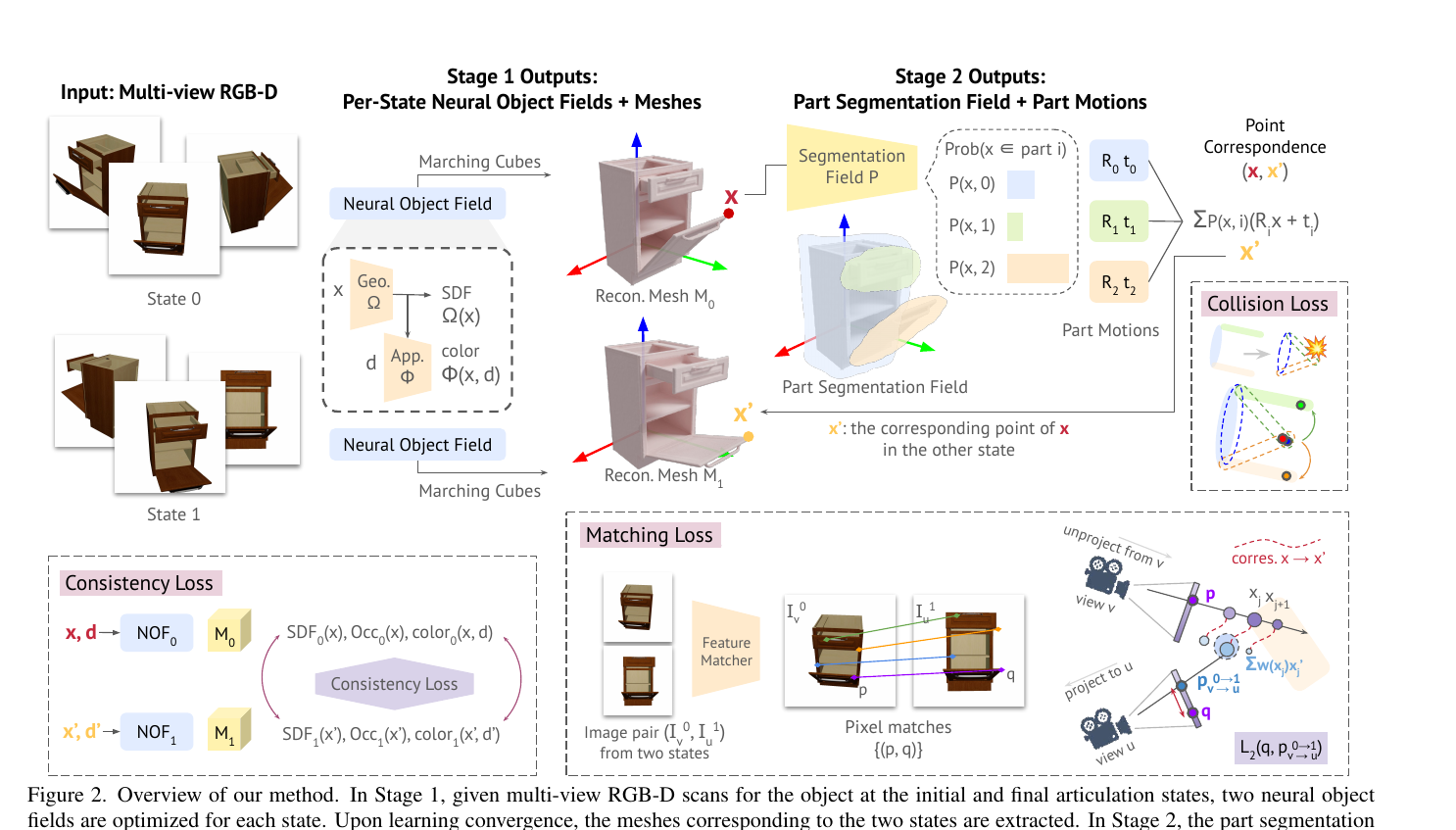
DigitalTwinArt takes approximately 100 calibrated RGB-D views of an unknown articulated object in each of two articulation states. It independently reconstructs two object-level neural SDFs, then derives a cross-state correspondence field from shared part motions. Geometry, color, image matching, and collision losses jointly recover part segmentation, joint types / axes, and multi-part 3D meshes.
3. Guide to figures and tables
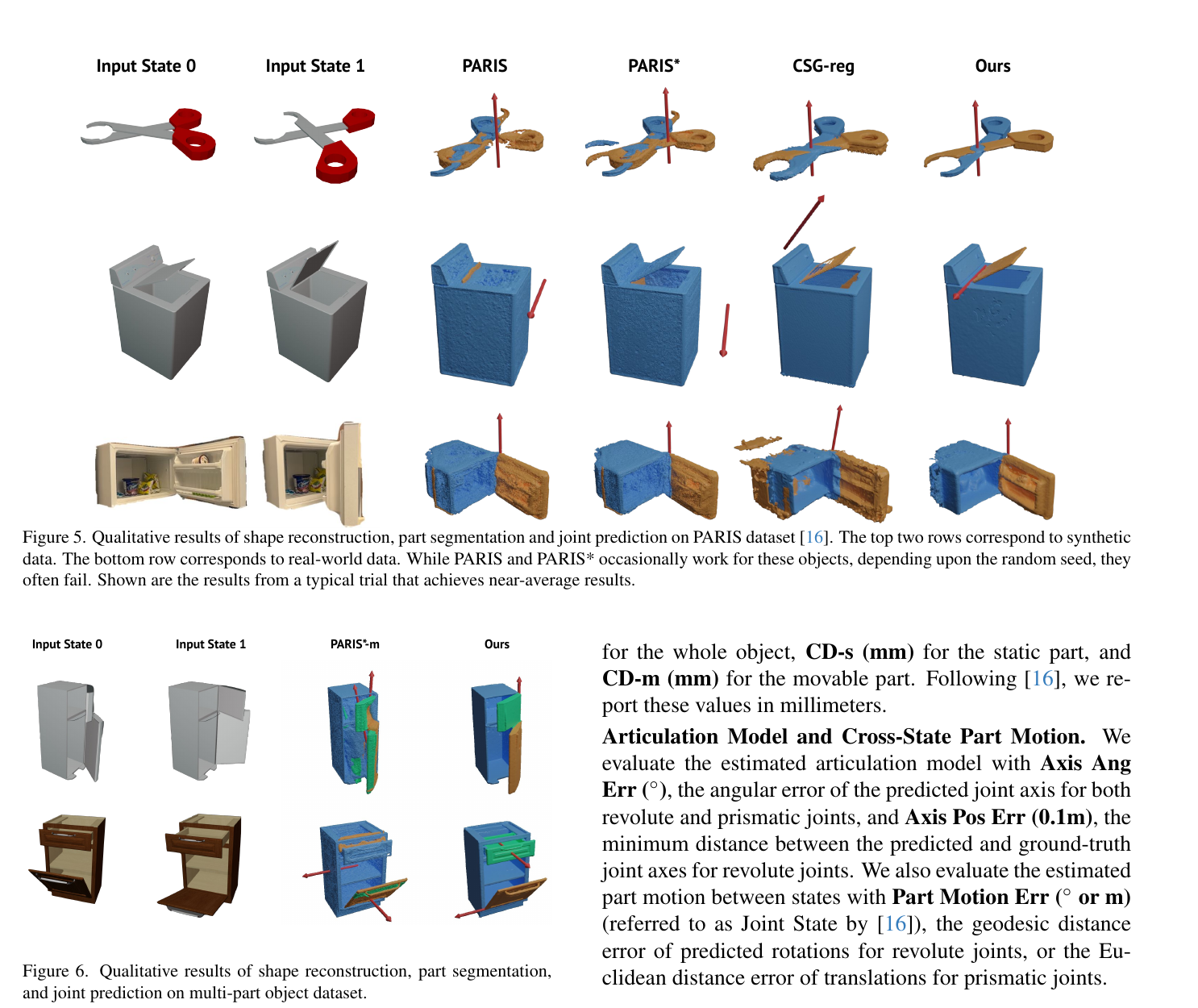
Figure 2 from the paper: Stage 1 reconstructs neural object fields and meshes separately for two articulation states. Stage 2 optimizes part-probability fields and shared rigid motions, with consistency, matching, and collision supervision through a correspondence field. Source: official CVPR 2024 paper. Image copyright belongs to the authors and IEEE/CVF; reproduced here for paper commentary.Figures 5–6 from the paper: on two-part PARIS objects and the authors' multi-joint fridge / storage objects, the method recovers parts and joint axes more reliably than PARIS, depth-augmented PARIS, and CSG registration. Source: official CVPR 2024 paper. Image copyright belongs to the authors and IEEE/CVF; reproduced here for paper commentary.
4. Problem setting
Input: multi-view RGB-D, object masks, and camera parameters for the same object in states 0 / 1.
Views: usually approximately 100 per state.
Known: joint / part count; part 0 is assumed static.
Unknown: object category, shape priors, part segmentation, joint type, axis / position, and part motion.
Output: meshes, segmentation, revolute / prismatic joints, and inter-state rigid transforms for each part, exportable to a simulator.
Relationship to standard pose: recovers part-to-part / state-to-state articulation pose rather than single-image camera-to-object 6D pose.
5. Method overview
Independently optimize a Neural Object Field for each state: hash-encoded SDF + appearance field.
Extract meshes with Marching Cubes and compute ESDF / occupancy.
Represent pointwise part probabilities Pt(x,i) with voxel features + MLP.
Optimize rigid transform Tit per part, sharing inverse motion between directions.
Combine segmentation and motion into a point-correspondence field through soft skinning.
SDF / color / occupancy consistency constrains cross-state geometry; LoFTR provides pixel matches, and collision loss penalizes incorrect part motions.
Discretize soft segmentation after optimization, then infer joint type, axis, and articulation amount from rigid motion.
6. Experiments at a glance
Synthetic + real PARIS: for most objects, joint axes, part motions, and moving-part CD substantially improve over Ditto, PARIS, PARIS*, and CSG-reg.
Overall multi-part ablation: full-model axis angle 0.26°, part-motion error 0.09, moving-part CD 0.33 mm.
Without shared bidirectional motion: 14.42° / 0.28 / 127.08 mm.
Without matching: 4.34° / 8.06 / 112.12 mm.
Without collision: moving-part CD worsens from 0.33 to 191.76 mm.
Part-motion error uses rotation geodesic error for revolute joints and Euclidean translation error for prismatic joints. Multi-joint means mix units and should not all be labeled mm.
7. Quick assessment
Highlight: no category-trained prior, with support for multiple moving parts from two states.
Strongest evidence: 10 random initializations reveal high PARIS variance but stable results here, directly addressing a main per-object-optimization risk.
Pose insight: jointly optimize part segmentation and rigid motion through a correspondence field rather than hard-segmenting first.
Limitations: expensive capture and computation; approximately 200 posed RGB-D views, known joint count, a static base, and high-quality masks are required.
Intended readers: those interested in articulated pose, digital twins, neural SDFs, test-time optimization, and automatic robot-simulation asset creation.
Available src/paper-notes/digital-twin-art-cvpr2024/deep.md
In-depth paper notes
Support reproduction, comparison, related-work writing, and identifying opportunities for further research.
Deep Reading Notes: DigitalTwinArt
1. Key assessment
DigitalTwinArt separates geometric reconstruction from articulation reasoning. Jointly optimizing multiple part-specific radiance fields from images, as in PARIS, lets part boundaries, shape, motion, and rendering compensate for one another, producing poor local optima sensitive to random initialization.
The first stage ignores articulation and treats each state as one complete rigid object to recover a high-quality object-level SDF. The second explains how several rigid-part motions relate the two reconstructed geometries. A point-correspondence field generated from segmentation + motion provides a unified interface for geometry, color, 2D matching, and collision constraints.
This is more stable on multiple parts and unknown categories than prior-based Ditto and jointly optimized PARIS, but requires expensive multi-view capture and two-stage optimization for every object and state.
2. Stage 1: An Object-Level Neural Field per State
For state t∈{0,1}, input is:
{(Ivt,Dvt,Mvt)}v=1V,
Here V≈100, with known camera parameters. The Neural Object Field contains:
Both use multi-resolution hash encoding with BundleSDF-style RGB rendering and SDF supervision. After optimization:
Extract mesh Mt through Marching Cubes;
Derive Euclidean SDF Ω~t(x) from the mesh;
Construct occupancy:
Occt(x)=clip(0.5−sΩ~t(x),0,1).
Stage 1 does not identify parts, preventing occlusion boundaries and seams from prematurely constraining shape reconstruction.
3. Stage 2: Rendering Correspondence through Articulation
Figure 2 from the paper. Complete meshes are first recovered for both states. A part-segmentation field and rigid motions softly map arbitrary state-0 points to state 1, with all supervision defined around this mapping. Source: official CVPR 2024 paper. Image copyright belongs to the authors and IEEE/CVF; reproduced here for paper commentary.
The object has M parts. Its soft segmentation field:
Pt(x,i)=Pr(x belongs to part i),
is implemented by a dense voxel 3D feature volume + MLP heads. Each part has:
Tit=(Rit,tit)∈SE(3),
Rotation uses a continuous 6D representation. Motions are shared across directions:
Ti1=(Ti0)−1.
The point-correspondence field resembles linear blend skinning:
xt→t′=i∑Pt(x,i)(Ritx+tit).
Soft part assignments and rigid motions correct one another, rather than hard segmentation followed by registration.
4. Four Types of Constraints
Surface consistency
If x is close to the surface in state t, its mapped point should have consistent SDF and color in state t′:
Far from surfaces, where SDF / color are unreliable, occupancy consistency instead constrains inside / outside structure throughout space.
Image matching
LoFTR provides cross-state pixel pairs. Camera rays and rendering weights yield the two 3D surface points, and articulation correspondence must map one to the other. These appearance anchors address ambiguities not resolved by 3D SDF alone.
Collision loss
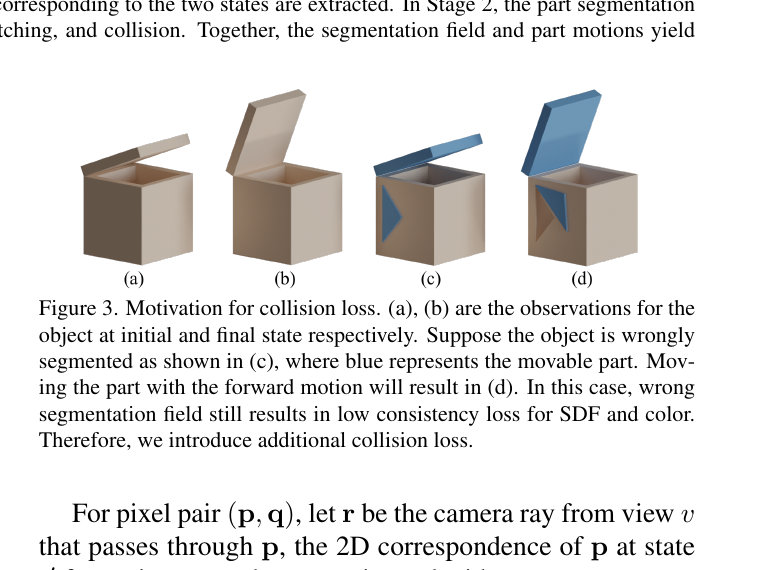
Figure 3 from the paper: incorrect segmentation can move a drawer panel through the base with the drawer. SDF / color consistency may not penalize this; collision loss adds constraints on part interpenetration during the motion sweep. Source: official CVPR 2024 paper. Image copyright belongs to the authors and IEEE/CVF; reproduced here for paper commentary.
The authors interpolate each part’s rigid motion between states and detect moving points entering other parts’ occupancy. Collision loss does not directly supervise joint axes, but rejects degenerate solutions that align endpoint geometry through physically implausible motion.
Partial observation handling
Cross-state consistency is evaluated only within the other state’s observed space. Mapped points in occluded / unseen regions do not turn hallucinated surfaces into reliable supervision, an important distinction for real RGB-D scans.
The total loss can be summarized as:
L=λconLcon+λmatchLmatch+λcollLcoll,
Consistency includes SDF, RGB, and occupancy terms.
5. Extracting Joints from Rigid Motions
After optimization:
Convert part probabilities into hard labels.
Compute each Ti‘s rotation angle.
Near-zero angles indicate prismatic motion; translation provides the axis and amount.
Otherwise infer a revolute joint, obtain its axis from the rotation matrix / axis–angle representation, and solve its position.
Export part meshes and joint parameters as an interactive digital twin.
Part / joint count is known, and part 0 is fixed. The method learns neither unknown topology nor closed-loop mechanisms.
Experimental Part Motion Err uses rotation geodesic error for revolute joints and Euclidean translation error for prismatic joints. Mixed-joint averages combine units and cannot uniformly be interpreted as millimeters.
6. Two-Part and Multi-Part Results
Figures 5–6 from the paper. PARIS / PARIS* often fragment parts or misplace joint axes; CSG-reg suffers from noisy geometric differences between states. This method maintains more complete meshes and stable segmentation in synthetic and real examples. Source: official CVPR 2024 paper. Image copyright belongs to the authors and IEEE/CVF; reproduced here for paper commentary.
PARIS covers 8 categories, 10 synthetic objects, and 2 real objects, with revolute and prismatic joints. Each optimization-based method is repeated with 10 random seeds, reporting mean ± standard deviation. This matters because PARIS can succeed well or fail completely; a single best run conceals instability.
The authors additionally construct 2 multi-part objects:
Object
Metric
PARIS*-m
DigitalTwinArt
Fridge-m
Axis Ang 0 / 1
34.52 / 15.91
0.16 / 0.10
Fridge-m
Part Motion 0 / 1
86.21 / 105.86
0.11 / 0.13
Fridge-m
moving CD 0 / 1
526.19 / 160.86
0.40 / 0.52
Storage-m
Axis Ang 0 / 1
43.26 / 26.18
0.21 / 0.88
Storage-m
Part Motion 0 / 1
79.84 / 0.64
0.13 / 0.00
Storage-m
moving CD 0 / 1
128.62 / 266.71
0.21 / 3.46
These synthetic results are strong, but only two multi-part objects do not establish support for arbitrary complex mechanisms.
7. Ablations: Which Constraints Are Necessary?
Tables 1–3 from the paper. Table 1 gives complete two-part results over 10 random seeds; Table 2 covers multiple parts; Table 3 separately removes shared motion, matching, RGB, occupancy, and collision. Source: official CVPR 2024 paper. Table copyright belongs to the authors and IEEE/CVF; reproduced here for paper commentary.
Multi-part means:
Configuration
Axis angle
Axis pos.
Part motion
Static CD
Moving CD
Full
0.26
0.01
0.09
0.80
0.33
No shared motion
14.42
0.01
0.28
2.42
127.08
No matching
4.34
1.14
8.06
1.05
112.12
No RGB consistency
0.43
0.01
0.13
0.76
0.35
No occupancy
0.42
0.01
0.12
7.16
164.33
No collision
0.18
0.01
0.10
11.64
191.76
Joint angle and shape need not degrade together: without collision, the angle is slightly better but moving-part CD jumps from 0.33 to 191.76. Collision / occupancy mainly remove incorrect segmentation and geometric degeneracy rather than directly optimizing joint axes.
Shared motion most strongly stabilizes bidirectional optimization; matching most directly affects motion. RGB contributes less at the margin, while geometry and whole-space constraints drive mesh quality.
8. Relationship to Pose Estimation
DigitalTwinArt should not be directly ranked against single-frame LM-O / BOP 6D pose methods. Its tasks are:
Part-level rigid transforms between two states of one object;
Part segmentation and joint axes;
Mesh reconstruction of unknown shapes;
Interactive asset generation.
Three implications for pose research:
Correspondence fields unify segmentation and motion.
Shared inverse transforms across states provide strong geometric constraints.
These ideas transfer to articulated tracking, object manipulation, and dynamic-NeRF pose.
9. Limitations and Reproduction Checks
Approximately 100 calibrated RGB-D views per state, far more costly than single-frame / few-view capture.
Camera poses, object masks, and joint count are known.
A static base part aligned between both states is assumed.
Two-stage per-object optimization is unsuitable for real-time online inference.
Very limited real data; multi-part validation uses only two synthetic objects.
Large occlusion differences reduce shared cross-state visibility, acknowledged as an open problem.
Only revolute / prismatic joints, without flexible, screw, closed-loop, or contact-changing structures.
Stage 1 reconstruction errors propagate into Stage 2; depth / calibration noise is not systematically swept.
10. Overall assessment
DigitalTwinArt is a strong extension of pose research, unifying unknown articulated-object part poses, shape, segmentation, and kinematics through correspondence-field optimization. Multiple seeds, multi-part examples, and detailed ablations support stability.
It is closer to offline digital-twin asset creation than real-time object pose. Practical robot use needs far fewer views and shorter optimization, automatic joint-count / base-alignment inference, and validation on real multi-joint objects with unknown camera poses and changing occlusion.