Robot Perception & Manipulation · 2024 · ICRA · CCF B
Learning Distributional Demonstration Spaces for Task-Specific Cross-Pose Estimation
TAX-PoseD represents the cVAE latent as a categorical spatial distribution over a point cloud, preventing multiple valid relative placements from averaging into an invalid pose. Few demonstrations allow generalization from 2-rack training to 3-rack scenes.
TAX-PoseD uses spatially grounded discrete latent distributions to represent multiple correct relative placements—for example, hanging a mug on any available peg. This avoids ordinary regression or continuous VAEs averaging valid poses into invalid positions between pegs.
3. Method overview
Input: segmented point clouds of an action object and anchor scene.
Training needs only 10–20 successful demonstrations, without manual semantic labels.
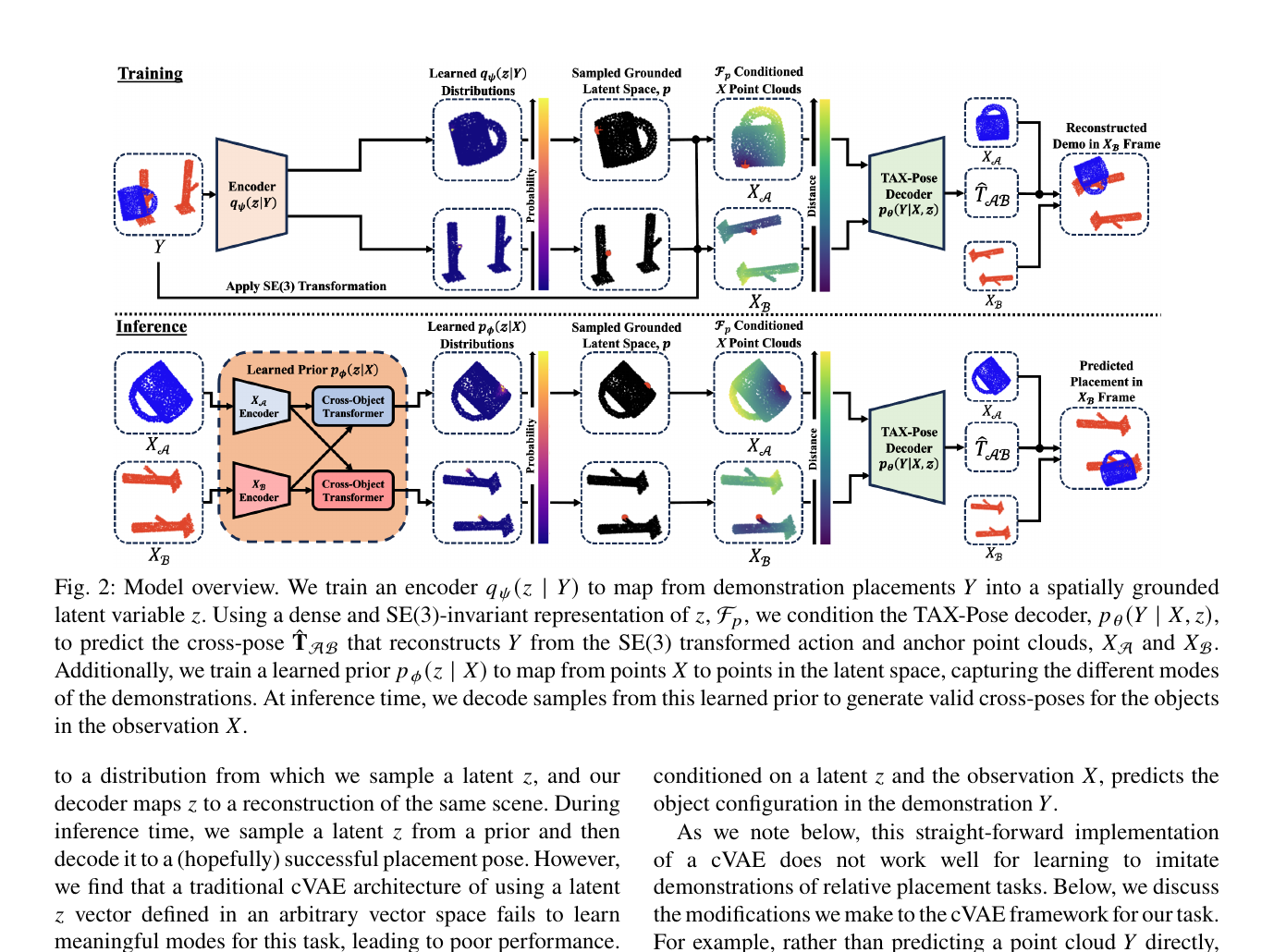
A cVAE encoder maps demonstration placements into categorical spatial latents on the point clouds.
A learned prior predicts valid-mode distributions from current geometry.
The TAX-Pose decoder outputs task-specific SE(3) cross-poses conditioned on the selected mode.
Figure 2 from the paper: demonstration encoder, spatial categorical latent, learned prior, and TAX-Pose decoder. Source: paper PDF. Image copyright belongs to the authors and publisher; reproduced here for paper commentary.
4. Main results
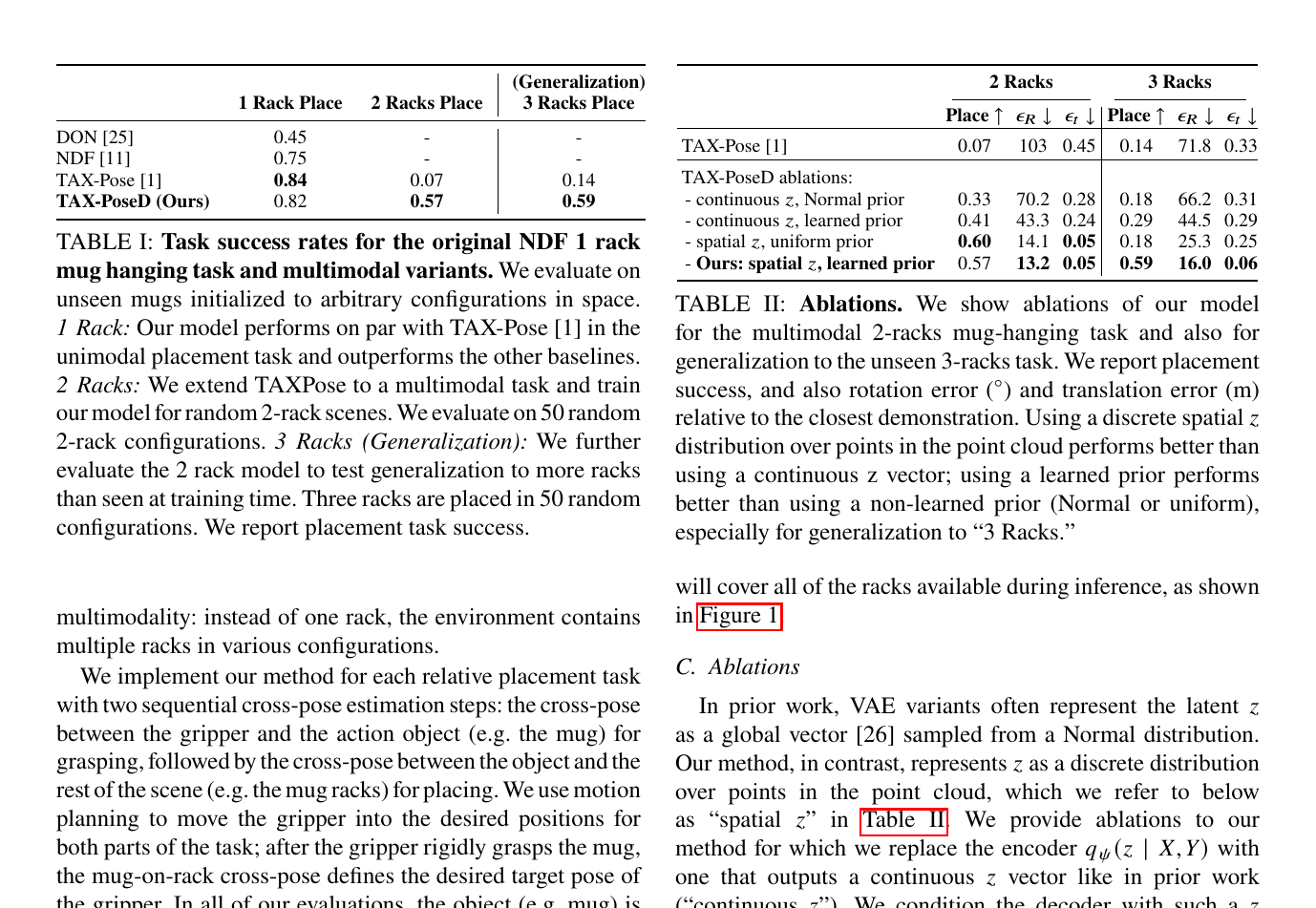
In PyBullet mug hanging, TAX-PoseD achieves 0.82 success with 1 rack, close to TAX-Pose’s 0.84. Multimodal 2-rack success improves from 0.07 to 0.57; training only on 2 racks and directly generalizing to 3 racks improves from 0.14 to 0.59.
5. Coarse-Reading Assessment
This estimates object-to-object relative pose for manipulation, rather than an object’s absolute camera-frame pose. Its central contribution is representing multimodal valid-action sets. Experiments focus on simulated mug–rack scenes with already-segmented point clouds, and success includes motion planning and stable placement.
Available src/paper-notes/distributional-cross-pose-icra2024/deep.md
In-depth paper notes
Support reproduction, comparison, related-work writing, and identifying opportunities for further research.
Deep Reading Notes: Learning Distributional Demonstration Spaces for Task-Specific Cross-Pose Estimation
1. Basic information
Authors / affiliation: Jenny Wang, Octavian Donca, David Held; Carnegie Mellon University
Relative-placement tasks often have multiple correct SE(3) solutions: a mug can hang on either peg, or a plate can occupy any placemat. Unimodal regression averages modes into a pose between support points. TAX-PoseD learns a distribution of valid cross-poses.
3. Absolute Pose, Relative Pose, and Cross-Pose
Given action object A and anchor object / scene B, predict
TAB=f(PA,PB)∈SE(3),
so that TABTA and TB satisfy the relationship defined by demonstrations. Applying one shared world transform to both objects should preserve that relationship, so the network should focus on inter-object geometry rather than world coordinates. Inputs are segmented point clouds, without object identities or manual peg-point labels.
Figure 2 from the paper: the encoder extracts spatial latents from successful demonstrations, the prior predicts modes from current point clouds, and the decoder outputs the corresponding cross-pose. Source: paper PDF. Image copyright belongs to the authors and publisher; reproduced here for paper commentary.
4. Method details
4.1 Why Ordinary cVAE Latents Are Insufficient
A standard cVAE models z as a continuous Gaussian vector. For discrete placement modes, this global vector lacks an inductive bias locating modes in the scene, making smooth intermediate decoder solutions likely.
TAX-PoseD represents z as a categorical distribution on the point cloud, directly selecting / weighting spatial locations. Mug–rack prior peaks can lie near each peg, making them interpretable and adaptable to rack counts and positions.
4.2 Encoder, Prior, and Decoder
Posterior encoder qψ(z∣X,Y) sees current scene X and successful placement Y, learning which spatial mode the demonstration used.
Learned prior pϕ(z∣X) sees only inference-available point clouds and predicts all feasible modes for the current geometry.
Decoder pθ(TAB∣X,z) uses TAX-Pose relational point features to output cross-pose.
The ELBO fits demonstrations with reconstruction / pose loss while KL(qψ∥pϕ) encourages the prior to cover demonstrated modes.
Rotation-invariant dense features communicate latent locations to the decoder instead of directly concatenating sparse one-hot maps.
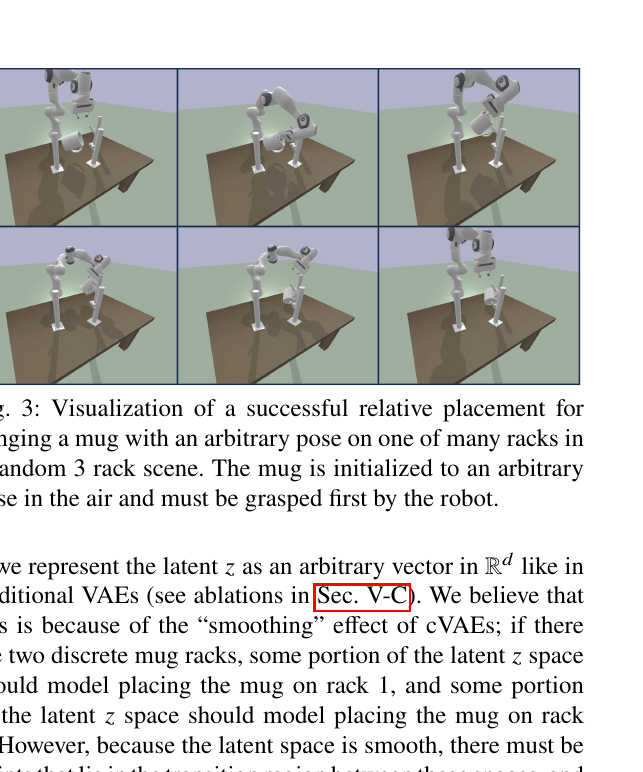
Figure 3 from the paper: cross-pose definition between action object and anchor scene, with successful relative placements. Source: paper PDF. Image copyright belongs to the authors and publisher; reproduced here for paper commentary.
5. Experiments
Four depth cameras generate PyBullet point clouds. Each task provides only 10 demonstrations; testing uses unseen mugs and random initial poses. The robot first predicts a gripper–mug cross-pose for grasping, then a mug–rack cross-pose for placement.
Method
1 Rack
2 Racks
3 Racks (trained only on 2 racks)
TAX-Pose
0.84
0.07
0.14
TAX-PoseD
0.82
0.57
0.59
Unimodal performance is largely retained, while multimodal tasks avoid TAX-Pose’s averaging into the midpoint between racks. More compelling is 3-rack generalization: a pointwise prior can assign a new probability peak to an unseen third rack at inference.
Tables I–II from the paper: placement success on 1/2/3 racks, comparing continuous latents, uniform priors, and spatial learned priors. Source: paper PDF. Image copyright belongs to the authors and publisher; reproduced here for paper commentary.
Continuous z ablations reach at most 0.41 / 0.29 success on 2 / 3 racks. Spatial z + uniform prior reaches 0.60 on 2 racks but falls to 0.18 on 3. The full learned prior obtains 0.57 / 0.59: spatial representation locates modes, while the learned prior identifies genuinely feasible points.
6. Limitations and Research Implications
Main experiments focus on mug hanging, with limited task and physics complexity.
Clean segmented point clouds are supplied, without modeling perception uncertainty.
Success depends on grasping, motion planning, and physical stability rather than a pure pose metric.
Limited reporting of distribution calibration, mode coverage, and sampling efficiency.
Three-rack generalization remains within similar geometry, without establishing cross-task composition.
For 6D pose research, symmetry and multiple solutions need not always collapse into a canonical pose. Manipulation can instead output a task-conditioned pose distribution and let the planner choose a solution using reachability, collision, and uncertainty.