DKPMV: Dense Keypoints Fusion from Multi-View RGB Frames for 6D Pose Estimation of Textureless Objects
DKPMV samples 512 CAD keypoints with FPS, improves per-view predictions through symmetry-aware training and local attention, then reconstructs keypoint clouds from dense multiview correspondences, aligns with Umeyama, and optimizes reprojection. With 8 RealSense views on ROBI, overall ADD AR / 5 mm 10° recall is 95.5 / 93.6. CAD, calibrated extrinsics, and target detection remain required.
Authors / affiliations: Jiahong Chen, Jinghao Wang, Zi Wang, Ziwen Wang, Banglei Guan, Qifeng Yu; National University of Defense Technology; Hunan Provincial Key Laboratory of Image Measurement and Vision Navigation.
Task: instance-level 6D pose estimation of known CAD objects from several calibrated RGB views when textureless, reflective industrial objects cause missing depth.
Reading mode: Overview.
2. Positioning in one sentence
DKPMV fuses multi-view geometry at 512 CAD keypoints rather than averaging single-view poses, then progressively recovers pose through point-cloud reconstruction, Umeyama alignment, and reprojection optimization.
3. Why Read This Paper?
Targets ROBI-style industrial objects: textureless, reflective surfaces complicate RGB matching and can leave large active-depth holes.
Moves multi-view fusion to keypoint correspondence, instead of estimating a pose independently per image and fusing afterward.
Symmetry can associate one image location with multiple equivalent CAD points. Symmetry-aware training aligns supervision, while attention aggregates local keypoint relationships.
4. Method overview
Sample 512 dense keypoints per CAD surface using FPS.
YOLOv11 detects targets in each view; modified CheckerPose / KeypointNet predicts a 2D location, visibility, and code for each CAD point.
Aggregate 20 neighbors per keypoint for local geometric consistency, with symmetry training mapping equivalent poses to consistent supervision.
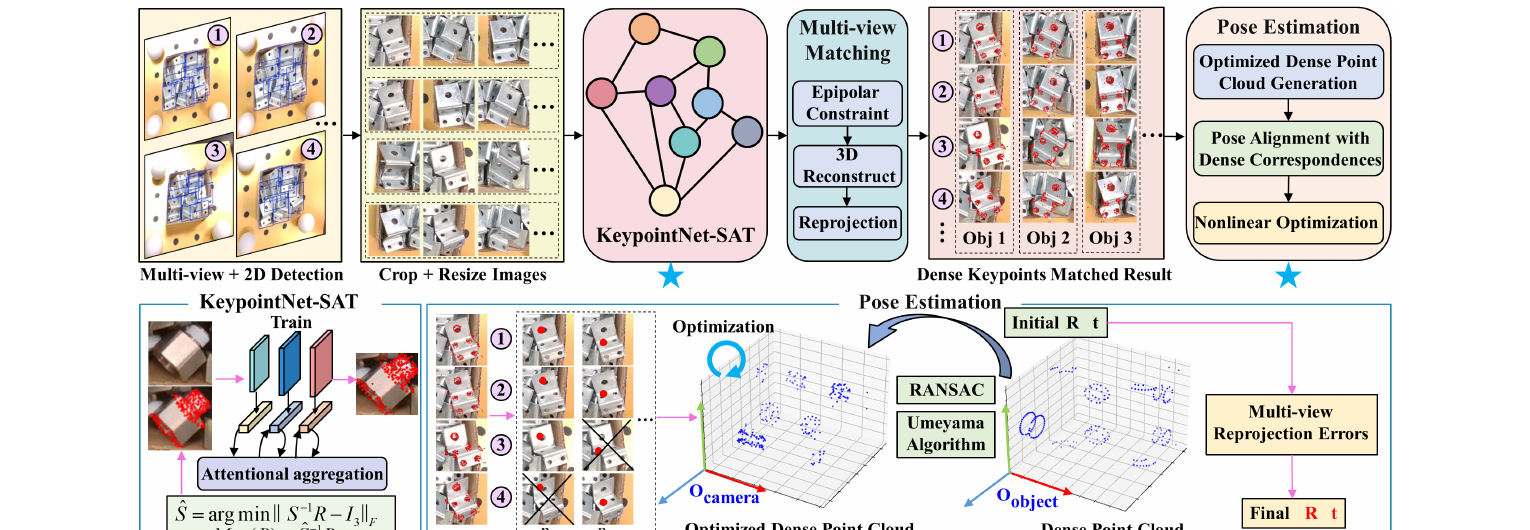
Feed multi-view 2D keypoints and known camera extrinsics into three-stage recovery:
Reconstruct 3D keypoints from multi-view rays, using RANSAC / SVD to suppress incorrect correspondences.
Align CAD keypoints and the reconstructed cloud with Umeyama.
Finally minimize cross-view reprojection error.
Figure 2 from the paper: every RGB view predicts the same CAD keypoints, followed by multi-view point reconstruction, initial alignment, and nonlinear optimization. Source: original DKPMV paper. Image copyright belongs to the authors; reproduced here for academic commentary.
5. Experiments at a glance
Dataset: ROBI, with 7 textureless / reflective industrial objects, Ensenso and RealSense capture, and 4 or 8 views.
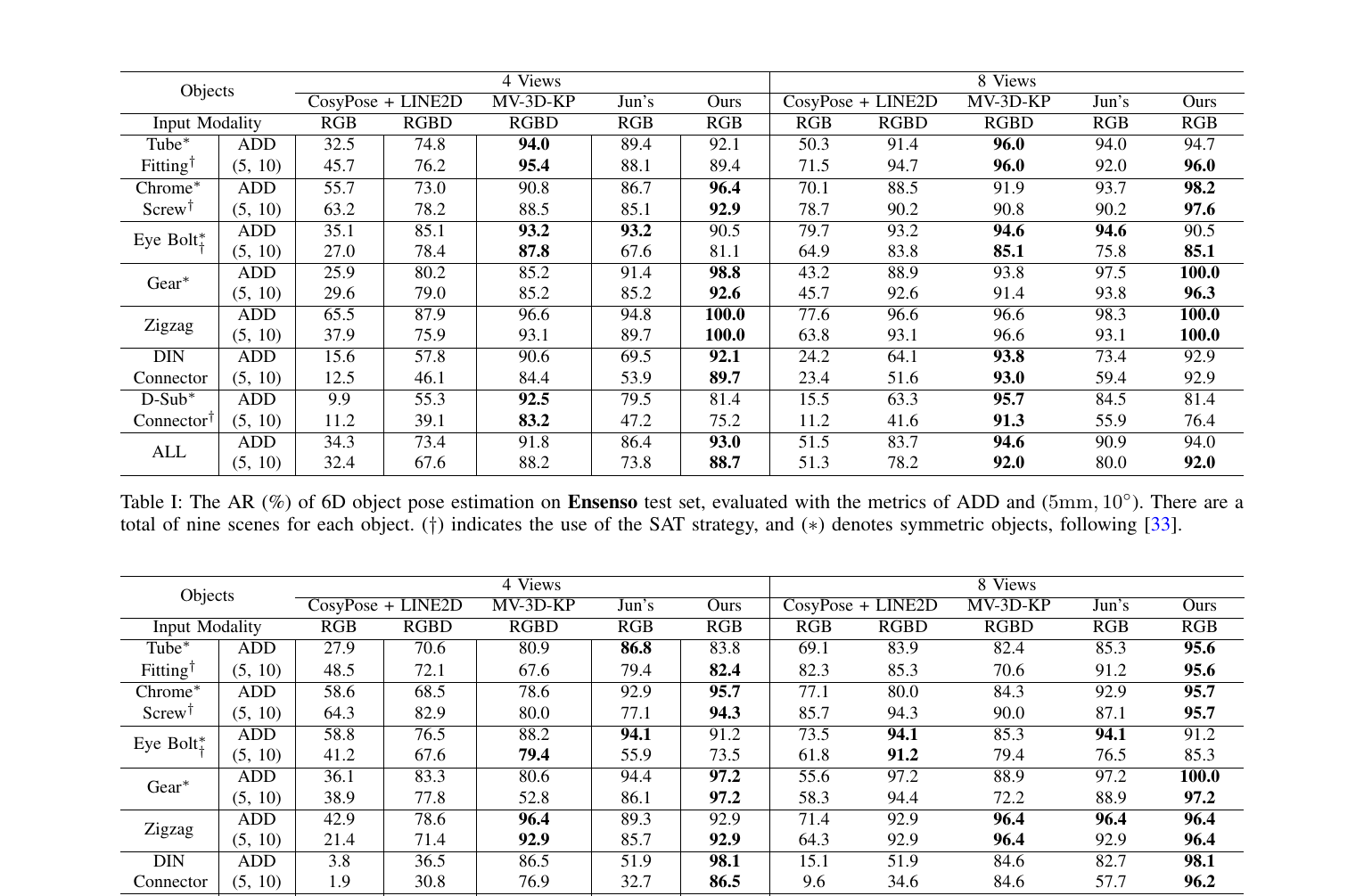
Ensenso ALL: 4-view ADD AR / 5 mm 10° recall is 93.0 / 88.7; 8-view results are 94.0 / 92.0.
RealSense ALL: 4-view results are 92.5 / 87.2; 8-view results are 95.5 / 93.6.
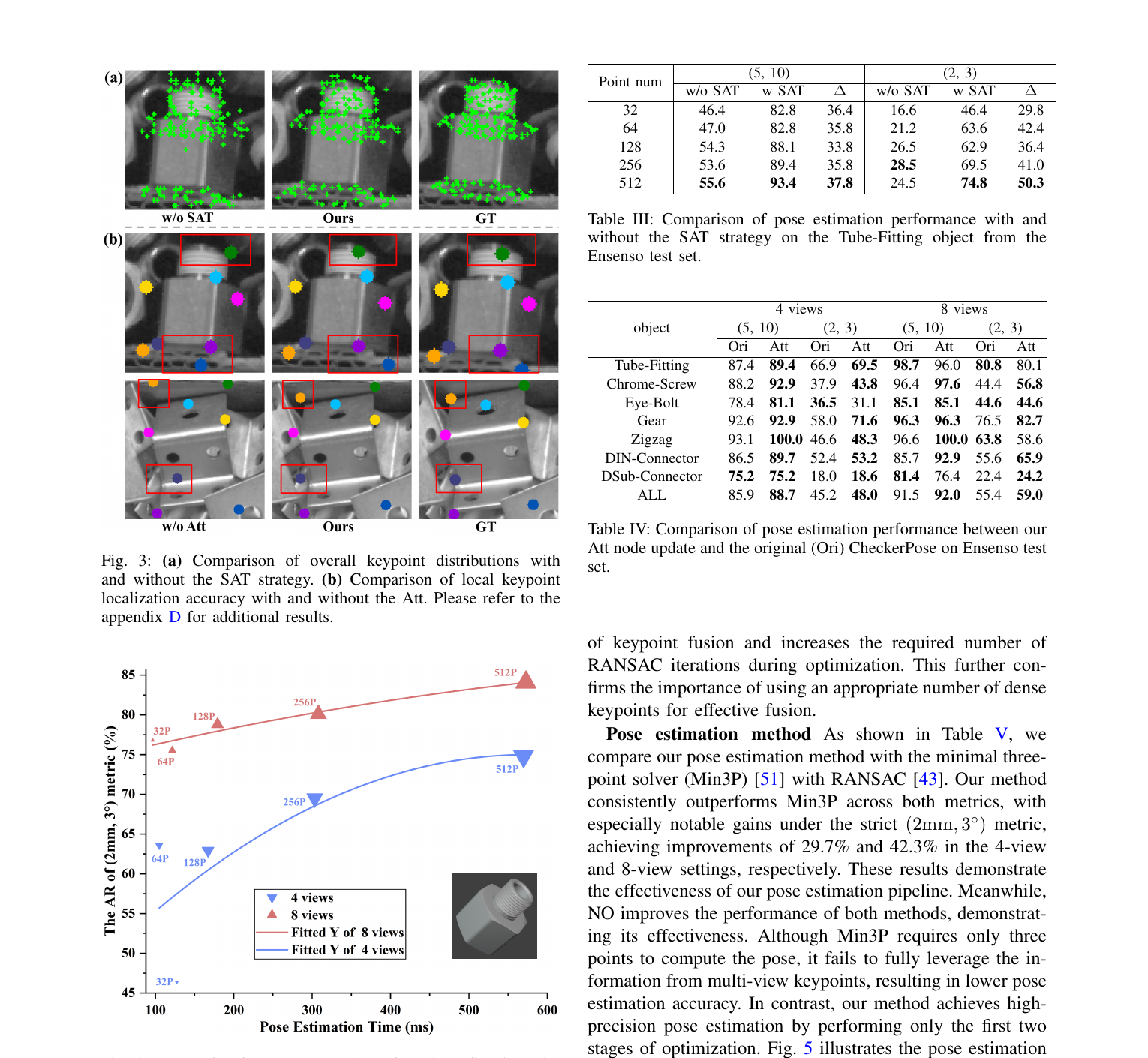
Tube Fitting with 512 keypoints: symmetry-aware training raises 5 mm 10° from 55.6 to 93.4 and strict 2 mm 3° from 24.5 to 74.8.
6. Quick assessment
Strengths: avoids unreliable depth, applies multi-view constraints at point level, and explicitly addresses symmetry and local keypoint structure.
Boundaries: still requires object CAD, accurate camera extrinsics, multi-camera synchronization, and detection; more keypoints / views increase compute and memory.
RGB-only means no online depth measurements, rather than monocular model-free estimation. Strong geometric priors and multi-camera calibration remain.
Available src/paper-notes/dkpmv-icra2026/deep.md
In-depth paper notes
Support reproduction, comparison, related-work writing, and identifying opportunities for further research.
Deep Reading Notes: DKPMV: Dense Keypoints Fusion from Multi-View RGB Frames for 6D Pose Estimation of Textureless Objects
Core question: when textureless, reflective industrial objects destabilize RGB correspondences and frequently defeat depth sensing, how can multi-view constraints be used beyond averaging unreliable single-view poses?
Core answer: fuse dense CAD keypoints rather than poses. All views predict the same 2D keypoints under visibility and symmetry conventions, then calibrated cameras reconstruct a 3D cloud for CAD alignment.
My assessment: the contribution is an interface combining fusible keypoint representations with progressive multi-view recovery, rather than a new closed-form pose solver. Effective on ROBI, it should not be characterized as model-free or monocular RGB.
2. Positioning in one sentence
DKPMV is a dense-CAD-keypoint multi-view RGB 6D pose pipeline: symmetry-aware supervision resolves label ambiguity, neighborhood attention improves point predictions, and three-stage geometry converts cross-view correspondences into precise pose.
2.1 Guide to figures and tables
Figure / table
What to examine
Figure 2
How 512 CAD points retain identity across RGB views and flow through three-stage recovery.
Tables I–II
Read Ensenso / RealSense and 4 / 8 views separately; ALL gives overall results.
Figure 3, Tables III–IV
Which errors attention and symmetry-aware training correct individually.
Table V
Compare DKPMV and generic Min3P three-stage recovery: gains involve input-point quality and first-stage geometry beyond final optimization.
Figure 2 from the paper: after detection, per-view networks predict dense keypoints with shared CAD identities. Multi-view recovery performs 3D-point reconstruction, initial alignment, and reprojection optimization in sequence. Source: original DKPMV paper. Image copyright belongs to the authors; reproduced here for academic commentary.
3. Problem setting
Inputs are V synchronized or nearly synchronized RGB images, known camera intrinsics / extrinsics, and test-object CAD. The goal is rotation R∈SO(3) and translation t∈R3 in a shared reference-camera frame. Online depth is unused, but three strong priors remain:
Known identity and CAD: predicted points are predefined CAD-surface locations rather than category-free keypoints.
Known inter-camera extrinsics: calibration determines whether multi-view rays intersect correctly.
Per-view detection boxes: the paper uses YOLOv11; detection failures stop the pipeline before keypoint prediction.
RGB-only therefore means no depth measurement modality, rather than no CAD, no calibration, or monocular input.
4. Why Dense Keypoints Instead of Pose-Level Fusion?
Many multi-view methods first estimate independent poses and globally optimize a consistent answer. If occlusion, reflections, or symmetry push a view into the wrong mode, the back end sees only a compressed 6DoF answer, hiding reliable local evidence. Retaining 512 keypoints and visibility exposes local support to geometry:
Reject individual points visible in too few views without discarding an entire image pose.
Directly check geometric consistency of rays assigned to the same CAD point.
RANSAC and many remaining points dilute local reflection-induced errors.
Additional views add constraints rather than merely adding poses to average.
The cost is explicit: point identities must agree across views, and predicting, storing, and pairing 512 points costs more than a few semantic keypoints.
5. Keypoint Network
5.1 CAD Point Definition and Encoding
Farthest-point sampling selects 512 CAD-surface points. Built on CheckerPose / KeypointNet-SAT, the network predicts discrete codes, visibility, and local positions rather than directly regressing every continuous 2D coordinate. Fixed CAD indices ensure output i refers to the same surface point across cameras, enabling triangulation.
5.2 Neighborhood Attention
Each target keypoint aggregates features from k=20 CAD neighbors. This is single-view attention over local object geometry, rather than a cross-view Transformer. A textureless point may be indistinct alone, while nearby contours, holes, and edges still provide structural cues.
5.3 Symmetry-Aware Training
Axial or discrete symmetries admit multiple geometrically equivalent poses. Selecting arbitrary canonical labels can demand different CAD identities for identical appearances, creating conflicting supervision. SAT uses object symmetry groups to normalize equivalent labels before supervising codes and visibility. It prevents random keypoint-identity flips at their source rather than relaxing evaluation thresholds.
Figure 3 and Tables III–V from the paper: neighborhood attention aggregates CAD-point structure; SAT particularly improves strict thresholds on symmetric objects; recovery ablations also compare DKPMV with Min3P. Source: original DKPMV paper. Image copyright belongs to the authors; reproduced here for academic commentary.
Tube Fitting with 512 points is illustrative: SAT raises 5 mm 10° recall from 55.6 to 93.4 and 2 mm 3° from 24.5 to 74.8. Such gains suggest systematic mismatches between symmetry-equivalent points rather than ordinary regression noise. Attention gives smaller but still useful strict-threshold gains.
6. Three-Stage Progressive Recovery
Stage 1: Multi-View 3D Keypoint Reconstruction
Each CAD point defines back-projected rays in multiple known cameras. Reconstruct its 3D reference-frame position and handle incorrect predictions with RANSAC / SVD. Cross-view geometry is already used here; this is not single-view PnP followed by pose fusion.
Stage 2: CAD-to-Reconstruction Alignment
Shared point indices allow Umeyama / SVD rigid alignment, producing initial R,t. CAD fixes object scale, so the relevant transform is rigid; the alignment adopts Umeyama’s stable closed-form solution.
Stage 3: Nonlinear Reprojection Optimization
Use 2D keypoints from every available view to minimize reprojection errors of CAD points under the candidate pose and camera projections. Reusing original image observations corrects small triangulation and closed-form-alignment errors.
Table V shows that DKPMV’s first two stages already produce strong results, with relatively small final-refinement gains. Applying three stages to Min3P still gives much poorer strict 2 mm 3° results: DKPMV leads by approximately 29.7 / 42.3 percentage points for 4 / 8 views. Gains therefore depend on dense, fusible points and first-stage multi-view reconstruction, beyond another nonlinear refinement.
7. Reading the Main Results
Tables I–II from the paper: per-object and ALL ADD AR, 5 mm 10°, and 2 mm 3° results, separately for Ensenso / RealSense and 4 / 8 views. Source: original DKPMV paper. Image copyright belongs to the authors; reproduced here for academic commentary.
ROBI contains higher-quality Ensenso and more common RealSense capture. Overall results:
Sensor
Views
ADD AR
5 mm 10°
Ensenso
4
93.0
88.7
Ensenso
8
94.0
92.0
RealSense
4
92.5
87.2
RealSense
8
95.5
93.6
Increasing views from 4 to 8 usually helps, especially for RealSense, consistent with geometric redundancy compensating for weaker individual views. Results still vary by object, with D-Sub remaining difficult; ALL does not establish uniform stability on all reflective geometry.
DKPMV exceeds RGB-D baselines in most evaluated settings, supporting the idea that unreliable depth need not be better than no depth. This is not universal RGB superiority: comparisons are limited to ROBI, specified camera arrays, and selected baselines. High-quality depth, inaccurate extrinsics, or a single view may reverse the conclusion.
Supported by ROBI tables and Min3P comparisons, without broader cross-domain industrial-dataset validation.
SAT resolves symmetric-object keypoint ambiguity
Large strict-threshold Tube Fitting gains provide direct evidence; discrete / continuous symmetry coverage still needs checking.
RGB alone can exceed RGB-D
Holds in most ROBI comparisons, relying on multiple views, CAD, and calibration; not a universal sensor conclusion.
Three-stage recovery exploits multi-view geometry
Derivation and ablations agree; final optimization is not the sole source of accuracy.
9. Reproduction Checklist
Specify the 512-point FPS seed, CAD units, and origin; changing indices invalidates the trained network.
Use the same BOP / ROBI symmetries for SAT, aligning training and evaluation equivalence classes.
Extrinsic errors appear as keypoint errors; first validate calibration through reprojection.
Inspect views-per-point visibility, RANSAC minimum samples, and thresholds alongside final pose.
End-to-end timing must include YOLOv11, all per-view keypoint networks, cross-view fusion, and nonlinear optimization.
When these notes were compiled, the project repository link did not provide a verifiable complete reproduction package; metadata therefore does not yet mark open-source release complete.
10. Limitations and Extensions
Strong asset requirements: known CAD, object identities, and calibration. This addresses unavailable depth rather than open-world onboarding.
System complexity: multi-camera layout and synchronization may cost more than adding depth sensing; weigh application-site constraints.
Correlated occlusion: nearby camera directions produce dependent occlusions; more views need not add useful baselines.
Continuous symmetry and repetition: consistent symmetry labels remove supervision conflicts but cannot create unobservable axial orientation.
Natural next step: pass keypoint uncertainty into triangulation / alignment rather than only binary visibility, and jointly optimize small extrinsic drift for real industrial deployment.
The most reusable DKPMV idea is its interface: preserve testable local correspondences and confidence in multi-view systems, giving geometry access to evidence instead of prematurely compressing every image into one pose.