DVMNet: Computing Relative Pose for Unseen Objects Beyond Hypotheses
DVMNet lifts two RGB feature maps into object-centric 3D voxels with cross-view attention. Soft voxel matching and Weighted Closest Voxel weighted SVD directly recover relative rotation without enumerating poses. Mean angular error across 10 unseen CO3D categories is 19.95°; GROP Objaverse / LINEMOD errors are 20.19° / 36.82°. Inference takes around 23 ms per pair on an A100.
ground-truth object bounding boxes in the reported protocolthe same rigid object in both imagesknown reference pose for conversion to absolute posecategory-disjoint CO3D or GROP training pairs
Full paper metadataAuthors, affiliations, research area, datasets, metrics, method tags, and reading statusExpandCollapse
ground-truth object bounding boxes in the reported protocolthe same rigid object in both imagesknown reference pose for conversion to absolute posecategory-disjoint CO3D or GROP training pairs
Reading Notes
Overview / Deep Dive
Available src/paper-notes/dvmnet-cvpr2024/coarse.md
Paper overview notes
Quickly assess the paper's scope, problem setting, core method, experimental findings, and whether to read it in depth.
Overview Notes: DVMNet
1. Basic information
Title: DVMNet: Computing Relative Pose for Unseen Objects Beyond Hypotheses
DVMNet lifts reference / query RGB images into a shared object-centric 3D voxel grid, softly matches voxels, and combines 2D masks with 3D objectness in Weighted Closest Voxel SVD for relative rotation, avoiding thousands to hundreds of thousands of discrete pose hypotheses.
3. Guide to figures and tables
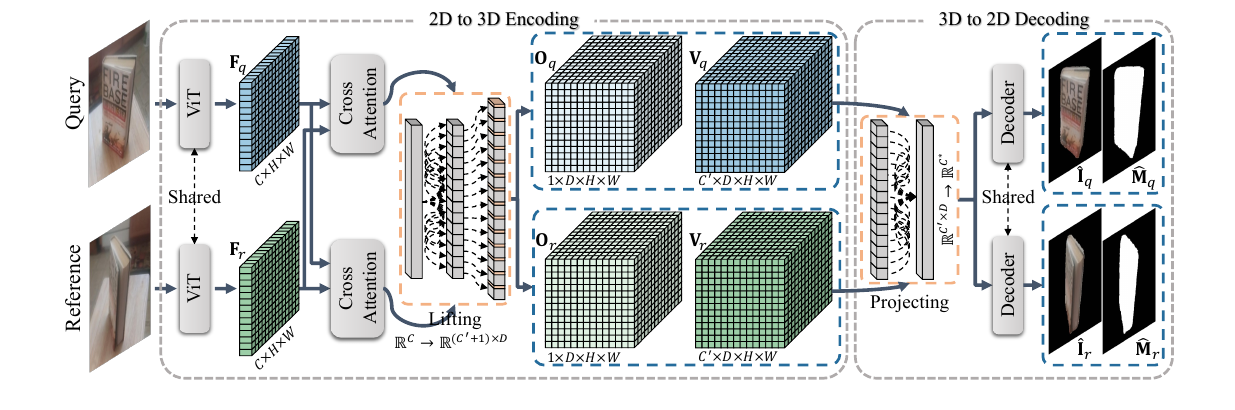
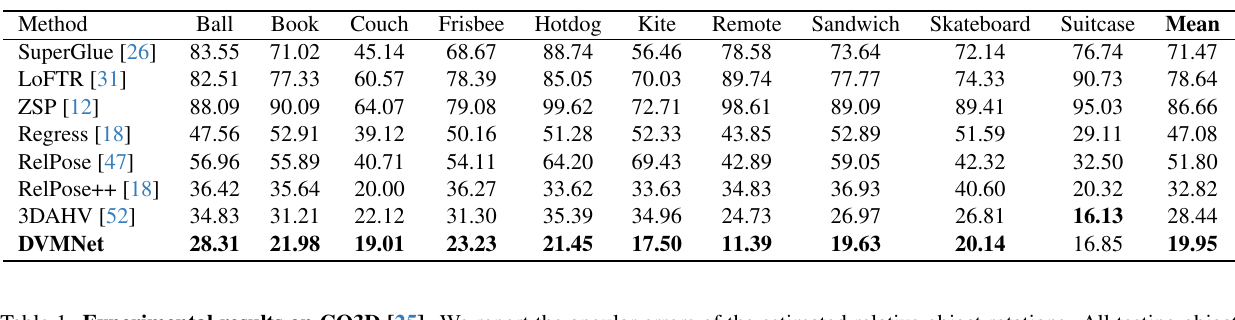
Figure 2 from the paper: shared ViT features and cross-view attention lift two images into voxel volumes with 3D objectness. A decoder reconstructs foreground images and masks, encouraging object shape rather than background in the voxels. Source: official CVPR 2024 paper. Image copyright belongs to the authors and IEEE/CVF; reproduced here for paper commentary.Table 1 from the paper: all 10 CO3D test categories are unseen during training. DVMNet mean angular error is 19.95°, versus 3DAHV 28.44° and RelPose++ 32.82°. Source: official CVPR 2024 paper. Table copyright belongs to the authors and IEEE/CVF; reproduced here for paper commentary.
4. Problem setting
Input: reference / query RGB crops of the same object.
Output: query rotation relative to the reference, ΔR; known absolute reference pose enables query rotation recovery.
Not required: CAD, depth, or a discrete template database.
Ground-truth bounding boxes are supplied, excluding detection errors.
Training / testing: CO3D uses 41 training and 10 test categories; GROP uses Objaverse and real LINEMOD with test objects excluded from training.
5. Method overview
A shared ViT encodes both RGB images, with cross-view attention making each representation aware of the other view.
Channel reshaping lifts 2D features into a fixed 3D voxel grid and predicts voxel objectness.
A shared decoder projects voxels back to 2D and reconstructs foreground images / masks, supplying shape supervision without CAD.
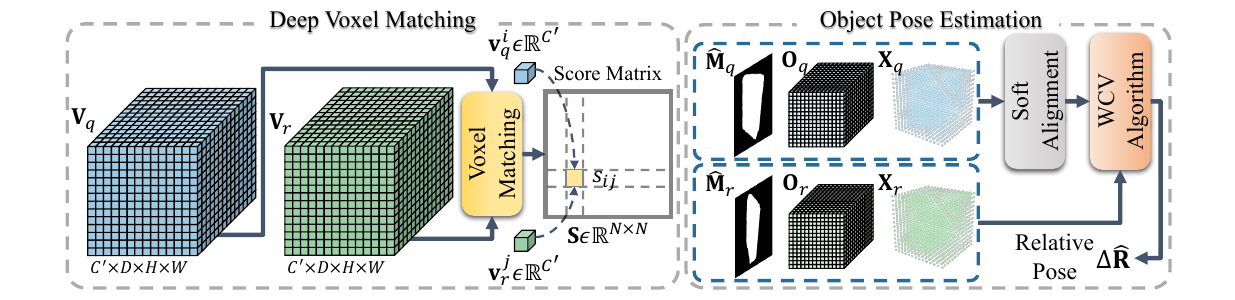
Query / reference voxel cosine similarities form a score matrix; softmax gives soft voxel correspondences.
WCV combines 2D pseudo-masks and 3D objectness into reliability weights, forms weighted covariance, and solves ΔR through SVD.
6. Experiments at a glance
Mean angular error over 10 unseen CO3D categories: 19.95°, versus 3DAHV 28.44°, RelPose++ 32.82°, and direct regression 47.08°.
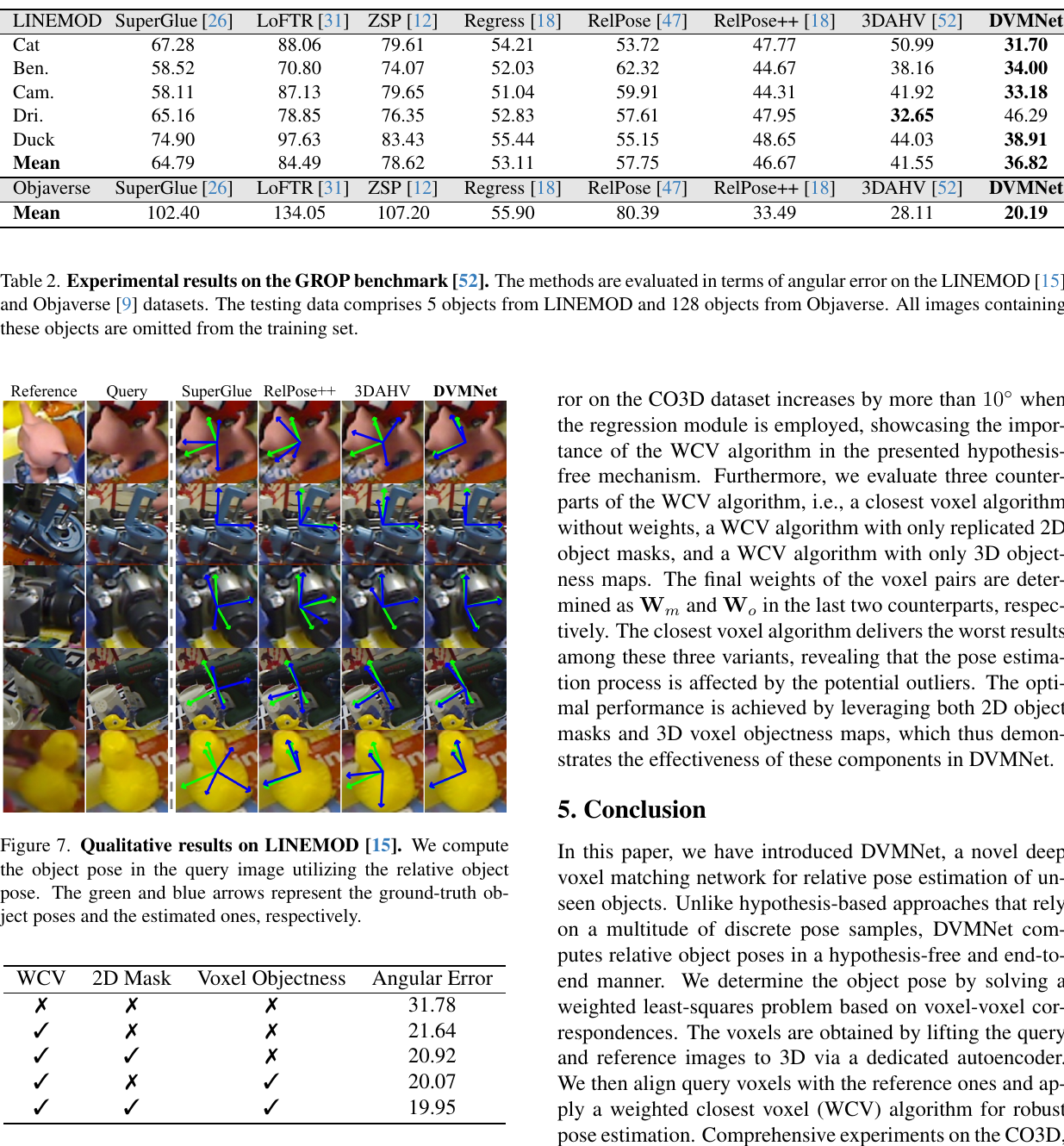
GROP Objaverse: 20.19°; 3DAHV 28.11°, RelPose++ 33.49°.
GROP LINEMOD: 36.82°, versus 3DAHV 41.55°. DVMNet’s driller error is 46.29°; it does not lead every object.
Mean image-pair runtime on A100: 23 ms, versus RelPose++ 29 ms and 3DAHV 35 ms.
Full WCV model: 19.95°; without WCV: 31.78°; direct-regression replacement: 21.64°; mask-only / objectness-only: 20.92° / 20.07°.
7. Quick assessment
Highlight: formulates relative pose as interpretable voxel correspondence + weighted Procrustes rather than enumerating and scoring rotations.
Main limitations: evaluates only rotation, without metric translation; uses ground-truth boxes; fixed voxel lifting need not represent true metric 3D.
Reading note: the 6D continuous representation parameterizes training rotations; it does not imply complete experimental 6DoF output R,t.
Intended readers: CAD-free relative rotation, 3D lifting, soft matching, weighted SVD, and hypothesis-free pose researchers.
Available src/paper-notes/dvmnet-cvpr2024/deep.md
In-depth paper notes
Support reproduction, comparison, related-work writing, and identifying opportunities for further research.
Deep Reading Notes: DVMNet
1. Key assessment
DVMNet challenges discrete-hypothesis scoring for single-reference relative pose. RelPose / 3DAHV approximate continuous SO(3) with many sampled rotations, increasing computation with hypothesis count while leaving no explicit final correspondence.
DVMNet instead:
Lifts reference / query 2D features into a shared 3D voxel grid.
Establishes soft voxel-to-voxel correspondences.
Weights them using 2D masks and learned 3D objectness.
Recovers relative rotation in one weighted Procrustes / SVD solve.
Mean angular error is 19.95° over 10 unseen CO3D categories, versus 3DAHV 28.44°, with approximately 23 ms per pair on A100. The central value is combining network predictions with closed-form geometry, beyond voxels merely looking geometric.
2. Task Boundaries
Input:
Reference RGB crop Ir of an object;
Query RGB crop Iq;
Ground-truth bounding boxes in experiments.
Output:
ΔR=RqRr⊤.
If absolute reference rotation Rr is known, Rq=ΔRRr. Translation is not estimated, so experimental relative object pose strictly means relative rotation.
Not required:
CAD / mesh;
depth;
test-object training;
pose hypothesis enumeration.
Object localization and shared instance identity are nevertheless assumed solved.
3. Cross-view 2D→3D autoencoder
Figure 2 from the paper. Shared ViT query / reference features exchange information through cross-attention, then reshape into voxel volumes and objectness maps; the decoder reconstructs foreground images and masks. Source: official CVPR 2024 paper. Image copyright belongs to the authors and IEEE/CVF; reproduced here for paper commentary.
The shared ViT extracts:
Fq,Fr∈RC×H×W.
Three cross-attention modules let query features attend to reference keys / values, and vice versa, encoding cross-view relationships before lifting.
The network reshapes channels into depth:
RC×H×W→R(C′+1)×D×H×W.
producing:
Voxel features Vq,Vr∈RC′×D×H×W;
Objectness volumes Oq,Or∈R1×D×H×W.
Without intrinsics, depth, or multi-view triangulation, these coordinates are an object-centric latent 3D grid shaped by supervision rather than metric camera-frame geometry.
The decoder aggregates along depth, applies three self-attention modules, and reconstructs foreground image I^ and mask M^. The loss is:
Autoencoder supervision encourages object patterns in the voxels and reduces background contamination of matching.
4. Deep voxel matching
Figure 3 from the paper: voxel cosine similarities form a score matrix; soft assignment aligns query coordinates to the reference. WCV combines 2D masks, 3D objectness, and voxel coordinates for relative rotation. Source: official CVPR 2024 paper. Image copyright belongs to the authors and IEEE/CVF; reproduced here for paper commentary.
Flatten valid voxels into vqi,vrj∈RC′, with similarity:
sij=∥vqi∥2∥vrj∥2(vqi)⊤vrj.
Softmax at temperature τ converts scores into soft assignments of query coordinates:
Xq′=p(S/τ)Xq.
Each reference voxel thus obtains an expected query coordinate, allowing end-to-end gradients without hard nearest neighbors.
With reliable correspondences, relative rotation follows from covariance
H=i∑xri(xqi)⊤=UΣV⊤
through closed-form ΔR^=VU⊤. Actual 2D lifting produces background and incorrect voxels, motivating WCV.
5. Weighted Closest Voxel
WCV weights combine two complementary cues:
Repeat the predicted 2D mask along depth into a pseudo-3D mask, removing obvious background.
Learned 3D objectness further assesses whether voxels represent the object.
The final weighted covariance is:
H=i∑ωixri(xqi)⊤.
Soft assignment, masks, and objectness determine ωi∈(0,1), followed by SVD rotation recovery. Pose loss compares continuous 6D representations of predicted / ground-truth rotations:
Lpose=∥q(R^)−q(Rgt)∥,L=Lae+Lpose.
Lifting, matching, weighting, and the closed-form solver can therefore train end to end.
6. CO3D: Disjoint-Category Evaluation
CO3D contains 18,619 video sequences and 51 categories. Following RelPose:
41 training categories;
10 test categories;
All test categories unseen during training;
Geodesic angular-error evaluation:
e=arccos(2tr(R^⊤Rgt)−1).Table 1 from the paper: DVMNet averages 19.95° over ball, book, couch, frisbee, hotdog, kite, remote, sandwich, skateboard, and suitcase. Source: official CVPR 2024 paper. Table copyright belongs to the authors and IEEE/CVF; reproduced here for paper commentary.
Method
Mean angular error
SuperGlue
71.47°
LoFTR
78.64°
ZSP
86.66°
direct regression
47.08°
RelPose
51.80°
RelPose++
32.82°
3DAHV
28.44°
DVMNet
19.95°
DVMNet improves on the nearest comparator, 3DAHV, by 8.49°. Poor image-matching performance shows that large viewpoint gaps on one object exceed what ordinary 2D matching reliably handles.
It does not win every category: suitcase errors are 16.13° for 3DAHV and 16.85° for DVMNet. DVMNet leads the other 9 categories, so one outlier category does not drive the mean gain.
7. GROP: Real and Large-Scale Synthetic Objects
GROP includes:
Objaverse: synthetic multi-view images of 128 test objects;
LINEMOD: 5 real objects;
Images containing test objects excluded from training.
Table 2, Figure 7, and Table 3 from the paper: GROP angular errors above, LINEMOD qualitative results at middle-left, and WCV / mask / objectness ablations below. Source: official CVPR 2024 paper. Figure / table copyright belongs to the authors and IEEE/CVF; reproduced here for paper commentary.
Data
SuperGlue
LoFTR
RelPose++
3DAHV
DVMNet
Objaverse mean
102.40°
134.05°
33.49°
28.11°
20.19°
LINEMOD mean
64.79°
84.49°
46.67°
41.55°
36.82°
LINEMOD has a stronger domain shift and textureless household objects difficult for RGB lifting. DVMNet leads the mean, but driller error 46.29° is clearly worse than 3DAHV 32.65°; local-structure robustness is not universal.
8. WCV Ablations and Efficiency
CO3D mean:
WCV
2D mask
voxel objectness
Error
None
No
No
31.78°
Direct regression replacing WCV
No
No
21.64°
Unweighted closest voxel
Yes
No
20.92°
WCV
No
Yes
20.07°
WCV
Yes
Yes
19.95°
Interpretation:
Removing the geometric solver entirely increases error by +11.83°.
Direct regression already achieves 21.64°, showing strong lifted features.
Correspondence recovery adds a further 1.69° improvement.
Objectness contributes slightly more than repeated 2D masks.
Combining masks and objectness improves on objectness alone by only 0.12°, a small but consistent gain.
Efficiency:
DVMNet: 23 ms / pair;
RelPose++: 29 ms;
3DAHV: 35 ms;
Evaluation hardware: A100.
Hypothesis-based MACs grow with samples from 1k to 500k; DVMNet matches a fixed set of locations for a better error / MAC tradeoff. Its 23 ms excludes box detection and is not a complete absolute-pose pipeline.
9. Interpreting the 3D Voxel Grid
The grid has 3D coordinates and supports rotation alignment, but is not calibrated metric scene geometry:
No intrinsics;
No depth;
Only two RGB images;
Channel reshaping defines the initial depth axis;
Cross-view, reconstruction, and pose losses supply 3D consistency.
A precise description is a learned object-centric, equivariant-like 3D latent grid. It supports relative rotation without naturally yielding metric translation. Despite weighted least squares and a 6D rotation representation, experiments therefore report only angular errors.
10. Relationship to Neighboring Approaches
NOPE enumerates 342 viewpoints and outputs multimodal distributions. DVMNet is faster and hypothesis-free, with a closed-form single solution but no explicit symmetry uncertainty.
SuperGlue / LoFTR lack object-centric 3D priors under large viewpoint gaps, yielding high error rates.
Oryon combines RGB-D, text, and robust registration to estimate ΔR,Δt. DVMNet is lighter but limited to crop-level RGB rotation.
11. Limitations and Reproduction Checks
Rotation only, rather than full 6DoF.
Ground-truth boxes in the reported protocol.
Shared reference / query instance identity is known.
Symmetric objects receive one rotation, without calibrated multimodal uncertainty.
Non-metric latent voxels do not directly extend to translation.
CO3D / GROP splits must strictly exclude test categories or objects.
Temperature τ=0.1, weight temperature 1.0, and voxel-coordinate normalization affect SVD.
Training batch 64, AdamW, learning rate 10−5, and A100 hardware.
Correctly orthogonalize the 6D rotation representation before computing loss.
Handle reflection correction for det(R)<0 in SVD.
Runtime comparisons should explicitly exclude detection.
12. Overall assessment
DVMNet’s strongest result is moving computation from hypothesis space into correspondence space and imposing geometric structure through a differentiable closed-form solver. The CO3D -8.49° gap to 3DAHV, WCV -11.83° gain over no solver, and 23 ms pair latency support this approach.
It remains a controlled relative-rotation module with ground-truth crops, no translation, and no symmetry distribution. Full robotic 6D pose also needs detection, absolute reference pose, and translation estimation. Within CAD-free, single-reference, cross-category rotation, however, DVMNet offers a clear and efficient design.