Object Pose Estimation · 2026 · ICRA / IEEE RA-L · CCF B
DynOPETs: A Versatile Benchmark for Dynamic Object Pose Estimation and Tracking in Moving Camera Scenarios
DynOPETs provides 175 RGB-D sequences with moving objects / cameras, around 210,000 frames, and over 530,000 annotations, covering category-level and unseen-object pose estimation and tracking. Annotations fuse FoundationPose absolute poses, TAP relative motion, and an SE(3) pose graph. PGO mean ATE is 4.94 mm on 10 additional motion-capture sequences. Most ground truth still comes from a pseudo-label pipeline with manually removed graph edges; independent motion-capture validation covers only 10 sequences.
moving-camera RGB-D videocamera poses from motion captureobject CAD modelsinstance masks
Requirements
calibrated RGB-D cameracamera trajectory or motion-capture setup for annotationobject scans and canonical alignmentabsolute pose proposalslong-range 2D point tracks
Full paper metadataAuthors, affiliations, research area, datasets, metrics, method tags, and reading statusExpandCollapse
calibrated RGB-D cameracamera trajectory or motion-capture setup for annotationobject scans and canonical alignmentabsolute pose proposalslong-range 2D point tracks
Reading Notes
Overview / Deep Dive
Available src/paper-notes/dynopets-icra2026/coarse.md
Paper overview notes
Quickly assess the paper's scope, problem setting, core method, experimental findings, and whether to read it in depth.
Overview Notes: DynOPETs
Summary in one sentence
DynOPETs is an RGB-D benchmark in which both objects and cameras move: 175 sequences support category-level pose, unseen-object pose, and pose tracking, with annotations produced by fusing absolute poses, relative point trajectories, and an SE(3) pose graph.
Data and tasks
The dataset contains approximately 210K RGB-D frames and over 530K mask / camera-pose / object-pose annotations, with around 500 frames per sequence at 15 Hz. The authors divide the 175 object sequences into:
COPE-119: categories including bottles, bowls, cameras, cans, laptops, and mugs for category-level pose;
UOPE-56: other household objects for unseen-object pose;
All 175 sequences: dynamic object pose tracking.
The mobile RGB-D device combines an iPad Pro with a Structure Sensor Pro. OptiTrack motion capture supplies camera trajectories; objects themselves have no markers, and CAD models / scans are scaled and aligned to object-local coordinates.
Annotation pipeline
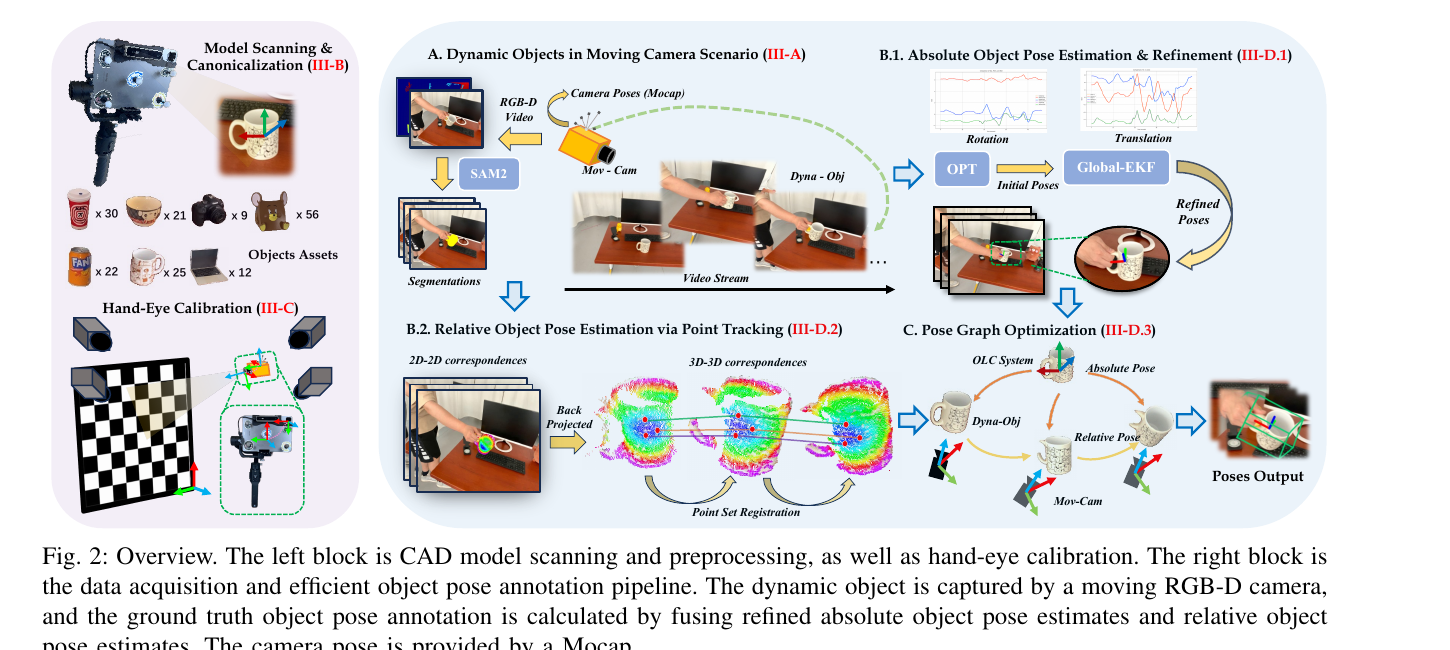
Original Figure 2: FoundationPose + EKF/RTS provide absolute poses, long-term point trajectories provide relative poses, and a pose graph fuses them. Source: original paper. Image copyright belongs to the paper’s authors; shown here for academic analysis.
Annotation has three components:
FoundationPose estimates per-frame absolute poses, with a global EKF and Rauch–Tung–Striebel smoother reducing jumps;
A TAP model tracks 2D points, which are back-projected with depth into 3D–3D correspondences; point-set registration estimates relative inter-frame motion;
A GTSAM pose graph fuses absolute and relative edges. Visibly incorrect absolute edges are manually removed before optimizing the full trajectory.
Absolute poses provide a global reference but can jump; relative poses are smoother for symmetric / weakly textured objects but drift. The pose graph exploits this complementarity.
Benchmark results
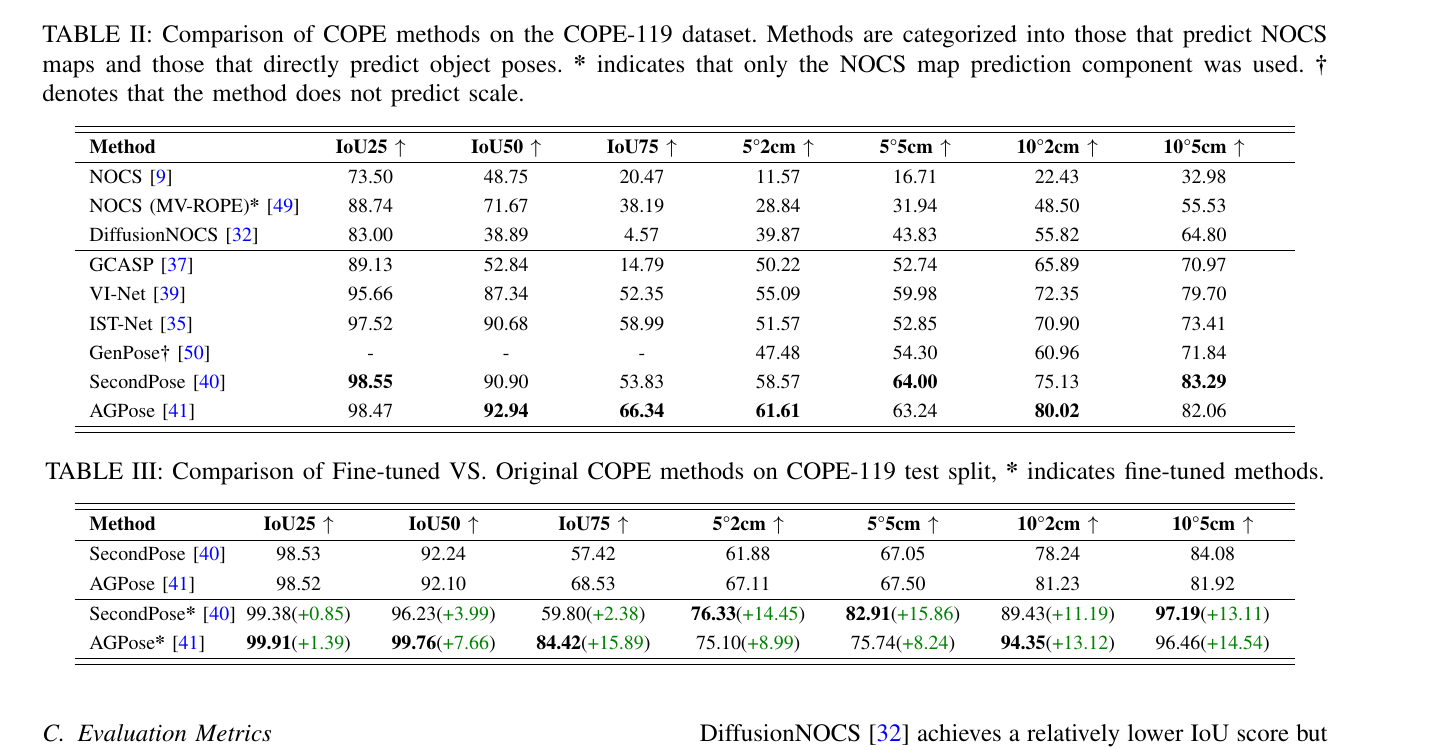
In the original COPE-119 benchmark, SecondPose / AGPose lead at different thresholds. After fine-tuning on only 84 training sequences for 2 epochs, SecondPose improves from 67.05% to 82.91% at 5°5 cm and from 84.08% to 97.19% at 10°5 cm.
On UOPE-56, FoundationPose reaches BOP AR of 92.41, clearly above MegaPose RGB-D at 80.49 and SAM6D at 79.75, but runs at approximately 0.98 FPS.
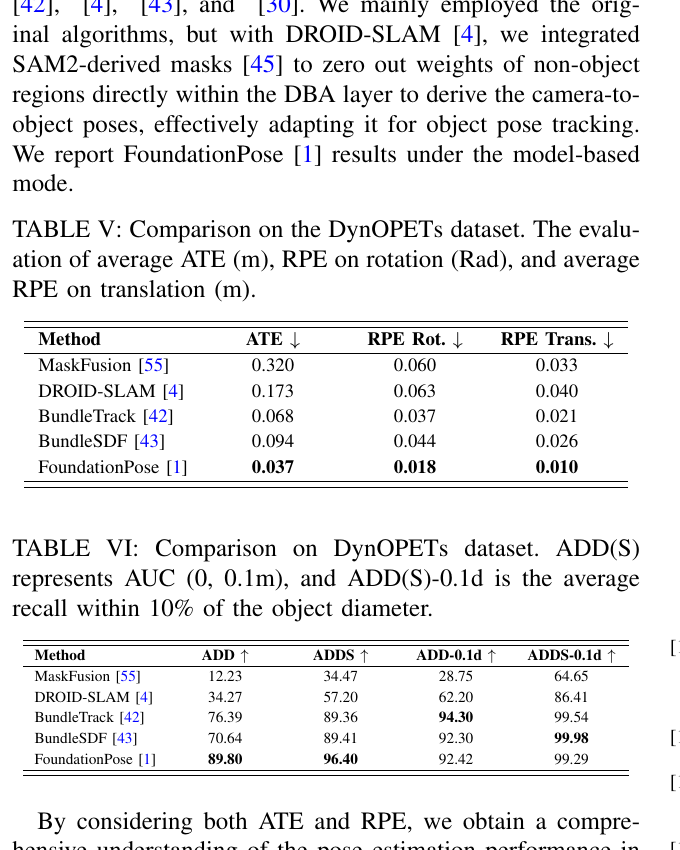
Mean tracking ATE: FoundationPose 0.037 m, BundleTrack 0.068 m, BundleSDF 0.094 m, DROID-SLAM 0.173 m, MaskFusion 0.320 m.
BundleTrack / BundleSDF exceed FoundationPose on some ADD(S)-0.1d metrics, indicating that a few full-sequence FoundationPose failures affect threshold recall.
Original Tables II–IV: COPE, fine-tuning gains, and UOPE benchmarks. Columns follow different protocols; a single bold value cannot establish an overall ranking. Source: original paper. Image copyright belongs to the paper’s authors; shown here for academic analysis.
Important boundaries
The main dataset’s “ground truth” is high-quality pseudo-annotation from FoundationPose, point tracking, manual rejection, and graph optimization, rather than markers attached to objects. The authors separately collect 10 marker-equipped sequences for independent validation, obtaining mean PGO ATE of approximately 4.94 mm. This supports annotation quality but does not establish equal accuracy across all 175 long sequences.
Assessment
DynOPETs brings three previously separate tasks into one dynamic-video domain and releases its annotation toolchain. It should be treated as an optimized-annotation benchmark with small-scale mocap validation, rather than per-frame physical ground truth. Train / test splits should isolate objects or sequences to avoid leakage between neighboring frames of the same long sequence.
Available src/paper-notes/dynopets-icra2026/deep.md
In-depth paper notes
Support reproduction, comparison, related-work writing, and identifying opportunities for further research.
Deep Reading Notes: DynOPETs
1. Why dynamic-object / dynamic-camera data are needed
Most 6D object pose datasets assume at least one controllable condition:
A fixed camera, with a turntable or robot moving the object;
A stationary object, with the camera moving around it;
Relatively independent frames, without long-term tracking-consistency requirements;
Dynamic video covering only one of category-level pose, unseen-object estimation, or tracking.
Real AR, mobile robotics, and human–robot interaction often involve a person moving an unfamiliar object while the observer also moves. Blur, hand occlusion, fast rotation, weak texture, and camera motion then occur together, challenging both single-frame pose and temporal tracking. DynOPETs mainly contributes long videos supporting the following tasks, rather than a new network:
category-level object pose estimation (COPE);
unseen-object pose estimation (UOPE);
dynamic object pose tracking (OPT).
2. Dataset scale and composition
The paper releases 175 distinct object sequences, each with approximately 500 frames at 15 Hz, totaling approximately 210K RGB-D frames and over 530K annotations. Annotations include instance masks, camera intrinsics / extrinsics, camera poses, object poses, and scanned CAD models.
COPE-119
For category-level 6D pose / size, the subset covers standard NOCS categories such as bottle, bowl, camera, can, laptop, and mug, with within-category shape and scale variation.
UOPE-56
The remaining 56 household objects evaluate novel-object estimators not previously trained on the target data, given a query object model / scan.
Tracking
All 175 sequences support object pose tracking. Challenges include both object motion and a moving camera; evaluation concerns camera-to-object trajectories expressed in the camera frame.
Acquisition uses an iPad Pro + Structure Sensor Pro. External OptiTrack mocap provides camera trajectories, aligned with RGB-D through hand–eye calibration. Objects carry no markers, avoiding texture occlusion or changes to everyday appearance. Scanning, scale recovery, and canonicalization align models to object-local coordinates (OLC).
3. Why annotation needs three geometric sources
Original Figure 2: scanning and hand–eye calibration on the left; fusion of mobile RGB-D, mocap camera poses, absolute object poses, and relative point tracking into globally consistent trajectories on the right. Source: original paper. Image copyright belongs to the paper’s authors; shown here for academic analysis.
3.1 Absolute pose: FoundationPose + EKF/RTS
FoundationPose estimates each frame’s pose from RGB-D, an object mask, and a CAD model. Absolute poses do not accumulate drift but are affected by occlusion, symmetry, and mask errors; individual frames can abruptly jump to an incorrect mode.
The authors use a constant-velocity state over the global sequence:
x=[p,q,v,ω],
Here p,q denote position and quaternion, and v,ω linear and angular velocity. A forward EKF reduces noise, followed by backward Rauch–Tung–Striebel smoothing. This reduces jitter but cannot automatically recover the correct symmetry branch when observations remain wrong.
3.2 Relative pose: TAP point trajectories + 3D registration
Query points are selected in a reference frame and followed through video with a Track-Any-Point model. Per-frame depth back-projects their 2D correspondences into 3D; point-set registration estimates inter-frame SE(3) motion.
Relative estimation avoids recognizing canonical object pose anew in every frame and is smoother for approximately symmetric or weakly textured objects. However, drifting tracks or missing depth accumulate error, and long sequences lack a global anchor.
3.3 Pose graph optimization
Each frame’s object pose becomes a graph node. Absolute estimates form unary / prior-like edges; relative motion forms adjacent or cross-frame edges. Information matrices express their reliability. All nodes are optimized in GTSAM:
Absolute edges suppress long-term drift;
Relative edges preserve local motion continuity;
Visibly incorrect absolute poses require manual inspection and edge deletion.
This manual step matters. The data result from algorithmic proposals + smoothing + manual curation + graph optimization, rather than one-click automatic ground truth.
4. Annotation validation: scope of the evidence
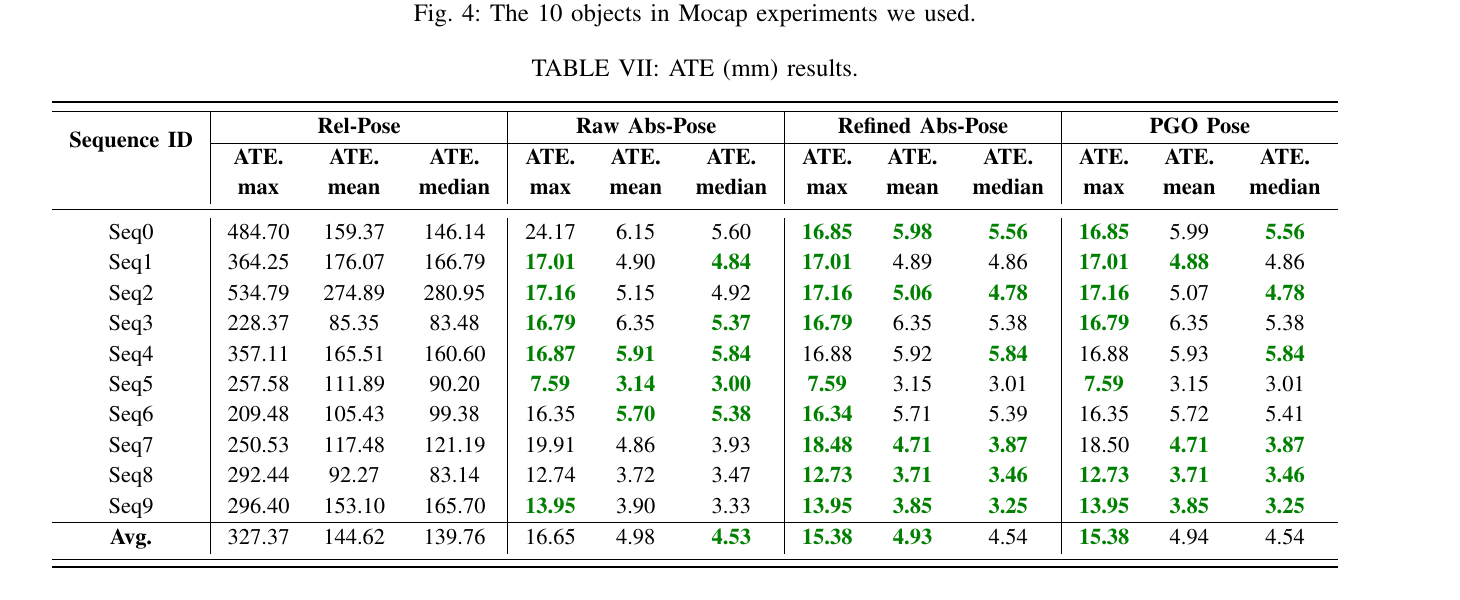
The authors attach mocap markers to 10 additional objects and collect validation sequences separate from the main data. OptiTrack then measures both object and camera reference trajectories, allowing comparison of four annotation routes:
Rel-Pose;
Raw Abs-Pose;
Refined Abs-Pose;
PGO Pose.
Supplementary Table VII: PGO has an average mean ATE of 4.94 mm and a ten-sequence average maximum ATE of 15.38 mm; relative-only pose drifts to mean ATE of 144.62 mm. Source: original paper and supplement. Image copyright belongs to the paper’s authors; shown here for academic analysis.
Key averages are:
Annotation route
ATE max
ATE mean
ATE median
Rel-Pose
327.37 mm
144.62 mm
139.76 mm
Raw Abs-Pose
16.65 mm
4.98 mm
4.53 mm
Refined Abs-Pose
15.38 mm
4.93 mm
4.54 mm
PGO Pose
15.38 mm
4.94 mm
4.54 mm
The results indicate:
Substantial long-term drift from relative-only estimation;
FoundationPose absolute estimates are already within a centimeter;
Smoothing / PGO only slightly improve average error; their main value may be removing discrete jumps and improving trajectory consistency;
The 10 validation sequences support millimeter-scale average errors, but are far fewer than the 175 main sequences, and marker-equipped validation objects may have different motion / occlusion distributions.
The main paper summarizes rotation error below 1° and translation below 1 cm. These are best treated as results of an independent small-sample audit, rather than guarantees for every frame.
5. Category-level pose benchmark
COPE evaluates both 3D IoU and pose thresholds. Methods share SAM2 segmentation where possible to reduce detector differences.
Original Tables II–IV: COPE IoU / angular-translation thresholds, brief fine-tuning gains, and UOPE BOP AR and FPS. Source: original paper. Image copyright belongs to the paper’s authors; shown here for academic analysis.
For the original models:
SecondPose: IoU25 98.55, 5°5 cm 64.00, 10°5 cm 83.29;
AGPose: IoU50 92.94, IoU75 66.34, 5°2 cm 61.61, 10°2 cm 80.02.
Different methods favor scale / IoU or strict pose thresholds; a single bold column cannot establish overall superiority.
The authors also fine-tune on 84 training sequences for only 2 epochs and evaluate on 35 test sequences:
Method
5°2 cm
5°5 cm
10°5 cm
SecondPose original
61.88
67.05
84.08
SecondPose fine-tuned
76.33
82.91
97.19
AGPose original
67.11
67.50
81.92
AGPose fine-tuned
75.10
75.74
96.46
This shows that DynOPETs training annotations provide useful supervision. Fine-tuning gains do not independently prove absolute annotation correctness, however, because domain matching can also improve results. The preceding marker-based mocap validation remains the stronger check.
6. Unseen-object pose benchmark
UOPE-56 uses BOP VSD, MSSD, MSPD, and their mean AR, and reports FPS:
Method
Input
AR
FPS
FoundPose coarse
RGB
60.46
0.50
MegaPose
RGB
72.23
2.25
GigaPose
RGB
69.79
3.37
MegaPose
RGB-D
80.49
2.61
SAM6D
RGB-D
79.75
3.75
FoundationPose
RGB-D
92.41
0.98
FoundationPose has a clear accuracy advantage but does not lead in speed. The paper also states that FoundPose’s core refinement code was unavailable, so only coarse results could be reported. This makes the comparison partly asymmetric between full methods and reproducible portions.
7. Dynamic tracking benchmark
The authors compare MaskFusion, DROID-SLAM, BundleTrack, BundleSDF, and FoundationPose. For DROID-SLAM, SAM2 masks set non-object region weights to zero, then camera motion is converted into object-relative motion.
Original Tables V–VI: FoundationPose has the lowest ATE / RPE, while BundleTrack / BundleSDF achieve higher recall on some ADD(S)-0.1d metrics. Average trajectory error and failure rate capture different behavior. Source: original paper. Image copyright belongs to the paper’s authors; shown here for academic analysis.
Trajectory error
Method
ATE ↓
RPE Rot. ↓
RPE Trans. ↓
MaskFusion
0.320 m
0.060 rad
0.033 m
DROID-SLAM
0.173 m
0.063 rad
0.040 m
BundleTrack
0.068 m
0.037 rad
0.021 m
BundleSDF
0.094 m
0.044 rad
0.026 m
FoundationPose
0.037 m
0.018 rad
0.010 m
Pose threshold / AUC
FoundationPose leads in ADD / ADD-S AUC at 89.80 / 96.40. However, its ADD-0.1d of 92.42 is slightly below BundleTrack’s 94.30, and its ADD-S-0.1d of 99.29 is slightly below BundleSDF’s 99.98. The paper attributes this to FoundationPose tracking failures in a few sequences. AUC and strict threshold recall differ in sensitivity to the failure tail, so both should be considered.
8. Risks when using the data
8.1 Pseudo-annotations and inherited algorithmic bias
FoundationPose initializes absolute poses in the main dataset. Even with relative edges and PGO, annotations may inherit its biases regarding texture, symmetry, or depth quality. Evaluation of the same or a closely related model can therefore exhibit annotation-model affinity.
8.2 Manual edge rejection matters
Clearly incorrect absolute edges are deleted manually. Reproducing data generation should record rejection rules, reviewer agreement, and retention rates; otherwise the cost of the “automatic annotation pipeline” is underestimated.
8.3 Neighboring-frame leakage
Each video contains approximately 500 highly correlated frames. Train / test splitting must operate by sequence or object, rather than randomly by frame, to prevent leakage of poses, backgrounds, and hand appearance.
8.4 175 objects do not imply 175 dynamic conditions
The paper largely provides one main sequence per object. Object coverage is broad, but repeated capture of the same instance across backgrounds, operators, speeds, and lighting is limited. It supports studying object diversity but cannot independently isolate acquisition-condition variance.
8.5 Scale of mocap validation
Independent marker ground truth covers only 10 additional sequences. Benchmark users should ideally consider quality signals such as per-frame annotation confidence, deleted absolute edges, and depth support, rather than assuming identical accuracy in every frame.
9. Differences from existing datasets
DynOPETs is distinctive because three tasks share one dynamic domain, beyond simply providing more frames:
COPE methods can test within-category shape variation and dynamic occlusion;
UOPE methods can test novel-object generalization given CAD models;
Trackers can test long-term temporal behavior, fast motion, and moving cameras.
This enables comparisons between strong single-frame recognition and temporal stability, as well as stagewise diagnosis of detection / segmentation / pose initialization / tracking.
10. Overall assessment
DynOPETs is a valuable 2026 dynamic object pose benchmark, especially as a complement to static / short-term data such as YCB-V and REAL275. Recommended use in the source notes is to:
Specify the task subset and split;
Report both ATE/RPE and ADD(S) thresholds;
Stratify by symmetry, hand occlusion, and rapid motion;
Treat annotations as pose-graph-optimized pseudo ground truth audited with small-scale mocap;
For supervised training, apply annotation-confidence filtering and cross-annotator validation.
It addresses the shortage of dynamic-domain data while highlighting a lasting research question: when large-scale 6D pose data rely on strong models for annotation, how can a benchmark quantify and avoid inheriting those models’ systematic biases?