Reading Notes
Overview / Deep Dive
Available src/paper-notes/environment-agnostic-pose-iccv2025/coarse.md
Paper overview notes
Quickly assess the paper's scope, problem setting, core method, experimental findings, and whether to read it in depth.
Overview Notes: Environment-Agnostic Pose: Generating Environment-independent Object Representations for 6D Pose Estimation
1. Basic information
- Year / venue: 2025 / ICCV; reading mode: coarse.
- Task: RGB 6D object pose estimation under environmental changes.
- Paper: ICCV Open Access; code: EA6D.
2. Positioning in one sentence
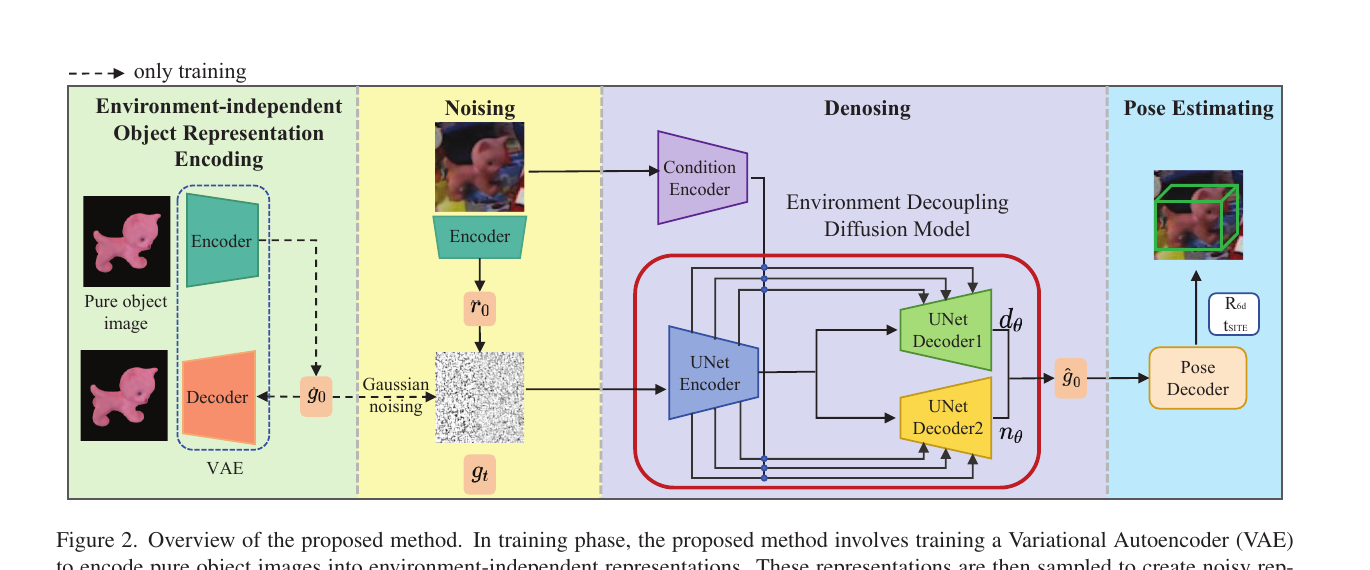
EA6D first learns a latent representation of pure-object images, then uses an Environment Decoupling Diffusion Model to generate this environment-independent representation from inputs containing background, lighting effects, and occlusion, before decoding 6D pose.
2.1 Guide to the paper’s figures and tables
| Figure / table | What to examine |
|---|---|
| Figure 2 | Training / testing paths through VAE object representations, noising, dual-decoder EDDM, and pose decoding. |
3. Method overview
- A VAE encodes pure-object images into , providing a learning target separated from environmental factors.
- With a U-Net encoder and two decoders, EDDM recovers the target object representation using an input-image prior and latent noising; a pose decoder then regresses rotation and translation.
- The paper emphasizes few-step sampling, trains mainly on synthetic data, and adds DiverseScenes for more complex environmental tests.
4. Experimental overview
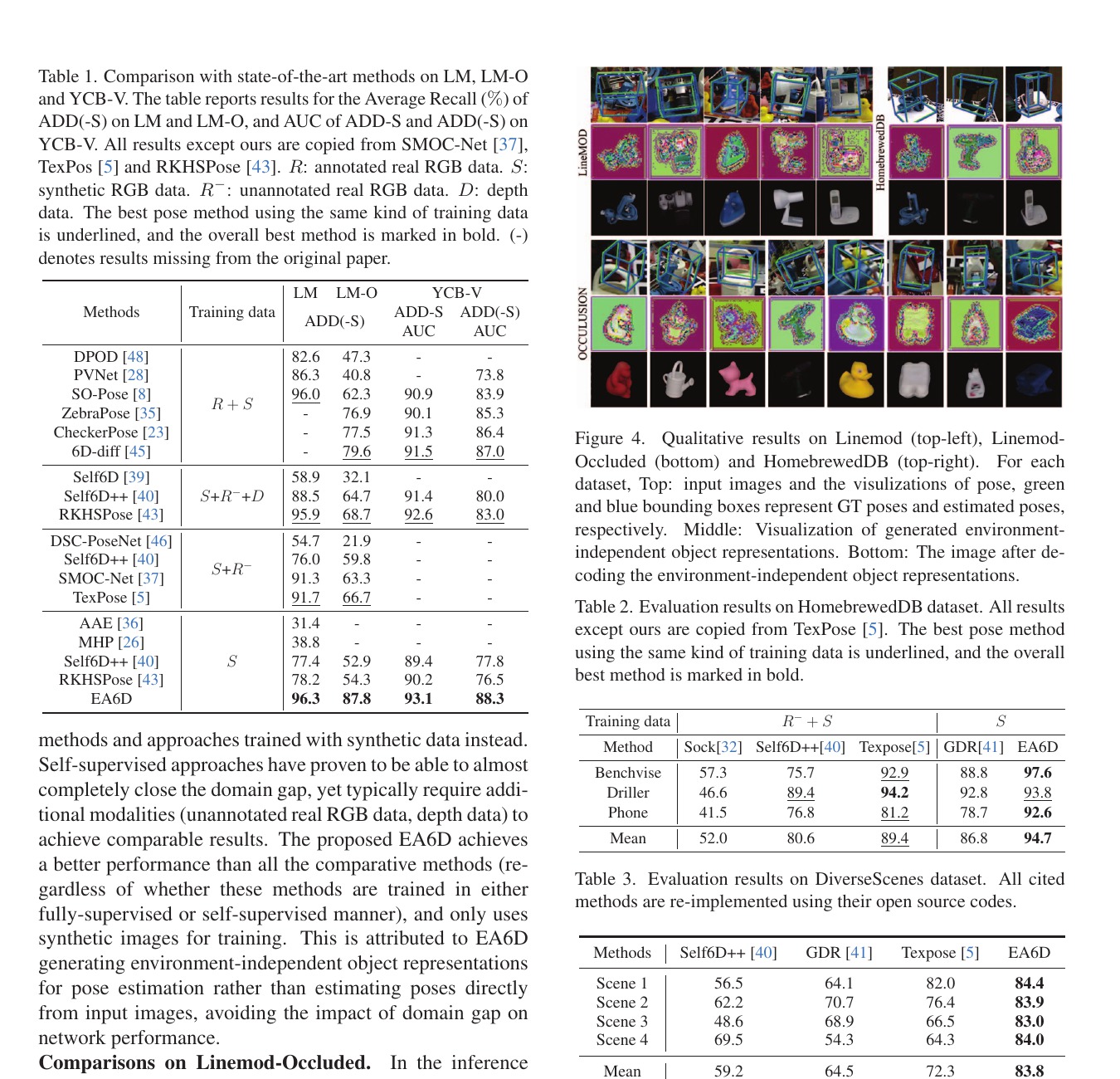
- Datasets: LINEMOD, Occlusion LINEMOD, other standard 6D pose benchmarks, and the authors’ DiverseScenes.
- Author claim: under fair synthetic-only training comparisons, improvements over previous methods are 18.1% / 33.5% on LINEMOD / Occlusion LINEMOD.
- My analysis: generating an environment-free representation makes the domain-gap objective more explicit than direct style transfer. Generalization still depends on pure-object supervision and coverage of transparent / specular objects and extreme occlusion.
5. Strengths, limitations, and implications
- Strengths: explicitly treats environmental factors as nuisance variables; few-step diffusion targets practical speed.
- Risks: instance-level training, masks/crops, and synthetic data are still required; this is not a universal solution without CAD or annotations.
- Implication: learn pose-invariant / environment-invariant latents, then evaluate geometric decoding separately from generation.