Keypoint-Based Dynamic Object 6-DoF Pose Tracking via Event Camera
The network detects semantic keypoints from event time surfaces, builds 2D–3D correspondences through a precomputed hash, and automatically initializes with EPnP. Polarity, spatial distance, and local event density propagate keypoints, while an EKF suppresses jitter. Most rotation errors on custom simulated / EVK4 data are substantially below EDOPT's, but data are limited and both models and keypoints are known beforehand.
asynchronous event streamknown 3D model keypointsinitial event time surface
Requirements
known object CAD / 3D keypointstrained object keypoint detector2D–3D hash correspondenceinitial detection before continuous trackingcalibrated event camera
Full paper metadataAuthors, affiliations, research area, datasets, metrics, method tags, and reading statusExpandCollapse
Authors
Zhe Wang, Qijin Song, Zihao Li, Jingyu Xiao, Weibang Bai
Affiliations
ShanghaiTech Automation and Robotics Center / ShanghaiTech University / WLSA Shanghai Academy
known object CAD / 3D keypointstrained object keypoint detector2D–3D hash correspondenceinitial detection before continuous trackingcalibrated event camera
Reading Notes
Overview / Deep Dive
Available src/paper-notes/event-keypoint-pose-track-icra2026/coarse.md
Paper overview notes
Quickly assess the paper's scope, problem setting, core method, experimental findings, and whether to read it in depth.
Overview Notes: Keypoint-Based Dynamic Object 6-DoF Pose Tracking via Event Camera
Authors / affiliations: Zhe Wang, Qijin Song, Zihao Li, Jingyu Xiao, Weibang Bai; ShanghaiTech STAR Center, WLSA Shanghai Academy.
Task: automatically initialize and continuously track known mechanical parts’ 6DoF poses from a monocular event stream under motion blur, low light, and fast dynamics.
2. Positioning in one sentence
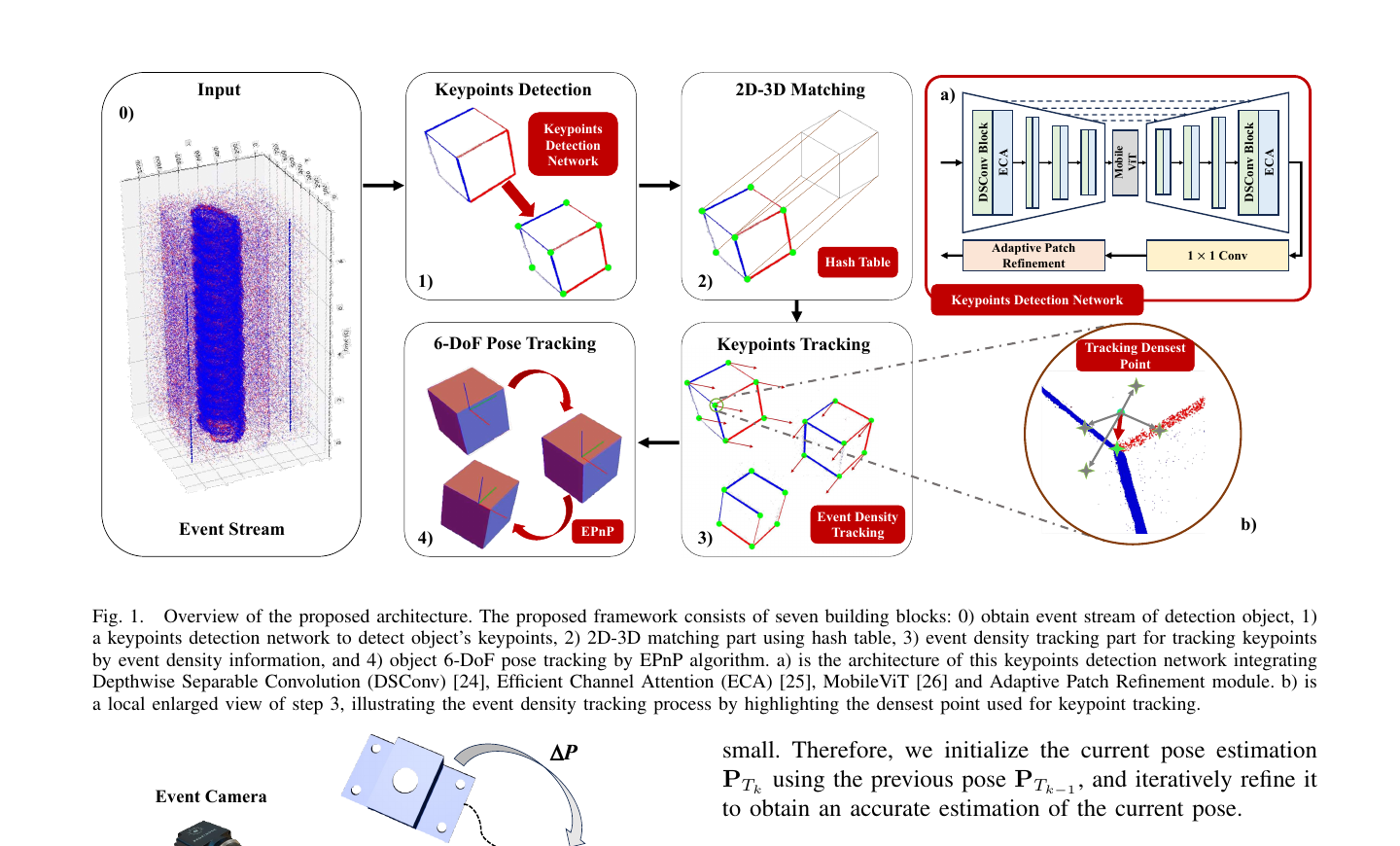
The method uses an explicit geometric chain: detect semantic 2D keypoints on a time surface → hash to known 3D keypoints → initialize pose with EPnP → propagate keypoints with polarity and local event density → stabilize trajectories with EKF → solve EPnP again.
3. Method overview
Detector: U-Net + depthwise separable convolution + ECA + MobileViT, followed by adaptive patch refinement around coarse heatmaps using a Tiny U-Net.
Losses: heatmap MSE, coordinate L1, and structural loss on the pairwise distance matrix of all keypoints.
2D–3D association: semantic keypoint indices bind to CAD keypoints through a prebuilt hash table.
Tracking: local positive / negative event ratios separate single-polarity and mixed-polarity points. The former use dominant-polarity density peaks; the latter jointly score positive / negative time surfaces and density.
Each keypoint has an EKF position / velocity state: predict during weak observations, update with reliable observations, then recover pose using EPnP.
Original Figures 1–2: the network locates keypoints during initialization / redetection only; local asynchronous event density and polarity propagate them during tracking. Explicit 2D–3D geometry always recovers pose. Source: original paper. Image copyright belongs to the paper’s authors; shown here for academic analysis.
4. Experiments at a glance
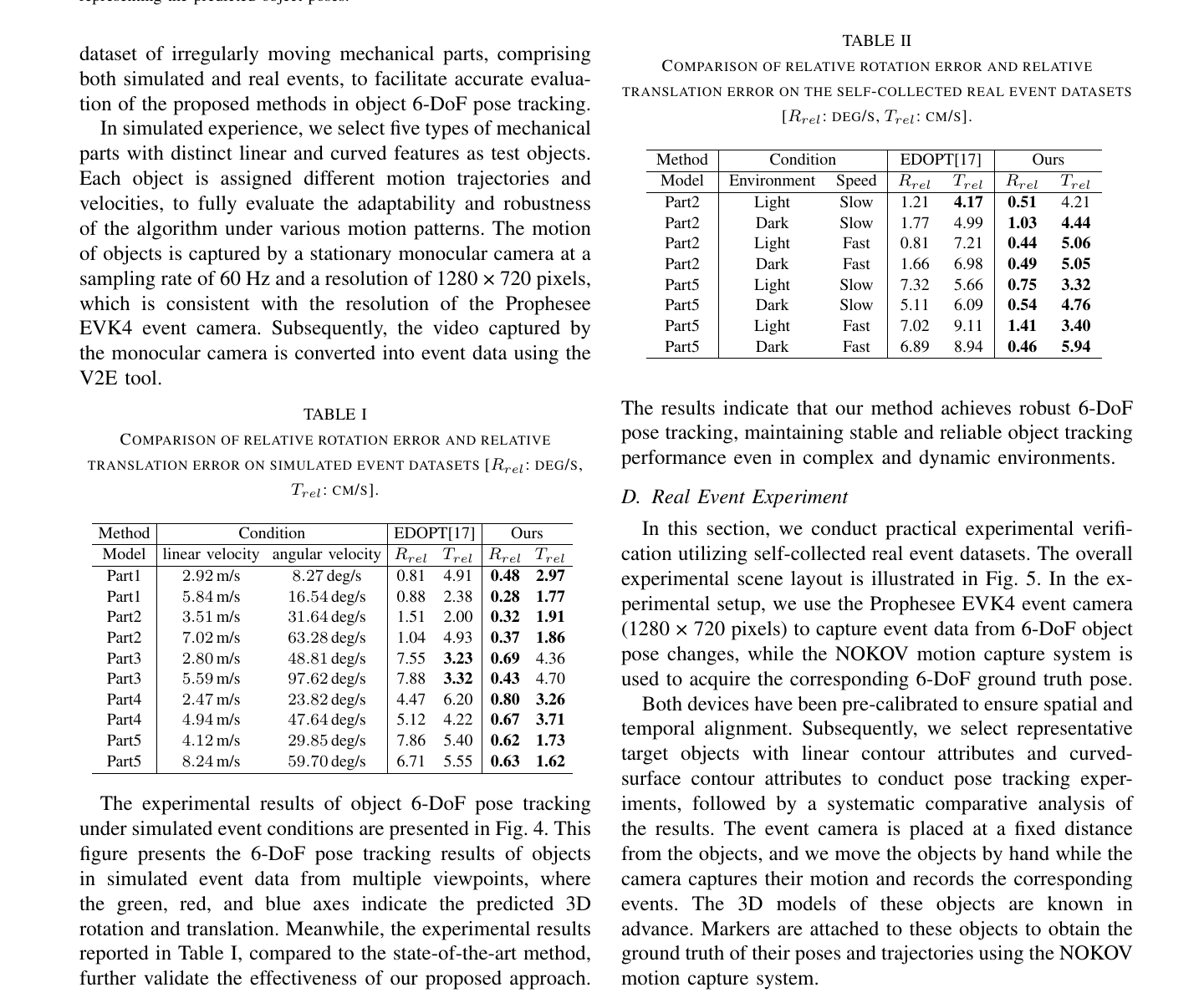
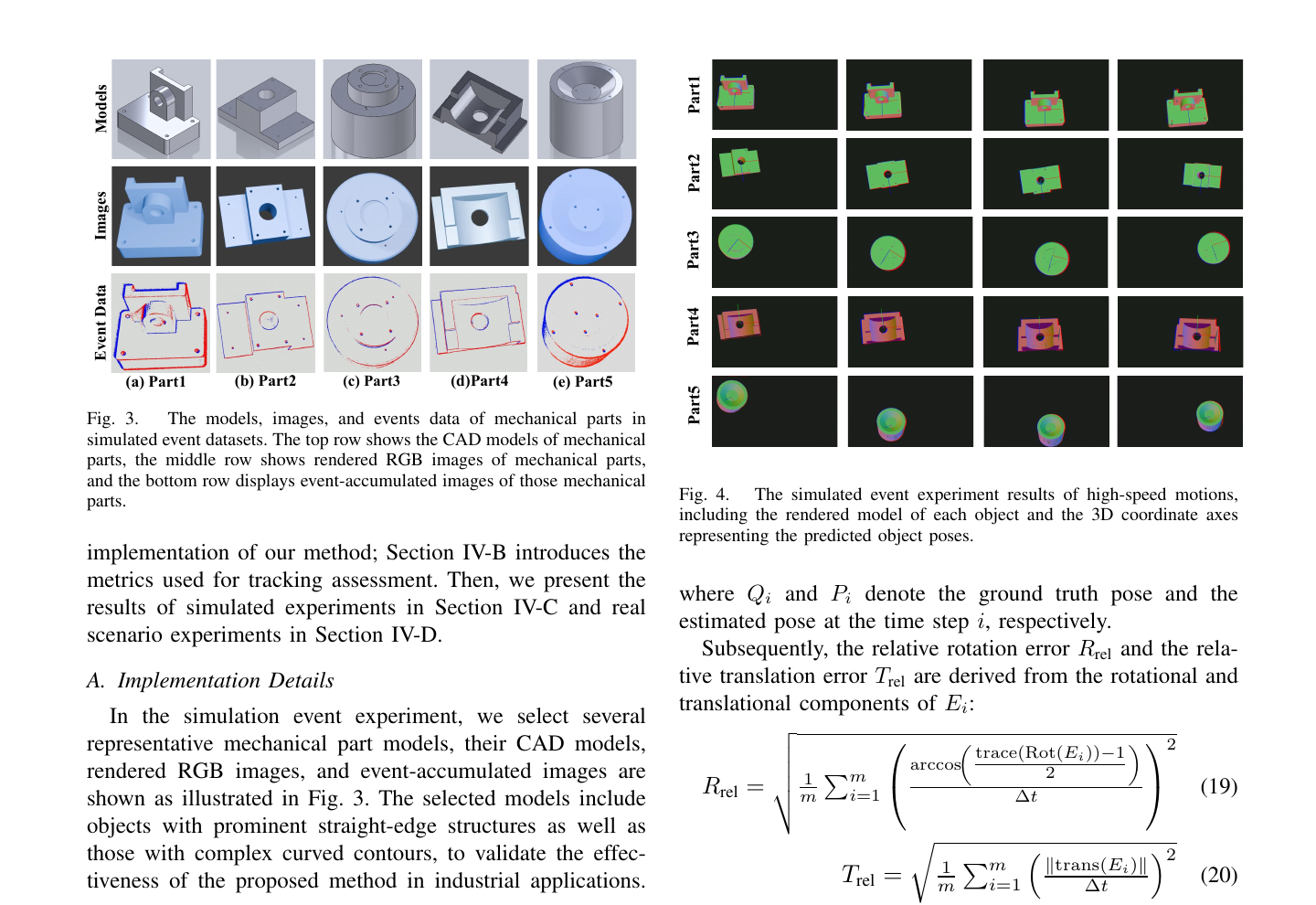
Simulation: 5 mechanical parts, RGB renders converted to events with V2E, 60 Hz at 1280×720; linear speed up to 8.24 m/s and angular speed up to 97.62 deg/s.
Rotation error is below EDOPT in all 10 simulation settings; for example, Part3 at 97.62 deg/s improves from 7.88 to 0.43 deg/s. Translation does not always improve: Part3 at 48.81 deg/s changes from 3.23 → 4.36 cm/s.
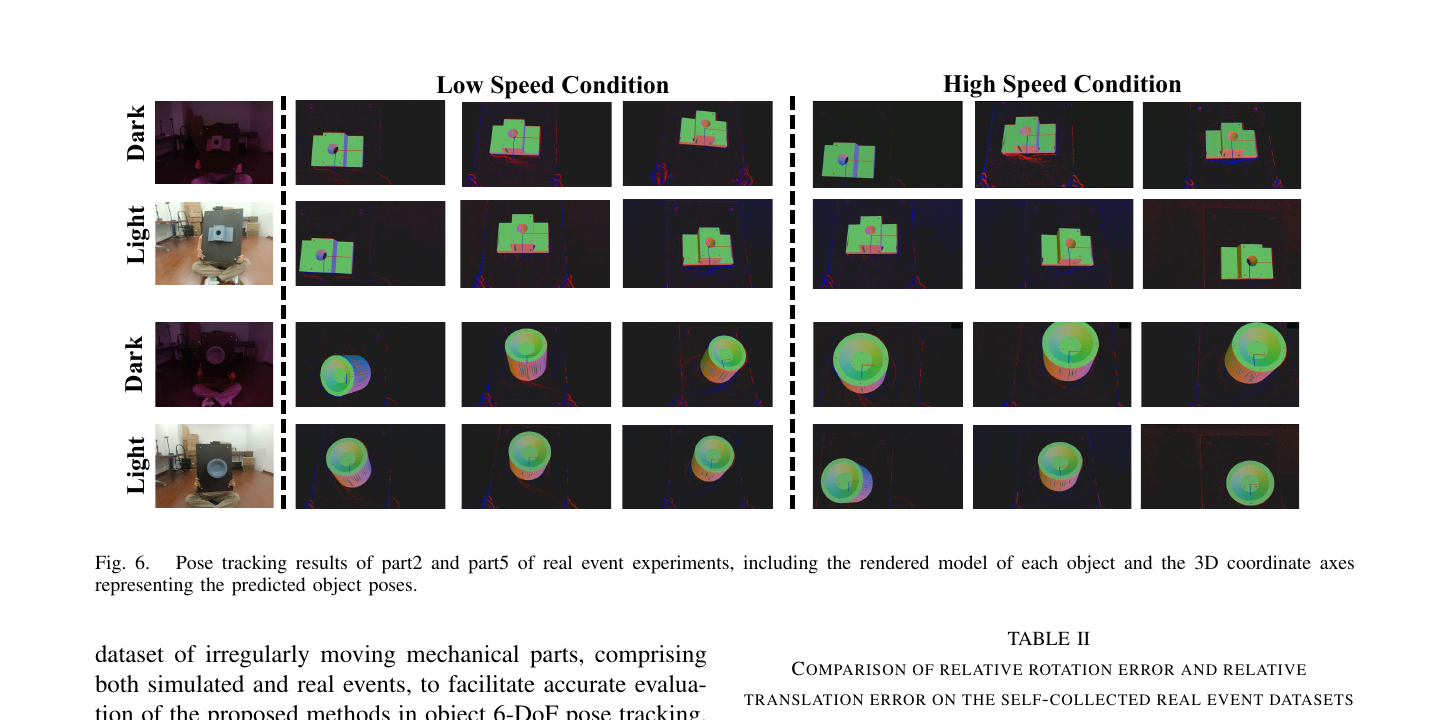
Real data: Prophesee EVK4 + NOKOV ground truth, Part2 / Part5, with 8 light / dark and slow / fast settings. Rotation error always improves over EDOPT; translation improves except Part2-light-slow at 4.17 → 4.21.
Real Part5-dark-fast: rotation / translation errors decrease from 6.89 deg/s and 8.94 cm/s to 0.46 and 5.94.
Original Tables I–II: metrics are relative inter-step motion error rates, rather than absolute-pose ADD. Rotation gains are most consistent; some translation results are similar or slightly worse. Source: original paper. Image copyright belongs to the paper’s authors; shown here for academic analysis.
5. Quick assessment
Strengths: automatic initialization, curved-part support, and a diagnosable geometric pipeline; event density is a natural cue for fast keypoint tracking.
Limitations: known models, semantic keypoints, and object-specific detectors; comparison only with EDOPT on a small custom dataset, without a general public benchmark or complete latency report.
Low relative rotation error does not directly establish accurate absolute pose. Long-sequence drift, EPnP conditioning, and redetection frequency need separate testing.
Available src/paper-notes/event-keypoint-pose-track-icra2026/deep.md
In-depth paper notes
Support reproduction, comparison, related-work writing, and identifying opportunities for further research.
Deep Reading Notes: Keypoint-Based Dynamic Object 6-DoF Pose Tracking via Event Camera
Core question: existing event object trackers often require a manually supplied first pose, clear wireframes, or planar objects. How can complex curved mechanical parts be initialized automatically under fast motion and low light without fragile direct association between sparse events and complete CAD edges?
Core answer: train a lightweight semantic-keypoint detector to establish reusable 2D–3D correspondences from event time surfaces. Continuous tracking follows local intersections of positive / negative event density around keypoints, rather than rerunning the full network, with EKF providing temporal stability.
My assessment: rotation tracking and system interpretability are the strongest aspects, with clear gains over EDOPT on custom mechanical parts. Evidence remains narrow: only 5 simulated parts, 2 real objects, and one main baseline, without absolute ADD, runtime, or long-term drift curves.
2. Positioning in one sentence
This is an event-native keypoint–PnP tracker: a neural network turns sparse time surfaces into semantic anchors; polarity–density search propagates them frequently; EKF bridges brief missing observations; EPnP recovers SE(3) from all anchors.
2.1 Guide to figures and tables
Figure / table
What to look for
Figure 1
Roles of detection, 2D–3D hashing, density tracking, and EPnP.
Figures 3–5
Data sources: simulated CAD / V2E and real EVK4 + NOKOV.
Table I
Broad speed range, but metrics are relative errors per second.
Figure 6, Table II
Light / dark and slow / fast cover only Part2 and Part5.
Original Figures 1–2: the network detects keypoints from an initial time surface, and semantic indices map them to CAD. Later steps track event density around previous locations before updating pose. Source: original paper. Image copyright belongs to the paper’s authors; shown here for academic analysis.
3. Task and event representation
An event ek=(xk,tk,pk) triggers when pixel log-intensity change exceeds a contrast threshold, with pk∈{+1,−1}. Events in a local time window form a time surface with positive / negative polarity responses, used by both detection and continuous tracking.
Object pose is Pt=[Rt∣Tt]∈SE(3). The system assumes small inter-step motion ΔP, initializes the current solution with Pt−1, and updates it through EPnP using propagated 2D keypoints and fixed 3D points. Automatic initialization uses the first keypoint detection rather than a manual pose.
Assumptions include:
Known object CAD and semantic 3D keypoints;
A network trained for these mechanical parts / keypoint definitions;
MobileViT at the bottleneck models long-range keypoint structure while preserving local edge information;
The decoder outputs a heatmap for each semantic point.
Sparse event images often contain broken edges, making local convolutions vulnerable to confusing structural fragments. MobileViT lets responses across patches jointly constrain the part’s keypoint layout.
4.2 Adaptive Patch Refinement
Crop a small patch around the k-th coarse heatmap peak, enhance local structure with a Tiny U-Net, and insert it back into the heatmap. A global network finds the approximate region and a local network sharpens its peak, avoiding enlargement of the entire backbone for subpixel precision.
4.3 Structure-aware loss
Total loss:
L=λ1Lheatmap+λ2Lcoord+λ3Lstructure.
Heatmap MSE constrains response shape;
Coordinate L1 constrains peaks relative to ground-truth locations;
Structural loss compares predicted / ground-truth pairwise Euclidean distance matrices over all keypoints.
The final term prevents arbitrary global distortion from a strong local event response. It constrains image-plane keypoint configurations rather than 3D rigid reprojection. Large perspective changes also change pairwise 2D distances, so training must cover sufficient poses.
5. 2D–3D hashing and EPnP
Each heatmap channel corresponds to a fixed semantic keypoint, directly linked to its CAD 3D coordinate through a prebuilt hash table. Initial detection yields K 2D–3D correspondences, and EPnP outputs absolute pose.
Compared with nearest-edge event–mesh optimization, this better accommodates curved objects: a few stable anchors replace full alignment of CAD contours with sparse events. However, swapping two semantic points creates confidently incorrect hashed correspondences. The paper does not emphasize RANSAC / uncertainty-weighted PnP; reproduction should check this separately.
6. Event-density keypoint tracking
During fast motion, corners / intersections of multidirectional edges continuously generate different event polarities and high local density. The authors first measure positive / negative event ratios around each keypoint and handle two cases separately.
6.1 mixed-polarity keypoint
When both polarities are abundant, score candidate (x,y) as follows:
Si(x,y)=Ti+(x,y)Ti−(x′,y′)+βDi(x,y),
This combines paired-polarity response and density, selecting the window maximum. It favors positive / negative edge intersections rather than isolated edges.
6.2 single-polarity keypoint
When one polarity dominates, a mixed product fails because one component is absent. The system instead uses the dominant-polarity time surface: large-window integration tolerates sparsity, small-window maxima identify structural peaks, and the highest combined response determines the location.
6.3 EKF
Each keypoint state contains position / velocity. EKF predicts from the previous instant and updates using density-matched positions; missing or noisy events are briefly bridged by the motion prior. The final location is blended with the original search result using α and restricted to a local window to prevent a single large anomalous jump.
This is frequent, local, and avoids a full network pass per frame. However, independent local constant-motion priors can let all points drift together under long occlusion or large displacements.
7. Data and metrics
Original Figures 3–5: five CAD parts in simulation, with RGB sequences converted to events by V2E; real experiments use Prophesee EVK4 and NOKOV mocap for spatiotemporal calibration and ground truth. Source: original paper. Image copyright belongs to the paper’s authors; shown here for academic analysis.
7.1 Simulation
The 5 parts contain straight edges and curved contours. Blender produces RGB and ground-truth poses; V2E converts them to events at 1280×720 and 60 Hz. The 10 trajectories cover:
Linear speeds of 2.47–8.24 m/s;
Angular speeds of 8.27–97.62 deg/s.
These high speeds test event-sensing advantages, but V2E contrast / noise models still differ from the real EVK4, leaving a sim-to-real gap.
7.2 Real data
Only Part2 (straight features) and Part5 (curved features) are moved by hand. EVK4 records events and NOKOV markers provide 6DoF ground truth. Light / dark × slow / fast yield four conditions per object and 8 cases in total.
7.3 Relative error
The paper compares estimated and ground-truth rotation / translation increments between adjacent steps and normalizes by Δt, giving deg/s and cm/s. This measures local motion-tracking accuracy rather than absolute pose error. Small systematic per-step biases can yield low relative errors while absolute trajectories drift; ATE / ADD or loop-return errors should also be reported.
8. Quantitative results
Original Figure 6: green boxes / axes project predicted poses onto real accumulated-event images, grouped by object, lighting, and speed. Source: original paper. Image copyright belongs to the paper’s authors; shown here for academic analysis.Original Tables I–II: Rrel is in deg/s and Trel in cm/s. Bold entries generally favor the proposed method, but not every translation result improves. Source: original paper. Image copyright belongs to the paper’s authors; shown here for academic analysis.
8.1 Simulation
Rotation error is below EDOPT in all 10 settings. Representative results:
Part3 translation worsens at both speeds (3.23 → 4.36 and 3.32 → 4.70), suggesting a keypoint configuration unfavorable to translation / depth or poor EPnP conditioning for its curved projection. Rotation mainly supports the authors’ “both accuracy and robustness” claim; the translation counterexample should remain visible.
8.2 Real data
Part2:
light slow: R 1.21 → 0.51, T 4.17 → 4.21 (slightly worse);
dark fast: 1.66 → 0.49, 6.98 → 5.05.
Part5:
light slow: 7.32 → 0.75, 5.66 → 3.32;
dark fast: 6.89 → 0.46, 8.94 → 5.94.
The largest rotation gains occur on curved Part5, supporting semantic keypoints over EDOPT’s global lines / contours for nonplanar parts. Translation remains at several centimeters per second; suitability for precision assembly requires considering frame rate and absolute error.
9. Authors’ claims and my assessment
Authors’ claims
My assessment
Automatic initialization and curved-object tracking
No manual initial pose is required; Part5 supports curved-shape applicability. Known CAD / keypoint detectors are still needed.
Better than SOTA under fast motion and low light
Supported against EDOPT on custom data; one main baseline cannot establish superiority over all event trackers.
Improved accuracy and robustness
Rotation consistently improves; translation is slightly worse in 3 cases, requiring metric-specific claims.
Suitable for real-time dynamics
Local event-density search is lightweight, but no end-to-end FPS / latency quantifies this claim.
10. Reproduction checklist and limitations
Release / fix the five CAD models, 3D keypoint definitions, training-pose distribution, and V2E parameters.
Add public event datasets or release the custom EVK4 + NOKOV data for fair comparison with more methods.
A local window + EKF cannot globally relocalize after major occlusion / departure from the FOV; periodic neural redetection is needed.
The paper provides no official code / data links; this site does not mark reproducibility as complete.
Event cameras can support more than continuous edge-to-model optimization. Stable semantic keypoints followed by classical PnP combine complex geometry with automatic initialization. The next step is broader public evaluation and extending strong relative rotation results to absolute, long-term pose tracking with recovery.