Direct 3D Model-Based Object Tracking with Event Camera by Motion Interpolation
BIAM converts ROI events into absolute brightness increments and interpolates 3D model rendering across the entire motion window. Predicted images reproduce accumulation blur in real events, improving continuous tracking with perspective / fisheye cameras at speeds up to around 2 m/s.
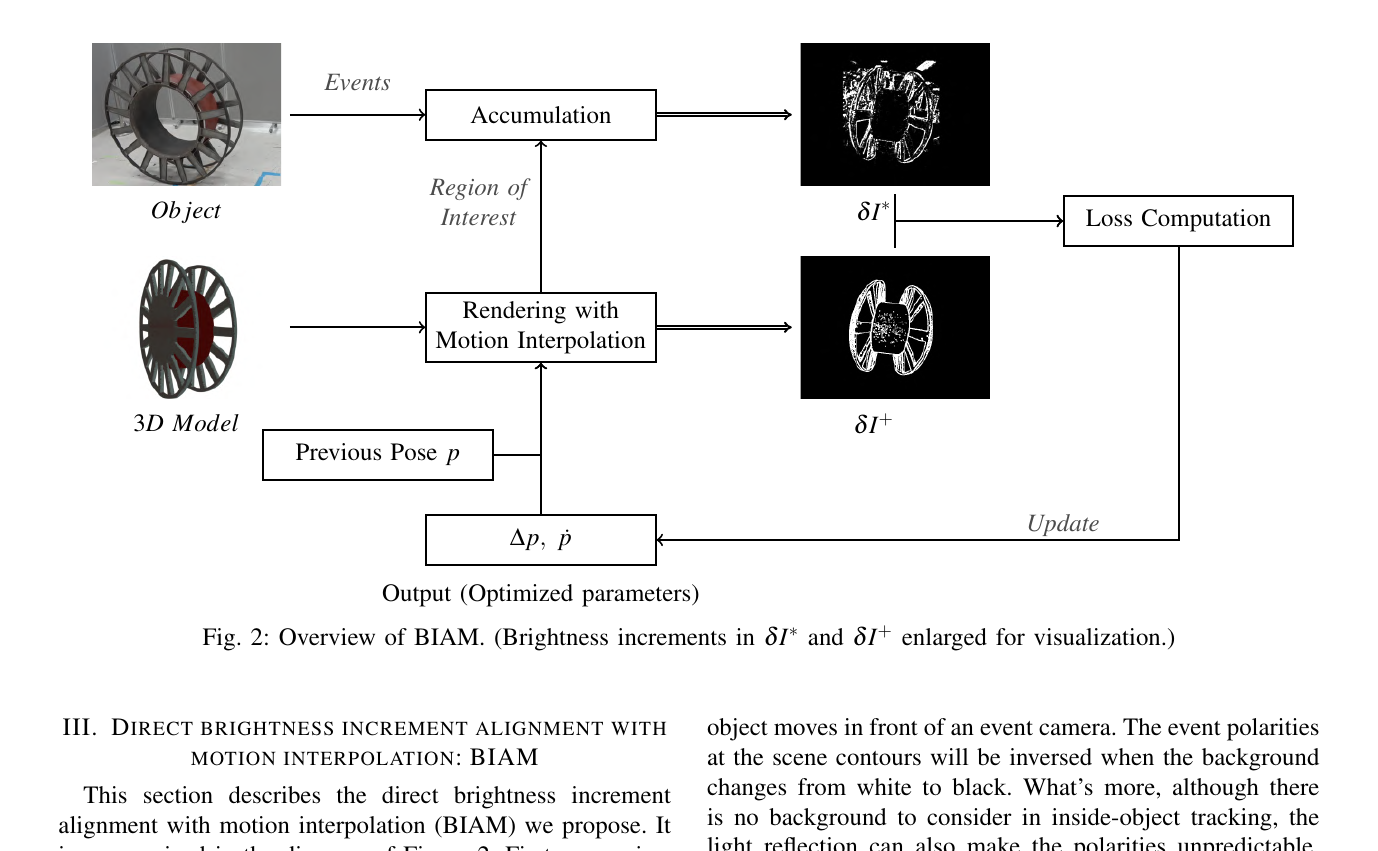
BIAM accumulates asynchronous ROI events into an absolute brightness-increment image. Interpolating a 3D model’s projected motion between neighboring poses produces a prediction with similar motion blur; direct optimization of pose and velocity then tracks fast 6DoF motion.
3. Task boundaries
Inputs: events, a known 3D model with appearance, camera calibration, and a manually supplied initial pose.
This is tracking rather than redetection from arbitrary initialization; the previous pose initializes the next optimization.
Supports perspective and fisheye cameras, emphasizing fast egocentric motion.
The new dataset has 5 objects, 14 perspective sequences, and 15 fisheye sequences; only the large coil has complete quantitative results.
Original Figure 2: direct alignment of observed event images with brightness increments predicted from a 3D model, pose, and motion interpolation. Source: paper project page. Image copyright belongs to the paper’s authors and publisher; shown here for paper analysis.
4. Main results
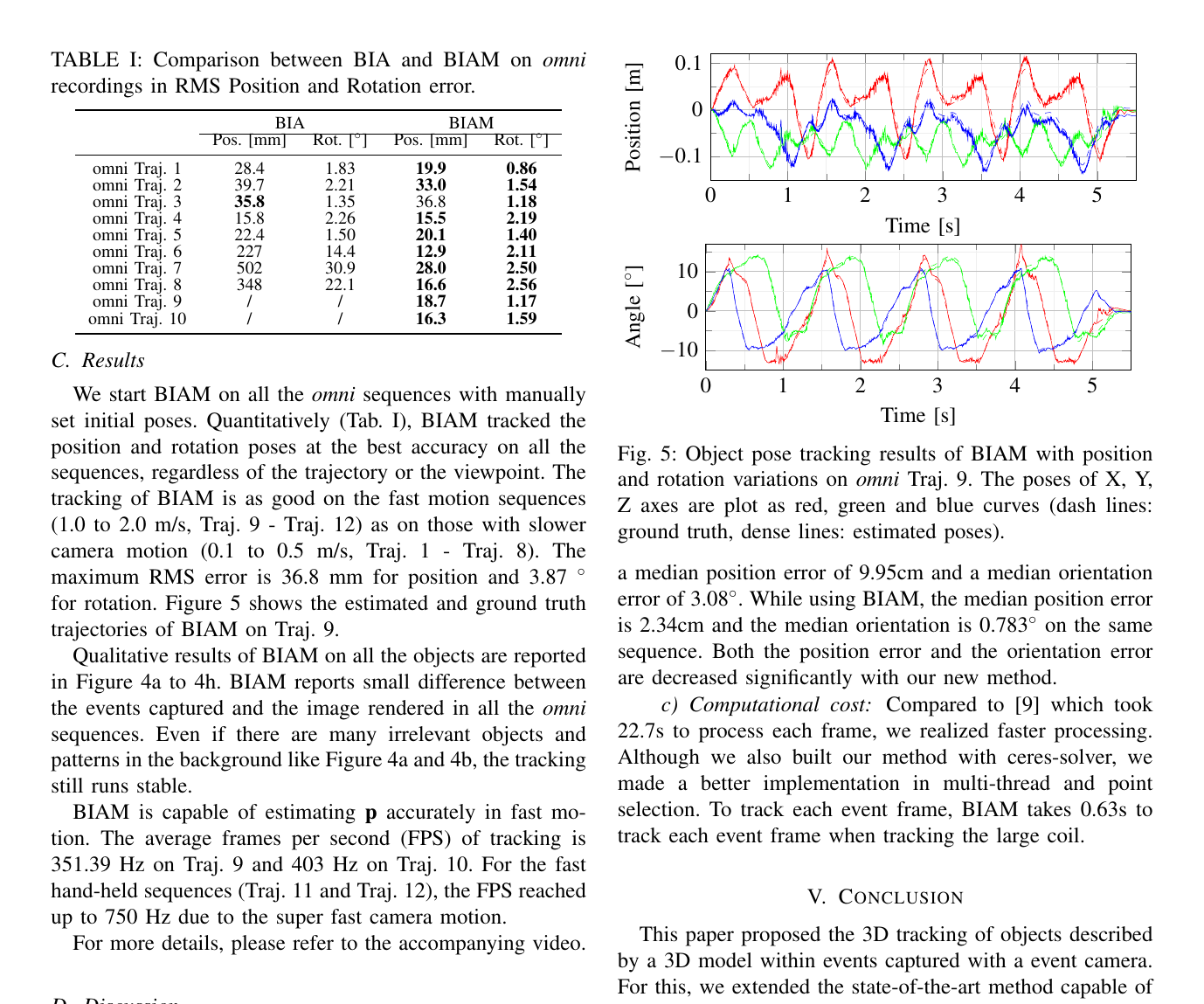
At fisheye camera speeds of approximately 0.1–2.0 m/s, the maximum sequence RMS errors are 36.8 mm / 3.87°.
BIA without motion interpolation fails on all fast sequences 9–12.
Without absolute brightness increments, tracking fails on over 70% of sequences.
Event-frame generation can reach hundreds of Hz, but optimization for the large coil takes approximately 0.63 s per event frame. These are different measures and do not establish real-time solving at 750 FPS.
5. Assessment
The central contribution incorporates motion within the event window into the predicted event image, matching the blur of actual accumulated events. It suits continuous tracking of known objects under fast motion and high dynamic range, but requires reliable initialization and a 3D appearance model. Background-event filtering also relies on an ROI generated from the previous pose.
Available src/paper-notes/event-model-tracking-icra2024/deep.md
In-depth paper notes
Support reproduction, comparison, related-work writing, and identifying opportunities for further research.
Deep Reading Notes: Direct 3D Model-Based Object Tracking with Event Camera by Motion Interpolation
1. Basic information
Authors / affiliations: Yufan Kang et al.; CNRS-AIST JRL, the University of Tokyo, Inria, and others
Event cameras provide no conventional frames, so direct tracking must convert a window of events into a representation comparable with 3D model rendering. Fast motion carries the same 3D edge across several pixels within a window; predicting only from the endpoint pose creates a systematic shape mismatch. BIAM includes this trajectory through motion interpolation.
3. Conditions and outputs
Item
Paper setting
Sensor
Prophesee Gen3.1, 640×480; perspective or fisheye
Object representation
Known dense CAD / scanned mesh with renderable brightness
Initialization
Manually supplied first-frame pose
State
Current 6DoF pose and camera velocity
Background model
Not required; pose-conditioned ROI removes most background events
This is a frame-to-frame local tracker. There is no global redetection when the target leaves the ROI, initialization is wrong, or prolonged full occlusion occurs.
Original Figure 2: motion interpolation from the 3D model and previous pose predicts increments, aligned with ROI event observations using normalized SSD. Source: paper project page. Image copyright belongs to the paper’s authors and publisher; shown here for paper analysis.
4. Method details
4.1 Why absolute brightness increments?
An event ek=(uk,tk,pk) triggers when log-brightness change crosses a threshold, with pk∈{−1,+1}. Contour polarity depends on the unknown background as well as the object: the same gray object has reversed edge polarity against white versus black. The authors therefore accumulate the following within the ROI:
δI\*(u)=tk∈T,uk∈ROI∑pkCδ(u−uk).
Discarding the polarity sign reduces mismatch from changing backgrounds. The ROI pads the previous-pose rendered bounding box; the event count is 0.15 times the ROI pixel count, balancing signal-to-noise ratio against accumulation blur.
4.2 Predicting events from the 3D model
For rendered brightness gradient ∇I(u), small-motion brightness increments are approximated by
δI(u)≈∣−∇I(u)Lup˙Δt∣,
where Lu is the pixel sensitivity / interaction matrix. A unified camera model covers both perspective and omnidirectional lenses.
4.3 Motion interpolation
Conventional predictions use only the window endpoint, while real events arise along the full projected trajectory. BIAM divides inter-pose SE(3) motion into segments, uses intermediate positions along um→um+1 to evaluate δI(ui), and averages them into δI+. The objective is normalized SSD between observation and prediction:
This models the imaging process of event accumulation rather than merely smoothing trajectories over time.
5. Data and results
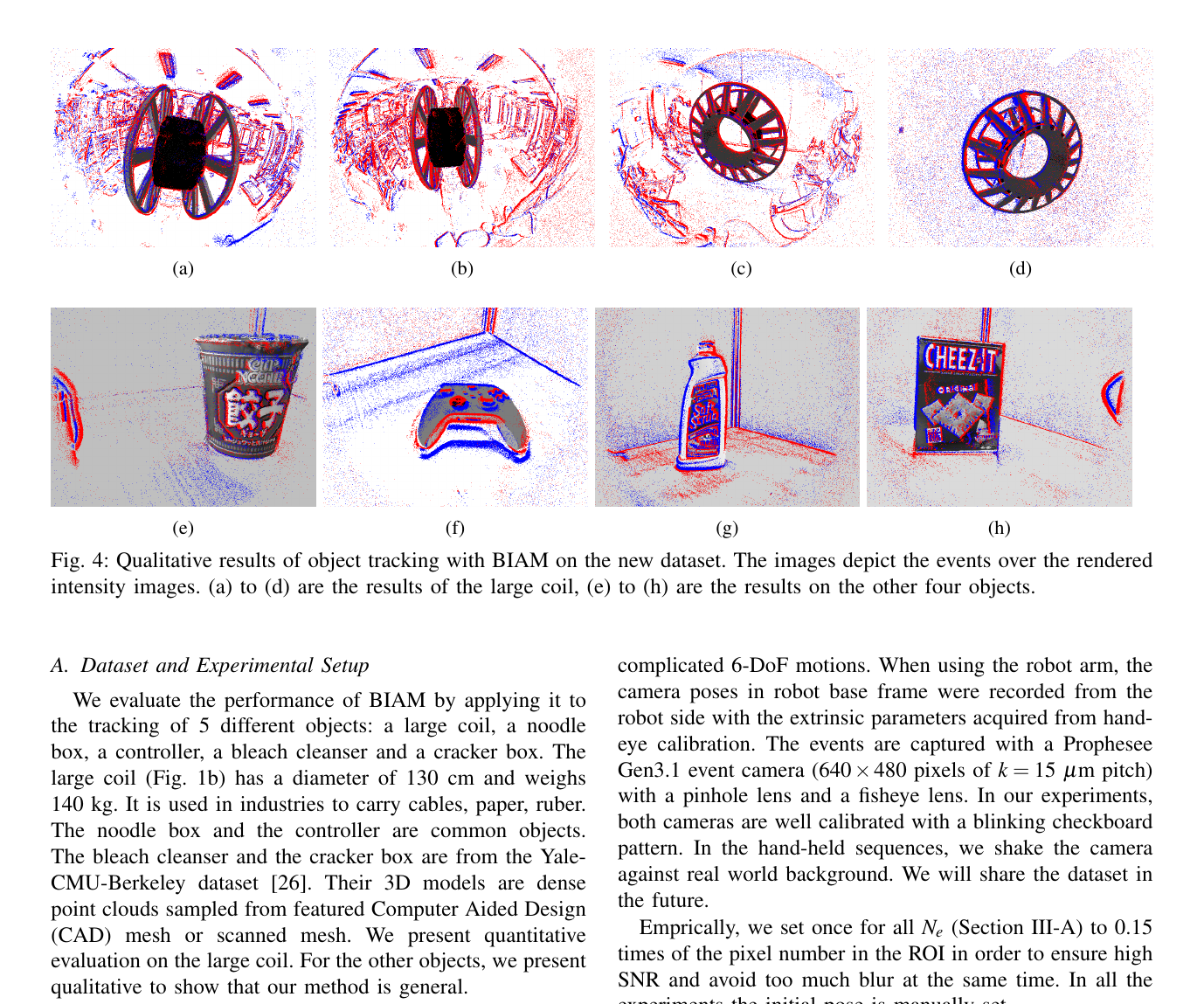
The custom dataset contains a large industrial coil, noodle box, controller, bleach cleanser, and cracker box: 14 perspective and 15 omnidirectional sequences lasting 2–20 s. A UR10 or handheld setup moves the camera at approximately 0.1–2.0 m/s. Robot kinematics provide coil GT; other objects are primarily qualitative demonstrations.
Original Figure 4: observed events overlaid with rendered contours across five objects, including fisheye views of the large coil and tabletop YCB-type objects. Source: paper project page. Image copyright belongs to the paper’s authors and publisher; shown here for paper analysis.
BIAM maintains tracking on all fisheye sequences; maximum sequence RMS position / rotation errors are 36.8 mm / 3.87°.
On fast trajectories 6–8, BIA position RMS is 227–502 mm, reduced by BIAM to 12.9–28.0 mm.
BIA fails on fast trajectories 9–12; BIAM achieves 18.7 mm / 1.17° on trajectory 9 and 16.3 mm / 1.59° on trajectory 10.
Over 70% of sequences fail without absolute increments, demonstrating that polarity ambiguity is a substantial issue.
Original Table I / Figure 5: BIA versus BIAM RMS errors on fisheye sequences and pose curves for fast trajectories. Source: paper project page. Image copyright belongs to the paper’s authors and publisher; shown here for paper analysis.
5.1 Interpreting speed figures
The paper reports event-window update frequencies of approximately 351–750 Hz, but its computational-cost discussion gives approximately 0.63 s optimization per event frame for the large coil. The former appears to describe event-data / window formation, while the latter is wall-clock solver cost in that implementation. This site does not interpret 750 Hz as real-time throughput of the complete CPU tracker.
6. Limitations and research value
Only the coil is quantitatively evaluated; five-object generalization is mainly visualized.
Manual initialization, accurate 3D appearance, and camera calibration are required.
Absolute increments improve robustness but discard some discriminative polarity information.
The ROI depends on the old pose, so drift can reinforce itself by excluding correct events.
No detector / relocalizer is provided; the setting differs from modern learned event-pose methods.
The research value is an explicit optimization chain linking event formation, camera projection, and 3D alignment. Possible extensions include uncertainty-aware ROIs, GPU differentiable rendering, global event-feature relocalization, and learned residuals compensating differences between model brightness and real materials.