Event-based Motion & Appearance Fusion for 6D Object Pose Tracking
This learning-free event tracker decodes event optical flow and speed-independent EROS in parallel. Flow propagates 6D velocity through a Kalman filter; EROS corrects pose by matching 13 local renderings, followed by UKF smoothing. Mean ablation errors across 8 synthetic sequences are 2.18 cm / 14.57°, approaching FoundationPose on some fast motions. Real data lack ground truth, the complete online system is not implemented, and around 110 Hz is inferred only from component timings.
Publication classification: the preprint first page states acceptance for ICRA 2026 publication, but page footers explicitly identify “Challenges and Opportunities of Neuromorphic Field Robotics and Automation IEEE ICRA Workshop 2026”; this site records it as a workshop paper.
Authors / affiliations: Zhichao Li, Chiara Bartolozzi, Lorenzo Natale, Arren Glover; Istituto Italiano di Tecnologia, University of Genoa.
Task: continuous dynamic-object 6D pose tracking using events only, given a known mesh and initial pose.
2. Positioning in one sentence
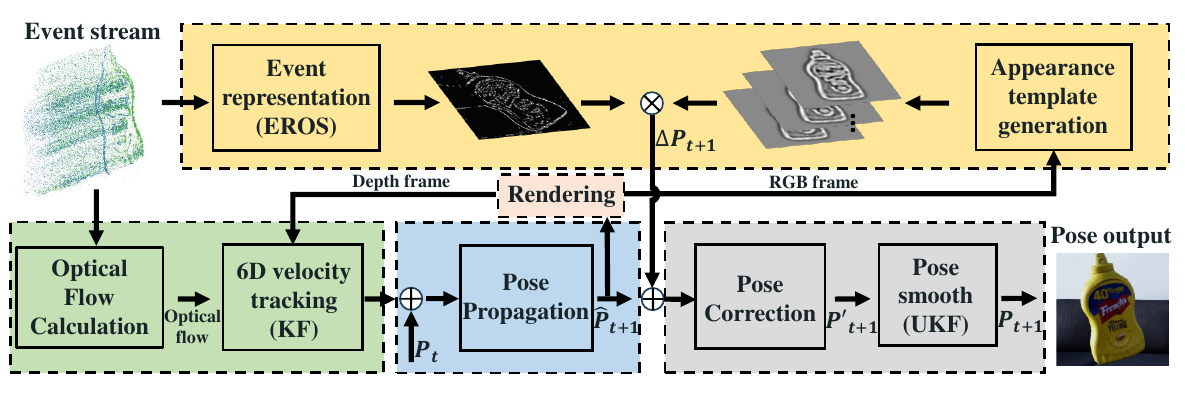
The method extracts complementary motion and appearance channels from one event stream: event optical flow estimates 6D velocity and advances the search center, while EROS and local rendered templates correct integration drift.
3. Method overview
Estimate event optical flow using spatiotemporal triplets and registration within local RoIs.
A Kalman filter fits 2D flow through the image interaction matrix to estimate rigid linear and angular velocity. Depth comes from rendering the current mesh / pose rather than a depth camera.
Integrate 6D velocity to propagate pose.
In parallel, update a speed-independent EROS event representation.
Render 13 edge templates around the propagated pose: 12 positive / negative perturbations plus 1 zero perturbation. Choose the hypothesis most similar to EROS for local correction.
Smooth the final output with UKF.
Original Figure 1: the green branch estimates 6D velocity from optical flow; the yellow branch corrects pose using EROS and rendered templates; UKF smooths the output. Source: original paper. Image copyright belongs to the paper’s authors; shown here for academic analysis.
4. Experiments at a glance
Synthetic data: 4 YCB objects under regular / fast motion, with events, 500 FPS RGB-D, and GT at 500 Hz. RGB-D is averaged to 60 FPS and given 25 mm depth noise to simulate motion blur and RealSense measurements.
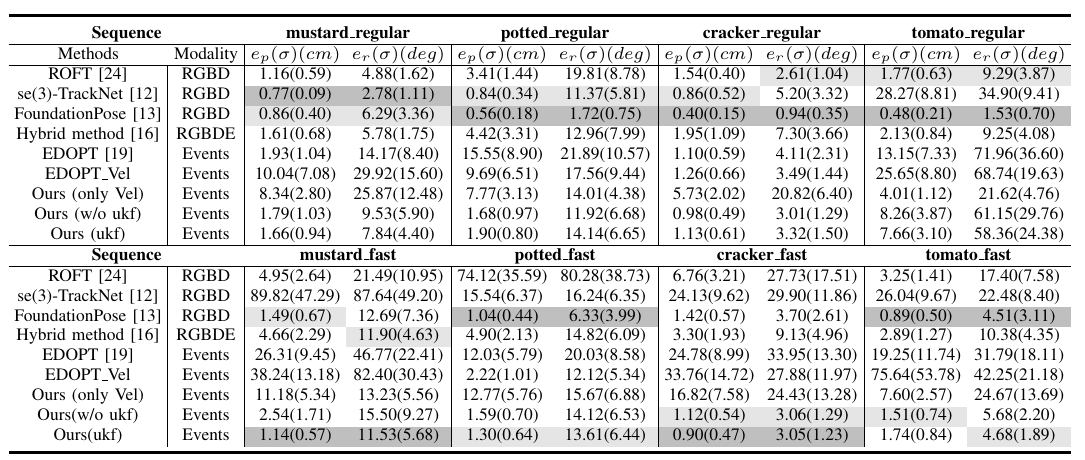
Under fast motion, translation RMSE for mustard / cracker is 1.14 / 0.90 cm, below FoundationPose’s 1.49 / 1.42 cm; potted / tomato still lag behind.
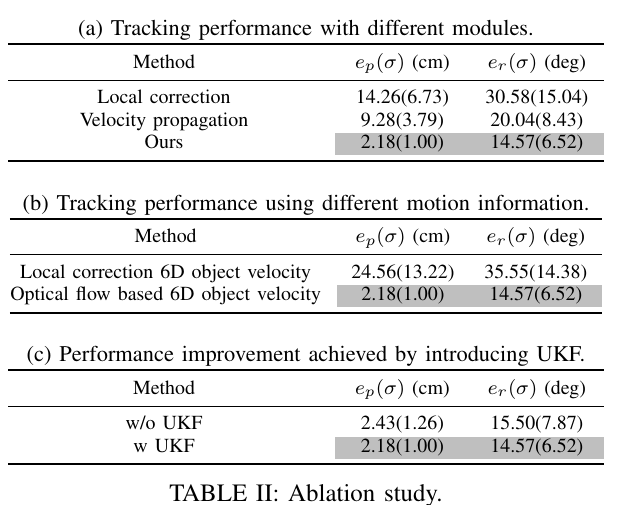
Ablations averaged over 8 sequences:
Local correction only: 14.26 cm / 30.58°;
Velocity propagation only: 9.28 cm / 20.04°;
Both combined: 2.18 cm / 14.57°.
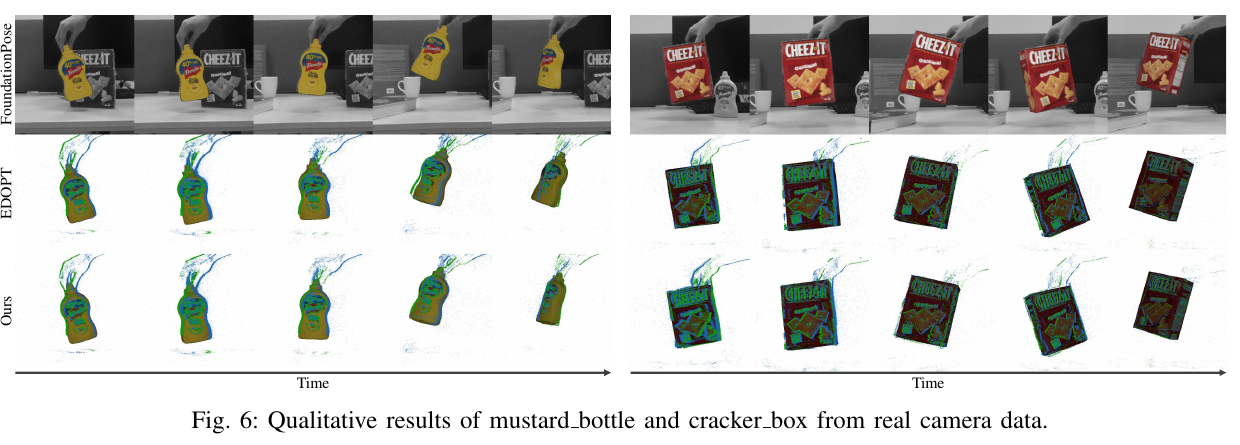
Real event sequences have no ground truth, only qualitative overlays against EDOPT and FoundationPose.
Separately measured components total approximately 9 ms; the authors estimate approximately 110 Hz for a complete online system while explicitly stating that the full online pipeline was not yet implemented.
5. Quick assessment
Strengths: no learning, one event sensor, and no frame-blur limitation under fast motion; propagation expands capture range and correction reduces integration drift.
Key boundary: an object mesh and externally provided initial pose remain necessary. This is not novel-object detection; stationary objects generate few events, while background motion violates the static-background assumption.
Evidence: persuasive synthetic fast-motion results, but regular-motion accuracy is usually below RGB-D foundation models. Real data lack quantitative GT, and 110 Hz is not a measured full-system rate.
Available src/paper-notes/event-motion-appearance-fusion-icra2026/deep.md
In-depth paper notes
Support reproduction, comparison, related-work writing, and identifying opportunities for further research.
Deep Reading Notes: Event-based Motion & Appearance Fusion
Core problem: event cameras avoid motion blur and have low latency but only report brightness changes. Fast motion can escape local template searches, while integrating optical-flow velocities alone accumulates drift.
Core answer: decode the event stream into motion and speed-independent appearance cues, combine them in a propagation–correction architecture, and use UKF to reduce jitter from discrete template corrections.
My assessment: a clear, interpretable event-only tracking baseline. Fast synthetic sequences and ablations provide the strongest evidence; absent real 6D GT and a complete online implementation, approximately 110 Hz is only a latency-budget estimate.
2. Publication and task boundaries
The preprint first page states acceptance for IEEE ICRA 2026 publication, but every footer identifies the ICRA 2026 neuromorphic field robotics workshop. This site records ICRA 2026 Workshop to avoid labeling it as a main-conference paper.
Given:
A known object 3D mesh;
A known initial 6D pose P0={t0,R0};
A calibrated event stream E={xi,yi,ti};
A static camera and usually stationary background.
The output is continuous pose in camera coordinates. The algorithm neither detects objects nor estimates an initial pose from scratch. Event information weakens when the object stops or moves together with the background; camera motion / dynamic backgrounds create additional events outside the experimental assumptions.
3. Dual-channel overview
Original Figure 1: one event stream updates both optical flow and EROS. Flow predicts the pose center; EROS selects corrections among 13 locally rendered templates; UKF provides final temporal smoothing only. Source: original paper. Image copyright belongs to the paper’s authors; shown here for academic analysis.
The architecture addresses complementary failures:
Propagation alone: unrestricted search-center motion, but small velocity biases integrate across frames;
Local correction alone: avoids continually integrating the same error, but cannot recover once the true pose leaves its small perturbation neighborhood;
Combined: propagation moves the local neighborhood with the object, and correction brings the propagated center back toward observations.
4. Motion branch
4.1 Spatiotemporal triplet optical flow
If a surface point successively triggers three events ei,ej,ek within a short interval, displacement and timing approximately follow constant velocity. Candidate flow is
F(xi)=tk−tixk−xi.
A single triplet is vulnerable to background noise or incorrect association. The authors divide the image into small RoIs, collect candidate sets in each, and select flow through spatiotemporal registration that jointly explains multiple events:
F=argF∈Mmini=1∑nFic∈Mimin∣F−Fic∣.
This is a robust representative vector from local event consistency, rather than dense learned optical flow.
4.2 From 2D flow to 6D velocity
Rigid velocity is written as
Vt=[vto,ωto],
where vto is the linear velocity of an object-attached point instantaneously coincident with the camera origin, and ωto is angular velocity. The Kalman motion model is
Vt+1=ρVt+w,ρ=0.5,
and the observation residual compares event flow F(u,v) with the interaction-matrix projection of
F^(u,v)=J(u,v)Vt.
The image Jacobian requires point depth. Earlier work reads RGB-D depth; this method renders it from the known mesh and current pose, reducing online inputs to events only. This creates circular dependence: pose error corrupts rendered depth and recovered 6D velocity, making appearance correction essential.
4.3 Pose propagation
Integrate linear velocity into translation and angular velocity through quaternions to obtain P^t+1. This predicts a search center under large motion but does not remove long-term bias.
5. Appearance branch
5.1 EROS
EROS is an image-sized state in [0,1]. An event at (u,v) sets that pixel to 1 and multiplies neighboring old responses by decay factor λ. This converts asynchronous events into an edge-like, relatively speed-insensitive image representation:
No fixed-exposure blur under fast motion;
More consistent contour strength across slow / fast motion than direct accumulation;
No absolute color or static texture, favoring rendered edges rather than RGB templates.
5.2 Local templates
Around the propagated pose, generate positive / negative perturbations along 6 degrees of freedom:
Use the image Jacobian to set translation increments for approximately 1 pixel of image motion;
Use ±0.5∘ on each rotation axis;
Include zero perturbation for 13 pose hypotheses.
Render each hypothesis, extract Sobel gradients, and widen edges using Difference of Gaussians for matching tolerance. The template with the highest EROS dot product provides ΔPt+1 to correct P^t+1.
Image-plane steps make sense because the same 1 mm projects differently at different depths. However, 13 axial candidates do not search coupled rotation–translation changes and select only one discrete direction per update. Propagation errors beyond this neighborhood still cause failure.
The improvement is modest; propagation plus correction delivers the main gains, rather than UKF being the central innovation.
6. Data and evaluation protocol
Synthetic sequences come from earlier work and include mustard bottle, potted meat can, cracker box, and tomato soup can:
Events, RGB-D, and GT originally at 500 Hz;
RGB frames averaged to 60 FPS to introduce exposure blur;
Gaussian depth noise with standard deviation 25 mm;
Regular and fast motion per object, totaling 8 sequences.
Real data synchronize a 1280×720 event camera with a RealSense D415. The D415 serves only RGB-D baselines, not this tracker. Objects move by hand, without real-sequence pose ground truth.
Metrics are position RMSE ep in cm, rotation RMSE er in degrees, and temporal standard deviation σ.
7. Main synthetic results
Original Table I: RGB-D methods usually lead under regular motion; under fast motion, this method matches or exceeds FoundationPose on mustard and cracker, without leading every object. Source: original paper. Image copyright belongs to the paper’s authors; shown here for academic analysis.
Representative fast-motion results:
Object
FoundationPose
This method
mustard
1.49 cm / 12.69°
1.14 cm / 11.53°
potted
1.04 / 6.33
1.30 / 13.61
cracker
1.42 / 3.70
0.90 / 3.05
tomato
0.89 / 4.51
1.74 / 4.68
The supported conclusion is competitive or better performance on some fast sequences, rather than overall event-only superiority over RGB-D transformers. Regular motion has little frame blur, preserving richer texture / depth for FoundationPose. Event methods particularly lag in potted and tomato rotation.
Most sequences show clear gains over EDOPT, whose local templates can lose poses outside the perturbation region. Flow propagation here first relocates the search center.
8. Component ablations
Original Table II: averages over 8 sequences show both propagation and correction are essential. Event-flow 6D velocities outperform differences between neighboring locally estimated poses; UKF adds modest gains. Source: original paper. Image copyright belongs to the paper’s authors; shown here for academic analysis.
Design
Translation RMSE
Rotation RMSE
Interpretation
Local correction only
14.26 cm
30.58°
True pose readily leaves the local template region
Velocity propagation only
9.28
20.04°
Integration drift
Both combined
2.18
14.57°
Effective complementarity
Velocity from adjacent pose differences
24.56
35.55°
Differentiates correction noise
Event-flow velocity
2.18
14.57°
More stable direct motion cues
Rotation RMSE remains 14.57°: maintaining a track differs from high accuracy. Translation gains are stronger than orientation gains.
9. Real experiments and latency
Original Figure 6: this method and FoundationPose retain contour alignment over short sequences while EDOPT drifts. Without real 6D GT this is qualitative evidence only. Source: original paper. Image copyright belongs to the paper’s authors; shown here for academic analysis.
Real mustard / cracker results show mesh overlays only:
FoundationPose on RGB frames;
EDOPT and this method on short event accumulations;
The authors observe retained alignment for this method and FoundationPose, with later EDOPT drift.
Different image types and absent GT prevent quantifying how closely performance matches.
Independent component timing:
Optical flow + velocity KF: approximately 2 ms;
Template correction: approximately 5 ms;
Propagation + final UKF: below 2 ms.
These timings motivate an estimated online rate of approximately 110 Hz, but the Discussion explicitly states that no complete full-online pipeline exists yet. Report this as “estimated from component timings,” rather than measured end-to-end FPS.
10. Limitations and reproduction advice
Initial pose and mesh are required; future event-pose detection is suggested for initialization / relocalization.
Background motion, moving cameras, and independently moving objects add events that violate the static-background assumption.
A stopped object generates insufficient events, requiring state priors; stop–start behavior is not systematically evaluated.
The 13 templates cover only local axial discrete perturbations; larger errors, combined perturbations, and coarse-to-fine searches need testing.
Averaging 500 FPS frames for synthetic blur may not reproduce real rolling- / global-shutter exposure.
Real data need motion-capture 6D GT covering fast translation, out-of-plane rotation, low contrast, and varying illumination.
Separately report event rate, events per pose update, end-to-end latency, and hardware utilization.
No official repository was found when the source notes were compiled; reproduction requires integrating earlier event flow, EROS, rendering, and filters.
11. Methodological lesson
Event pose tracking benefits from different representations for different jobs: local spatiotemporal structure conveys motion, while a decaying memory image conveys contours. One representation serving both large-range prediction and precise alignment often trades capture range against drift. Propagation–correction assigns each cue its stronger role and provides clear interfaces for learned event reconstruction or novel-object descriptors.