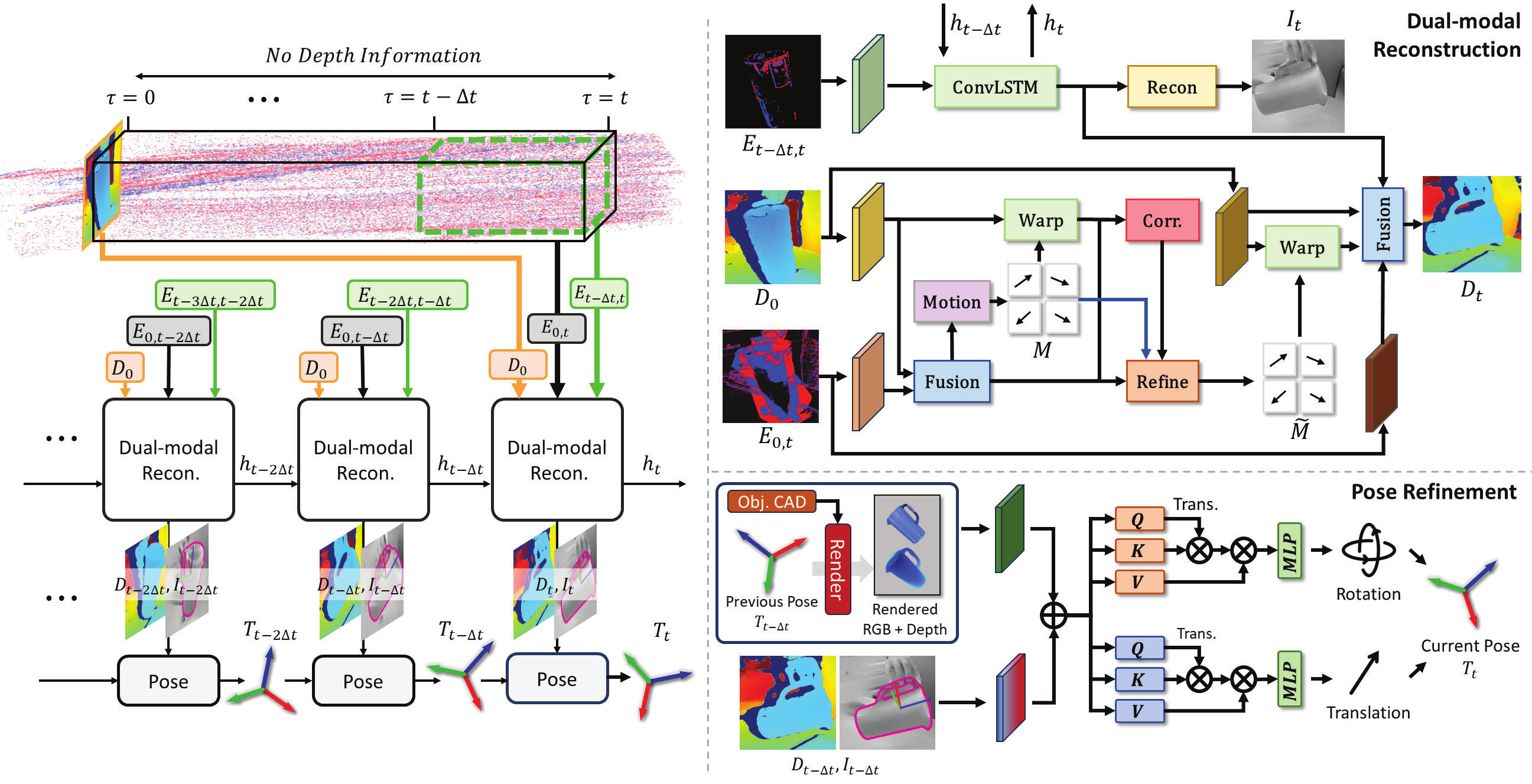
Event6D targets high-speed tracking of unknown objects. Event streams and the latest depth frame reconstruct intensity / depth at arbitrary timestamps for render-and-compare tracking. The system exceeds 120 FPS and evaluates generalization on real event data.
Event6D reconstructs intensity and depth at arbitrary timestamps between depth frames using events, then applies render-and-compare pose tracking for fast motion and novel objects, exceeding 120 FPS with TensorRT optimization.
2.1 Guide to the paper’s figures and tables
Figure / table
Purpose
Overview reading tips
Figure 1
Low-rate RGB-D versus event-driven dual-modal reconstruction
Understand the need for continuous-time pose
Table 1
Event-based 6D dataset comparison
Distinguish training / evaluation roles of EventBlender6D, EventHO3D, and Event6D
Tables 2 / 3
Tracking at 120 / 30 FPS
Examine fast-motion runtime and pose accuracy
Table 5
Dual-modal reconstruction ablation
Test intensity / depth complementarity
Figure 4
Qualitative tracking at 120 FPS
Inspect RGB-D baseline failures under large motion
Relevant crop from the original paper’s figures: events reconstruct images and depth between depth frames for fast pose tracking. Source: project page / CVF Open Access. Image copyright belongs to the paper’s authors and publisher; shown here for paper analysis.
Key assessment: event temporal resolution fills geometric and photometric observations between low-rate depth frames, letting a pose tracker operate at intermediate timestamps rather than simply stacking events into an image.
2. Positioning in one sentence
EventTrack6D conditions on sparse events to reconstruct intensity/depth between depth frames, then uses CAD render-and-compare to track novel-object poses on a 120 FPS timeline.
2.1 Guide to the paper’s figures and tables
Figure / table
Deep-dive questions
Figure 1
How does dual reconstruction bridge RGB-D intervals at 30 FPS?
Table 1
Do the new datasets jointly cover scale, object diversity, motion speed, and real events?
Figure 2
How do event encoding, reconstruction, and pose refinement exchange data?
Tables 2 / 3
Are gains over RGB-D baselines consistent at 120 FPS and 30 FPS?
Table 5
How do image-only, depth-only, and dual-modal reconstruction differ?
Relevant crop from the original paper’s figures: ordinary RGB-D is limited by low frame rates during fast motion; EventTrack6D reconstructs intermediate images and depth from events. Source: project page / CVF Open Access. Image copyright belongs to the paper’s authors and publisher; shown here for paper analysis.
3. Problem setting and task boundaries
Event cameras asynchronously report pixel brightness changes, while RGB-D supplies complete frames less frequently.
Real Event6D uses 120 Hz motion-capture GT, with RGB / depth at 30 FPS, creating an event-driven intermediate-frame reconstruction problem.
Training uses only synthetic EventBlender6D; evaluation objects in Event6D and EventHO3D are separated from training objects to test novel-object generalization.
The initial frame requires pose; later estimates need no future RGB / depth, supporting online tracking rather than offline video estimation.
4. Research context
Conventional RGB-D tracking suffers from 30 FPS sampling, blur, and large displacement; events provide microsecond temporal resolution and high dynamic range.
Earlier event-pose datasets have few objects, slow motion, or annotations derived from low-rate RGB-D methods.
Event6D contributes dual reconstruction, novel-object tracking, and synthetic-to-real benchmarks together.
5. Research motivation
Fast motion between RGB-D frames can exceed an ordinary tracker’s search range.
Events are sparse but precisely timed, lacking complete photometry and depth; historical depth supplies context.
Converting events into an ordinary grayscale image loses timing and does not directly recover depth.
Dual-modal reconstruction is therefore connected to established render-and-compare pose refinement.
6. Method details
6.1 Event-conditioned reconstruction
Events include pixel location, timestamp, and polarity; a temporal window encodes motion and brightness changes.
Condition on the latest available depth frame to predict intensity and depth at an arbitrary current timestamp.
Depth reconstruction supplies geometry; intensity supplies appearance and edges, supervised by L1 / photometric objectives, respectively.
No future frames are used, preserving online causality.
6.2 Pose refinement
Compare reconstructed RGB-like / depth-like patches with CAD-surface renderings.
A refinement operator updates the current pose to output the next pose.
Dense intermediate photometric / geometric cues let tracking proceed before the next complete depth frame.
6.3 Dataset design
EventBlender6D uses Google Scanned Objects, BlenderProc, and event simulation for 495,840 samples and 1033 objects.
EventHO3D combines event simulation with HO3D motion for 103,462 samples and 5 objects.
Real Event6D has 54,556 samples and 14 objects, with 120 Hz mocap pose annotations and newly scanned object CAD models.
7. Experimental analysis
7.1 Settings and metrics
At 120 FPS, RGB-D remains 30 FPS and event methods are evaluated at intermediate times. At 30 FPS, more baselines are compared at complete RGB / depth timestamps.
Metrics include ADD / ADD-S AUC, Average Recall, VSD, MSSD, MSPD, and runtime FPS.
Evaluation objects are unseen in training, testing synthetic-only generalization.
7.2 Main results
On Event6D’s 120 FPS evaluation, TensorRT runtime exceeds 120 FPS: approximately 50 FPS unoptimized versus approximately 128 FPS optimized.
RGB / RGB-D baselines receive no new intermediate depth at 120 FPS and become unstable under fast, large motion; EventTrack6D maintains temporal continuity.
Synthetic-only training also generalizes well to EventHO3D’s different motions and sensor setup, supporting cross-domain dataset value.
Single-modal reconstruction reduces refinement quality; both modalities improve fast-motion stability.
Longer / better-matched event windows add information but may mix motion, requiring speed-dependent adjustment.
8. Critical analysis
Strength: task, data, and system speed are relevant to fast robotics, with explicit 120 / 30 FPS evaluation settings.
Synchronization: event, RGB, depth, and mocap timing errors directly become pose-label noise.
CAD dependence: novel-object tracking still needs CAD / references; this is not fully model-free event pose.
Distribution risk: synthetic event noise, exposure, and trajectories differ from real cameras, motivating real training / adaptation.
9. Implications for my research
Events can provide frequent pose evidence for asynchronous fusion with low-rate depth / multiview geometry.
Continuous-time pose uncertainty could determine when to request another depth frame.
Robot grasping could connect event tracking with active deceleration / regrasping.
10. Open questions
How can novel-object tracking use a few RGB-D references without CAD?
How can timestamps support continuous-time SE(3) motion rather than framewise refinement?
How can timing offsets, event noise, and occlusion be modeled jointly?
11. Further analysis: from events to 120 Hz pose
11.1 Dataset statistics
Dataset
Samples
Objects
Resolution
Temporal properties
EventBlender6D
495,840
1,033
—
dynamic synthetic
EventHO3D
103,462
5
640×480
moderate motion
Event6D
54,556
14
1280×720
real, 120 Hz, dynamic
EventBlender6D supplies large-scale training, EventHO3D tests cross-motion / sensor generalization, and Event6D evaluates real fast motion. RGB / depth remain 30 FPS while events arrive asynchronously; ordinary RGB-D baselines therefore cannot be compared directly as if they had equivalent 120 FPS observations.
11.2 Main 120 FPS results
On Event6D at 120 FPS, EventTrack6D averages ADD-S / ADD / AR of 52.79 / 25.26 / 64.38, running at approximately 50.19 FPS (128.04 FPS with TensorRT). It clearly improves over E2VID+MG at 6.78 / 2.12 / 9.02, E2VID+FP at 37.24 / 16.97 / 48.72, ETAP at 7.77 / 2.22 / 11.42, and event-trained FP at 22.93 / 4.31 / 25.72.
On EventHO3D, mean ADD-S / ADD / AR is 64.75 / 50.95 / 66.27, versus E2VID+FP at 57.10 / 41.13 / 56.77 and event-trained FP at 35.31 / 8.83 / 27.64. These cross-dataset results argue against fitting only Event6D motion trajectories.
11.3 Dual-modal reconstruction ablation
Depth reconstruction
Image reconstruction
ADD-S
ADD
AR
✗
✗
18.45
3.29
20.07
✓
✗
28.67
4.75
29.08
✗
✓
30.53
13.79
44.99
✓
✓
52.79
25.26
64.38
Image reconstruction supplies appearance / texture evidence and depth reconstruction supplies geometry, with clear complementarity. Table 6 additionally reports 42.26 / 19.32 / 48.99 for event motion vectors alone and 41.88 / 17.61 / 50.54 for image features alone; both restore the full 52.79 / 25.26 / 64.38.
11.4 Author claims and my analysis
Authors’ claims
My assessment
Events enable high-temporal-resolution tracking
Supported by 120 Hz GT, 128.04 FPS TensorRT, and speed comparisons.
Dual reconstruction fills geometry between depth frames
AR improving from 20.07→64.38 in ablations is strong evidence.
Generalization to real fast objects
Supported by EventHO3D / Event6D, though real data remain smaller than synthetic; timing and event noise are key risks.
12. Reproduction checklist
Record event windows, timestamps, depth-to-event extrinsics / timing offsets, 160×160 ROIs, CAD-render parameters, and TensorRT use. Separate 30 FPS and 120 FPS evaluation and save reconstructed intensity / depth and pose residuals. Without novel-object CAD, future work must replace render-and-compare with reference-based representations.