FAFA: Frequency-Aware Flow-Aided Self-Supervision for Underwater Object Pose Estimation
FAFA augments PBR synthetic RGB using real-amplitude mixing / dropout, then self-supervises refinement with EMA-teacher pseudo-flow / pseudo-poses and photometric, warped-mask, feature, and point-matching consistency. ROV6D / DeepURL means are 91.39 / 73.46. It still requires known UUV CAD, coarse poses, and 1,000 real images per domain; the repository currently contains no implementation.
known BlueROV or Aqua2 instancecamera intrinsicsinitial pose from DeepURL / GDRN or another estimatorPBR synthetic pose labels1,000 target-domain unlabeled real imagesdifferentiable CAD rendering
Full paper metadataAuthors, affiliations, research area, datasets, metrics, method tags, and reading statusExpandCollapse
known BlueROV or Aqua2 instancecamera intrinsicsinitial pose from DeepURL / GDRN or another estimatorPBR synthetic pose labels1,000 target-domain unlabeled real imagesdifferentiable CAD rendering
Reading Notes
Overview / Deep Dive
Available src/paper-notes/fafa-eccv2024/coarse.md
Paper overview notes
Quickly assess the paper's scope, problem setting, core method, experimental findings, and whether to read it in depth.
Overview Notes: FAFA
1. Basic information
Title: FAFA: Frequency-Aware Flow-Aided Self-Supervision for Underwater Object Pose Estimation
FAFA refines known-UUV poses from monocular RGB. Fourier amplitudes from real target-domain images mix with / drop out amplitudes in PBR synthetic images; an EMA teacher then supervises a noisy student with pseudo-flow / pseudo-pose plus photometric, warped-mask, feature, and point-matching consistency. This yields iterative flow–pose refinement for underwater sim-to-real adaptation without depth or real pose labels.
3. Guide to figures and tables
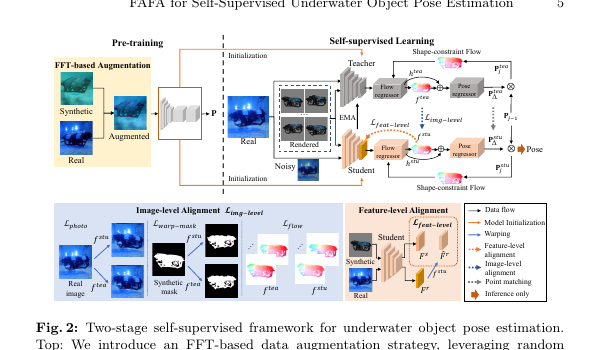
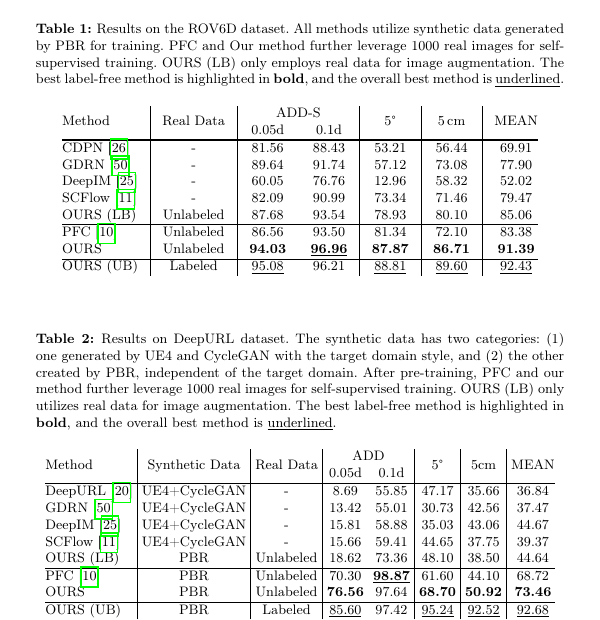
Original Figure 2: FFT augmentation during pretraining; self-supervision renders four views from the initial pose and links teacher / student through flow, pose, image warping, and latent features. Shape-constrained flow iteratively updates pose. Source: published ECVA paper; image copyright belongs to the paper’s authors and Springer Nature. Shown here for paper analysis.Original Tables 1–2: unlabeled-real FAFA averages 91.39 on ROV6D, close to the labeled upper bound 92.43. On DeepURL, 73.46 exceeds PFC’s 68.72 using the same 1,000 unlabeled images, but remains far below the labeled upper bound 92.68. Source: published ECVA paper; table copyright belongs to the paper’s authors and Springer Nature. This site places the two original tables side by side for analysis.
4. Problem setting
Objects: BlueROV in ROV6D and Aqua2 in DeepURL, both known single-instance UUVs with 3D CAD, rather than arbitrary underwater objects.
Inputs: real underwater RGB, intrinsics, known CAD, and initial pose P0 from existing estimators such as DeepURL / GDRN.
Outputs: rotation / translation after relative pose refinement.
Pretraining: PBR synthetic RGB with 6D pose GT; FFT amplitude mixing also reads unlabeled target-real images.
Self-supervision: 1,000 real images without pose labels per dataset.
Testing: ROV6D adapts on Pool-Basic and tests on Pool-Occluded; DeepURL uses 1,000 random real images for adaptation and the remainder for testing.
5. Method overview
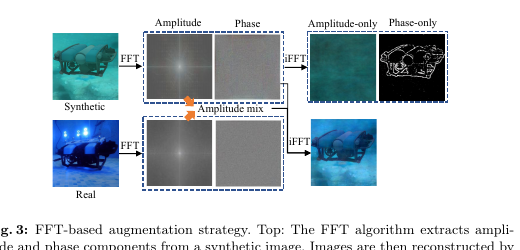
Apply FFT to synthetic / real RGB, retaining synthetic phase.
Randomly drop amplitudes or linearly mix synthetic / real amplitudes, then apply iFFT for target-style synthetic images.
Obtain coarse P0 from an existing estimator and render N=4 nearby CAD views.
The teacher predicts pseudo-flow ftea and pseudo-pose Ptea from clean inputs; the student receives noisy inputs.
Iterate flow and pose regressors: current pose generates shape-constrained flow, which predicts decoupled relative pose.
Image-level losses include pseudo-flow, Census photometric consistency, and warped rendered-mask consistency.
Feature loss warps real features with student flow and aligns them with synthetic features.
Model-point matching constrains pose, while student EMA updates the teacher.
6. Experiments at a glance
ROV6D means for OURS (LB) / PFC / OURS / labeled UB: 85.06 / 83.38 / 91.39 / 92.43.
DeepURL OURS: 76.56 / 97.64 ADD 0.05d / 0.1d, 68.70 at 5°, 50.92 at 5cm, 73.46 mean.
DeepURL PFC mean is 68.72 and labeled UB is 92.68; the full model remains far from real-supervised performance there.
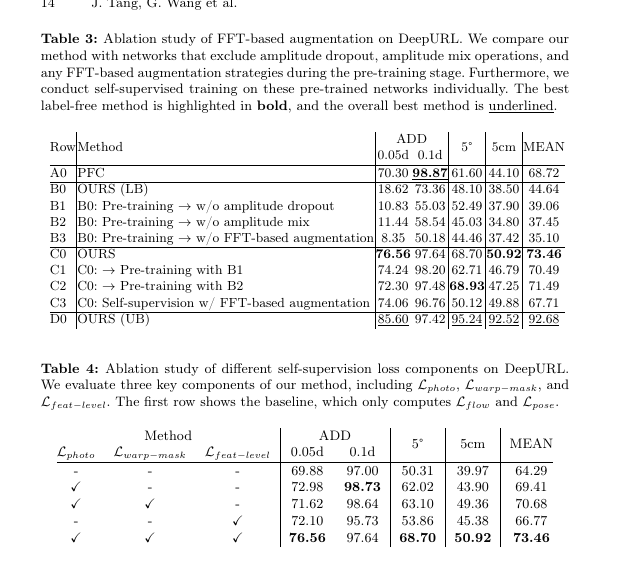
Pretraining mean without FFT augmentation is 35.10; amplitude mix + dropout reaches 44.64; self-supervision then reaches 73.46.
Flow + pose consistency alone gives self-supervised mean 64.29; all photo / warped-mask / feature terms give 73.46.
No FPS, per-frame latency, or end-to-end timing including coarse estimation / rendering is reported.
7. Quick assessment
Strengths: no underwater depth; frequency augmentation reduces appearance gaps early; multilevel flow / mask / feature / pose constraints exceed reliance on one teacher output; validated on two UUV datasets.
Limitations: CAD, an initial pose, and 1,000 target-real images are required; only two single objects, no open-water Maoming main results, and no timing. The source notes found a README-only repository, not a reproducible implementation.
Support reproduction, comparison, related-work writing, and identifying opportunities for further research.
Deep Reading Notes: FAFA
1. Key assessment
FAFA studies a harder but narrower setting than typical indoor pose: near-infrared depth often fails underwater and real 6D annotation is costly, so it relies on RGB, known UUV CAD, synthetic GT, and unlabeled target-real images.
It divides sim-to-real adaptation into two stages:
Change training-input spectra first: retain synthetic phase / geometry and incorporate real amplitude / style;
Then change refinement constraints: teacher–student consistency covers photometric warps, rendered masks, and features as well as final pose / flow.
ROV6D mean 91.39, close to labeled upper bound 92.43, is the strongest result. DeepURL reaches 73.46 versus PFC’s 68.72 but remains far below upper bound 92.68. Multilevel self-supervision is effective; unlabeled adaptation has not generally replaced real labels.
2. Precise task boundaries
Given:
Known UUV 3D CAD;
Synthetic RGB with pose GT;
Unlabeled real RGB from the target water environment;
camera intrinsics;
Initial pose P0 from an external coarse estimator.
Refine accurate SE(3) from real underwater RGB. This is instance-level, model-based, monocular pose refinement, rather than:
Full-image detection + pose estimation end to end;
Absolute pose without initialization;
Unseen-object / category-level pose;
Domain generalization without target-domain samples.
FFT pretraining already reads amplitudes of random target-real images. OURS (LB), although lacking teacher–student fine-tuning, is therefore not strictly synthetic-only; its Real Data column explicitly says Unlabeled.
Original Figure 3. The authors associate phase with relatively stable contours / structure and amplitude with domain appearance. Final images retain synthetic phase while mixing or dropping amplitudes. Source: published ECVA paper; image copyright belongs to the paper’s authors and Springer Nature. Shown here for paper analysis.
Here α∼U(0,β), with δ0=0.5,β=1 in main experiments. Invert this amplitude with synthetic phase:
xs→r=F−1[F^A(xs,xr)e−jFP(xs)].
Amplitude mixing injects target-water color cast, lighting, and blur; dropout encourages phase / contour reliance. This is inexpensive domain randomization, but phase-as-geometry and amplitude-as-style are approximations. Strong scattering, occlusion, and caustics also change phase, while global mixing cannot model spatially varying water.
4. Iterative flow–pose refinement
Original Figure 2. Features, a RAFT-style flow regressor, and a pose regressor form a differentiable loop: pose creates shape-constrained flow, which updates relative pose. Source: published ECVA paper; image copyright belongs to the paper’s authors and Springer Nature. Shown here for paper analysis.
Starting from coarse P0, render N=4 synthetic images around it. Iteration pose Pj=[Rj∣tj] projects CAD point pi as follows:
λi[ui1]=K(Rjpi+tj).
Projection differences relative to P0 form shape-constrained flow. Dense 2D–2D correspondences feed decoupled pose updates RΔ,tΔ, with continuous 6D rotation. Updated poses generate new geometric flow for the next iteration.
The teacher uses 8 iterations, the student 4; teacher weights follow student EMA with factor 0.999. Only forward / backward geometrically consistent clean-input teacher flow becomes pseudo-labels. This rejects some underwater texture errors, but valid-pixel fractions, threshold sensitivity, and retention across turbidity are not reported.
5. Multilevel self-supervision
Image-level:
Limg=γ1Lflow+γ2Lphoto+Lwarp-mask.
Lflow: fit student flow to filtered teacher pseudo-flow.
Lphoto: backward-warp real images with both flows and compare using Census distance.
Lwarp-mask: L1 between teacher / student forward-warped rendered masks.
Feature-level:
Warp real features with student flow;
Measure weighted dissimilarity against synthetic features;
Seek a latent metric more robust than raw photometric errors under low light, color cast, and blur.
Here γ1=γ2=0.1,γ3=γ4=10. Freeze BatchNorm during self-supervision to avoid mixing source / target statistics.
6. Data and evaluation protocol
ROV6D
Object: BlueROV, treated as symmetric under the paper’s ADD-S protocol.
synthetic: PBR.
Target real data: 1,000 Pool-Basic images for self-supervision.
test: Pool-Occluded.
Excluded: the small, low-visibility open-lake Maoming subset.
The split tests adaptation from basic to occluded pool scenes, not pool-to-open-water generalization.
DeepURL
Object: Aqua2, evaluated with ADD.
An additional 30,000 PBR synthetic images are generated with BlenderProc.
A random 1,000 real images support self-supervision; remaining real images evaluate without overlap.
Non-self-supervised baselines use UE4 + CycleGAN target style; PFC and FAFA use PBR + the same 1,000 unlabeled real images.
DeepURL Table 2 mixes synthetic sources. FAFA versus PFC is comparatively fair; comparisons with DeepURL / GDRN / DeepIM / SCFlow also reflect PBR versus UE4+CycleGAN differences.
7. Main results
Original Tables 1–2 combined. LB uses real images only for FFT augmentation; OURS additionally self-supervises with 1,000 real images; UB uses their pose labels. Source: published ECVA paper; table copyright belongs to the paper’s authors and Springer Nature. This site combines the original tables for cross-dataset reading.
ROV6D
Method
Real supervision
ADD-S 0.05d
ADD-S 0.1d
5°
5cm
Mean
OURS (LB)
unlabeled, FFT only
87.68
93.54
78.93
80.10
85.06
PFC
unlabeled
86.56
93.50
81.34
72.10
83.38
OURS
unlabeled
94.03
96.96
87.87
86.71
91.39
OURS (UB)
labeled
95.08
96.21
88.81
89.60
92.43
OURS improves PFC mean by +8.01 points, mainly through 5cm +14.61 and 5° +6.53. Its 0.1d exceeds UB by 0.75, but 0.05d, rotation, translation, and mean remain lower. Winning one loose threshold does not establish superiority over the supervised upper bound.
DeepURL
Method
Real supervision
ADD 0.05d
ADD 0.1d
5°
5cm
Mean
OURS (LB)
unlabeled, FFT only
18.62
73.36
48.10
38.50
44.64
PFC
unlabeled
70.30
98.87
61.60
44.10
68.72
OURS
unlabeled
76.56
97.64
68.70
50.92
73.46
OURS (UB)
labeled
85.60
97.42
95.24
92.52
92.68
OURS improves PFC mean by +4.74 points. The 5cm change 44.10→50.92 is +6.82 points; the paper’s 15.46% is relative improvement. PFC leads loose ADD 0.1d by 1.23. Self-supervision still trails UB by 26.54 / 41.60 at 5° / 5cm, leaving precise Aqua2 rotation / translation unresolved.
8. Ablations: contributions of each stage
Original Tables 3–4: top, amplitude mix / dropout and self-supervision combinations; bottom, photometric, warped-mask, and feature consistency. Source: published ECVA paper; table copyright belongs to the paper’s authors and Springer Nature. Shown here for paper analysis.
FFT pretraining:
Configuration
Mean
No FFT augmentation
35.10
Amplitude mix only
39.06
Amplitude dropout only
37.45
mix + dropout, LB
44.64
full pretrain + self-supervision
73.46
Continue FFT during self-supervision
67.71
Mix and dropout complement each other, but continuing real-image perturbations during target self-supervision distorts the real distribution, reducing mean by 5.75.
Self-supervised losses:
Photo
Warp mask
Feature
Mean
—
—
—
64.29
✓
—
—
69.41
✓
✓
—
70.68
—
—
✓
66.77
✓
✓
✓
73.46
Photo provides the largest individual gain; feature-only also helps, while all three levels work best. The reported 23.28% photo gain at 5° is relative, from 50.31→62.02; the absolute gain is +11.71 points.
9. Engineering settings
PyTorch on one RTX 3090;
AdamW, batch size 16;
OneCycle, maximum learning rate 4×10⁻⁴;
Initial-pose crops resized to 256×256;
N=4 rendered views;
teacher / student iterations = 8 / 4;
EMA = 0.999;
Frozen BatchNorm during self-supervision.
Not reported:
Latency including coarse estimation, 4-view rendering, and 12 teacher/student iterations;
Per-frame GPU memory;
Real-time suitability for UUV control loops;
Initial-pose perturbation range or convergence basin.
Using flow refinement alone does not establish online deployability.
10. Limitations and risks
Few objects: only BlueROV and Aqua2 across two datasets, limiting cross-geometry conclusions.
Target data remain necessary: 1,000 real images per new water domain; FFT pretraining already uses its style.
No main open-water results: small Maoming data are excluded; principal ROV6D experiments cover pools.
Loose symmetry convention: symmetric ADD-S for BlueROV reduces orientation ambiguity penalties; also examine 5°.
Pseudo-flow / pose bias: shared teacher–student origins mean EMA smooths but cannot automatically correct systematic errors.
Approximate appearance assumptions: phase / amplitude do not strictly equal geometry / style.
Mixed protocols: DeepURL tables combine PBR and UE4+CycleGAN baselines.
No runtime: real robot closed-loop suitability cannot be assessed.
Code status in the source notes: the paper / ECCV page promised code, but the checked GitHub repository had only README and two commits, without training / inference implementation. Metadata therefore does not mark it as released code.
11. Reproduction checklist
Fix BlueROV / Aqua2 CAD, intrinsics, frames, and symmetry;
Save the exact 1,000 unlabeled-real IDs and evaluation split;
Generate the same 30,000 DeepURL PBR images;
Separate FFT-only LB, teacher–student self-supervision, and real-label UB;
Record amplitude sampling with δ0=0.5,β=1;
Report coarse-estimator errors in P0 bins;
N=4, teacher 8 / student 4 iterations;
EMA 0.999, BN frozen;
Reproduce flow-consistency thresholds and valid-pixel fractions;
Report ADD(-S), 5°, and 5cm separately, without hiding precise-pose gaps in a mean;
Include detection / coarse pose / rendering / refinement in end-to-end timing;
Add open-water and cross-water domain-shift tests.
12. Overall assessment
FAFA’s design fits underwater constraints: replace unavailable depth with shape-constrained CAD-projection flow; constrain noisy pseudo-poses through images, masks, features, and model points; and introduce target style through FFT before formal self-supervision.
The strongest evidence is ROV6D mean 83.38→91.39, DeepURL 68.72→73.46, and full-loss ablation 64.29→73.46. Key boundaries remain two known UUVs, initialization and 1,000 target-real images, no open-lake evaluation or runtime, and no implementation in the repository when checked. This is persuasive underwater pose refinement / adaptation, rather than a general underwater 6D pose system.