FastCAD: Real-Time CAD Retrieval and Alignment from Scans and Videos
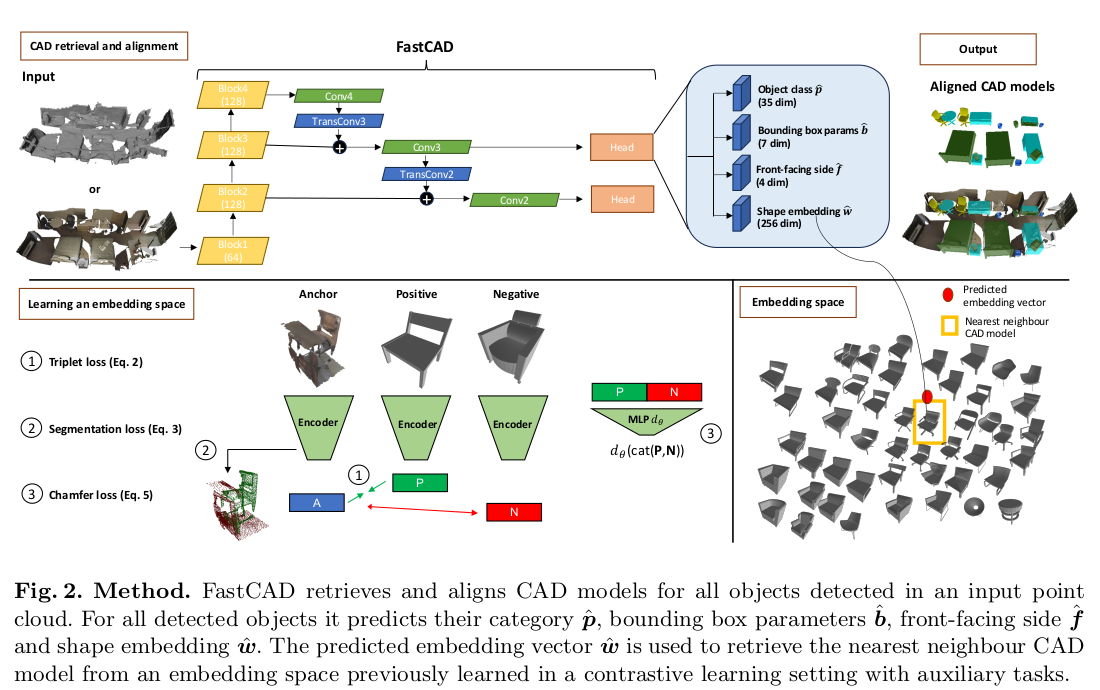
FastCAD combines object detection, upright 9-DoF alignment, and CAD embedding regression in one scene-level forward pass. Training-time embedding distillation removes the per-object encoder at test time. Scan input achieves 61.7% / 50ms, and the video pipeline 48.2% / 100ms. Reconstruction accuracy of 29.6 applies only when retrieval is restricted to the same pool as Vid2CAD.
RGB-D scene scanpoint cloud from online RGB video reconstructionCAD model database
Requirements
gravity-aligned indoor scene point cloudknown 35-category vocabularyShapeNet / Scan2CAD CAD retrieval databaseonline scene reconstruction for video inputsparse 3D convolution runtime
Full paper metadataAuthors, affiliations, research area, datasets, metrics, method tags, and reading statusExpandCollapse
Authors
Florian Langer, Jihong Ju, Georgi Dikov, Gerhard Reitmayr, Mohsen Ghafoorian
Affiliations
XR Labs, Qualcomm Technologies / University of Cambridge
gravity-aligned indoor scene point cloudknown 35-category vocabularyShapeNet / Scan2CAD CAD retrieval databaseonline scene reconstruction for video inputsparse 3D convolution runtime
Reading Notes
Overview / Deep Dive
Available src/paper-notes/fastcad-eccv2024/coarse.md
Paper overview notes
Quickly assess the paper's scope, problem setting, core method, experimental findings, and whether to read it in depth.
Overview Notes: FastCAD
1. Basic information
Title: FastCAD: Real-Time CAD Retrieval and Alignment from Scans and Videos
Authors: Florian Langer, Jihong Ju, Georgi Dikov, Gerhard Reitmayr, Mohsen Ghafoorian
Affiliations: XR Labs, Qualcomm Technologies; University of Cambridge
One scene-level sparse 3D network detects objects and predicts oriented boxes, front sides, and 256D shape embeddings; nearest-neighbor CAD retrieval then directly provides 9DoF alignment. Scan2CAD scan input reaches 61.7% alignment accuracy in 50 ms; the video-reconstruction pipeline reaches 48.2% in 100 ms / 10 FPS.
3. Guide to figures and tables
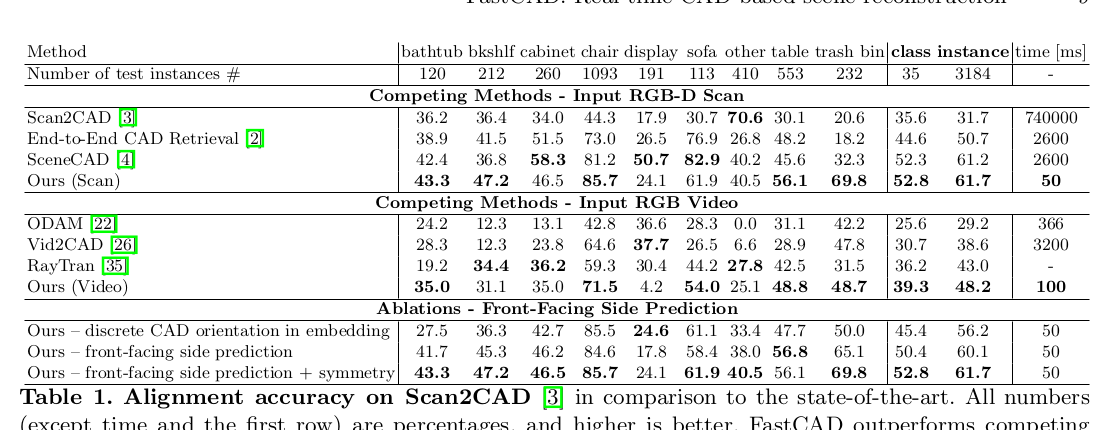
Original Figure 2: a single scene pass predicts classes, 7D boxes, 4-way front sides, and shape embeddings. Below, scan / CAD contrastive learning builds an embedding space, whose GT CAD embeddings train the detector through distillation. Source: published ECVA paper; image copyright belongs to the paper’s authors and Springer Nature. Shown here for paper analysis.Original Table 1: RGB-D scan FastCAD reaches 61.7% instance alignment in 50 ms, versus SceneCAD 61.2% / 2,600 ms; video reaches 48.2% / 100 ms. Source: published ECVA paper; table copyright belongs to the paper’s authors and Springer Nature. Shown here for paper analysis.
4. Problem setting
Input A: colored point clouds from complete RGB-D scans.
Input B: progressively updated point clouds / meshes from online RGB-video scene reconstruction.
Outputs per object: category, retrieved ShapeNet / Scan2CAD CAD shape, and 9DoF alignment with translation, rotation, and anisotropic scale.
This is not arbitrary-orientation single-object 6D pose. ScanNet supplies gravity / upright priors; orientation combines an oriented box with four horizontal front faces, mainly handling yaw and object size.
No test-scene masks, crops, or object IDs are required; detection, retrieval, and alignment share one scene-level forward pass.
5. Method overview
Sparse 3D convolutions / transposed convolutions encode up to 50K scene points.
Shared multiscale heads predict 35 classes, 7D boxes, four front-side classes, and 256D shape embeddings.
A separate Perceiver maps noisy partial-scan anchors, GT CAD positives, and same-category negatives into one embedding space.
Triplet loss attracts the true CAD; foreground segmentation and positive-negative Chamfer regression preserve local shape distances as auxiliary tasks.
Train FastCAD to regress GT CAD embeddings directly, removing object crops and encoder passes at test time.
Retrieve nearest CADs within predicted categories and place them using box size / center and front side.
Soft front labels handle 2-fold, 4-fold, and continuous axial symmetry without arbitrary orientation supervision.
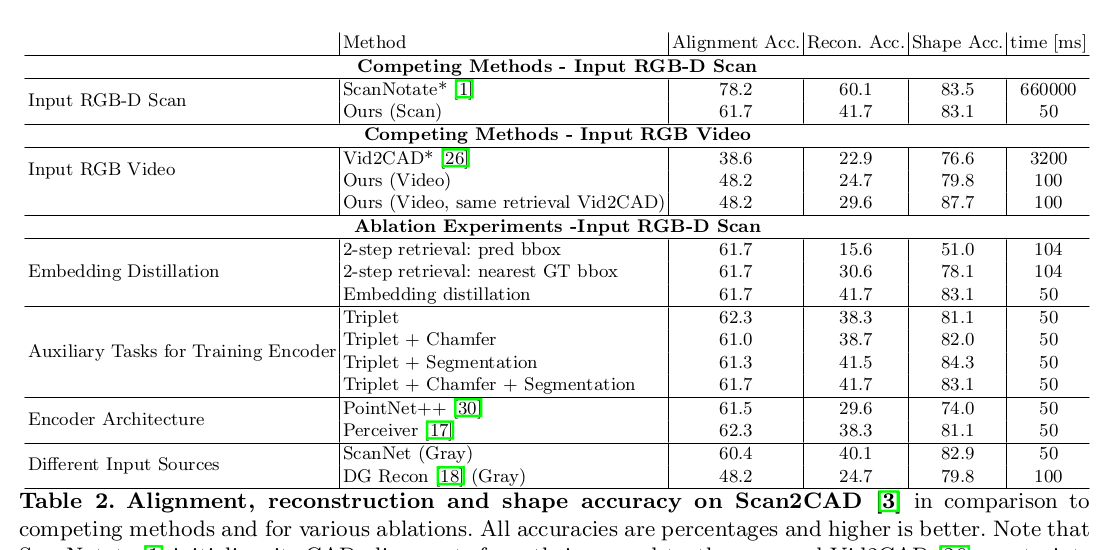
Main video: 48.2 / 24.7 / 79.8. The abstract’s 29.6 reconstruction accuracy uses an additional retrieval-pool restriction matching Vid2CAD, not the main open-library setting.
Distillation improves reconstruction / shape over predicted-box two-stage retrieval from 15.6 / 51.0 to 41.7 / 83.1.
7. Quick assessment
Strengths: single-stage detection, 9DoF alignment, and retrieval; separately quantified speed, accuracy, and shape quality; relevant to online AR / scene digitization.
Limitations: only 35 indoor ScanNet / Scan2CAD categories; video depends on reconstruction; independent updates jitter; no collision / support constraints; no code released with the paper.
Relation to pose: adjacent scene-level category CAD alignment provides transforms for pose / AR / robotics, but upright 9DoF cannot be ranked directly against BOP object SE(3).
Intended readers: Scan2CAD, 9DoF alignment, CAD retrieval, sparse 3D detection, online reconstruction, and digital twins.
Available src/paper-notes/fastcad-eccv2024/deep.md
In-depth paper notes
Support reproduction, comparison, related-work writing, and identifying opportunities for further research.
Deep Reading Notes: FastCAD
1. Key assessment
The key is using a training encoder to teach the scene detector shape embeddings, then removing per-object encoding at test time:
Conventional: scene detection → crop each object → encode crops → CAD retrieval → alignment optimization;
FastCAD: one scene pass predicts detection, alignment, and distilled CAD embeddings → nearest neighbors.
This removes crop encoders scaling with object count and uses scene context for shape, such as similar chairs around a table. The 50× speedup mainly comes from reformulating tasks, rather than merely a faster backbone.
2. Task boundary: 9DoF CAD alignment versus 6D pose
Outputs are category / CAD identity and object transforms including:
3D center translation;
oriented box rotation;
Three-axis size / anisotropic scale;
Four-way front-facing side.
Gravity-aligned indoor Scan2CAD objects use four horizontal box sides and up-axis 2-fold / 4-fold / full rotational symmetry. This is upright indoor 9DoF object-to-scene alignment, rather than arbitrary SO(3) tabletop BOP pose.
Video first reconstructs a scene mesh / cloud rather than regressing from one RGB frame. The 100 ms pipeline comprises reconstruction 50 ms + FastCAD 50 ms.
3. Single-stage scene network
Original Figure 2: four heads share scene features; a separate encoder produces training targets and is absent at inference. Source: published ECVA paper; image copyright belongs to the paper’s authors and Springer Nature. Shown here for paper analysis.
MinkowskiEngine sparse convolutions and generative transposed convolutions produce multiscale features, inspired by TR3D. Each detection location outputs:
p^∈R35: object class;
b^∈R7: oriented-box parameters;
f^∈R4: front-facing side;
w^∈R256: shape embedding.
Small / large categories use feature levels 2 / 3. Total loss:
L=Lcls+1matched(Lbb+Lff+Lemb),
Focal loss handles category, DIoU boxes, cross-entropy front side, and MSE regresses w^ to GT CAD embeddings. Each GT is assigned once among its nearest k=6 detection locations.
Separating front orientation from embeddings offers two benefits:
Avoid four 90° embeddings per CAD, reducing library size to 1/4;
Encode symmetry directly as soft front labels:
non-symmetric: one-hot;
2-fold: probability 1/2 on each opposite face;
4-fold / full up-axis symmetry: 1/4 on every face.
4. Learning and distilling shape embeddings
Anchors are GT-box scan points with background, occlusion, and missing data; positives are corresponding clean CADs; negatives are randomly sampled same-category CADs. A shared Perceiver produces 256D embeddings.
4.1 Triplet
Ltri=max(0,∥A−P∥22+m−∥A−N∥22).
Same-category negatives require distinguishing shapes within chairs / tables, rather than learning only category semantics.
4.2 Foreground segmentation auxiliary task
Anchor crops retain background. Pointwise BCE predicts foreground, balancing classes so 80–90% foreground does not overwhelm background supervision.
4.3 Chamfer-distance regression auxiliary task
A shallow MLP regresses positive / negative CAD-cloud Chamfer distance from their embeddings. This preserves continuous same-category geometric similarity rather than directly optimizing retrieval rank.
After encoder training:
Encode all CADs offline;
Retrieve GT CAD embedding wi for each training annotation;
Train FastCAD by MSE to regress wi;
At inference, use w^ for nearest neighbors within the predicted category.
This distills target representations, rather than logits / teacher probabilities.
5. Data and metrics
Scan2CAD aligns ShapeNet CADs to 1,201 training / 312 validation ScanNet scenes, with 14K+ object annotations, 3K+ unique CADs, and 35 categories.
5.1 Alignment accuracy
Alignment counts as correct only when all conditions hold:
Correct class;
translation error < 20 cm;
rotation error < 20°;
scale error < 20%.
Each GT matches once. Retrieved-shape similarity is not checked, so correct alignment can still place a poor same-category CAD.
5.2 Reconstruction accuracy
Place predicted / GT CADs using predicted / GT transforms and sample surfaces. Normalize the largest GT side to 10; F-score at τ=0.5 must exceed μ=0.7. This penalizes both shape retrieval and alignment.
5.3 Shape accuracy
Shape accuracy instead places both CADs with perfect GT alignment before the same F-score test. All three metrics matter:
Alignment: transform and category;
Shape: retrieved geometry;
Reconstruction: both jointly.
6. Alignment accuracy and speed
Original Table 1: inference time per scene / update, without assuming inclusion of unspecified preprocessing. RayTran reports no timing. Source: published ECVA paper; table copyright belongs to the paper’s authors and Springer Nature. Shown here for paper analysis.
Input
Method
Instance alignment
Time
RGB-D scan
SceneCAD
61.2
2,600 ms
RGB-D scan
FastCAD
61.7
50 ms
RGB video
ODAM
29.2
366 ms
RGB video
Vid2CAD
38.6
3,200 ms
RGB video
RayTran
43.0
Not reported
RGB video
FastCAD
48.2
100 ms
Scan accuracy exceeds SceneCAD by only 0.5 point with approximately 52× faster inference: this is the tradeoff. Video accuracy exceeds RayTran by 5.2 points, but at-least-threefold speed evidence mainly comes from ODAM / Vid2CAD, since RayTran lacks timing.
Front-side ablation:
Orientation inside embeddings: 56.2;
Separate front head: 60.1;
symmetry-aware target: 61.7.
The head adds +3.9 and symmetry another +1.6, supporting separation of orientation supervision from retrieval rather than only larger embeddings.
7. Shape quality and key ablations
Original Table 2: ScanNotate starts from GT poses; Vid2CAD restricts retrieval to a small GT scene pool. Starred results therefore differ from FastCAD’s main setting. Source: published ECVA paper; table copyright belongs to the paper’s authors and Springer Nature. Shown here for paper analysis.
Main settings:
Input
Alignment
Reconstruction
Shape
Time
FastCAD scan
61.7
41.7
83.1
50 ms
FastCAD video
48.2
24.7
79.8
100 ms
FastCAD video, Vid2CAD-matched retrieval pool
48.2
29.6
87.7
100 ms
The abstract’s reconstruction 22.9→29.6 compares both methods restricted to GT scene retrieval pools. Main open-library FastCAD is 24.7; summaries must state this rather than treating 29.6 as default.
Embedding distillation:
Design
Reconstruction
Shape
2-stage, predicted bbox crop
15.6
51.0
2-stage, nearest GT bbox crop
30.6
78.1
distilled one-stage
41.7
83.1
Two-stage retrieval lags even with near-GT crops. The authors suggest scene receptive fields exploit shape correlations, but scene / category co-occurrence shortcuts may also contribute and need cross-building checks.
Auxiliary encoder tasks improve triplet-only 38.3 / 81.1 to 41.7 / 83.1. Segmentation alone has slightly higher shape accuracy 84.3, while joint training leads reconstruction. Perceiver versus PointNet++ gives reconstruction / shape 38.3 / 81.1 versus 29.6 / 74.0; encoder quality transfers to the distilled detector.
ScanNotate shape accuracy 83.5 is close to FastCAD 83.1, but GT initialization and 660,000 ms per scene make it an offline annotation reference rather than an equivalent online baseline.
8. Online video behavior
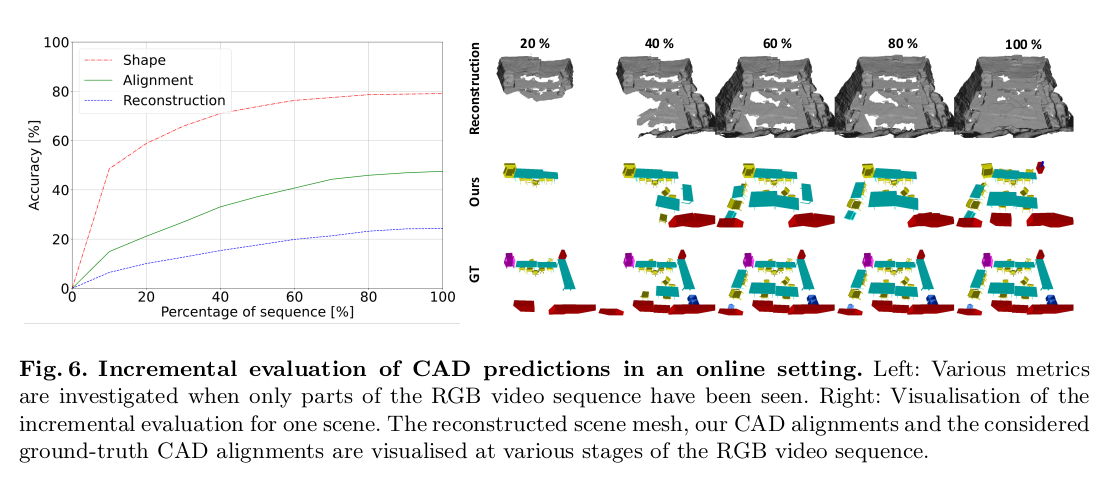
Original Figure 6: usable results after approximately 30% of a sequence improve as reconstruction fills in and occluded objects appear, increasing shape / alignment / reconstruction scores. Source: published ECVA paper; image copyright belongs to the paper’s authors and Springer Nature. Shown here for paper analysis.
Evaluation includes only GT whose centers have entered an observed frame’s FOV. Those objects may still be occluded and unreconstructed, lowering early recall. Approaching and observing more views improves scene meshes and CAD predictions.
Independent inference on each updated cloud provides no tracking / temporal association, so:
CAD identities can switch;
Alignment can jitter;
The same object may receive different categories across detections;
Previous poses cannot stabilize refinement.
Throughput of 10 FPS does not establish temporal consistency.
9. Limitations and failures
One ScanNet / Scan2CAD domain, 35 classes, upright indoor objects;
Finite CAD coverage only approximates out-of-library shapes;
Video reconstruction propagates camera-tracking / fusion errors;
No layout, support, collision, or physical plausibility constraints;
No iterative refinement for residual small pose errors;
Independent online estimates jitter;
Scene context can become a training shortcut;
50 ms / 100 ms concern the paper’s implementation, without mobile deployment;
PyTorch, MMDetection3D, and MinkowskiEngine are specified, without an official FastCAD code link in the paper.
10. Reproduction checklist
Use official Scan2CAD 1,201 / 312 scene splits;
Limit clouds to 50K points;
Separate scan models from video models trained on reconstruction outputs;
Sample CAD negatives within categories;
Use triplet + balanced foreground segmentation + Chamfer regression for the encoder;
Distill 256D GT embeddings rather than cropping at inference;
Separate front sides from shape, with 2 / 4 / full symmetry soft labels;
Report alignment, shape, and reconstruction together;
Distinguish open CAD and GT scene pools;
Split runtime into reconstruction, FastCAD, NN search, and preprocessing;
Add identity switches, pose jitter, and time to stable detection in online evaluation.
11. Overall assessment
FastCAD compresses expensive per-object retrieval encoders into one scene detector through embedding distillation, reducing SceneCAD’s 2.6-second pipeline to 50 ms while slightly improving alignment. Beyond 20°/20cm/20% alignment, new shape / reconstruction metrics prevent a correct pose with incorrect CAD geometry from counting as unqualified success.
Its relation to 6D pose is gravity-aligned indoor category / CAD retrieval plus 9DoF alignment, not BOP-style arbitrary-object SE(3). Within that scope it is a strong real-time digitization, AR, and robot scene-model baseline.