Shape-guided Configuration-aware Learning for Endoscopic-image-based Pose Estimation of Flexible Robotic Instruments
PoseFlex uses attention from per-part 3D shape priors to guide endoscopic RGB features. An initial four-angle configuration creates dynamic priors for refinement, while a matrix-Fisher distribution outputs angles and uncertainty. On 12,473 private ex-vivo pairs, G3 α/β/γ/δ mean errors are 7.08°/4.66°/1.62°/11.68°. It does not predict standard 6-DoF translation.
Given a single endoscopic RGB image, a binary robot mask, and a 3D flexible-arm shape prior with segment labels, PoseFlex uses part-level point Transformer features as keys / values to attend to image features. It first regresses four configuration angles (α,β,γ,δ), then generates a dynamic shape prior consistent with the initial estimate using piecewise constant curvature for a second refinement stage. Independent matrix-Fisher distributions provide both angle estimates and uncertainty.
3. Guide to figures and tables
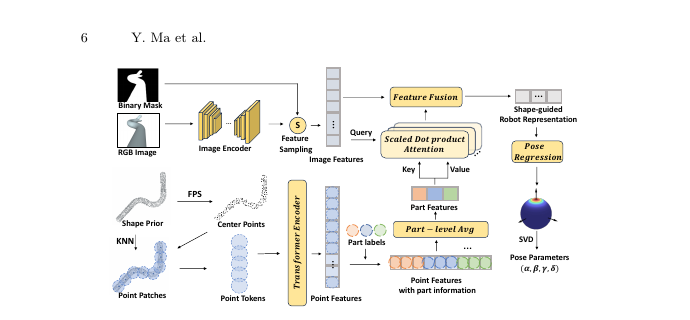
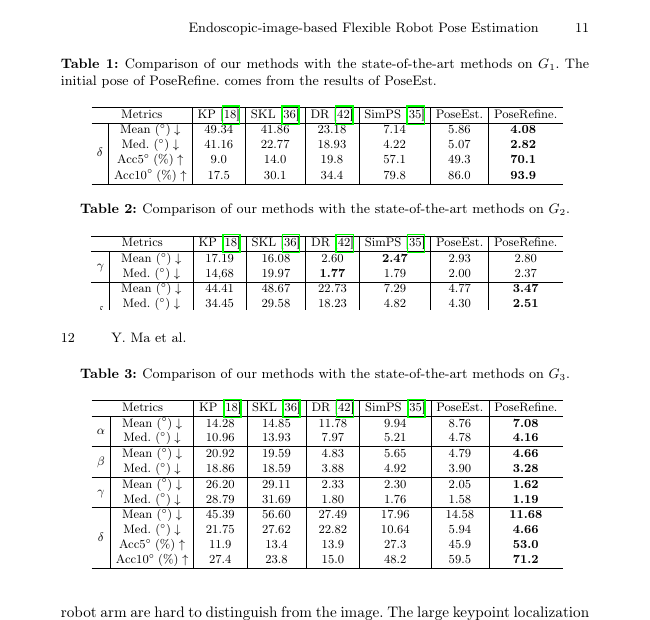
Original Figure 3: the static 3D shape prior is divided into point patches, encoded, and aggregated by robot part. Part features attend to image features within the mask; fused features regress matrix-Fisher parameters for each configuration angle. Source: official ECVA paper. Image copyright belongs to the paper's authors and Springer Nature; reproduced here for paper analysis.Original Tables 1–3: from G1, which varies only roll, to G3, which varies all four parameters, PoseRefine generally outperforms keypoint, skeleton, direct-regression, and SimPS approaches. In G3, \(\delta\) remains the hardest parameter, with a mean error of 11.68°. Source: official ECVA paper. Table copyright belongs to the paper's authors and Springer Nature; this site combines the three original tables for analysis.
4. Problem setting
Object: a specific flexible robot prototype for endoluminal surgery.
Inputs: monocular endoscopic RGB, a binary robot mask, a predefined robot configuration, and a 3D shape prior.
Outputs: bending angles α,β for two segments, global yaw γ and roll δ, and uncertainty for each prediction.
The output is not standard rigid-body 6DoF R,t: it has no independent 3D translation and estimates a four-degree-of-freedom flexible-arm configuration / orientation.
Training uses real ex-vivo image–pose supervision; it is neither synthetic-only nor unlabeled learning.
5. Method overview
An image encoder extracts RGB features, sampled only within the binary mask.
FPS / KNN divide the static shape-prior point cloud into patches. PointNet produces point tokens, and a Transformer aggregates local and global geometry.
Point features are averaged by part using predefined segment labels.
Part features serve as attention keys / values and image features as queries, producing a shape-guided image representation.
PoseEst regresses initial (α,β,γ,δ).
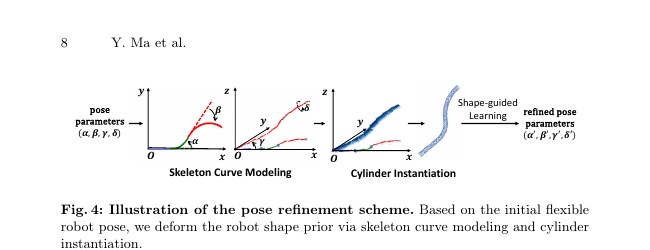
Each segment’s centerline is bent using piecewise constant curvature, and cylinders are instantiated along the curves to generate a dynamic 3D prior.
PoseRefine repeats feature guidance with the dynamic prior to correct the initial angles.
Each degree of freedom is trained with an independent matrix-Fisher distribution, replacing ordinary L1 / L2 with NLL.
6. Experiments at a glance
Private ex-vivo data: 12,473 image–pose pairs; 9,473 for training / validation and 3,000 for testing.
G1 (varying only δ): PoseRefine mean / median = 4.08° / 2.82°; Acc5° / Acc10° = 70.1 / 93.9%.
G2: mean error of 2.80° for γ and 3.47° for δ; the latter has Acc5° / Acc10° = 74.4 / 97.1%.
G3 mean errors for the four parameters: α7.08°, β4.66°, γ1.62°, and δ11.68°.
G3 δ Acc5° / Acc10° = 53.0 / 71.2%; roll remains difficult with more degrees of freedom and self-occlusion.
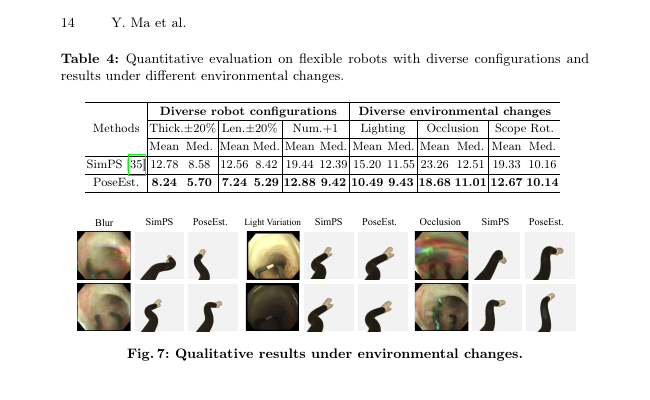
Experiments on configuration changes and visual disturbances report only PoseEst: mean errors are approximately 7.24–18.68°, better than SimPS at 12.56–23.26°.
The main paper reports no FPS / latency; integration into real control / manipulation remains future work.
7. Quick assessment
Strengths: robot kinematic priors directly inform the 2D representation; the dynamic prior better reflects flexible deformation than static CAD; probabilistic outputs provide confidence estimates; the open-source code includes models, test data, and a checkpoint.
Limitations: one private robot and an ex-vivo setting; binary masks, accurate configuration, and real angle labels are required; no translation prediction; cross-robot experiments use manual modifications with insufficiently disclosed sample sizes.
Available src/paper-notes/flexible-instrument-pose-eccv2024/deep.md
In-depth paper notes
Support reproduction, comparison, related-work writing, and identifying opportunities for further research.
Paper Reading Notes (Deep): PoseFlex
1. Key assessment
The main difference from conventional object 6D pose estimation is the output space. The method estimates:
θ=(α,β,γ,δ),
Here, α,β are the arc / bending angles of two flexible-arm segments, and γ,δ are global yaw / roll. The method outputs no independent 3D translation and does not estimate rigid-body SE(3). It should therefore be classified here as configuration-aware pose estimation for deformable robotic instruments, without numerical rankings against ADD / BOP AR papers.
The main contribution turns known robot kinematics into a dynamically deformable 3D geometry prior and injects it into monocular image features through attention, rather than asking a CNN to infer four angles solely from appearance.
2. Data, Inputs, and Supervision
The authors collect 12,473 image–pose pairs with an Agilis Robotics flexible-arm prototype for endoluminal surgery in an ex-vivo environment:
9,473 for training / validation;
3,000 for testing;
Ground truth comes from robot motor signals with manual rectification;
G1: only δ varies;
G2: γ,δ vary;
G3: α,β,γ,δ all vary.
The network requires more than RGB:
A binary robot mask;
A home-position 3D shape prior;
A segment / part label for each prior point;
Configuration information such as part length, radius, and segment count.
The main paper neither incorporates mask prediction into the pipeline nor reports robustness to mask noise. The open-source test data also directly provide mask/, making this an external prerequisite.
3. How the Static Shape Prior Guides the 2D Image
Original Figure 3. The image and shape prior have no explicit 2D–3D correspondences. Instead, attention uses part geometry as keys / values to guide masked image features in feature space. Source: official ECVA paper. Image copyright belongs to the paper's authors and Springer Nature; reproduced here for paper analysis.
Given a shape point cloud X∈RN×3:
Pc=FPS(X),Pp=KNN(X,Pc).
PointNet maps each patch to a token, augmented with a positional embedding of its center coordinates. A Transformer then produces point features fp. Predefined part labels support averaging by segment:
fpartj=∣s(partj)∣1i∈s(partj)∑fpi.
Image features fI then act as queries and part features as keys / values; scaled dot-product attention produces part-aware descriptors. This provides an explicit prior even for robot segments far from the camera or small in the image, but assumes that the kinematic segmentation exactly matches the physical robot.
This is not conventional CAD matching: it does not project 3D points to establish pixel correspondences. The shape prior provides learned feature conditioning.
4. Dynamic Shape Deformation and Refinement
Original Figure 4. The initial pose transforms the straight / static home-position prior into a piecewise constant-curvature skeleton. Cylinders instantiated between adjacent control points produce a pose-conditioned dynamic prior. Source: official ECVA paper. Image copyright belongs to the paper's authors and Springer Nature; reproduced here for paper analysis.
The static prior represents only the home position. Its geometric guidance becomes less reliable as bending increases the shape discrepancy. PoseFlex therefore uses two stages:
PoseEst uses the static prior to obtain initial θ^;
Deformation function Λ(θ^,ϕ,w) generates a dynamic prior from the predicted angles, configuration ϕ, and radius w;
Skeleton control points are calculated for each segment using piecewise constant curvature;
Rodrigues rotation composes γ,δ;
Cylinder surfaces are sampled between adjacent control points;
PoseRefine uses the new prior to guide the image features again.
This resembles analysis by synthesis, but synthesizes a geometric point cloud for the feature encoder rather than rendering a photometric image. An incorrect initial estimate also produces an incorrect dynamic prior, so the refinement basin still depends on PoseEst.
5. Matrix-Fisher Probabilistic Regression
Each degree of freedom is represented by an independent matrix-Fisher distribution:
p(R)=M(R;A)=n(A)1exp(tr(A⊤R)).
Training uses negative log likelihood:
L(Y,A)=−logM(Y;A).
At inference, SVD is applied to A=USV⊤:
U,V recover the distribution mode / pose;
Singular values S describe concentration and can be converted into uncertainty.
A continuous rotation distribution avoids the direct-regression problems of Euler wrap-around and quaternion double cover. However, the authors use independent distributions for the four angles without explicitly modeling joint correlations among α,β,γ,δ, despite the strong coupling in flexible-arm kinematics.
6. Main Results: Roll Becomes Harder with More Degrees of Freedom
Original Tables 1–3. PoseRefine starts from PoseEst. KP / SKL also use a monocular depth Transformer to lift 2D keypoints / skeletons into 3D, so their failures include depth error. Source: official ECVA paper. Table copyright belongs to the paper's authors and Springer Nature; this site combines the three original tables for analysis.
G1, varying only δ:
Method
Mean
Median
Acc5°
Acc10°
SimPS
7.14°
4.22°
57.1
79.8
PoseEst
5.86°
5.07°
49.3
86.0
PoseRefine
4.08°
2.82°
70.1
93.9
Although PoseEst has a lower mean error than SimPS, its Acc5° is 7.8 points lower, indicating a different error distribution. Only refinement provides gains across all metrics.
G2:
γ: PoseRefine has mean error 2.80°, but DR / SimPS are lower at 2.60° / 2.47°. The method is not best on every parameter.
δ: PoseRefine mean / median error is 3.47° / 2.51° and Acc5° / Acc10° is 74.4 / 97.1%, clearly the best result.
G3:
Parameter
SimPS mean
PoseEst mean
PoseRefine mean
α
9.94°
8.76°
7.08°
β
5.65°
4.79°
4.66°
γ
2.30°
2.05°
1.62°
δ
17.96°
14.58°
11.68°
δ remains substantially harder than the other three parameters. More degrees of freedom, self-occlusion, and camera-axis geometry leave roll ambiguity that the shape prior does not fully eliminate.
7. Configuration and Environmental Changes
Original Table 4 and Figure 7. These compare only SimPS and PoseEst, without PoseRefine. Changes include thickness / length ±20%, an additional segment, lighting, irrigation water / bubble occlusion, and motion blur. Source: official ECVA paper. Figure and table copyright belongs to the paper's authors and Springer Nature; reproduced here for paper analysis.
PoseEst mean / median:
thickness ±20%: 8.24° / 5.70°;
length ±20%: 7.24° / 5.29°;
segment count +1: 12.88° / 9.42°;
lighting: 10.49° / 9.43°;
flushing / bubbles occlusion: 18.68° / 11.01°;
scope rotation blur: 12.67° / 10.14°.
All conditions outperform SimPS, but the evidence is limited to manual configuration variations of one prototype. The table provides neither the sample count per condition nor cross-robot data with entirely different mechanisms / materials / cameras.
8. Evidence for Uncertainty
Supplementary project results show that samples with high matrix-Fisher uncertainty more often have large errors. This could support:
Rejecting low-confidence predictions during control;
Choosing to observe again / slow down;
Setting measurement covariance in a temporal filter.
However, the main paper provides no Expected Calibration Error, reliability diagram, or coverage–risk curve under uncertainty thresholds. The evidence establishes correlation rather than full probabilistic calibration.
9. Key Limitations
The output comprises four angles without metric translation and should not be described as general 6DoF instrument pose.
One private prototype and ex-vivo data; no independent verification on a public benchmark.
Ground truth uses motor signals plus manual rectification, with no quantified error bounds.
A binary mask is required, but segmentation error is not considered.
It is insufficiently clear whether testing strictly separates temporal sequences / motion trajectories; adjacent frames may be highly correlated.
The dynamic prior depends on PoseEst and may reinforce an incorrect initial estimate.
The four matrix-Fisher distributions are independent and ignore joint correlations.
Comparisons with depth baselines use monocular predicted depth and do not establish that real stereo / depth sensors would perform worse.
No runtime, model size, or control frequency is reported.
Synthetic training and robot closed-loop integration remain future work.
The open-source repository provides code, test data, and a checkpoint, but users must organize the complete training data themselves.
10. Reproduction Checklist
Publish train / val / test image IDs and separate trajectories to prevent adjacent-frame leakage;
Record motor-to-angle calibration and the variance of manual corrections;
Specify the source of binary masks and add mask corruption tests;
Fix the home prior, part labels, length, radius, and segment count;
Evaluate PoseEst and PoseRefine separately;
Report mean / median / threshold metrics separately for α,β,γ,δ;
Report refinement success by initial-error bin;
Evaluate uncertainty with ECE, NLL, and coverage–risk;
Compare against real depth / stereo sensors rather than only monocular predicted depth;
Measure end-to-end latency across preprocessing, shape deformation, the network, and SVD;
Add cross-robot, cross-endoscope, in-vivo, or more realistic tissue environments.
11. Overall assessment
PoseFlex offers a complete design for incorporating known robot geometry into monocular flexible-instrument state estimation: part-aware shape tokens improve image features, initial angles deform the static prior into a dynamic prior, and matrix-Fisher distributions attach uncertainty to predictions. All four G3 parameters outperform SimPS, supporting the value of shape guidance for deformation with many degrees of freedom.
Its task nevertheless remains four-angle estimation for one flexible arm rather than general 6DoF object pose. Binary masks, real pose labels, accurate configuration, and private data are prerequisites; δ still has a mean error of 11.68°, with no speed or closed-loop control results. It is a representative example of combining kinematic priors with visual representations, rather than a method to rank directly against BOP rigid-pose results.