Free-Moving Object Reconstruction and Pose Estimation with Virtual Camera
Virtual Camera Pose jointly reconstructs shape and continuous poses from monocular freely moving-object sequences. It first reduces the optimization space in a virtual camera frame, then uses PnP to return to the real camera frame and performs global refinement.
Available src/paper-notes/free-moving-object-virtual-camera/coarse.md
Paper overview notes
Quickly assess the paper's scope, problem setting, core method, experimental findings, and whether to read it in depth.
Overview: Free-Moving Object Reconstruction and Pose Estimation with Virtual Camera
One-Sentence Summary
This work jointly reconstructs the shape and continuous poses of a freely moving object from monocular video. A virtual camera first restricts the optimization search space, before global refinement in the real camera coordinate system.
Task Boundaries
Inputs: a monocular RGB sequence with object masks and camera intrinsics.
Outputs: an object mesh and a pose for each frame.
No fixed scene, hand pose, or category pose prior is assumed; segmentation / calibration are still required.
Method at a Glance
Jointly fit the sequence using an SDF MLP, Color MLP, and Pose MLP.
Transform the camera system into a more controlled virtual camera to reduce the rotation / translation search difficulty under free motion.
Use PnP to return the results to the real camera, then refine globally; progressive training handles long sequences.
Experimental Highlights
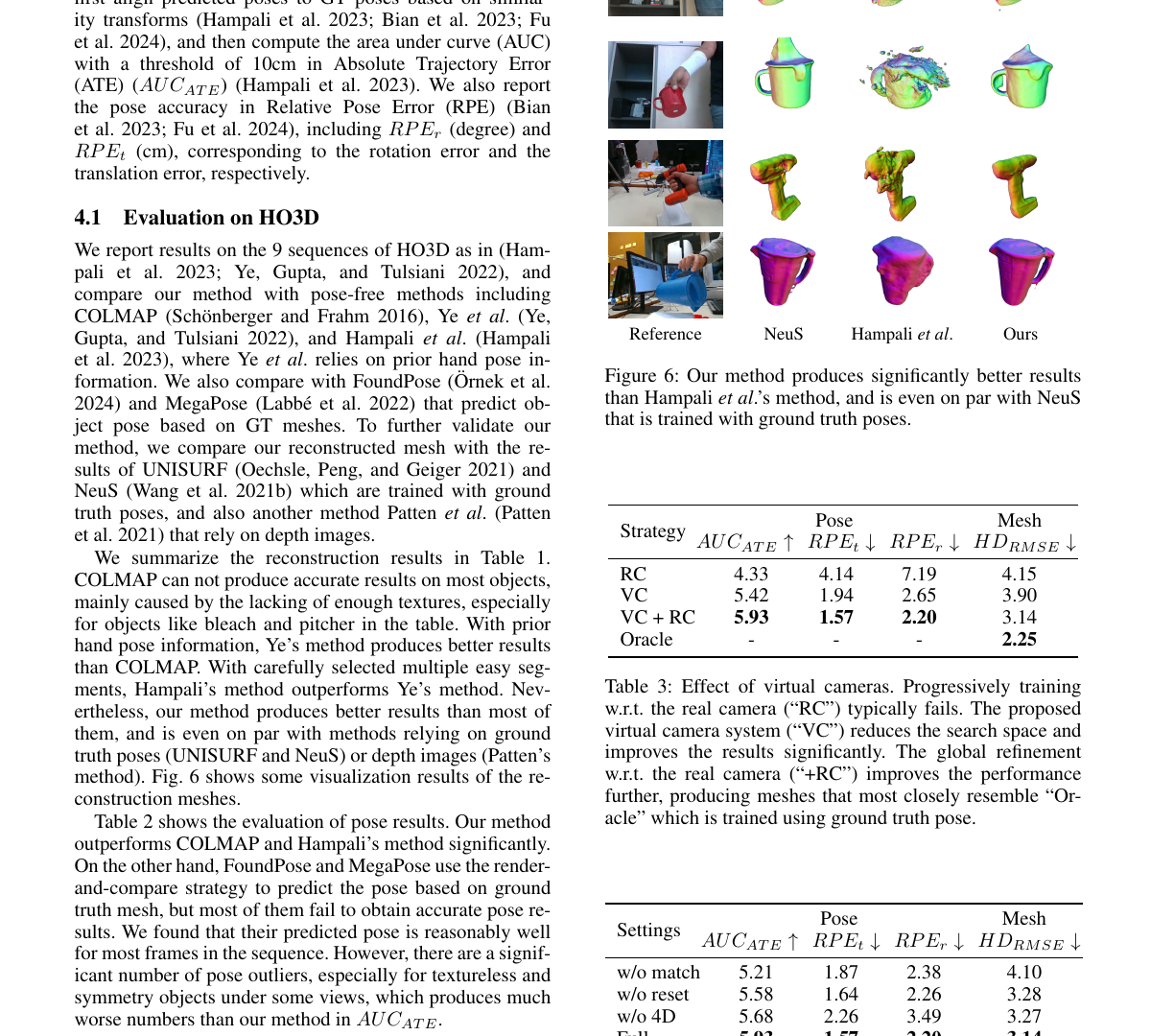
HO3D mesh: mean HDRM SE of 3.14 mm (lower is better).
Pose: mean AUC ATE of 5.9 (higher is better).
virtual camera + real-camera refinement: AUC ATE 5.93, relative translation 1.57 cm, relative rotation 2.20°, HDRM SE 3.14 mm.
This monocular sequence optimization method uses pose-free initialization. Instead of starting from known CAD or a fixed hand relationship, it uses a virtual camera to reparameterize optimization with both freely moving camera and object into a problem that converges more easily.
2.1 Guide to the paper’s figures and tables
Figure / table
Reading focus
Figures 3–5
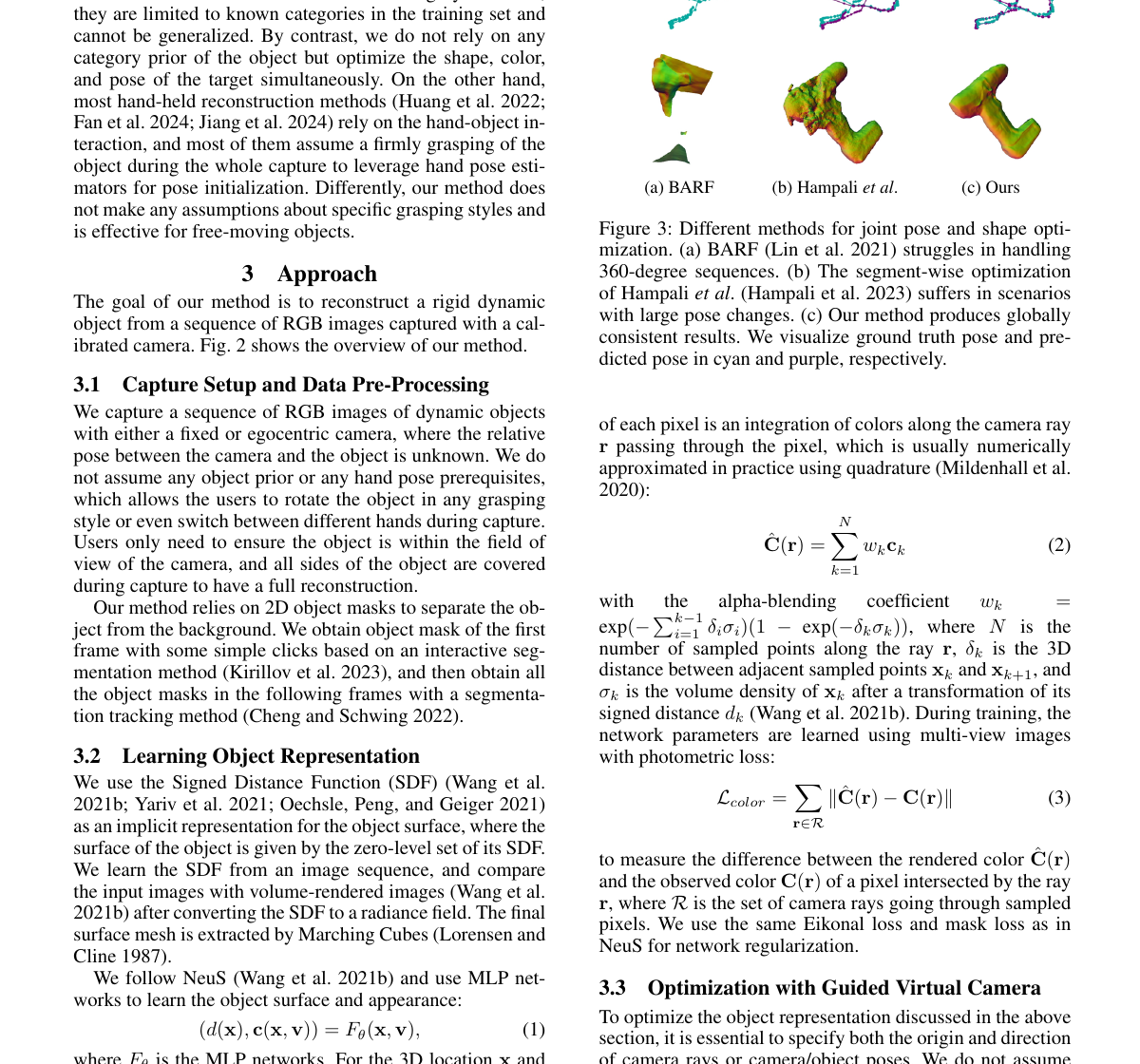
Which optimization obstacles are addressed by the virtual camera, progressive training, and global refinement
Table 1
Mesh HDRM SE, where lower is better
Tables 2–4
Pose AUC / relative errors and ablations of the virtual camera, matching, resetting, and 4D reduction
Excerpt from the original paper's virtual-camera optimization method page. Source: official AAAI PDF. Image copyright belongs to the paper's authors and publisher; reproduced here for paper analysis.Excerpt from the original paper's HO3D results and ablation page. Source: official AAAI PDF. Image copyright belongs to the paper's authors and publisher; reproduced here for paper analysis.
3. Setup and Challenges
The input is monocular RGB video with object masks; outputs are per-frame poses and an object mesh.
When the object, camera, and hand can all move freely, conventional static-camera or known-hand-pose assumptions no longer hold. Directly optimizing both an SDF and a 6DoF trajectory is also prone to local optima.
The main contribution therefore lies in coordinate systems and a training schedule for joint shape–pose optimization, rather than a new pose head.
4. Method Breakdown
An SDF MLP and Color MLP form an implicit object representation; a Pose MLP predicts pose from a frame embedding.
The virtual camera projects observations into a controlled camera system, narrowing the search space caused by free rotation / translation.
Progressive training expands across groups of sequence frames, replaying small numbers of already-converged images to maintain consistency.
Once 3D–2D correspondences are obtained from the virtual system, RANSAC EPnP maps back to the real camera, followed by global refinement over all images.
The paper also uses a matching loss, periodic shape-network resets, and a reduction of pose degrees of freedom to 4D during initialization to improve convergence.
5. Experiments and Numbers
HO3D mean result
Value
Interpretation
Mesh HDRM SE ↓
3.14 mm
Better than most tabulated pose-free methods; close to some reconstruction approaches using GT poses
Pose AUC ATE ↑
5.9
Depends on absolute trajectory error thresholds and must not be conflated with ADD AUC
virtual camera + real refinement
AUC 5.93; RPE-t 1.57 cm; RPE-r 2.20°; HDRM 3.14 mm
Better than progressive training in the real camera alone (AUC 4.33, HDRM 4.15)
The full ablation also shows that removing matching / resetting / 4D reduction worsens the final metrics, so the virtual camera is not the only contribution.
6. Critical analysis
Strengths: identifies the optimization coordinate system as the problem rather than network capacity alone; evaluates shape and pose together; provides multicomponent ablations.
Limitations: training a 100-frame sequence requires approximately 3 hours of initialization and 7 hours of refinement (V100, as reported in the paper), making it unsuitable for immediate deployment. It depends heavily on masks and stable sequences; weak texture / prolonged occlusion can still cause implicit optimization to drift.
Insight: for pose without CAD, constructing a controlled local / virtual coordinate system before global registration can be more stable than directly regressing world coordinates. Pretrained object representations or uncertainty-aware keyframe selection could reduce per-sequence optimization costs.