Generalizable Single-View Object Pose Estimation by Two-Side Generating and Matching
Gen2SM estimates unseen-object relative orientation from one reference and one query. Assuming known reference pose and gravity alignment, Zero-1-to-3 generates 64 intermediate upper-hemisphere views from the reference. Query conditioning explains their noisy latents, and Monte-Carlo denoising residuals form a two-sided pose score. Grid search and SGD refinement recover elevation / azimuth. NAVI 15° / 30° rotation accuracy is 55.32 / 82.14; GSO gives 58.26 / 72.61. Translation, scale, and independent roll are not estimated. Default search and refinement take around 6.5 s + 1.3 s on one A100.
single posed reference RGB imagesingle query RGB imageobject-centric query crop
Requirements
known reference elevation and azimuthgravity-aligned object up directionsame object instance in reference and queryobject detector and object-centric croppretrained Zero-1-to-3 diffusion modeltest-time grid search and gradient refinement
Full paper metadataAuthors, affiliations, research area, datasets, metrics, method tags, and reading statusExpandCollapse
Original paper terminology:rotation accuracy within 15 degrees / rotation accuracy within 30 degrees / large-viewpoint rotation accuracy / inference runtime
known reference elevation and azimuthgravity-aligned object up directionsame object instance in reference and queryobject detector and object-centric croppretrained Zero-1-to-3 diffusion modeltest-time grid search and gradient refinement
Reading Notes
Overview / Deep Dive
Available src/paper-notes/gen2sm-wacv2025/coarse.md
Paper overview notes
Quickly assess the paper's scope, problem setting, core method, experimental findings, and whether to read it in depth.
Paper Reading Notes (Coarse): Generalizable Single-View Object Pose Estimation by Two-Side Generating and Matching
Given one reference RGB object image with known pose and one query RGB image of the same object, Gen2SM does not ask Zero-1-to-3 to generate the query directly across a large viewpoint change. Instead, both sides condition denoising toward shared intermediate viewpoints. Noise residuals define matching scores, and grid search plus gradient refinement estimate query azimuth and elevation.
Here, object pose must be interpreted according to the actual output: relative 3D rotation / viewpoint under gravity alignment. The method estimates neither translation, scale, nor unrestricted SE(3) pose, and does not treat roll as an independent unknown. It is therefore a related one-reference, unseen-object, rotation-only method, rather than directly comparable with BOP 6D pose methods predicting all three rotation axes and translation.
2.1 Guide to the paper’s figures and tables
Figure / table
Reading focus
Coarse assessment
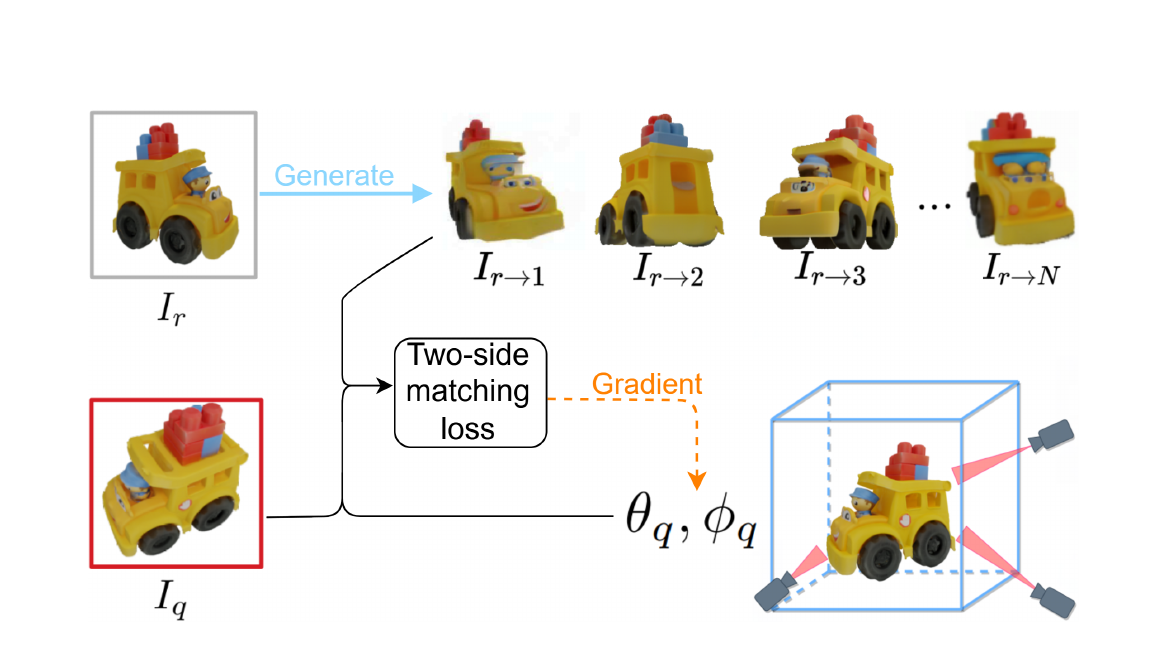
Figure 3
Inputs, generation branches, matching loss, and output variables
The reference generates intermediate views; query pose is recovered by minimizing two-side matching loss
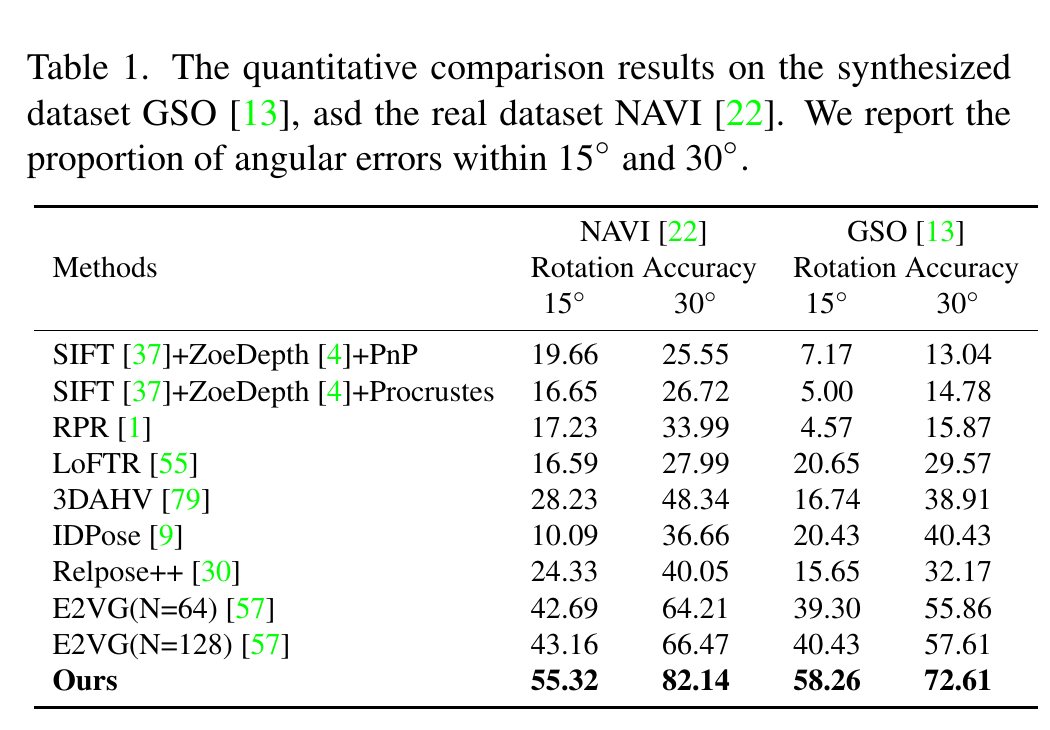
Table 1
Main NAVI / GSO results
Gen2SM leads all listed baselines at both 15° and 30° thresholds
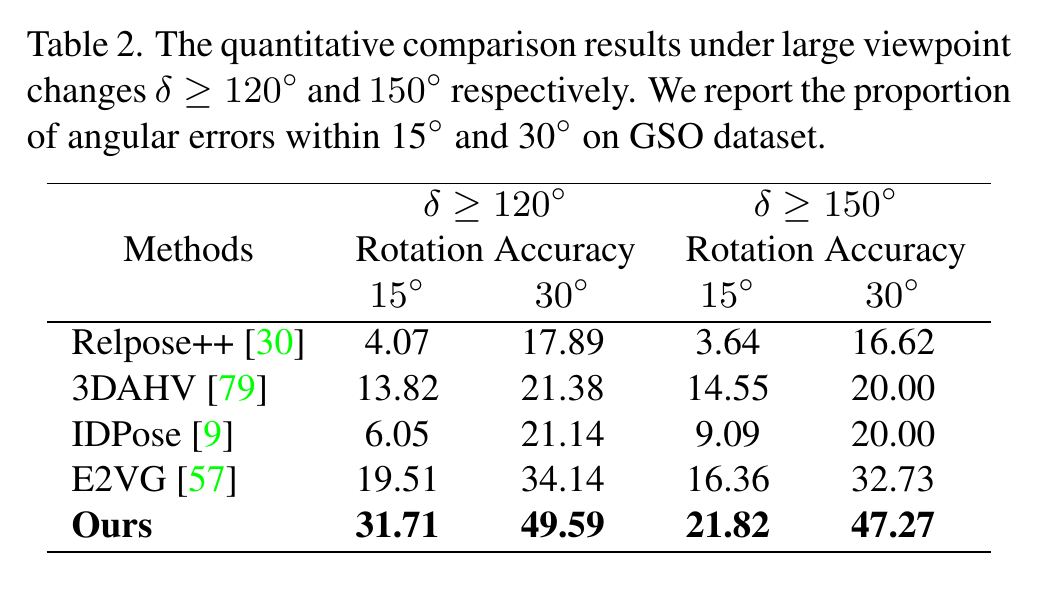
Table 2
Large-viewpoint-gap subsets
Still substantially better than E2VG at 120° / 150°, though absolute accuracy has considerable room to improve
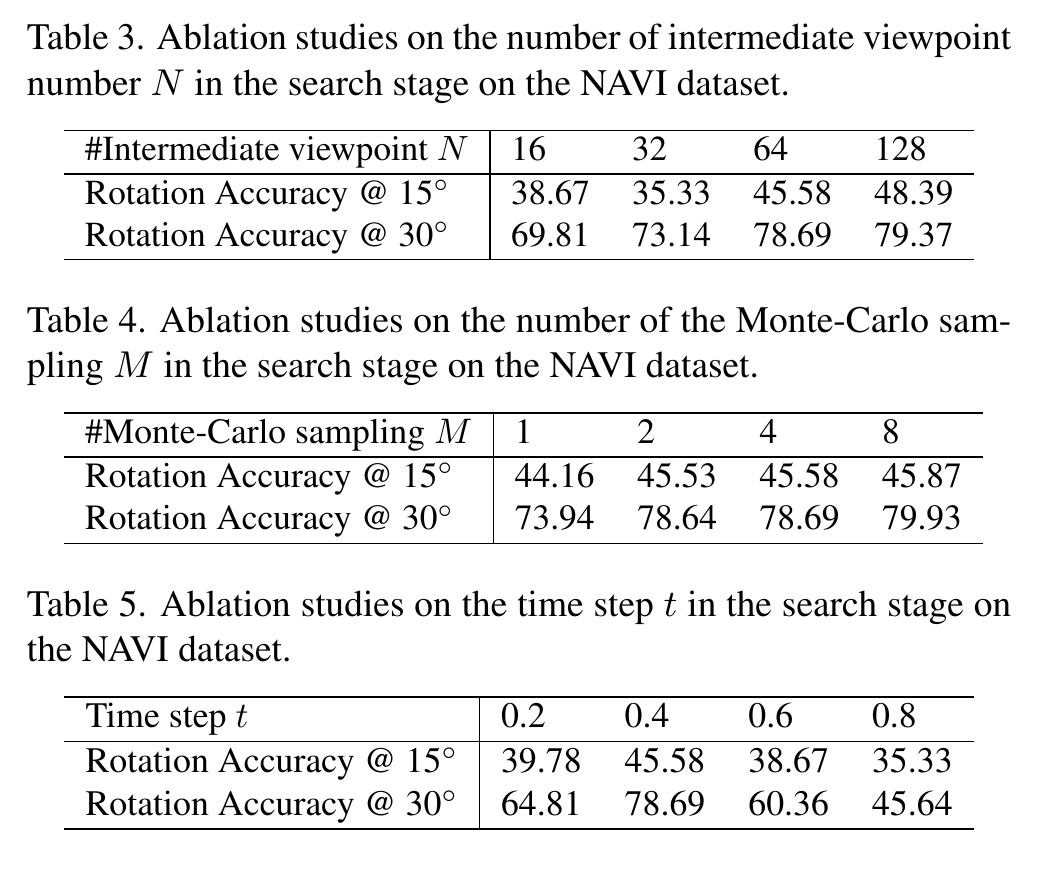
Tables 3–5
Ablations of N, M, and diffusion timestep t
N=64, M=4, t=0.4 balance accuracy and runtime; larger settings are not always better
Original Figure 3: Gen2SM overview. The reference generates multiple candidate intermediate views, and search plus gradient updates on the two-side matching loss recover query azimuth and elevation. Source: CVF Open Access. Image copyright belongs to the paper's authors and publisher; reproduced here for paper analysis.
3. Problem setting
Item
Paper setting
Task
Given one reference image and one query image of the same unseen object, estimate their relative viewing directions
Reference input
One RGB image; the reference object lies at the object-coordinate origin, reference viewpoint pose is known, and the up direction aligns with gravity
Query input
One RGB image; detection and object-centric normalization follow E2VG
Test-time search + gradient-based refinement; the default method is not real-time
“Only one RGB image” can be misleading. Single-view in the title means only one reference image is needed to describe the target object; inference still receives both reference and query images. It does not recover absolute 6D pose from arbitrary uncalibrated photos: the reference frame, reference pose, and object’s upright direction are already defined.
4. Core motivation
Existing sparse-view methods broadly follow three routes:
Feature matching + geometric solving: SIFT, LoFTR, and related methods find cross-image correspondences, then solve relative pose using PnP / Procrustes / RANSAC. Large viewpoint gaps and little shared visible surface can leave too few correspondences.
Direct regression: RPR, RelPose++, and 3DAHV predict relative rotation or pose hypotheses directly from image pairs. They must learn cross-object statistics, and generalization depends on the training distribution.
Generate then match: E2VG and IDPose use Zero-1-to-3’s novel-view prior, potentially favoring unseen objects. However, when reference and query differ by 120° or even 150°, direct generation must infer much of the back side, reducing generation quality and identity consistency.
Gen2SM’s central insight is that a difficult large viewpoint transformation may become easier when each endpoint moves toward intermediate views. Smaller conditional transformations from both reference and query help the generative prior retain object identity. A correct query-pose hypothesis should make the two sides consistent across multiple intermediate views.
5. Method overview
5.1 Define the Task Variables
Let reference view I_r have elevation / azimuth (θ_r, φ_r), and query view I_q have unknown (θ_q, φ_q). Zero-1-to-3 also accepts radial change Δr, but the paper sets Δr=0, so camera–object distance and translation are not solved.
5.2 Build Intermediate Views on the Upper Hemisphere
A Fibonacci sphere uniformly samples N intermediate viewpoints (θ_i, φ_i) on the object’s upper hemisphere, with default N=64. The reference generates views I_{r→i} from I_r; each query-pose hypothesis also defines conditional transformations toward those same intermediate views.
5.3 Compare Denoising Residuals Instead of Fully Generating Both Sets
Full diffusion sampling for every candidate and viewpoint would be expensive. Gen2SM draws on score distillation:
Generate intermediate images I_{r→i} from the reference;
Add Gaussian noise at a fixed diffusion timestep t;
Ask Zero-1-to-3 to predict that noise conditioned on the query image and the transformation from the current query-pose hypothesis to the intermediate view;
If the pose hypothesis is correct, the query condition should explain the reference-side intermediate image, yielding a smaller L2 residual between predicted and actual added noise;
Sum over N intermediate views and M noise samples to score candidate (θ_q, φ_q).
The default fixes t=0.4 and uses M=4 Monte Carlo samples per candidate. Matching here means noise-prediction consistency in a conditional diffusion model at shared intermediate views, rather than SIFT-style pixel correspondences or direct comparison of final generated RGB images.
5.4 Coarse-to-Fine Solving
Inference has two stages:
Coarse grid search: sweep initial azimuth over 0°–360° at 45° intervals, with elevations 15°, 45°, and 75°. Then reduce the azimuth / elevation intervals around the best result.
Gradient refinement: differentiate the score with respect to θ_q and φ_q, updating the query viewpoint with SGD. The default uses 3 refinement steps.
Gen2SM thus defines and optimizes a pose energy using a generative prior, rather than regressing pose in one forward pass.
6. Experimental overview
6.1 Datasets and Protocol
GSO: Google Scanned Objects, approximately 1,000 scanned objects. Following E2VG’s synthetic protocol, the test set contains 23 objects with 1 randomly selected reference view and 20 query views per object.
NAVI: multiview images of 36 real objects in multiple environments. Following E2VG’s filtering rules, symmetric and other unsuitable objects are excluded, leaving 27 test objects, usually with 20 reference–query pairs each.
Filtering symmetric objects matters: a single RGB image may admit multiple equivalent rotations. Angular error against a unique rotation GT can label a visually correct equivalent pose as incorrect. Filtering reduces ambiguity but means the results do not demonstrate robustness to symmetric objects.
6.2 Metrics
The paper obtains relative rotation error from R_gt^T R_pred, converts it to axis-angle angular magnitude, then reports the proportions below 15° and 30°. This site denotes them Acc≤15° and Acc≤30°.
These metrics evaluate rotation-only orientation recovery, without measuring:
Translation accuracy;
Object dimensions and scale;
Projection alignment or grasp usability;
Symmetry-equivalent poses;
Localization within a few degrees.
6.3 Main results
Original Table 1: main NAVI and GSO results. Gen2SM is best in all four reported columns; these are relative-rotation threshold accuracies, rather than full 6D pose metrics. Source: CVF Open Access. Image copyright belongs to the paper's authors and publisher; reproduced here for paper analysis.
Dataset
Gen2SM Acc≤15°
Gen2SM Acc≤30°
Strongest listed baseline
Coarse assessment
NAVI
55.32
82.14
E2VG (N=128): 43.16 / 66.47
Clear gains on real data, especially 15.67 points at 30°
GSO
58.26
72.61
E2VG (N=128): 40.43 / 57.61
Also leads on synthetic data, with 17.83 points at 15°
These results support two-side intermediate matching over one-sided direct generate-and-match. However, Acc≤15° is still only approximately 55%–58%, indicating large-range relative orientation recovery, rather than high-precision 6D pose for industrial assembly.
6.4 Large Viewpoint Gaps
On GSO with viewpoint gap δ≥120°, Gen2SM achieves 31.71 / 49.59; at δ≥150°, it reaches 21.82 / 47.27. The strongest baseline, E2VG, gives 19.51 / 34.14 and 16.36 / 32.73, respectively.
This directly tests the paper’s motivation: at extreme viewpoint gaps, the 30°-threshold gain remains approximately 15 points. Yet at δ≥150°, only 21.82% of samples fall within 15°, showing that crossing large viewpoint gaps does not imply precise rotation recovery.
6.5 Speed
Default configuration on one A100: approximately 6.5 s for coarse search and 1.3 s for refinement, totaling approximately 7.8 s / query.
Light version: approximately 1.12 s / query; the paper reports drops of only about 1 and 4 percentage points in Acc≤15° and Acc≤30°, respectively.
Candidates can be parallelized across GPUs, trading hardware for wall-clock time without reducing the high total computation.
It is therefore better suited to offline mapping, selected keyframes, or generating pose hypotheses than to direct high-frame-rate tracking.
7. Are the Contributions Supported by Experiments?
Author claim
Evidence
Coarse assessment
Generalizes to unseen objects from one reference without object-specific training
Main comparisons with E2VG / IDPose and δ≥120°/150° subsets
Strong support directly aligned with the motivation
Coarse-to-fine refinement improves accuracy
Refinement curves mainly improve 15° accuracy
Supported, but the main paper provides no exact step-by-step numerical table
Has practical application potential
Real NAVI data and light version
Partly supported; no standard scene, occlusion, symmetry, or robot closed-loop experiments
8. Strengths and limitations
Strengths
Splits diffusion’s difficult large-gap direct generation into smaller transformations from both endpoints toward intermediate views, aligning the design with the failure mechanism.
Test objects need no CAD, multiple reference images, or object-specific retraining, keeping reference acquisition inexpensive.
Evaluates relative-rotation metrics rather than relying on the visual appeal of generated images.
Specifically reports 120° / 150° viewpoint gaps, preventing overall averages from hiding the central challenge.
Analyzes N, M, t, refinement, and runtime to expose accuracy–computation trade-offs.
Limitations / risks
Outputs are not full SE(3): no translation, scale, or independent roll, so the method cannot directly replace a standard 6D object-pose estimator.
Depends on reference pose, gravity alignment, object-centric crops, and Zero-1-to-3 object priors; one image does not mean no priors.
Symmetric objects are filtered, and scene-level clutter / occlusion is outside the main protocol. The paper also states that Zero-1-to-3’s object-centric nature prevents direct scene processing.
Approximately 7.8 s / query by default, or still approximately 1.12 s for the light version, remains far from real-time tracking.
If the foundation model hallucinates incorrect back-side structure for an object class, the matching score can follow that incorrect prior.
Absolute Acc≤15° values indicate insufficient precision; the authors also explicitly acknowledge difficulty reaching errors of only a few degrees.
9. Is It Worth a Deep Reading?
Yes, with the correct task boundaries in mind.
Relevant readers include those:
Studying novel / unseen-object pose, one-reference pose, or diffusion priors;
Investigating large viewpoint gaps, sparse references, and test-time optimization;
Designing bidirectional consistency objectives where two observations explain a shared intermediate latent.
It should not directly be treated as:
A standard BOP instance-level 6D pose baseline;
An absolute-pose method without detection or a reference coordinate frame;
A symmetry- / occlusion-robust method;
A real-time robotic-grasping pose module.
10. Ideas for Future Research
Use shared intermediate states as bridges: when endpoints are difficult to match directly, map each toward shared intermediate views, canonical surfaces, or latents, then compare consistency.
Foundation models can do more than extract features: pretrained diffusion denoising residuals can define a pose score and contribute to geometric optimization through search or differentiation.
Decouple rotation search from full 6D solving: Gen2SM can supply coarse orientation hypotheses, followed by depth / correspondence / render-and-compare modules for translation and refinement.
Handle symmetry explicitly: extending to BOP requires equivalent-rotation sets or symmetry-aware energies rather than continued filtering.
Gen2SM’s value lies in a clear generative relative-rotation energy rather than solving full 6D pose from one image. Reference and query verify each other across shared intermediate viewpoints instead of generating directly across a large gap. Main and large-gap results broadly support the design; costs include heavy inference, foundation-model dependencies, and restricted pose outputs. For one-reference unseen-object orientation, it is a useful baseline to reproduce and extend. For standard R,t 6D pose, it should serve as rotation initialization rather than a complete solution.
Available src/paper-notes/gen2sm-wacv2025/deep.md
In-depth paper notes
Support reproduction, comparison, related-work writing, and identifying opportunities for further research.
Paper Reading Notes (Deep): Generalizable Single-View Object Pose Estimation by Two-Side Generating and Matching
Gen2SM estimates relative viewing direction for unseen objects from one reference RGB image, rather than full 6D object pose. It replaces unreliable direct generation from reference to query across large viewpoint gaps with mutual explanation across shared intermediate viewpoints. Pretrained Zero-1-to-3 noise-prediction residuals define a pose energy, and discrete search plus SGD refinement recover query elevation and azimuth.
The main contribution is the two-side matching reformulation, beyond simply using diffusion:
Shorter transformations: two images separated by 150° can each move smaller angles toward intermediate viewpoints.
Generation becomes a discriminative energy: each candidate need not be fully sampled into RGB; how well the denoiser explains noise scores the pose hypothesis.
Results align with the motivation: on GSO subsets with δ≥120° and δ≥150°, Gen2SM substantially outperforms direct-generation / inversion methods such as E2VG and IDPose.
Its boundaries are equally clear: no translation, scale, or independent roll; known reference pose, gravity alignment, and object-centric crops are required; symmetric objects are filtered from NAVI; default inference takes approximately 7.8 seconds / query on one A100; and the paper acknowledges that errors remain above a few degrees.
2.1 Guide to the paper’s figures and tables
Figure / table
Question answered
Key interpretation
Figure 3
What enters the method and what is optimized?
The images are not directly feature-matched; only query elevation / azimuth are unknown
Table 1
Does it outperform correspondence, regression, and diffusion baselines?
Leads all four main columns, but metrics measure only rotation-threshold accuracy
Table 2
Does two-side matching address large viewpoint gaps?
Gains remain substantial on 120° / 150° subsets, the most direct evidence for the motivation
Tables 3–5
Are gains due to scaling parameters or a stable design?
N, M, and t differ in saturation and sensitivity; t=0.4 is especially important
3. Problem setting and task boundaries
3.1 Coordinates, Inputs, and Unknowns
The object lies at the object-coordinate origin. Reference image Ir has elevation hetar and azimuth phir; its pose is known and the object’s up direction aligns with gravity. Query image Iq contains the same object. Preprocessing follows E2VG: detect the query object, then convert its crop into an object-centric view.
The objective is to estimate the query viewpoint:
(θq,ϕq),
Or, equivalently, the relative change:
Δθrq=θq−θr,Δϕrq=ϕq−ϕr.
Zero-1-to-3’s conditioning interface also permits radial change Δr. Gen2SM sets Δr=0, so camera–object distance is not an unknown and translation is not estimated.
3.2 This Is Not Arbitrary SO(3) or SE(3)
The variables and implementation explicitly optimize only elevation and azimuth. Known gravity alignment fixes the object’s upright direction, and roll is not solved as a third independent rotational degree of freedom. This site therefore labels it gravity-aligned relative rotation / viewpoint estimation, rather than unrestricted three-axis rotation or standard six-degree-of-freedom R,t object pose.
Rotation matrices can still evaluate this task: the authors convert GT and predictions to Rgt and Rpr and calculate geodesic angular error. Expressing evaluation in rotation matrices does not imply that the model estimates unrestricted SO(3).
3.3 Inputs, Outputs, and Priors
Dimension
Gen2SM
reference
One RGB image of the same object, with known reference pose
query
One RGB image of the same object, after detection and object-centric cropping
CAD / mesh
Not required
depth
Not required
mask
GT masks are not inputs to the main method, but an object detection / cropping frontend is required
camera intrinsics
Not explicit score inputs; the protocol supplies camera information for GT and preprocessing
multi-view reference
Not required
object-specific training
Not required
pretrained prior
Zero-1-to-3 is required; it is pretrained on large-scale rendered 3D object data
output
(θq,ϕq) / relative rotation
missing output
translation, scale, independent roll, uncertainty distribution
Gen2SM neither retrains for test objects nor trains a pose regressor on NAVI / GSO, so object-level training-free or test-object training-free is appropriate. It still depends on training: the core prior is Zero-1-to-3, pretrained on extensive viewpoint-conditioned renderings. Generalization and failure modes inherit the foundation model’s training distribution.
4. Research context
4.1 Dense-Reference Approaches
Gen6D, OnePose++, template retrieval, and many CAD-based methods find evidence close to the query viewpoint among multiple known-pose reference images or dense templates. They benefit from explicit observations at the cost of reference acquisition. Gen2SM reduces references to one image, filling missing viewpoints through a generative prior.
4.2 Image Correspondences + Geometric Solving
SIFT / LoFTR recover relative geometry through cross-image correspondences. Rich texture and sufficient overlap give strong geometric interpretability; when views show almost opposite sides, little shared visible surface rapidly reduces correspondence count and stability. The paper also tests PnP / Procrustes variants with ZoeDepth, where monocular-depth and cross-view matching errors accumulate.
4.3 Direct Relative-Rotation Regression
RPR, RelPose / RelPose++, and 3DAHV regress relative rotation or verify hypotheses from image pairs. They are typically faster than diffusion search but learn category, geometry, and viewpoint statistics from their training distributions. Gen2SM instead reuses Zero-1-to-3 as a cross-category object prior without retraining for pose.
4.4 One-Sided Generation / Diffusion Inversion
E2VG generates candidate views from the reference and matches them against the query; IDPose optimizes relative pose by inverting diffusion denoising. Their similar generative priors make them the key comparisons. Across large reference–query gaps, both must synthesize substantial unobserved structure at once, degrading identity consistency and detail.
4.5 Gen2SM’s Actual Addition
Gen2SM introduces shared intermediate viewpoints instead of requiring generation directly between endpoints. A correct query-pose hypothesis should make reference-conditioned and query-conditioned generation compatible there. Pose estimation becomes set-to-set consistency across intermediate views.
5. Motivation: Why Both Sides Meet More Reliably in the Middle
Suppose reference and query differ by 120° azimuth. Directly generating the query requires inferring much of the unseen back side. Even an image that semantically resembles the same category may have incorrect local structure, color, or accessory placement. Direct RGB similarity or feature matching can then mistake generative hallucination for pose error.
With an intermediate viewpoint at, for example, 60°, each side changes by only approximately 60°. Both retain more observed regions, helping conditional generation preserve identity. An incorrect query-pose candidate also gives an incorrect transformation to that intermediate view; the denoiser explains the noise on the reference-side intermediate image less well, increasing the score.
This resembles finding a shared geometric coordinate frame, but the shared space is a viewpoint-conditioned image manifold defined by pretrained diffusion, rather than an explicit 3D mesh.
6. Method details
Original Figure 3: overview. A known reference pose and generative prior provide intermediate-view evidence; search and gradient refinement on the two-side score recover query elevation / azimuth. Camera frames illustrate viewpoint estimation and do not imply translation estimation. Source: CVF Open Access. Image copyright belongs to the paper's authors and publisher; reproduced here for paper analysis.
6.1 Zero-1-to-3 Denoiser
Standard forward diffusion adds noise to clean image I:
It=αtI+σtϵ,
Here ϵ∼N(0,I) and t controls noise strength. Zero-1-to-3’s denoiser also conditions on an input view and target viewpoint change:
ϵΘ(It;t,Icond,Δθ,Δϕ,Δr).
Gen2SM cares less about sampling an attractive final novel-view image than whether a pose-conditioned denoiser correctly predicts noise on a known intermediate image.
6.2 Naive generation-and-matching
The most direct objective generates the query viewpoint from the reference and minimizes its distance to the actual query:
Δϕrq,ΔθrqminEz∥Iq−G(z,Ir,Δθrq,Δϕrq)∥22.
z denotes generation randomness. E2VG discretely generates and matches candidates; IDPose optimizes through denoising inversion. This objective places all the burden on a single Ir→Iq generation, making instance details harder to preserve as the viewpoint gap grows.
6.3 Two-side generated-image objective
The paper uniformly samples N known intermediate viewpoints on the upper hemisphere with a Fibonacci sphere:
{(ϕi,θi)}i=1N.
The change from reference to intermediate viewpoint i is:
(Δϕri,Δθri)=(ϕi−ϕr,θi−θr),
The change from the current query-pose hypothesis to the intermediate viewpoint is:
If (θq,ϕq) is correct, both sides condition on the same object and reach the same intermediate viewpoints, so the output sets should agree. An incorrect hypothesis gives incorrect query-side transformations and larger set differences.
To avoid fully sampling both image sets for each pose candidate, the paper first generates and caches reference-side images:
Gr={Ir→i}i=1N.
Noise is then added to each Ir→i, giving Ir→i,t. Feed that noisy image to Zero-1-to-3, but condition it on query image Iq and the change from the query hypothesis to the intermediate view. Under a correct hypothesis, predicted noise should approach the actual added ϵ.
Drawing on DreamFusion’s score-distillation idea, the objective becomes:
t=0.4; the paper states that the full diffusion schedule has 1,000 steps;
refinement iterations = 3.
Fixing t is an important engineering approximation rather than a full solution to the original expectation. Large accuracy differences across t values show strong dependence of score discrimination on noise level.
6.6 Grid-based coarse search
Coarse search narrows candidates hierarchically instead of sweeping one uniform high-resolution grid:
Sweep azimuth from 0° to 360° in 45° intervals, with elevation candidates 15°, 45°, and 75°.
Fix the best current elevation and evaluate -30°, -15°, +15°, and +30° around the best azimuth.
Evaluate -10°, -5°, +5°, and +10° around the best updated azimuth.
Continue comparing elevation candidates within an approximately 10° local range around the initial elevation; the text specifically evaluates (θq−15°,θq+15°) and updates the best elevation.
Discrete search first crosses large-scale local extrema in the energy landscape, reaching an angular spacing of approximately 10° before continuous optimization.
6.7 Gradient refinement
Initialize from coarse search, randomly sample noise to evaluate f, and compute:
∂θq∂f,∂ϕq∂f,
Then update pose with SGD, using 3 refinement steps by default. Figure 8 shows gains mainly at the strict 15° threshold, while 30° saturates earlier; naive one-sided refinement lacks comparable gains. The two-side score therefore improves both coarse ranking and useful local gradients.
6.8 Module Inputs and Outputs
Module
Input
Output
Role
Main risk
Detection and normalization
query RGB
object-centric query crop
Match the object-centric distribution familiar to the foundation model
Detector / crop errors alter appearance and viewpoint cues
Intermediate-view sampling
Upper hemisphere, N
Set of (θi,ϕi)
Establish shared target states
No lower-hemisphere coverage; more samples cost more time
reference generation
Ir, reference pose, intermediate views
Ir→i
Cache reference-side generative evidence
Back-side hallucination and instance-identity drift
two-side score
noisy Ir→i, Iq, query pose hypothesis
scalar f(θq,ϕq)
Assess whether the query hypothesis explains reference intermediate images
Sensitive to t, random noise, and foundation-model calibration
coarse search
Discrete viewpoint hypotheses
Coarse (θq,ϕq)
Global exploration
Many candidates and high computation
SGD refinement
Coarse pose, score gradient
Refined pose
Improve 15° accuracy
Local optima and stochastic-gradient variance
6.9 Training and Supervision
No new pose network is trained for Gen2SM, and no GSO / NAVI pose labels optimize its parameters. Dataset GT is used only for evaluation. The actual supervision belongs to Zero-1-to-3 pretraining, outside this paper’s training pipeline.
Reproduction therefore focuses on inference implementation rather than a training recipe:
Zero-1-to-3 checkpoint and scheduler versions;
Reproducing object-centric crops;
Viewpoint coordinate conventions, angle signs, and periodicity;
Caching reference intermediate images;
Whether random noise is shared across candidates;
The coarse-to-fine candidate expansion order;
SGD learning rate and angular parameter constraints;
Pruning / feature-reuse implementation in the light version.
7. Experimental analysis
7.1 Datasets and Sampling Protocol
Dataset
Type
Object count
Reference–query protocol
Key boundary
GSO
Synthetic renderings of scanned objects
Approximately 1,000 in the source library; 23 for testing
Clean rendered inputs; useful for very large viewpoint-gap statistics
NAVI
Real objects in multiple environments and views
36 in the source library; 27 tested following E2VG
Usually 20 reference–query pairs per object; use all available pairs when images are insufficient
Symmetric and other unsuitable objects are filtered, so symmetry handling is not tested
Using E2VG’s benchmark facilitates direct diffusion-baseline comparisons, but inherits its boundaries: object-centric views, filtered symmetric objects, rotation-only outputs, and limited object counts.
7.2 Metric Definition
The paper computes:
Rerr=Rgt⊤Rpr,
Convert Rerr to axis-angle and take its angular magnitude as geodesic error. Report the fractions below 15° / 30°. To avoid interpreting @ as a link, this site uses:
Acc≤15°: the stricter orientation-accuracy threshold;
Acc≤30°: a looser coarse-orientation success rate.
These thresholds provide neither median / mean error nor calibration and exclude translation. Success at 30° does not imply suitability for precise AR overlays, assembly, or grasping.
7.3 Baselines and Fairness
Category
Methods
Main inputs / solution
Comparability with Gen2SM
Handcrafted / dense correspondence
SIFT + ZoeDepth + PnP / Procrustes, LoFTR
Image correspondences, sometimes with monocular depth
Same single reference–query setting; depends on shared visibility and is inherently disadvantaged at large gaps
Direct regression
RPR, RelPose++
Regress relative rotation from two images
Similar outputs permit direct rotation-accuracy comparison; training priors differ
hypothesis & verification
3DAHV
Learn a 3D-aware representation and verify candidates
Similar task, different training and inference paradigm
Key comparisons with similar foundation models and one-reference settings
The paper uses implementations from reference [1] for SIFT-ZoeDepth and RPR, official repositories for other methods, and only the two-view setting for RelPose++. Overall comparability is reasonable, but crops, pretraining data, generated candidate counts, and runtime are not standardized in one comparison table.
7.4 Main results
Original Table 1: main results. Gen2SM leads in 15° / 30° rotation accuracy on NAVI and GSO; the table contains no translation or full 6D pose metrics. Source: CVF Open Access. Image copyright belongs to the paper's authors and publisher; reproduced here for paper analysis.
NAVI
Method
Acc≤15°
Acc≤30°
3DAHV
28.23
48.34
RelPose++
24.33
40.05
E2VG (N=64)
42.69
64.21
E2VG (N=128)
43.16
66.47
Gen2SM
55.32
82.14
Against the strongest listed baseline, E2VG (N=128), Gen2SM gains 12.16 and 15.67 percentage points, respectively. Improvements on real data show that two-side scoring works beyond clean renderings.
GSO
Method
Acc≤15°
Acc≤30°
IDPose
20.43
40.43
E2VG (N=64)
39.30
55.86
E2VG (N=128)
40.43
57.61
Gen2SM
58.26
72.61
Against E2VG (N=128), gains are 17.83 and 15.00 points, respectively. GSO’s upper-hemisphere rendering matches the intermediate-view sampling domain more closely. GSO alone therefore does not establish generalization to arbitrary real scenes; NAVI is more important for that assessment.
7.5 Large Viewpoint Gaps
Original Table 2: large-viewpoint-gap GSO subsets. Gen2SM retains clear gains over E2VG at `δ≥120°` and `δ≥150°`, directly supporting shared intermediate views over endpoint-to-endpoint generation. Source: CVF Open Access. Image copyright belongs to the paper's authors and publisher; reproduced here for paper analysis.
GSO subset
RelPose++
3DAHV
IDPose
E2VG
Gen2SM
δ≥120°, Acc≤15°
4.07
13.82
6.05
19.51
31.71
δ≥120°, Acc≤30°
17.89
21.38
21.14
34.14
49.59
δ≥150°, Acc≤15°
3.64
14.55
9.09
16.36
21.82
δ≥150°, Acc≤30°
16.62
20.00
20.00
32.73
47.27
Compared with E2VG:
δ≥120°: gains of 12.20 / 15.45 points;
δ≥150°: gains of 5.46 / 14.54 points.
The authors summarize performance as approximately 1.5 times the best baseline, but the ratio varies across columns. The more defensible statement is that every column shows a substantial lead. Yet strict-threshold accuracy at δ≥150° is still only 21.82%, indicating that foundation-model hallucination remains a major bottleneck with almost no shared visible surface.
7.6 Ablation studies
Original Tables 3–5: three key hyperparameter ablations on NAVI. Gains saturate as `N` grows, `M=4` approaches `M=8`, and diffusion timestep `t` strongly affects score discrimination. Source: CVF Open Access. Image copyright belongs to the paper's authors and publisher; reproduced here for paper analysis.
Intermediate-View Count N
N
16
32
64
128
Acc≤15°
38.67
35.33
45.58
48.39
Acc≤30°
69.81
73.14
78.69
79.37
Increasing from 64 to 128 adds only 0.68 point at 30°, while computation grows approximately linearly with N, supporting the default 64. However, 15° accuracy drops by 3.34 points from N=16 to N=32, so results are not strictly monotonic. Noise variance, viewpoint coverage, or single-run variation may contribute; the paper provides no multiseed confidence intervals.
Monte Carlo Sample Count M
M
1
2
4
8
Acc≤15°
44.16
45.53
45.58
45.87
Acc≤30°
73.94
78.64
78.69
79.93
Going from M=1 to 2 adds 4.70 points at 30°; 2 to 4 barely changes it; 4 to 8 adds only 0.29 / 1.24 points. The authors report that M=8 takes nearly twice as long as M=4, motivating 4. This supports using few noise samples to reduce score variance.
Diffusion Timestep t
t
0.2
0.4
0.6
0.8
Acc≤15°
39.78
45.58
38.67
35.33
Acc≤30°
64.81
78.69
60.36
45.64
t=0.4 is clearly best. Too little noise may overemphasize local pixel differences, while too much discards instance structure. The paper favors intermediate noise but does not further analyze score landscapes or object-specific optimal t. Adaptive selection is a promising extension.
Refinement Steps and Two-Side Score
Figure 8 gives curves without an exact numerical table. Supported conclusions are:
Two-side refinement improves continuously from 0 to 3 steps, mainly at 15° accuracy;
Naive generate-and-match refinement does not improve substantially;
Gains slow after 3 steps, motivating the default 3.
This site does not estimate exact values from curve pixels, avoiding false precision.
7.7 Runtime and Scalability
Version
Hardware
Search
refinement
Total / paper report
Default
One A100
6.5 s
1.3 s
Approximately 7.8 s / query
light
Similar GPU context in the paper
Not separated
Not separated
1.12 s / query
The light version uses intermediate-viewpoint pruning and feature reuse, with reported drops of approximately 1 and 4 points at Acc≤15° and Acc≤30°. Candidate scoring can run across GPUs, reducing wall-clock time approximately with GPU count, but total FLOPs and resource use remain.
AR first-frame initialization: the light version may be marginally usable;
Closed-loop robotic grasping: still needs translation, stable detection, precise refinement, and speed improvements;
Video tracking: unsuitable as an independent per-frame estimator; better invoked for relocalization after tracking loss.
7.8 Robustness and Failure Conditions
Factor
Adequately evaluated?
Site assessment
Large viewpoint gaps
Yes, separate 120° / 150° subsets
Strong evidence for the central advantage
synthetic-to-real
GSO + NAVI
Basic evidence, but few real objects
Symmetric objects
No; NAVI filters some symmetric objects
Symmetry robustness is not established
Occlusion / clutter
No visibility bins; object-centric Zero-1-to-3
Insufficient evidence for real-scene capability
textureless / reflective
Not grouped separately
Generative priors may depend on category appearance; further experiments needed
detector / crop error
No separate perturbation
An important hidden deployment variable
Query–reference lighting gap
Multiple NAVI environments, without bins
Mixed evidence without causal analysis
scene-level multiple objects
Authors explicitly state no direct support
A current method boundary
Accuracy within a few degrees
Authors explicitly acknowledge not reaching it
Unsuitable for high-precision assembly
8. Do Experiments Support the Contributions?
Author claim
Relevant experiments
Evidence strength
Site assessment
One reference and unseen-object generalization
GSO / NAVI, no object-specific training
Moderate–strong
Holds under the given object-centric and gravity-aligned protocol
Two-side matching addresses large viewpoint gaps
Table 1, Table 2, Figure 8
Strong
E2VG / IDPose comparisons and viewpoint bins directly test the claim
More effective diffusion-prior use
Main results and intermediate-view visualizations
Moderate
Supported overall, without finer causal controls for model versions, generation quality, and scoring
Applicability to robotics, AR, SLAM, etc.
Application outlook in the conclusion
Weak
No translation, slow inference, and no system experiments; potential rather than established capability
9. Critical analysis
9.1 Strengths
Specific problem reformulation: shared intermediate viewpoints address one-sided large-gap generation failure instead of adding abstract modules.
Appropriate comparisons: E2VG and IDPose use the same type of Zero-1-to-3 prior, helping isolate the matching strategy.
Separate key subsets: 120° / 150° bins directly test the main claim.
An extensible energy-based view: denoising residuals provide differentiable scores for geometric unknowns and may transfer to other foundation models.
Candid limitations: the authors acknowledge foundation-model bottlenecks, insufficient precision within a few degrees, and object-centric scene restrictions.
9.2 Weaknesses
Object pose invites overinterpretation: only elevation / azimuth are solved, without R,t; this site must make that explicit.
Foundation-model priors are hard to audit: if Zero-1-to-3 has seen similar objects or categories, gains from the two-side objective and pretraining coverage are difficult to separate.
Symmetry is bypassed: filtering simplifies angular error without resolving single-view pose ambiguity.
No uncertainty output: Monte Carlo scoring naturally supports a candidate distribution, but only the best pose is returned. Top-K hypotheses are more useful under large gaps / symmetry.
High computation: N×M×candidates×refinement denoiser evaluations are the main bottleneck. Light-version details lie in supplementary material / code, with limited main-paper evidence.
Insufficient frontend auditing: detection, cropping, reference-pose errors, and gravity misalignment may affect results substantially, without perturbation experiments.
No statistical uncertainty: ablations contain nonmonotonic values without multiseed variance or confidence intervals.
9.3 Implicit Assumptions
Reference and query depict the same instance; no object retrieval / identity verification is performed.
The object’s up direction is definable and gravity-aligned.
Reference pose is sufficiently accurate; reference-pose noise is not evaluated.
Objects remain mainly within Zero-1-to-3’s familiar object-centric distribution.
Upper-hemisphere intermediate views suffice to connect reference and query.
Detection produces stable crops, and crop-scale changes preserve viewpoint conditioning.
Intermediate views generated from both endpoints retain sufficient instance-identity consistency.
One fixed t=0.4 works across objects.
9.4 Practical Feasibility
Gen2SM is competitive for estimating another image’s approximate orientation from one product image. For robotic 6D pose, at least the following remain missing:
Translation / scale solving;
symmetry-aware multi-hypothesis;
A frontend for clutter, occlusion, and multiple objects;
Stable detection / masks / crops;
Depth or geometric refinement;
Rotation within a few degrees and translation within millimeters;
Inference far below 1 second;
Failure detection and score calibration.
A more appropriate system role is: Gen2SM generates coarse orientation hypotheses; RGB-D registration, CAD render-and-compare, PnP, or learned refinement then solve full R,t.
10. Reproduction Checklist
10.1 Data and Protocol
Use E2VG’s GSO 23-object test split and per-object 1+20 view sampling.
Use NAVI’s filtered 27-object split and verify the symmetric-object exclusion list.
Fix reference–query pairs so methods do not randomly receive samples of different difficulty.
Specify how GT rotation converts from camera extrinsics to object coordinates.
Wrap azimuth across the periodic 0° / 360° boundary.
10.2 Image Preprocessing
Reproduce E2VG’s object detector and object-centric transformation.
Record crop center, scale, padding, and image resizing.
Keep reference and query background processing consistent.
Count detection failures separately; do not report pose only on successful detections.
10.3 Zero-1-to-3 and Score
Fix checkpoint, VAE, scheduler, image normalization, and precision.
Sample upper-hemisphere intermediate views with a Fibonacci sphere, default N=64.
Cache reference-side intermediate images instead of regenerating for each query candidate.
Fix Δr=0 and verify elevation / azimuth sign conventions.
Fix t=0.4 and specify its index conversion in the 1,000-step schedule.
Default M=4; common random numbers across candidates can reduce score-ranking variance.
Record whether the score is normalized by pixel / latent count.
10.4 Search and Refinement
Start with a 45° azimuth grid and elevations {15°,45°,75°}.
Follow the local azimuth search order: ±30° / ±15°, then ±10° / ±5°.
Verify local elevation candidates and bounds.
Default to 3 refinement steps; record SGD learning rate, gradient clipping, and angle wrapping.
Save top-K scores rather than only argmin to expose multimodality and symmetry.
10.5 Evaluation and Logs
Use the geodesic angle of Rgt⊤Rpr, reporting Acc≤15° and Acc≤30°.
Add median / mean angular error, per-object results, and bootstrap confidence intervals.
Report δ≥120° and δ≥150° separately.
Record search / refinement / preprocessing time, peak GPU memory, and denoiser calls.
Run at least 3 noise seeds, especially for N, M, and t ablations.
11. Improvement Directions
11.1 From a Point Estimate to a Pose Posterior
Retain the complete coarse-grid score map and normalize it into a posterior on the periodic angular domain. Multiple hypotheses under symmetry or back-side ambiguity can then be disambiguated by downstream depth / temporal evidence, more reliably than forcing one argmin.
11.2 Adaptive Intermediate Views
A fixed set of 64 upper-hemisphere points is inefficient across all objects. Use a few candidates to estimate high-probability pose regions, then retain intermediate views that shorten generation from both endpoints, or learn each view’s information gain.
11.3 Adaptive Diffusion Timesteps
The strong t=0.4 ablation suggests that noise levels carry different geometric / appearance information. Scores across multiple t values could form a coarse-to-fine schedule: high noise for broad semantic orientation, low noise for instance details. Selection could also adapt to object texture and uncertainty.
11.4 Multiview-Consistent Foundation Models
The authors propose stronger or multiview-consistent priors such as SV3D, SyncDreamer, Wonder3D, and MVDiffusion++. The useful tests go beyond changing the model name:
Does reference-side identity drift decrease?
Is the score landscape smoother?
Does strict-threshold accuracy improve beyond 150°?
Does computation increase?
Does training-data leakage risk grow?
11.5 Integration into Full 6D Pose
Three possible routes:
RGB-D: Gen2SM initializes orientation, while depth correspondences / Umeyama / ICP solve translation and scale.
CAD available: feed coarse orientation into render-and-compare and jointly optimize R,t.
CAD-free multi-view: reconstruct a sparse pointmap from reference / assist views, using Gen2SM’s orientation prior to stabilize registration.
11.6 Scenes and Occlusion
SAM / open-vocabulary detection could generate object masks, normalizing both images into object-centric crops before scoring multiple crops. An additional failure detector should identify incomplete objects, identity mismatches, or foundation-model generation collapse.
11.7 Symmetry
Apply the GT symmetry group to the pose score and compare:
fsym(R)=S∈Sminf(RS),
Alternatively, let the posterior remain multimodal over equivalent rotations. Without CAD symmetry annotations, reference-side generation consistency could discover approximately equivalent viewpoints.
12. Insights for 6D Object Pose Research
Turn foundation models into geometric energies: denoisers / decoders can supply differentiable pose-hypothesis scores beyond generation.
Move from endpoint matching to shared explanation: with little overlap, asking both observations to explain shared canonical states can be more stable than direct correspondence.
Separate coarse orientation from metric pose: foundation models provide broad category / semantic orientation; geometry modules provide local millimeter-level refinement.
Unseen objects do not mean no priors: no object-level training does not remove large-scale generative priors, upright-direction assumptions, or reference-pose requirements.
Metrics must match actual outputs: rotation-threshold accuracy cannot replace ADD(-S), BOP AR, or translation error.
13. Open questions
Conceptual Questions
How does 5°–10° reference gravity-alignment error shift the score optimum?
Why does 15° accuracy decrease from N=16 to 32 as intermediate views increase: random noise or viewpoint distribution?
Is denoising residual monotonic with actual generated-image similarity?
Experimental Questions
What is the per-category performance on symmetric, heavily occluded, transparent / reflective / textureless objects?
Which dataset underlies the light version’s 1 / 4 point drops, and are they stable across datasets?
How do runtime, GPU memory, and preprocessing compare under standardized baselines?
Does the gap persist with a stronger conventional image feature matcher given the same object-centric crop?
Reproduction Questions
The main paper omits SGD learning rate, full light-version details, and multiseed variance; code and supplementary material must be checked.
Figure 8 contains only curves, so exact refinement-step values cannot be recovered from the main text.
Confirm NAVI’s filtered object list and pair sampling in official code to avoid protocol drift.
14. Overall Assessment
Gen2SM has a narrow task boundary and a clear method. It neither solves full 6D pose nor establishes real-time scene-level capability, but addresses a real failure of generative one-reference pose: large viewpoint gaps cause severe identity and structural drift in one-sided novel-view synthesis. Shared intermediate viewpoints, score-distillation residuals, and coarse-to-fine optimization consistently improve real NAVI, synthetic GSO, and 120° / 150° subsets.
It is best reproduced and extended as a diffusion-based relative orientation energy. Combining symmetry-aware posteriors, RGB-D translation solving, fast candidate pruning, and scene frontends could make it part of a full 6D pose system. The current result is a substantial improvement in broad relative orientation estimation for unseen objects from one reference, rather than a solution to general 6D pose from one image.