GS-Pose: Category-Level Object Pose Estimation via Geometric and Semantic Correspondence
GS-Pose back-projects multiview DINOv2 features onto CAD points and learns synthetic full-to-partial 3D correspondences with normalized geometry. RANSAC + Umeyama recover pose / scale of unseen real instances. With 10 CAD models per category, REAL275 results are 63.2 3D*50 / 28.8 5°5cm. The advantage is data efficiency rather than uniformly outperforming strong models trained with real supervision.
GS-Pose uses only 10 ShapeNet CAD models per category. DINOv2 features from 40 rendered views are back-projected and averaged onto each full model to form a semantic point cloud. A transformer learns 3D–3D correspondences with its own partial RGB-D renderings. At test time, a category prior is matched to real RGB-D observations; RANSAC + Umeyama recover unseen-instance pose / scale without real pose annotations.
3. Guide to figures and tables
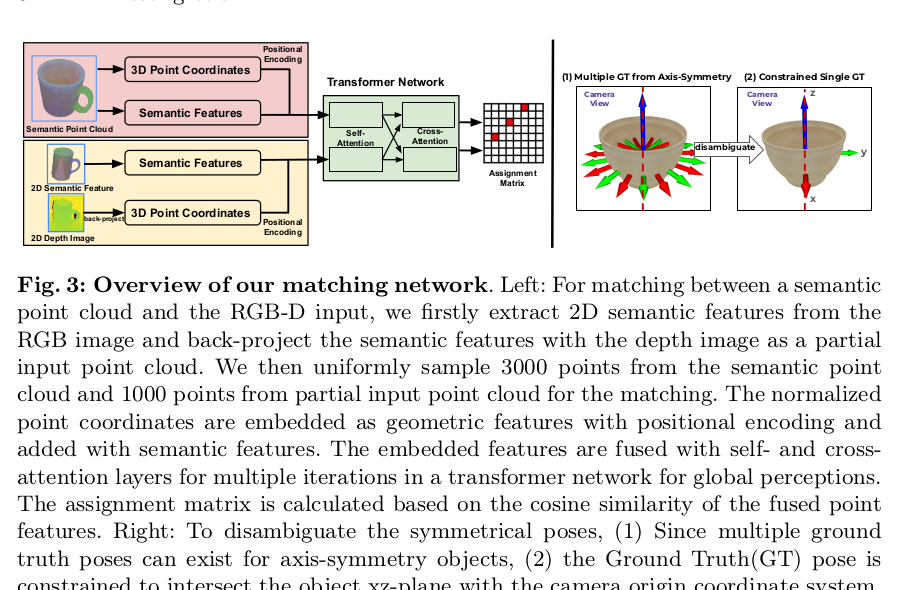
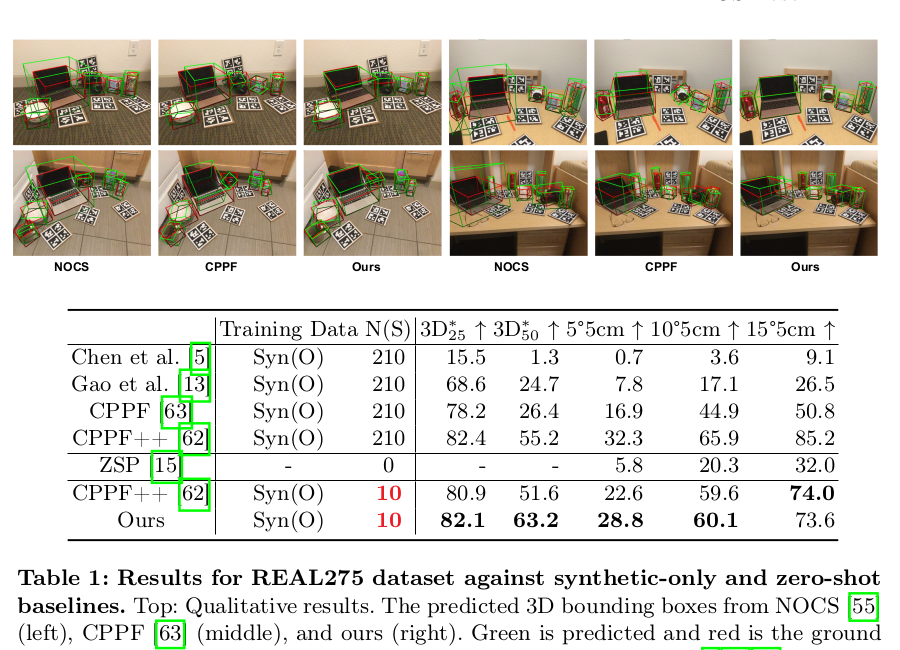
Original Figure 3: the full prior samples 3,000 points and the partial RGB-D observation 1,000. DINO semantics and normalized 3D coordinates enter self / cross attention; an assignment matrix supplies 3D–3D matches. The right side constrains axially symmetric GT to one camera-facing canonical representative. Source: official ECVA paper. Image copyright belongs to the paper's authors and Springer Nature; reproduced here for paper analysis.Original Table 1: with the same 10 synthetic objects per category, GS-Pose achieves 3D*50 / 5°5cm of 63.2 / 28.8 versus CPPF++ 51.6 / 22.6; CPPF++ with 210 objects still leads on strict pose metrics. Source: official ECVA paper. Table copyright belongs to the paper's authors and Springer Nature; reproduced here for paper analysis.
4. Problem setting
Training: a few synthetic CAD models per category, without real RGB-D or real pose labels.
Testing: real RGB-D, camera intrinsics, an external Mask R-CNN detection mask, category ID, and one reference CAD / semantic prior from the training set.
Output: rotation, translation, and 3D size for unseen instances of known categories.
This is category-level shape-prior matching, requiring CAD and known categories rather than offering arbitrary-category zero-shot inference.
“Self-supervised” means correspondences are generated automatically from CAD and known rendering poses; ShapeNet category labels, renderer poses, and dense synthetic correspondence supervision are still used.
5. Method overview
Render 40 RGB-D images at 480×480 per CAD model.
Extract 384D 2D features with DINOv2 ViT-S; back-project onto CAD vertices using visibility / projection and average visible features over views.
During training, back-project rendered depth into a partial semantic point cloud and use the known rendering transform to find exact mutual-nearest 3D correspondences.
Sample 3,000 / 1,000 points from the full prior / partial observation and fuse coordinate positional encodings with semantic features.
Self- / cross-attention produces point features and inlier probabilities; cosine similarity multiplied by both endpoints’ inlier confidence forms the assignment matrix.
For symmetric categories, align equivalent GT poses to one representative facing the camera origin; treat a mug as axially symmetric when its handle is invisible.
Threshold matches at inference and robustly solve the similarity transform and 3D size using RANSAC + Umeyama.
6. Experiments at a glance
REAL275, with the same 10 synthetic objects / category: GS-Pose achieves 3D*25 / 50, 5°5cm, and 10°5cm of 82.1 / 63.2 / 28.8 / 60.1.
CPPF++ with 210 objects gives 82.4 / 55.2 / 32.3 / 65.9; GS-Pose does not beat the larger-data version on all strict pose metrics.
Against real-annotation methods, GS-Pose’s 3D+75 / 5°5cm / 10°5cm is 37.0 / 28.8 / 60.1, versus VI-Net 48.3 / 57.6 / 82.1.
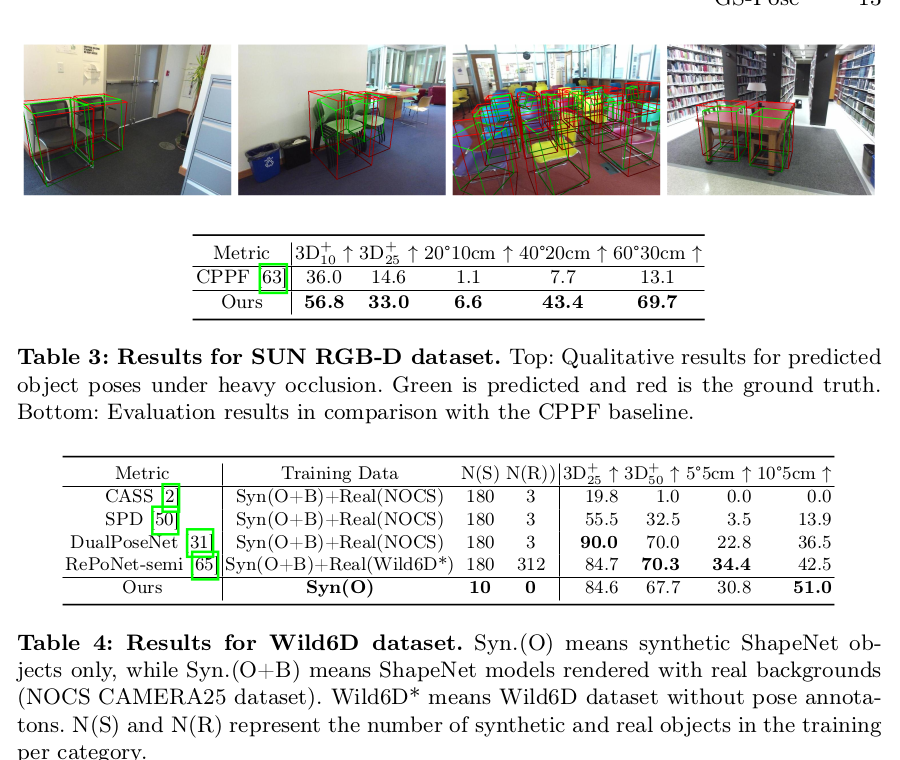
Wild6D: 3D+25 / 50 / 5°5cm / 10°5cm = 84.6 / 67.7 / 30.8 / 51.0; it exceeds RePoNet-semi’s 42.5 only on 10°5cm.
SUN RGB-D chair: 3D+10 / 25 = 56.8 / 33.0, versus CPPF 36.0 / 14.6.
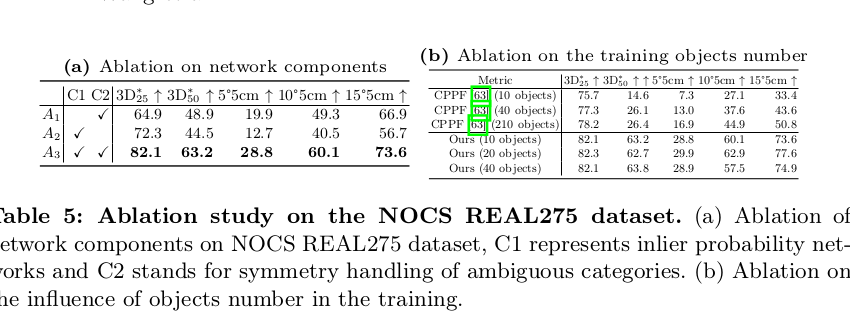
Removing the inlier head drops 3D*50 from 63.2 to 48.9; removing symmetry handling gives 63.2→44.5 and 10°5cm 60.1→40.5.
Reported runtime is 51 ms / object on RTX 3080, using supplied detector masks; this is not end-to-end detector-to-pose time.
7. Quick assessment
Strengths: no real pose labels; semantics and geometry fused in one 3D matching network; strong data efficiency; validation across the real NOCS, Wild6D, and SUN RGB-D datasets.
Limitations: requires RGB-D, an external mask, category, and a single CAD prior; prior selection is underexplained in the main text; transparent-object depth and incorrect masks can directly cause failure; 3D IoU implementations differ across papers.
Intended readers: researchers in synthetic-only category pose, DINOv2 feature lifting, 3D–3D correspondence, shape priors, RANSAC / Umeyama, and sim-to-real.
Available src/paper-notes/gs-pose-eccv2024/deep.md
In-depth paper notes
Support reproduction, comparison, related-work writing, and identifying opportunities for further research.
Paper Reading Notes (Deep): GS-Pose
1. Key assessment
GS-Pose addresses a structural tension in synthetic-only category pose:
Depth geometry alone has a small synthetic-to-real gap, but geometrically similar parts are easily confused;
Synthetic RGB directly supplies useful semantics such as keyboards and screens, but has a large texture / lighting domain gap.
Its compromise uses the same pretrained DINOv2 to map synthetic / real RGB into more stable semantics, then attaches semantics to 3D points and establishes correspondences together with real depth geometry. The strongest evidence is data efficiency: only 10 CAD models per category clearly outperform geometry-only CPPF++ at the same data budget.
2. Precise boundaries of “no real annotations” and “self-supervision”
Training does not use:
Pose labels from REAL275 / Wild6D / SUN RGB-D;
real RGB-D fine-tuning;
real object scans.
Training uses:
ShapeNet category labels and 10 CADs / category;
40 RGB-D renderings / CAD with known camera poses;
Renderer-produced depth, visibility, and exact 3D correspondences;
Pretrained DINOv2;
symmetry category convention.
It is therefore synthetic geometry-supervised correspondence learning: self-supervision comes from automatically labeled full / rendered-partial pairs of the same CAD model. It should not be read as self-supervised adaptation from unlabeled real videos.
Testing also needs an external Mask R-CNN mask, category identity, intrinsics, and a selected synthetic reference CAD. Generalization covers unseen instances within known categories.
3. From 2D DINO to a 3D semantic point cloud
For CAD point pi, use C=40 camera views to compute visibility Vi,j and project onto the DINO feature map:
Associate each surface point with semantics of its visible appearance;
Smooth view-dependent DINO variation;
Turn global image-backbone context into point descriptors usable for 3D registration.
However, averaging can dilute view-dependent semantic differences. When CAD textures / renderings differ strongly from real instances, DINO’s cross-domain stability remains an empirical assumption. The paper does not fully calibrate different renderer textures, untextured CAD models, or DINO layers.
Geometric features are normalized point coordinates passed through positional encoding rather than handcrafted PPF / FPFH. Since the full prior and partial observation can come from different instances, the network must learn approximate semantic correspondence under category deformation, not strict surface identity.
4. Matching network and explicit geometric solving
Original Figure 3. The full prior and partial observation are matched in 3D; semantic features supply part identity, point coordinates supply local / global geometry, and the inlier head suppresses invisible regions or regions absent in another instance. Source: official ECVA paper. Image copyright belongs to the paper's authors and Springer Nature; reproduced here for paper analysis.
The full prior Ps samples 3,000 points and the observation Qs 1,000. Alternating transformer self / cross attention outputs features FP,FQ and per-point inlier probabilities σP,σQ.
The assignment score can be summarized as:
A^ij=σiPσjQcos(FiP,FjQ).
Training combines inlier BCE at both endpoints with assignment focal loss. The inlier head is crucial: full CAD models contain many backside / invisible regions, and equivalent geometry may be absent across instances. Forcing every point to match would let these outliers dominate assignment.
Inference solves pose explicitly:
Threshold assignments;
Take high-confidence 3D-prior ↔ 3D-observation correspondences;
Reject incorrect cross-instance matches with RANSAC;
Solve the similarity transform with Umeyama;
Scale the reference CAD box to obtain metric 3D size.
Explicit correspondence and robust solving make failures inspectable and decouple the network from absolute metric pose regression.
5. Symmetry handling
Axially symmetric objects have infinitely many geometrically equivalent yaw angles. The authors constrain the object xz-plane at the GT pose to pass through the camera origin, selecting one viewpoint-dependent canonical representative from the equivalent set. Mugs with invisible handles are also treated as axially symmetric.
This makes correspondence labels single-valued and prevents conflicting targets for the same observation. Limitations include:
The canonical representative changes with camera viewpoint;
Mug-handle visibility decisions depend on masks / depth;
Only predefined axial symmetries are covered;
When texture breaks geometric symmetry, canonicalization does not guarantee an appearance-consistent pose;
This differs from BOP’s minimum-over-symmetry evaluation convention.
6. REAL275: strong data efficiency, with supervised methods still ahead
Original Table 1. 3D* denotes CPPF's convex-hull intersection implementation and must be distinguished from Table 2's 3D+ metric. Source: official ECVA paper. Table copyright belongs to the paper's authors and Springer Nature; reproduced here for paper analysis.
Synthetic-only:
Method
CAD / category
3D*25
3D*50
5°5cm
10°5cm
15°5cm
CPPF
210
78.2
26.4
16.9
44.9
50.8
CPPF++
210
82.4
55.2
32.3
65.9
85.2
CPPF++
10
80.9
51.6
22.6
59.6
74.0
GS-Pose
10
82.1
63.2
28.8
60.1
73.6
At the same 10-CAD budget, GS-Pose improves 3D50 by +11.6 and 5°5cm by +6.2; this is the fair, meaningful main conclusion. Against 210-CAD CPPF++, its 3D50 is higher, but all three joint pose metrics are lower or close; a blanket claim of outperforming CPPF++ is unsupported.
Table 2’s comparison with real-supervised methods uses the 3D+ implementation:
GS-Pose: 3D+75 37.0, 5°5cm 28.8, 10°5cm 60.1;
DualPoseNet: 30.8, 35.9, 66.8;
VI-Net: 48.3, 57.6, 82.1.
GS-Pose exceeds DualPoseNet on 3D+75 but clearly trails VI-Net on strict pose. Its strengths are annotation efficiency and domain transfer; the best real-supervised accuracy remains higher.
7. Wild6D and SUN RGB-D
Original Tables 3–4. SUN RGB-D evaluates only chairs with looser 20°10cm–60°30cm thresholds; Wild6D covers 162 test objects. Their tasks and metrics differ and cannot form one average score. Source: official ECVA paper. Table copyright belongs to the paper's authors and Springer Nature; reproduced here for paper analysis.
Wild6D:
Method
Real objects / category
3D+25
3D+50
5°5cm
10°5cm
DualPoseNet
3
90.0
70.0
22.8
36.5
RePoNet-semi
312
84.7
70.3
34.4
42.5
GS-Pose
0
84.6
67.7
30.8
51.0
GS-Pose leads only on 10°5cm and is slightly lower on 3D and 5°5cm. This still demonstrates strong transfer without real training data.
SUN RGB-D uses only ShapeNet chairs for training. Compared with CPPF, GS-Pose gives:
3D+10: 56.8 vs 36.0;
3D+25: 33.0 vs 14.6;
40°20cm: 43.4 vs 7.7;
60°30cm: 69.7 vs 13.1.
This validates transfer to occluded indoor chairs, but a single CPPF baseline and loose thresholds do not establish general indoor SOTA.
8. Ablation: inliers and symmetry matter more than CAD count
Original Table 5: the inlier head and symmetry canonicalization strongly affect strict pose; results for 10→20→40 CAD models are nonmonotonic, so saturation at 10 mainly applies to 3D IoU. Source: official ECVA paper. Table copyright belongs to the paper's authors and Springer Nature; reproduced here for paper analysis.
Configuration
3D*50
5°5cm
10°5cm
15°5cm
No inlier head
48.9
19.9
49.3
66.9
No symmetry handling
44.5
12.7
40.5
56.7
Full
63.2
28.8
60.1
73.6
Symmetry contributes more than inliers, indicating that noisy labels / equivalent poses are a primary issue in correspondence learning.
CAD counts:
10: 63.2 / 28.8 / 60.1 / 73.6;
20: 62.7 / 29.9 / 62.9 / 77.6;
40: 63.8 / 28.9 / 57.5 / 74.9.
3D IoU nearly saturates after 10 models, while strict pose is nonmonotonic. Variance from random CAD selection and choosing a single prior should be reported over multiple seeds.
9. Failure modes and limitations
Missing / incorrect depth on transparent bottles directly corrupts the observed 3D cloud;
Inaccurate 2D masks, especially for the camera category, contaminate correspondences;
Each category requires known synthetic CAD models, category identity, and one prior;
The main text underexplains inference-prior selection / sensitivity to multiple priors;
DINO semantic point clouds depend on synthetic textures / rendering;
3D* and 3D+ use different IoU implementations;
SUN RGB-D evaluates only chairs against a single baseline;
The 51 ms excludes the external detector; RANSAC latency / iteration counts are not reported separately;
The claim that 10 CAD models suffice lacks selection-seed and cross-category variance analysis.
10. Reproducibility checklist
Fix 10 ShapeNet CAD models per category and 40 views / CAD;
DINOv2 ViT-S 384D, render / crop 480×480;
Sample 3,000 / 1,000 points for full / partial clouds;
Project DINO features using visibility and average over views;
Generate training-pair correspondences from known rendering poses;
Enable both inlier BCE and assignment focal loss;
Fix symmetry GT canonicalization and mug-handle visibility rules;
Record prior CAD selection and variance across multiple priors;
Disclose complete RANSAC + Umeyama parameters;
Compare using the same 3D* / 3D+ evaluator;
Include detection, DINO extraction, matching, and solving in end-to-end timing.
11. Overall assessment
GS-Pose clearly illustrates how foundation semantics can enter geometric solving: DINOv2 patch semantics are lifted to 3D points and combined with depth geometry to build inspectable correspondences, followed by RANSAC + Umeyama transformation solving. At the same 10-CAD budget, 63.2 3D*50 and 28.8 5°5cm show greater data efficiency than geometry alone.
Its boundaries are clear: RGB-D, masks, category identity, and a CAD prior remain necessary; absolute accuracy trails the strongest real-supervised methods; transparent-object depth and symmetry rules remain weak points. The transferable lesson is to use a foundation model for global part semantics while retaining explicit 3D geometric solving.