
Reading Notes
Overview / Deep Dive
Paper overview notes
Quickly assess the paper's scope, problem setting, core method, experimental findings, and whether to read it in depth.
Paper Reading Notes (Coarse): High-Precision Object Pose Estimation Using Visual-Tactile Information for Dynamic Interactions in Robotic Grasping
1. Basic information
- Authors: Zicai Peng, Te Cui, Guangyan Chen, Haoyang Lu, Yi Yang, Yufeng Yue
- Venue / year: IEEE ICRA 2025
- Affiliation: Beijing Institute of Technology
- Paper: DOI
- Task: object pose tracking during dynamic robot interactions, covering contacted-object motion and in-hand slip of grasped objects
- Experimental scope: 13 objects with different geometries
- Availability: full text is not open access; no public author manuscript, code, or data was found
2. One-sentence summary
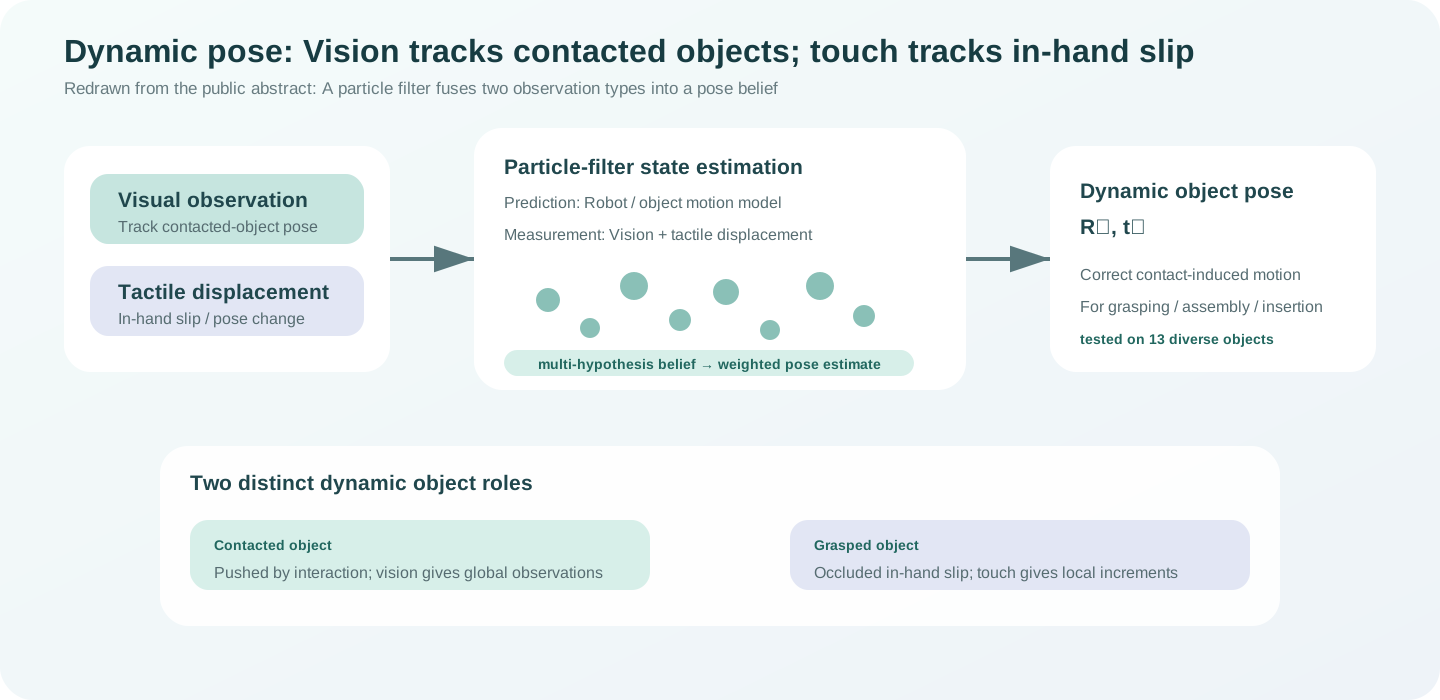
The method fuses vision and tactile displacement with a particle filter. Vision tracks contacted objects in the environment in real time, while tactile displacement corrects slip-induced pose changes of the grasped object. The authors validate dynamic adaptability on 13 objects, but the abstract provides no translation / rotation errors.
3. Main method
Static grasping assumes a fixed , but real interactions involve:
- In-hand slip caused by changing grasp force;
- A grasped object pushing an environmental object;
- Visual occlusion by the robot hand;
- Abrupt motion-model changes at contact.
A particle filter maintains a pose belief with multiple hypotheses:
- Predict particles using a motion model;
- Update the contacted object using vision;
- Update the grasped-object increment using tactile displacement;
- Reweight / resample to obtain the current pose.
4. Evidence boundaries
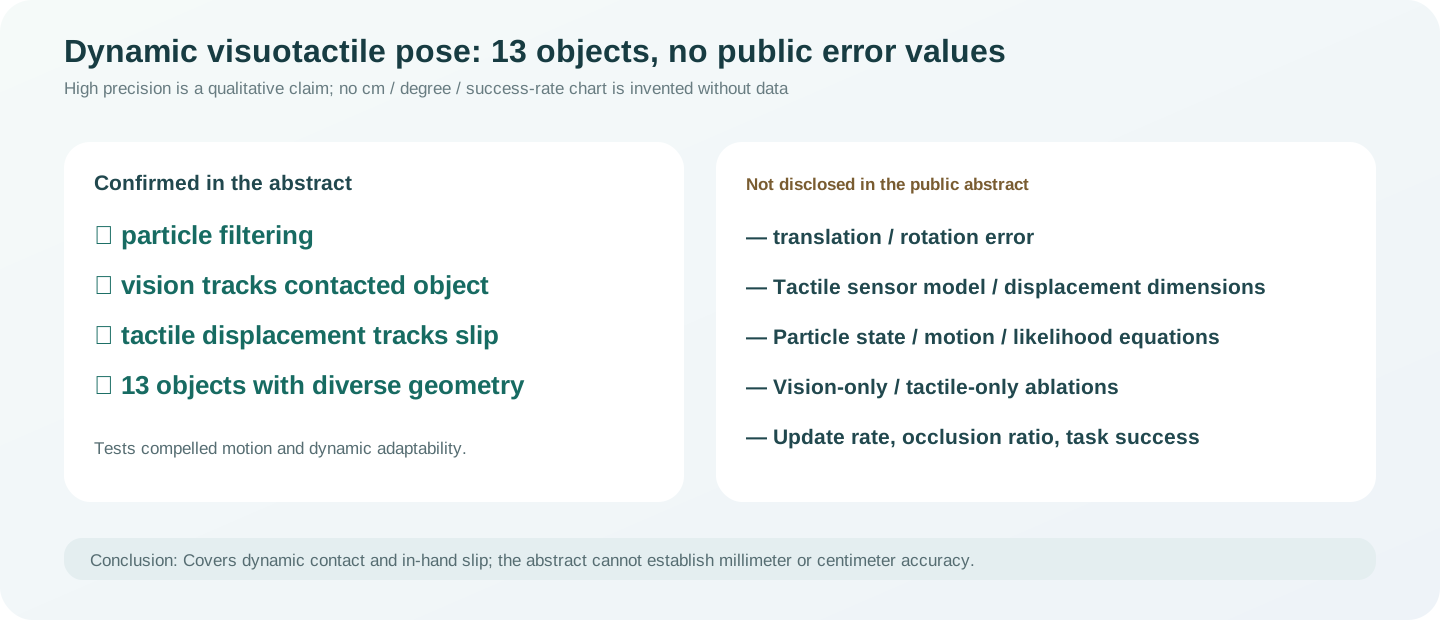
The abstract confirms 13 geometrically diverse objects, dynamic scenes, compelled motion, and a high-precision pose conclusion, but gives no cm / degree errors, update rates, baselines, or task success rates.
5. Coarse-reading assessment
The key value is separating two object roles: vision can supply global pose for an environmental contacted object, while tactile displacement supplies local changes for an occluded grasped object. Particle filtering suits noise, multiple hypotheses, and different update rates.
Limitations include dependence on initial pose, tactile-to-hand calibration, and motion models. Tactile sensing supplies local displacement rather than an inherent global pose, and long-term integration drifts. Without public numbers, millimeter-level accuracy for assembly cannot currently be established.