Towards in-the-wild Egocentric 3D Hand-Object Pose Estimation
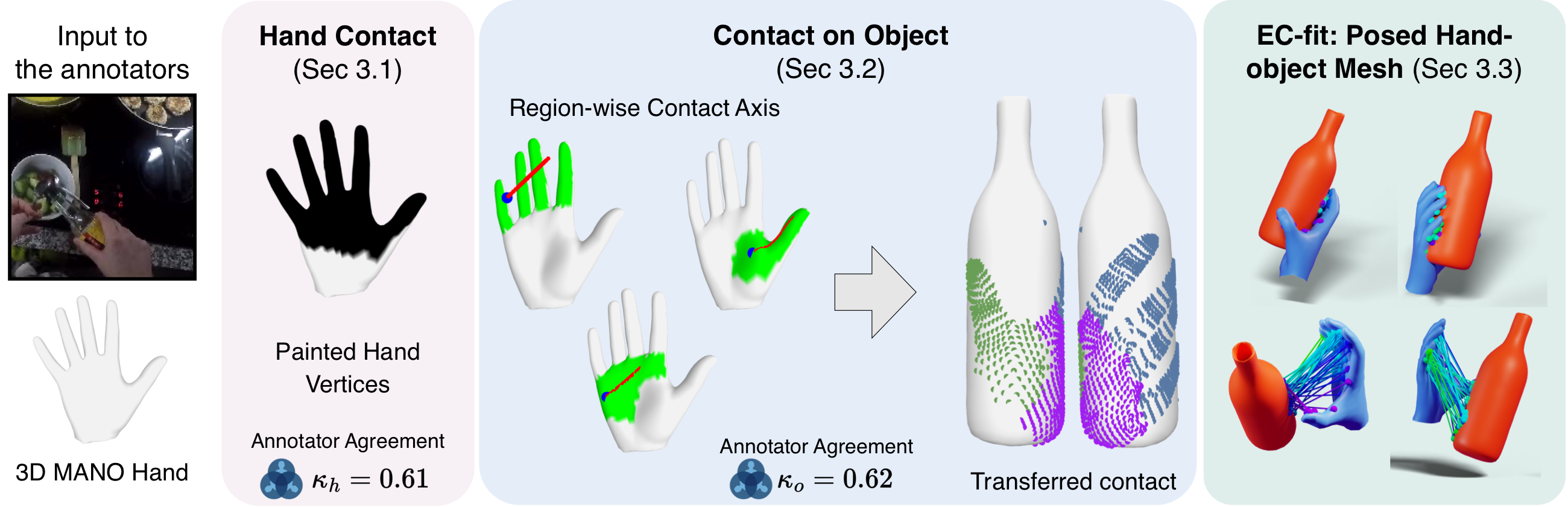
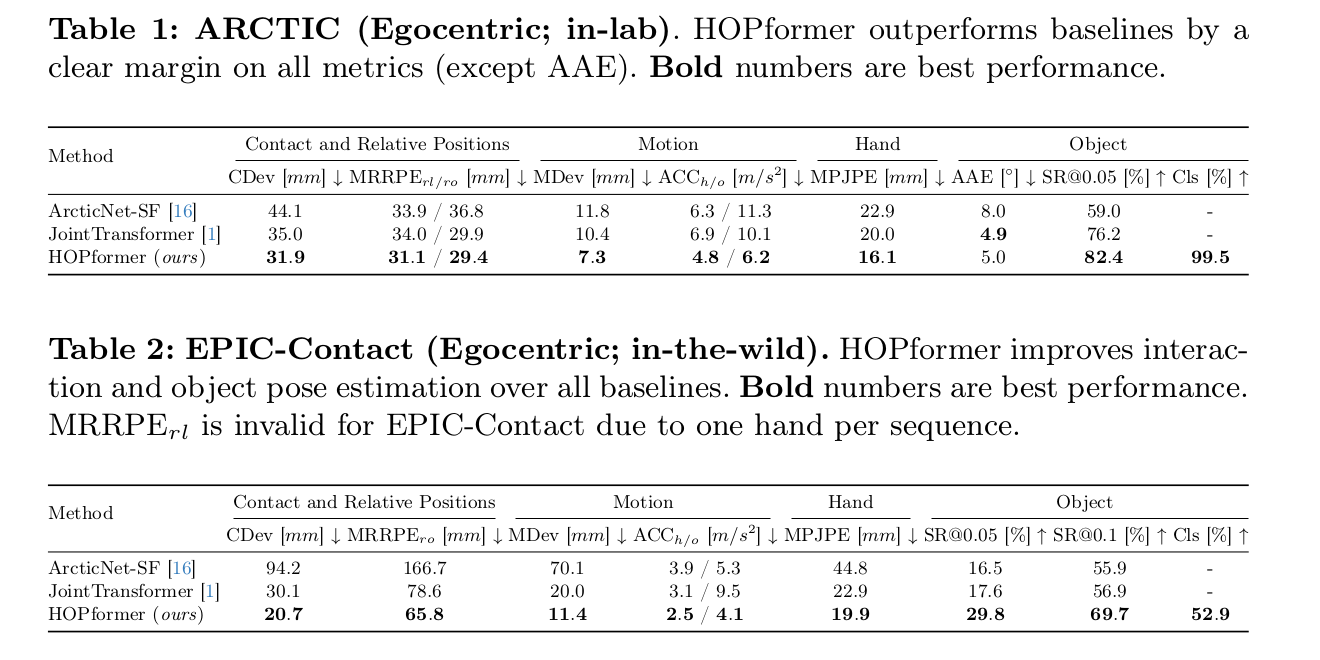
EPIC-Contact expands 2,272 egocentric stable-grasp clips into 62.3K frames of posed hand–object meshes through hand-contact painting, region-level bijective contact transfer, and EC-fit. HOPformer's 12-layer decoder lets DINOv2 object tokens read WiLoR hand-pose tokens, jointly predicting bimanual MANO, object classes, rotation / translation, and optional joint angles in one pass. Against the strongest JointTransformer, EPIC CDev drops from 30.1 to 20.7 mm and SR@0.05 rises from 17.6% to 29.8%. Main pose tables use oracle meshes, automatic classification accuracy is only 52.9%, and the official repository reports approximately 1.28× projection-scale and 0.78× absolute-depth biases in EPIC checkpoints. Results mainly establish relative / root-aligned hand–object improvements, rather than open-world or calibrated absolute 6D pose.
single egocentric RGB interaction imageleft / right hand crops for WiLoR featuresDINOv2 ViT-G object tokensMANO hand meshescategory mesh selected from a predefined model pool
Requirements
known object-category set and predefined mesh poolhand crops or the repository preprocessing that produces themMANO and WiLoR assets under their non-commercial termsARCTIC pretraining for the reported EPIC resultoracle object class / mesh for the main EPIC pose tableweak-perspective focal and crop conventions consistent with each checkpoint
Full paper metadataAuthors, affiliations, research area, datasets, metrics, method tags, and reading statusExpandCollapse
Authors
Siddhant Bansal, Zhifan Zhu, Shashank Tripathi, Jiahe Zhao, Michael J. Black, Dima Damen
Affiliations
University of Bristol / Max Planck Institute for Intelligent Systems, Tübingen
known object-category set and predefined mesh poolhand crops or the repository preprocessing that produces themMANO and WiLoR assets under their non-commercial termsARCTIC pretraining for the reported EPIC resultoracle object class / mesh for the main EPIC pose tableweak-perspective focal and crop conventions consistent with each checkpoint
Reading Notes
Overview / Deep Dive
Available src/paper-notes/hopformer-epic-contact-eccv2026/coarse.md
Paper overview notes
Quickly assess the paper's scope, problem setting, core method, experimental findings, and whether to read it in depth.
Paper Reading Notes (Coarse): Towards in-the-wild Egocentric 3D Hand-Object Pose Estimation
1. Basic information
Title: Towards in-the-wild Egocentric 3D Hand-Object Pose Estimation
Method / data: HOPformer / EPIC-Contact
Authors: Siddhant Bansal, Zhifan Zhu, Shashank Tripathi, Jiahe Zhao, Michael J. Black, Dima Damen
Affiliations: University of Bristol; Max Planck Institute for Intelligent Systems, Tübingen
Half of this work is data: hand-contact painting, bijective object-surface contact transfer, and EC-fit optimization turn 2,272 stable-grasp EPIC-Kitchens clips into 62.3K frames with egocentric hand-object 3D annotations. The other half is HOPformer: a 12-layer transformer decoder repeatedly lets object DINOv2 tokens read WiLoR hand tokens, jointly regressing bimanual MANO, object class, rotation / translation, and optional articulation in one forward pass.
Key assessment
HOPformer’s key hypothesis is that hand pose can condition object pose because it is often more stable than object appearance under heavy egocentric occlusion. ARCTIC ablations support this: replacing cross-attention with concatenation drops SR@0.05 from 82.4% to 29.4%; replacing WiLoR hand features with ordinary DINOv2 reduces success to 70.0%.
However, the abstract’s two headlines need separate interpretation:
Against the strongest baseline, JointTransformer with the same DINOv2 backbone, EPIC-Contact SR@0.05 rises 17.6%→29.8%, a gain of 12.2 percentage points or about 1.69 times, not twice; CDev falls 30.1→20.7 mm, a 31.2% reduction.
“Nearly doubles” and “reduces contact deviation by 75%” more closely describe comparison with weaker ArcticNet-SF: 16.5%→29.8% (1.81 times) and 94.2→20.7 mm (78.0% reduction), rather than gains over the strongest baseline.
Main EPIC pose results use oracle object meshes; automatic classification accuracy is only 52.9%. Supplementary pose results cover only correctly classified samples, without a unified end-to-end pose score including classification errors.
The official repository discloses an EPIC-checkpoint projection-scale mismatch: meshes are about 1.28 times too large and absolute depth about 0.78 of ground truth. Table 2’s root-aligned / relative metrics are unaffected, but these results do not establish reliable absolute camera-space translation.
The precise conclusion is: within known categories and a fixed mesh pool, HOPformer substantially improves relative hand-object geometry, contact, and root-aligned object pose. It is not CAD-free or open-world, and absolute translation is not yet fully validated for an object-only 6D pose system.
2.1 Guide to figures and tables
Figure / table
Focus
Supported conclusion
Not directly established
Figure 2
Three-stage EPIC-Contact annotation
Bijective contact turns a few clicks into optimizable 3D constraints
Independent manual labeling of every frame or MoCap-equivalent ground truth
Layerwise cross-attention injects hand priors into object representations
CAD-free inference or no known mesh pool
Tables 1–2
Main ARCTIC and EPIC-Contact results
Clear relative-geometry, contact, and object-SR gains over the strongest baseline
Exactly doubled EPIC success, reliable absolute 6D pose, or fully automatic handling of wrong classes
Table 3
Loss, fusion, hand-feature, and decoder-depth ablations
Cross-attention, pose-specialized hand priors, and deep iteration all matter
That 1.83B parameters do not contribute, or linear scaling to many more categories
Original Figure 2: paint contact on a subdivided MANO hand mesh, transfer bijective contact to the object surface using region-level 2-DoF contact axes, then jointly fit hand and object meshes with EC-fit. Source: arXiv. Image copyright belongs to the paper's authors and publisher; reproduced here for paper analysis.
3. Problem setting
3.1 Inputs, outputs, and known priors
External input: one egocentric RGB interaction image. The object encoder reads the scene; the hand encoder reads left / right hand crops. The public repository does not need WiLoR’s detector weights, but the paper does not evaluate full-scene hand / object detection error as a variable.
Hand outputs: MANO pose θ∈R^48, shape β∈R^10, root / global orientation, and a 778-vertex mesh for each hand.
Object outputs: 6D rotation representation, three-dimensional translation, and a one-dimensional joint angle for articulated ARCTIC objects.
Class output: a classification head predicts c, retrieves mesh O_c from predefined model pool M, and applies the predicted pose.
Supported settings: ARCTIC includes bimanual interactions and articulated objects; EPIC-Contact has one hand per sequence and evaluates its 9 object categories as rigid.
3.2 Interpretation boundaries
CAD is required: inference retrieves mesh geometry from a fixed model pool rather than generating it from the image.
Categories are known: EPIC tests new instances in the same 9 categories, not arbitrary unseen categories.
This differs from standard BOP object-only estimation: hands, objects, contact, and motion are jointly trained / evaluated, with object pose one of several outputs.
It does not establish complete end-to-end scene understanding: the paper does not evaluate target discovery or hand / object box errors through detection AP × pose AP.
It is a single-frame network: video supplies data and neighboring frames for MDev / ACC, but HOPformer has no recurrent state or tracking memory.
Reliable absolute camera-space 6D pose is not established: EPIC-checkpoint scale / depth bias must be distinguished from root-aligned and relative main-table metrics.
4. EPIC-Contact: from contact annotations to 3D pose
4.1 Dataset size and split
EPIC-Contact comes from EPIC-Grasps stable-grasp clips: 2,272 clips, 62.3K frames, and 9 everyday categories: pan 492, plate 437, bowl 396, bottle 286, glass 211, mug 160, cup 121, can 97, saucepan 72. Unique videos are split into 2,035 training and 237 testing videos (about 90/10), preserving hand-side / category distributions and preventing a video from crossing splits.
“62.3K annotated frames” does not mean 62.3K independent manual 3D fits. Only the center frame of each stable-grasp clip receives manual contact labeling and EC-fit; WiLoR hand motion propagates hand-relative object pose to other frames, assigning lower confidence to jittery propagation. This reduces frame-level work to clip-level annotation but introduces hand-side errors, camera jumps, and hand-pose drift into labels.
4.2 Three-stage annotation
Hand-contact painting: uniformly subdivide MANO’s 778 vertices to 3,106. Annotators watch the clip and paint all contact regions, including currently occluded areas. For 12 annotators on 10 videos, Fleiss’ kappa is κ_h=0.61.
Object contact transfer: divide the hand into thumb, four-finger, and palm regions, each represented by a 2-DoF contact axis. Two clicks specify its start and direction; at most 6 clicks define bijective hand-object contact. For 4 annotators on 10 videos, κ_o=0.62.
EC-fit: initialize the hand with WiLoR and objects with multiple random / category-prior guesses. First minimize bijective contact distance; then add occlusion-aware masks, penetration, hand masks, and MANO regularization, followed by manual review / correction.
κ≈0.61/0.62 indicates moderate to substantial agreement, not near perfection. Video context reduces single-image ambiguity, but occluded regions still require human inference.
4.3 Scale and annotation quality
EPIC-Grasps category meshes start at fixed scales, while real instances vary. Gemini 2.5 predicts several physical dimensions from the center frame and category-specific prompts, followed by nonuniform mesh scaling. On 30 real objects covering 9 categories, reported MAE is 0.94 cm, relative error 5.9%, and 82.5% of dimensions fall within ±10% of ground truth. This small validation sample and VLM-derived scale do not establish measurement-grade ground truth throughout the dataset.
Simulated annotation on 20% of ARCTIC training data gives full EC-fit vertex Pose L2 error 1.9 mm and MRRPE 8.0 mm, versus contact-only 5.0 / 9.6 mm. However, CDev rises from 7.0 to 12.2 mm: image alignment differs from minimizing contact-vertex separation. EPIC-Contact maximum penetration depth is 0.79 cm, close to ARCTIC 0.80 cm, but penetration volume is 20.9 cm³ versus 7.24 cm³, about 2.9 times larger. Overall penetration cannot be called MoCap-equivalent.
5. HOPformer method overview
Original Figure 4: frozen DINOv2 ViT-G produces object tokens; WiLoR supplies left / right hand-pose tokens. Object queries self-attend and read hand memory across 12 decoder layers, then aggregate to 39 tokens for hand, object-pose, and class outputs. Source: arXiv. Image copyright belongs to the paper's authors and publisher; reproduced here for paper analysis.
Hand branch: WiLoR, token dimension 1,280, projected by MLP into object-embedding space, supplying pose-specialized priors.
Object tokens are decoder queries; hand tokens are cross-attention memory. Each layer applies object self-attention, reads hand context, then uses an FFN. The design conditions objects on hands rather than averaging both feature streams.
After 12 layers, the object sequence has a residual connection to its initial features. Learnable aggregation reduces 256 tokens to 39: the first 18 regress the right hand, the next 18 the left, and the last 3 object pose. A separate classification head uses object-encoder semantics to choose the mesh.
5.2 Training signals
Hand losses cover root-aligned 3D joints, 2D projection, MANO pose / shape, and weak-perspective cameras. Object losses cover 3D / 2D keypoints, weak-perspective translation, class, and pose; rotation uses geodesic loss, with MSE for most other terms. Contact frames add a CDev-based interaction loss.
Training follows ARCTIC exocentric → ARCTIC egocentric → EPIC-Contact: stage one uses 4×GH200, total batch 256, and 25 epochs; stage two uses total batch 128 for up to 30 epochs; EPIC starts from ARCTIC egocentric weights and trains 125 epochs. Table 4 gives EPIC SR@0.05 of only 3.9% from scratch versus 29.8% with ARCTIC initialization, showing strong dependence on 2.1M-frame MoCap pretraining.
6. Main results by evaluation setting
Original Tables 1–2: HOPformer exceeds both learning baselines on ARCTIC except articulation error; EPIC-Contact improves CDev, MDev, and SR over strongest JointTransformer. Main EPIC pose results use oracle object meshes; Cls 52.9% is separate class accuracy. Source: arXiv. Image copyright belongs to the paper's authors and publisher; reproduced here for paper analysis.
6.1 ARCTIC: architectural evidence in a controlled setting
SR@0.05: 76.2%→82.4%, a gain of 6.2 percentage points;
AAE: 4.9°→5.0°, the only main metric without a lead;
Object classification accuracy 99.5%.
This is a relatively clean design comparison: ARCTIC uses MoCap, shares object instances across train / validation, and hosts all ablations. It does not establish in-the-wild novel-instance generalization.
6.2 EPIC-Contact: clear gains, with success still limited
Against strongest JointTransformer: CDev 30.1→20.7 mm, MDev 20.0→11.4 mm, MPJPE 22.9→19.9 mm, SR@0.05 17.6%→29.8%, and SR@0.1 56.9%→69.7%. Gains are clear, but about 70.2% still fail at the 5%-diameter threshold. Wild occlusion, transparency, and novel instances remain challenging.
EPIC CDev, MDev, object ACC, and SR are symmetry-aware. SR uses approximately ADD-S-style nearest surfaces after removing the object root. It compares relative shape / orientation, not full camera-space ADD(-S). EPIC clips also mix frame rates and dropped frames, while the repository evaluator fixes ACC at 15 fps; it is a relative smoothness score, not a strict physical m/s² measure.
6.3 What “fully automatic” results actually mean
The main table uses oracle class / mesh for fairness. HOPformer’s EPIC classification accuracy is only 52.9%. Supplement Table 7’s “fully automatic” results filter to correctly classified samples: SR@0.05=30.4%, close to full-data oracle-mesh 29.8%. This shows no major pose degradation when classification is correct, but excludes about 47.1% misclassified samples, whose different mesh topology leads the authors to call pose metrics undefined. Table 7 is therefore not end-to-end success over the whole test set.
7. Ablation: sources of improvement
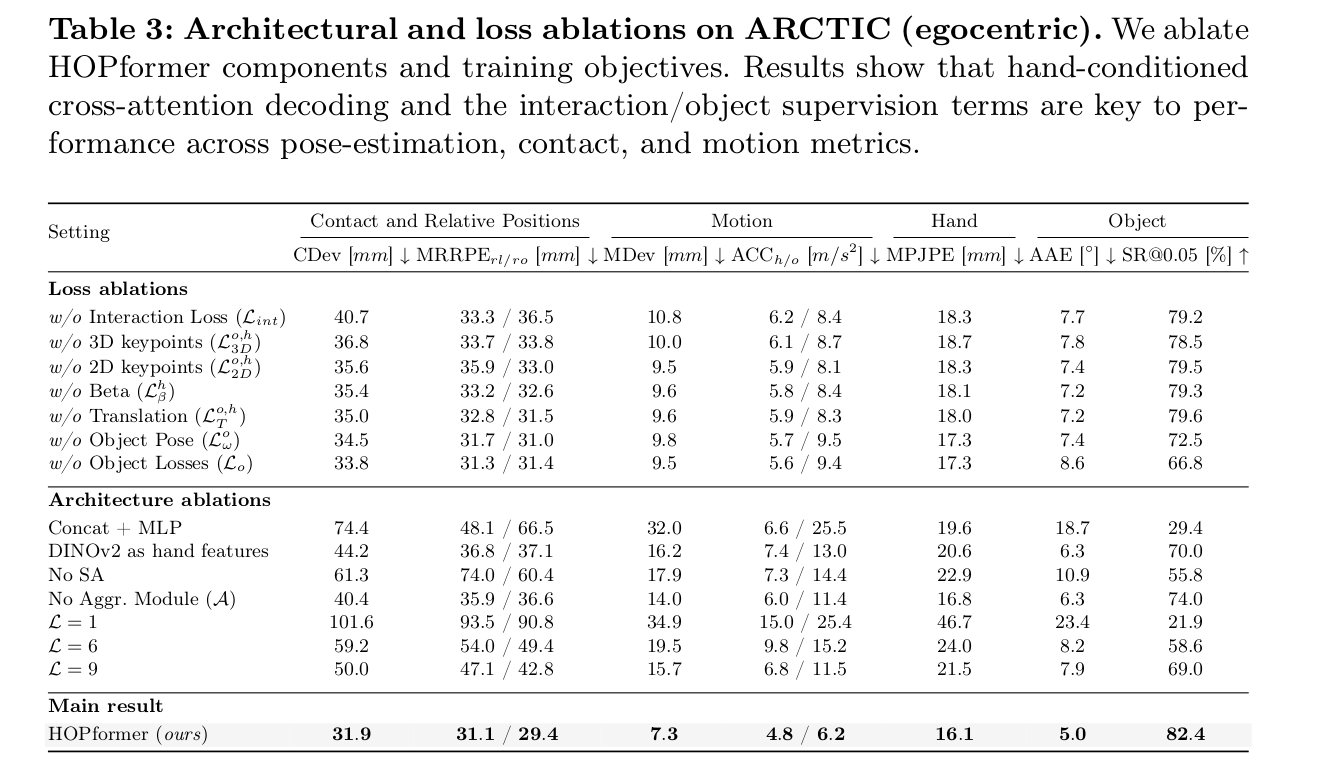
Original Table 3: concatenation + MLP, removing self-attention, replacing WiLoR, or shortening the decoder all hurt substantially. Object / interaction supervision separately affect object success and physical contact consistency. Source: arXiv. Image copyright belongs to the paper's authors and publisher; reproduced here for paper analysis.
Concat + MLP: SR 82.4→29.4, CDev 31.9→74.4, supporting layerwise conditioning over one-step concatenation.
Without self-attention: SR 55.8; without learnable aggregation: 74.0. Object-token communication and task-specific aggregation both matter.
DINOv2 instead of WiLoR hand features: MPJPE 16.1→20.6, SR 82.4→70.0, supporting pose-specialized hand priors.
Decoder depth 1 / 6 / 9 / 12: SR 21.9 / 58.6 / 69.0 / 82.4. Depth brings large gains and substantial compute.
Removing all object losses gives SR 66.8; removing only object-pose loss gives 72.5. Removing interaction loss changes CDev 31.9→40.7 and MDev 7.3→10.8. Each loss affects its intended target.
All ablations are on ARCTIC, not EPIC-Contact. Evidence for why individual modules help in the wild comes mainly from transferred main results, without itemized EPIC ablations.
8. Known issues and failure boundaries
8.1 EPIC scale bias disclosed by the repository
As of 2026-08-23, Known issues reports height-scaled focal f_y=2333.33 for EPIC weak-perspective training targets but average focal 1822.40 in head decoding. Released epic_epoch125.ckpt thus projects meshes about 1.28 times too large and gives median absolute depth about 0.78 of GT. Table 2’s root-aligned / relative metrics share this convention across baselines and remain reproducible, but do not establish absolute scale / camera-depth accuracy. A shared-scene translation workaround restores median scale / depth at about 3.4 px extra mean 2D hand-joint error. ARCTIC square-input checkpoints are unaffected.
8.2 Limitations stated in the paper
Each EPIC-Contact center frame needs about 3–4 minutes of manual annotation; WiLoR hand-side errors and camera jumps affect clip propagation.
EC-fit needs object masks, known-category meshes, and multistart optimization; it is not prior-free automatic 3D annotation.
HOPformer covers only 11 ARCTIC and 9 EPIC categories; category-expansion experiments remain within ARCTIC’s small set.
EPIC does not validate articulated objects and has one hand per sequence, leaving wild bimanual / articulated performance unproven.
EPIC qualitative failures show a training bias toward horizontal plates: strong priors fill occlusion but can override image evidence.
At 1.83B parameters and 1.157 TFLOPs per inference, with DINOv2 ViT-G and WiLoR, this is not lightweight deployment.
Timing covers network forward only and excludes the dataloader. It is far faster than >10 s optimization such as EC-fit, but hardware and measurement scope must accompany the figures.
The public repository supplies training scripts, checkpoints, EPIC / ARCTIC prediction dumps, and reference metrics, giving a fairly complete reproduction entry point. EPIC data / weights require gated downloads.
HOPformer code, EPIC-Contact, and checkpoints use CC BY-NC 4.0; vendored WiLoR uses CC BY-NC-ND, and MANO / ARCTIC have separate noncommercial terms. Research reproduction is feasible; commercial use requires checking component terms beyond the main repository license.
10. Is deep reading worthwhile?
Yes, especially for readers who want to:
Use hand pose as a structural object-pose prior instead of treating hands as ordinary occluders;
Build nonlaboratory hand-object 3D data without MoCap;
Understand joint evaluation of contact, relative pose, motion consistency, and object-pose metrics;
Examine the protocols behind “in-the-wild,” “fully automatic,” and “nearly doubles” headlines.
For standard BOP instance-level 6D pose, new objects without CAD, open-vocabulary scenes, or absolute camera-space translation, HOPformer is better read for hand-object interaction priors and wild-data construction than used as a direct object-only baseline replacement.
Available src/paper-notes/hopformer-epic-contact-eccv2026/deep.md
In-depth paper notes
Support reproduction, comparison, related-work writing, and identifying opportunities for further research.
Paper Reading Notes (Deep): Towards in-the-wild Egocentric 3D Hand-Object Pose Estimation
1. Basic information
Title: Towards in-the-wild Egocentric 3D Hand-Object Pose Estimation
Method / data: HOPformer / EPIC-Contact
Authors: Siddhant Bansal, Zhifan Zhu, Shashank Tripathi, Jiahe Zhao, Michael J. Black, Dima Damen
Affiliations: University of Bristol; Max Planck Institute for Intelligent Systems, Tübingen
Year / venue: ECCV 2026 Poster
Full text checked: arXiv:2606.30598 v1 (submitted 2026-06-29; 43 pages including the main paper and supplement)
Reading focus: manual / optimization / propagation contributions to EPIC-Contact 3D annotations; how hand priors constrain object pose; evaluation protocols for success, contact error, and fully automatic inference; whether public-checkpoint scale bias changes the paper’s conclusions.
2. Main conclusions first
HOPformer uses egocentric single-image object representations as queries and left / right WiLoR hand representations as memory. Across 12 layers of self-attention and hand-object cross-attention, it updates object tokens and jointly regresses bimanual MANO, object R/T, optional articulation, and class. EPIC-Contact expands sparse manual bijective contact into 2,272 clips / 62.3K wild frames through EC-fit and hand-motion propagation.
2.1 Overall assessment
The paper has two mutually supporting contributions:
Data construction goes beyond automatic RGB-video pseudo-labeling. Annotators paint contact on subdivided MANO and transfer regional contact axes onto object surfaces with at most 6 clicks. EC-fit combines contact, occlusion-aware silhouettes, penetration, and hand regularization. Quantitative checks cover contact agreement, VLM scale, EC-fit pose, penetration, and noisy-label training.
Model design has explicit counterfactual evidence. Concatenation + MLP, generic hand features, no self-attention, no aggregation, and shallow decoders all degrade substantially. Gains are linked to repeatedly conditioning object tokens on pose-specialized hand priors, beyond backbone size alone.
Four points are especially easy to misread:
The abstract’s “nearly doubles / 75%” is not the strongest-baseline comparison. Against JointTransformer, SR@0.05 improves about 69.3% and CDev falls 31.2%; ArcticNet-SF gives the closer headline figures of 80.6% relative success improvement and 78.0% CDev reduction.
Main EPIC pose results use oracle object meshes; class accuracy is only 52.9%. The fully automatic table keeps correctly classified samples only, so it does not represent the whole test set.
EPIC SR is root-removed, symmetry-aware object-vertex success. Most metrics describe relative geometry or root-aligned shape / orientation and cannot validate full camera-space translation.
The repository discloses about 1.28× projection-scale and 0.78× absolute-depth bias in epic_epoch125.ckpt. Main-table results remain reproducible and unaffected under their protocol, but absolute-pose deployment needs extra calibration beyond Table 2.
Overall, HOPformer / EPIC-Contact provides a substantial egocentric joint hand-object pose pipeline, spanning data and architecture. Its strongest evidence is improved relative pose, contact, and root-aligned object pose from hand priors within fixed categories / mesh pools, rather than open-world CAD-free absolute 6D pose.
Pose is usable with correct classes, but nearly half the test set is misclassified and lacks a unified pose score
Complete object pose prediction
R_o∈R^6, T_o∈R^3 outputs; MRRPE / SR
Partial
R/T are regressed, but main EPIC metrics and the checkpoint issue leave reliable absolute depth unverified
Scaling to more objects
ARCTIC 3/6/9/11 classes
Preliminary
Only 11 classes, with EPIC still at 9; larger scale remains future work
Original Figure 2: paint hand contact, establish hand-object bijections using regional contact axes, then optimize contact, mask, and penetration constraints into posed meshes with EC-fit. This is human-in-the-loop optimization rather than automatic pseudo-labeling. Source: arXiv. Image copyright belongs to the paper's authors and publisher; reproduced here for paper analysis.
3. Task definition and coordinate conventions
3.1 External inputs and internal representations
HOPformer takes one egocentric RGB hand-object interaction image. The full scene enters the DINOv2 object encoder; local left / right crops enter WiLoR. The public README says no separate WiLoR detector.pt download is needed because HOPformer prepares its hand crops. Hand detection, object detection, and box noise are not independent evaluation variables. Thus the evidence covers joint pose given an interaction image, not a validated full-scene detection-to-pose pipeline.
The model handles right hand r, left hand l, and object o. EPIC-Contact has one hand per sequence, making hand–hand MRRPE inapplicable; ARCTIC includes both hands and articulated objects.
3.2 Output parameters
Each hand uses MANO:
Θh={θh,βh},H(Θh)∈R778×3,
Here θ∈R^48 includes global orientation and β∈R^10 gives shape. Object pose is:
ωo={Ro,To,ao},
R_o∈R^6: continuous 6D rotation representation, converted to a rotation matrix;
T_o∈R^3: object translation;
a_o∈R: one joint angle when the object is articulated.
Given class c and mesh O_c, the output is posed mesh O_c(ω). Rotation and translation are indeed regressed, but geometry comes from predefined model pool M, not image reconstruction.
3.3 Known category, novel instance, and oracle mesh
The task selects one object from known categories. ARCTIC train / validation share the same 11 object instances; EPIC-Contact tests novel instances of its known 9 categories. This is harder than same-instance testing but does not establish unseen-category / open-vocabulary pose.
The class head predicts c from DINOv2 object features and retrieves its mesh from M. For fair comparison with ArcticNet-SF and JointTransformer, Table 2 uses oracle class / mesh for pose and reports Cls=52.9% separately. It asks how well the pose head works when mesh identity is correct, leaving whole-system success with wrong meshes unanswered.
3.4 Differences from standard 6D object pose
No BOP detection AP or combined VSD / MSSD / MSPD evaluation, nor full-scene multi-instance recall.
EPIC SR removes the object root, then uses closest equivalent vertices for symmetry, emphasizing orientation / root-aligned shape consistency.
CDev, MRRPE, and MDev refer to the hand, emphasizing hand-object relative geometry.
Articulation angles and MANO metrics belong to interaction reconstruction and are not directly comparable with object-only ADD(-S) rankings.
The site includes it as an ECCV 2026 extended entry, outside the 14 core object-pose papers, because object pose is only part of joint hand-object reconstruction.
4. EPIC-Contact data construction in detail
4.1 Why stable-grasp clips
EPIC-Grasps / EPIC-Kitchens provides real kitchens, head-mounted cameras, cluttered backgrounds, frequent hand / object occlusion, and transparent glasses / bottles. Stable-grasp segments keep the hand-object contact-vertex set approximately fixed, enabling:
Manual contact judgment only in the center frame;
Fitting the center-frame hand-relative object pose;
Propagating the object through the clip using per-frame WiLoR hand pose.
Labels are consequently correlated across frames. The authors acknowledge hand-side errors, camera-placement jumps, and WiLoR jitter, and release per-frame confidence for filtering. Relative / root-aligned metrics resist global propagation noise, a reasonable design that also leaves absolute camera-space quality incompletely measured.
4.2 Dataset size and long tail
Total: 2,272 clips, 62.3K frames, 9 categories:
Category
Clips
Approximate share
pan
492
21.7%
plate
437
19.2%
bowl
396
17.4%
bottle
286
12.6%
glass
211
9.3%
mug
160
7.0%
cup
121
5.3%
can
97
4.3%
saucepan
72
3.2%
The first three categories account for about 58%; saucepan has only 72 clips, showing clear imbalance. The split uses 2,035 training and 237 testing videos, selecting 10% of unique videos while preserving hand-side / category distributions and preventing video overlap. The supplement specifies video disjointness, not stricter kitchen, participant, or object-identity group splits. Novel-instance claims should stay within this protocol, without assuming independent cross-environment sampling.
4.3 Hand contact painting
Standard MANO’s 778 vertices are uniformly subdivided to 3,106 for finer fingertip / palm contact. The UI plays the entire stable-grasp clip alongside a rotatable canonical hand. Annotators infer contacts invisible in the video, not just the currently visible regions.
For 12 annotators on 10 clips, κ_h=0.61, versus DECO 0.65. Fleiss’ kappa supports broadly repeatable contact identification, but only 10 clips were tested and 0.61 still permits substantial boundary disagreement. It is not a confidence interval for each annotation.
4.4 Bijective contact transfer
A hand-contact mask alone cannot recover object pose: each hand vertex needs an object-surface match. Following ContactEdit, regional contact axes parameterize thumb, four-finger, and palm groups:
Each axis has 2 DoF, specified by two clicks for start and direction;
At most three axes, hence up to 6 clicks per clip;
WiLoR pose estimates finger spacing;
Axis transfer supplies one object-surface correspondence for every contacting hand vertex.
For 4 annotators on 10 videos, object-correspondence agreement is κ_o=0.62. This supplies more information than foreground masks alone, but category-mesh versus real-instance shape differences become correspondence bias.
4.5 VLM object scaling
EPIC-Grasps meshes have fixed per-category scale, while real pans, bottles, and glasses vary in size / proportion. Gemini 2.5 receives category-specific prompts, such as pan diameter without the handle and total length with it, or glass upper / lower diameter and height. Multiple scale degrees then nonuniformly resize the template mesh.
Validation measures 30 real objects spanning 9 categories:
absolute MAE 0.94 cm;
relative error 5.9%;
82.5% of measured dimensions fall within ±10% of the real size.
VLM scale is therefore not arbitrary, but has three limits: only 30 objects, some ground truth obtained by identifying and measuring the same branded product, and about 17.5% of dimensions outside ±10%. Contact transfer, translation, and projected meshes inherit these scale errors.
4.6 EC-fit optimization
WiLoR initializes center-frame hand pose Θ_0. Objects use 6D rotation and multiple random / category-aware pose initializations. First minimize bijective contact:
Lcon=∣C∣1(hi,oi)∈C∑∥hi−oi∥2.
Then perform image-guided refinement:
L_om: compare rendered object and VISOR masks only in unoccluded regions;
L_p: constrain hand-object penetration;
L_hm: align rendered hand masks;
L_reg=||Θ-Θ_0||²: keep MANO near the WiLoR initialization;
Retain L_con while alternately / jointly updating hand and object.
Manual review and correction follow. EPIC-Contact 3D poses combine manual contact, known meshes, multiple optimization priors, and manual review; they are neither manual MoCap ground truth nor human-free pseudo-labels.
4.7 Annotation-quality audit
On an ARCTIC 20% training subset of 37,051 frames, object GT is removed, simulated contact annotations retained, and EC-fit run:
Configuration
Pose L2 ↓
MRRPE ↓
CDev ↓
contact alignment only
5.0 mm
9.6 mm
7.0 mm
full EC-fit
1.9 mm
8.0 mm
12.2 mm
The full pipeline greatly improves vertex pose and relative roots at the cost of contact distance. Image mask / pose alignment can conflict with pulling chosen contact vertices extremely close. EC-fit labels are multi-objective compromises rather than simultaneous optima for all physical quantities.
Penetration comparison:
Data
Volume ↓
Maximum depth ↓
ARCTIC MoCap
7.24 cm³
0.80 cm
EPIC-Contact
20.9 cm³
0.79 cm
Maximum depths are almost equal, but EPIC volume is 2.89 times larger; “comparable” applies to depth, not volume. Encouragingly, training on EC-fit labels versus GT on the ARCTIC subset changes CDev 40.9→41.1, MRRPE 35.6/37.3→35.7/37.0, and SR 71.9→71.8 only slightly. This directly supports limited training impact at the observed label-noise level.
5. HOPformer architecture in detail
Original Figure 4: each layer lets object tokens self-attend, then cross-attend to left / right hand-pose tokens, rather than concatenating features once. Aggregation produces 39 tokens for hand and object heads. Source: arXiv. Image copyright belongs to the paper's authors and publisher; reproduced here for paper analysis.
5.1 Why objects are queries and hands are memory
DINOv2 ViT-G object encoder Φ_o produces dimension-1,536 generic object tokens z_o; WiLoR Φ_h produces dimension-1,280 pose-specialized tokens z_h from both hand crops. After linear projection:
Xo=Wozo,Xh=Whzh.
The hypothesis is asymmetric reliability: in the wild, hand foundation models are already more stable than joint hand-object models, so hands should condition objects. Each decoder layer applies:
Object self-attention: combine local and global object visual cues;
Hand-object cross-attention: object queries read hand keys / values;
This is not an explicit contact solver: attention need not correspond to real contact vertices, and collision avoidance is not enforced at inference. Training’s CDev interaction loss supplies most physical consistency.
5.2 12-layer iteration and aggregation
The final decoder output has a residual connection to initial object tokens, followed by aggregation:
zi=LayerNorm(A(XoL+Xo)).
The supplement describes A as an MLP mapping 256 object tokens to 39 task tokens:
tokens 1–16: right MANO joint pose / global orientation;
token 17: right root; token 18: right shape;
Tokens 19–36: corresponding left-hand outputs;
Last 3 tokens: object pose / articulation.
Learnable routing outperforms fixed token selection: without aggregation, SR@0.05 falls 82.4→74.0 and CDev changes 31.9→40.4.
5.3 Object class and model pool
The pose decoder does not hardcode object geometry, but converting R/T/a into a mesh requires O_c. The class head directly predicts c from z_o, then retrieves a mesh from M. Decoupled pose regression and identity classification works well on ARCTIC (Cls 99.5%), but falls to 52.9% on EPIC novel instances, becoming a bottleneck.
Omitting a mesh as an explicit per-frame input does not make the system CAD-free; lookup follows class prediction. Supplementary qualitative comparisons with HOLD-Net, G-HOP, and SAM 3D show wrong CAD-free shapes on transparent / heavily occluded objects, but these are video-reconstruction or different tasks without a common quantitative protocol. They cannot establish universal superiority over CAD-free methods.
5.4 Loss design
For each hand:
Lh=λ2DL2D+λ3DL3D+λθLθ+λβLβ+λTLT.
For the object:
Lo=λ3DL3D+λ2DL2D+λTLT+λcLc+λωLω.
Contact frames add L_int for right-object and left-object CDev. Total loss is L=L_r+L_l+L_o+L_int. Object rotation uses geodesic loss and classification its corresponding objective; the main text describes most remaining terms as MSE.
All λ default to 1, except hand 2D at 5, right / object 3D at 5, hand pose / left 3D at 10, and hand shape / class at 0.001. Left / right 3D weights are not described symmetrically; reproduce the public configuration rather than reconstructing it from one prose statement.
5.5 Weak-perspective translation
Metric translation is decoded from regressed weak-perspective camera parameters using fixed focal lengths: ARCTIC 1,000, EPIC 5,000 in the supplement’s training convention. Inherited from ArcticNet, this suits root-relative reconstruction, but inconsistent focal / crop-scaling conventions directly become absolute-depth bias, as in EPIC’s known issue.
6. Training and data dependence
6.1 Three-stage training chain
ARCTIC exocentric pretraining: 8 external views, total batch 256 (4×GH200, 64 per GPU), 25 epochs; LR warms from 1e-7 to 5e-5, then follows cosine decay.
ARCTIC egocentric fine-tuning: initialize from p1, total batch 128, 32 per GPU, at most 30 epochs, peak LR 3e-5, with early stopping.
EPIC-Contact fine-tuning: initialize from the ARCTIC egocentric checkpoint, keep the batch / LR convention, and train up to 125 epochs.
DINOv2 is frozen. The public implementation requires Python 3.10, PyTorch 2.5.1, CUDA 12.6, and manual smplx changes to return 21 hand joints. WiLoR code is vendored, but noncommercial weights and MANO assets require separate acquisition.
6.2 In-the-wild data does not mean wild-only training
Table 4 is crucial:
EPIC training
CDev ↓
MRRPEro ↓
MDev ↓
MPJPE ↓
SR@0.05 ↑
SR@0.1 ↑
scratch
24.4
99.5
19.5
54.8
3.9
24.2
ARCTIC init
20.7
65.8
11.4
19.9
29.8
69.7
Success rises from 3.9% to 29.8% and hand MPJPE falls from 54.8 to 19.9 mm, making 2.1M-frame ARCTIC MoCap pretraining decisive. EPIC-Contact currently supports fine-tuning / benchmarking but cannot train an equivalent model from scratch. This limits claims that scalable contact annotations alone remove dependence on laboratory data, without diminishing the dataset’s value.
7. Metric definitions: why one SR is insufficient
7.1 Hand-object relative geometry
CDev (mm): mean distance between corresponding contacting hand-object vertex pairs. EPIC’s symmetry-aware version finds the nearest predicted object-mesh point for each contacting hand vertex, tolerating surface sliding more.
MRRPE rl / ro (mm): relative-position errors between right–left hand roots and right-hand–object roots. EPIC has one hand per clip, making rl inapplicable.
MDev (mm): frame-to-frame motion differences between the hand and a fixed local object patch over stable contact. Its symmetric version allows equivalent initialization but still penalizes contact-point sliding over time.
These mainly assess plausible hand-object relative placement and stable contact, rather than fully evaluating an isolated object’s camera pose.
7.2 Hands and objects
MPJPE: 21 hand joints root-aligned 3D error.
AAE: average articulation error, meaningful only on ARCTIC.
SR@0.05 / 0.1: after removing the object root, vertex success within 5% / 10% of object diameter. EPIC uses nearest GT vertices, an ADD-S-style symmetry-aware protocol.
Cls: object class accuracy, reported separately from pose metrics.
Root removal excludes absolute translation bias from SR. MRRPEro measures relative hand-object roots and cannot isolate common hand-object scene-scale bias along camera z. This explains why EPIC’s absolute-depth checkpoint issue leaves Table 2 unaffected.
7.3 ACC and time units
The table header says m/s², but EPIC clips mix native frame rates and dropped frames. The public evaluator fixes 15 fps, and the official README explicitly treats ACC as relative smoothness. Values such as 2.5 / 4.1 are not exact SI acceleration errors for cross-dataset or physical-motion comparison.
8. Auditing the main results
Original Tables 1–2: object SR is root-aligned in both; EPIC additionally uses symmetry-aware evaluation. EPIC pose rows use oracle meshes, while 52.9% is separate class accuracy. Source: arXiv. Image copyright belongs to the paper's authors and publisher; reproduced here for paper analysis.
8.1 ARCTIC egocentric
Metric
ArcticNet-SF
JointTransformer
HOPformer
Versus strongest baseline
CDev ↓
44.1
35.0
31.9
-3.1 mm / -8.9%
MRRPE rl / ro ↓
33.9 / 36.8
34.0 / 29.9
31.1 / 29.4
-2.9 / -0.5 mm
MDev ↓
11.8
10.4
7.3
-3.1 mm / -29.8%
ACC h/o ↓
6.3 / 11.3
6.9 / 10.1
4.8 / 6.2
Both improve
MPJPE ↓
22.9
20.0
16.1
-3.9 mm / -19.5%
AAE ↓
8.0
4.9
5.0
+0.1°, not best
SR@0.05 ↑
59.0
76.2
82.4
+6.2 points
The main text accurately says best on all metrics except AAE. Since the same ARCTIC objects appear across train / validation, this mainly tests architecture and in-distribution interaction modeling rather than novel-instance / category generalization.
8.2 EPIC-Contact
Metric
ArcticNet-SF
JointTransformer
HOPformer
Versus JointTransformer
CDev ↓
94.2
30.1
20.7
-9.4 mm / -31.2%
MRRPEro ↓
166.7
78.6
65.8
-12.8 mm / -16.3%
MDev ↓
70.1
20.0
11.4
-8.6 mm / -43.0%
ACC h/o ↓
3.9 / 5.3
3.1 / 9.5
2.5 / 4.1
Both improve
MPJPE ↓
44.8
22.9
19.9
-3.0 mm / -13.1%
SR@0.05 ↑
16.5
17.6
29.8
+12.2 points / 1.69×
SR@0.1 ↑
55.9
56.9
69.7
+12.8 points
Cls ↑
—
—
52.9
No baseline
Object success clearly improves, but remains limited: at the strict 5% threshold, 29.8% still means most samples fail. At 10%, success is 69.7%, showing strong tolerance sensitivity.
8.3 Baseline choice behind the headline
The abstract claims nearly doubled success and 75% lower contact deviation without naming the baseline alongside it. From Table 2:
Against ArcticNet-SF: SR 16.5→29.8, 1.806×; CDev 94.2→20.7, down 78.0%, close to the abstract.
Against JointTransformer: SR 17.6→29.8, 1.693×; CDev 30.1→20.7, down 31.2%.
The main text identifies JointTransformer as the same-backbone, best direct comparison. A topic page should therefore pair the abstract’s 75% with the strongest-baseline figures.
8.4 Oracle mesh and the correct-class subset
Table 2 uses oracle meshes. Supplement Table 7:
Scope
CDev
MRRPEro
MDev
MPJPE
SR@0.05
SR@0.1
complete data, oracle class
20.7
65.8
11.4
19.9
29.8
69.7
only correctly classified subset
20.2
64.5
11.4
18.4
30.4
68.4
The subset is slightly easier, so similar scores are unsurprising. Wrong classes have different topology, leading the authors to omit pose calculation for about 47.1% of samples. Whole-system evaluation should count wrong classes as failures or use cross-mesh surface matching / detection-pose AP; the paper does not report this.
9. Ablation and causal evidence
Original Table 3: all ablations use the ARCTIC egocentric split with MoCap GT. The strongest counterfactuals are large degradations from concatenation + MLP, no self-attention, and shallow decoders. Source: arXiv. Image copyright belongs to the paper's authors and publisher; reproduced here for paper analysis.
9.1 Interaction and object supervision
No L_int: CDev 31.9→40.7, MDev 7.3→10.8, SR 82.4→79.2. Interaction loss mainly improves physical contact / motion consistency beyond pose-score gains.
No L_oω: SR 82.4→72.5; no entire L_o: 66.8, AAE 5.0→8.6. Hand priors cannot replace direct object supervision.
No 3D keypoints: MPJPE 16.1→18.7, the largest hand-accuracy loss ablation.
9.2 Cross-attention versus ordinary fusion
With the same backbone, Concat + MLP gives CDev 74.4, MDev 32.0, SR 29.4, a 53-point drop from the full model. Layerwise query–memory interaction is a main contribution beyond an added parameter head. However, parameter / FLOP matching is not documented rigorously, so optimization capacity may explain some of the gap.
9.3 Pose-specialized hand prior
Replacing WiLoR with DINOv2 hand-crop tokens changes MPJPE 16.1→20.6, CDev 31.9→44.2, and SR 82.4→70.0. Hand and object performance degrade together, supporting both positive conditioning and error propagation: strong hand priors help, wrong ones mislead.
9.4 Depth and compute
For decoder L=1/6/9/12, SR is 21.9 / 58.6 / 69.0 / 82.4 and CDev 101.6 / 59.2 / 50.0 / 31.9. Gains continue with depth, without a lightweight saturation point. The 1.83B parameters and 1.157 TFLOPs are part of attaining the main results, not incidental overhead.
9.5 Missing generalization ablations
All loss / architecture ablations use ARCTIC. Main EPIC results show full-model transfer but do not answer:
Would removing WiLoR cause an equally large EPIC drop?
Could contact loss overfit noisy EC-fit labels?
How much do transparent / reflective classes benefit separately?
Which of the 9 classes is most often misclassified, and how does that affect usability?
These questions determine why hand priors help in the wild; current answers extrapolate ARCTIC counterfactuals to EPIC.
10. Repository known issue: scale and absolute depth
As of 2026-08-23, the official HOPformer README records EPIC-checkpoint projection-scale bias:
EPIC weak-perspective targets use height-scaled f_y=2333.33;
Hand / object head decoding uses average focal 1822.40;
The ratio 2333.33/1822.40≈1.28 gives median projected-mesh scale about 1.28×;
Median absolute depth is about 0.78× GT.
The official correction sweep found no cost-free inference-only fix. A shared-scene translation workaround restores median projection scale / depth but adds about 3.4 px mean 2D hand-joint error. Square ARCTIC inputs with f_x=f_y are unaffected.
10.1 Why paper results remain reproducible
Table 2 mainly measures:
root-aligned hand MPJPE;
hand-object relative root MRRPE;
root-removed object SR;
hand-object contact / motion relative metrics.
Shared scene-scale / depth bias does not directly alter these root-aligned / relative quantities; baselines share the same convention. Prediction dumps and reference aggregate JSON reproduce Table 2 exactly. The correct interpretation is:
The comparison still supports improved interaction and root-aligned pose over baselines. The released EPIC checkpoint nevertheless has known absolute-camera-depth and projection-scale bias, outside the main table’s deployment coverage.
10.2 Practical implications for 6D pose readers
Robot grasping, AR overlays, and camera-frame object pose often require metric T=[x,y,z]. Reproducing Table 2 alone misses z and projected scale. Practical use should at least:
Independently validate camera-space translation / ADD(-S) without root removal;
Check intrinsics and focal conventions after crop resizing;
Report 2D reprojection, absolute depth, and relative hand-object geometry separately;
Distinguish workaround-adjusted poses from the original main-table checkpoint convention.
11. Failures and limitations
11.1 Data
Each center frame needs about 3–4 minutes of annotation; 2.3K clips still entail substantial data engineering and do not imply unlimited scalability.
One frame’s annotation propagates through its clip. Low-confidence frames can be filtered, but confidence-binned pose / training curves are not provided.
The 30-object scale check is small, and VLM nonuniform scaling may deform templates in ways not fully consistent with real rigid objects.
EPIC penetration volume is much larger than ARCTIC’s; similar maximum depth does not remove wider interpenetration across contact areas.
Strong class imbalance: saucepan has only 72 clips versus pan 492.
11.2 Method
Fixed model pool: mesh retrieval is necessary; unknown classes / wrong meshes leave pose undefined.
EPIC class accuracy is only 52.9%, and main-table success does not incorporate this frontend bottleneck.
Strong hand priors can override object appearance. A failure case predicts a plate as horizontal, showing plausible but wrong dataset-driven pose.
Single-frame inference does not use genuine temporal evidence, despite temporal data and MDev.
EPIC validates only single-hand rigid objects; wild bimanual and articulated settings remain future work.
1.83B parameters / 1.157 TFLOPs / GH200 profiling are far from mobile AR or onboard robot deployment.
11.3 Conclusions
SOTA is relative to retrained ArcticNet-SF and JointTransformer under the given protocol, not a unified quantitative comparison with all hand-object / CAD-free methods.
In-the-wild describes data origin and scene complexity, not open-world categories.
Fully automatic requires the correct-class-subset qualification rather than implying the entire test set.
Success rate is a root-aligned, diameter-normalized vertex metric, not whole-system task or grasp success.
12. Compute, resources, and licensing
12.1 Profiling
One NVIDIA GH200 120GB, batch 1, inputs preloaded on GPU, 30 warmup + 300 timed iterations, explicit CUDA synchronization:
parameters: 1.83B;
FLOPs: 1.157 TFLOPs / sample;
peak allocated memory: 7.01 GiB;
latency P50 / P95: 106.63 / 165.89 ms;
throughput: 9.12 samples/s.
This is two orders of magnitude faster than >10 s EC-fit / optimization baselines, but excludes complete loading, detection, visualization, and communication. The 9.12 FPS figure cannot be directly extrapolated to consumer GPUs.
12.2 Reproduction materials
The public repository includes:
ARCTIC / EPIC training, prediction extraction, and evaluators;
p1 / p2 / EPIC checkpoints;
ARCTIC p2 and EPIC per-sample prediction dumps;
Reference aggregate metric JSON and column-key mappings;
Pinned environments and data-directory conventions.
This is more substantial than inference-only demos. However, EPIC data, models, and prediction dumps are gated; ARCTIC, MANO, and WiLoR require separate access / downloads, leaving multiple reproduction dependencies.
12.3 Licensing boundaries
HOPformer code: CC BY-NC 4.0;
EPIC-Contact and checkpoints: CC BY-NC 4.0, gated;
vendored WiLoR code: CC BY-NC-ND 4.0;
WiLoR weights, MANO, and ARCTIC retain their respective noncommercial terms.
Public code therefore does not imply commercial permission or unrestricted modification / redistribution of every dependency. Product use requires reviewing component licenses individually.
13. Reproduction and improvement suggestions
13.1 Minimum trustworthy reproduction
Download official EPIC prediction dumps and align the evaluator with Table 2, checking cdev_sym/ho, mdev_sym/h, adds_success/0.05, mrrpe/r/o, mpjpe/ra/h, and obj_cls_acc.
Rerun the released checkpoint on the same split, checking FP precision, crop / focal conventions, and data version.
Compute absolute depth, camera-space ADD-S, and 2D reprojection to explicitly reproduce the known issue.
Report oracle mesh, correct-class subset, and whole-system scores counting wrong classes as failures separately.
Stratify by class, occlusion, transparency, confidence, and VLM scale error.
13.2 Research directions worth pursuing
Mesh uncertainty: maintain joint pose hypotheses over top-k classes / shapes rather than hard-selecting a mesh after classifier argmax.
Absolute geometry calibration: encode intrinsics-aware perspective translation and crop transforms in models / losses to avoid weak-perspective focal-convention drift.
Temporal models: use genuine motion and contact invariance in stable-grasp videos, beyond temporal metrics and label propagation.
Contact uncertainty: turn κ, propagation confidence, and EC-fit residuals into per-vertex / per-frame loss weights.
CAD-free bridge: combine reliable mesh pools with retrieval + deformation / category shape bases to handle new-instance geometry before relying on pure generation.
More categories and wild bimanual data: current 9-category, single-hand EPIC is a starting point, insufficient for household-scale open-world hand-object pose.
14. Overall assessment
Conclusions the paper establishes
In controlled same-instance ARCTIC, a hand-conditioned deep decoder clearly exceeds two retrained baselines and leads on all main metrics except AAE.
On EPIC-Contact novel instances of known categories, with correct meshes, HOPformer clearly improves CDev, MDev, MPJPE, and root-aligned SR over the strongest baseline.
Contact annotation + EC-fit constructs trainable wild 3D hand-object data with relatively little manual interaction; ARCTIC simulation gives similar results from noisy and GT training labels.
Cross-attention, WiLoR hand priors, self-attention, aggregation, and decoder depth have directionally consistent ablation support.
Broader conclusions still unproven
Open-category, CAD-free, or arbitrary-object pose;
Fully automatic pose over the whole test set, given only 52.9% classification accuracy;
Reliable absolute camera-space 6D translation from Table 2;
Mobile real-time use or large-scale category expansion;
Itemized causal attribution of EPIC gains to individual architecture components.
For 6D object pose researchers, the main insight is: hands provide a learnable geometric condition, not just occlusion. Once hand priors, mesh identity, weak-perspective cameras, and contact metrics enter the system, oracle conditions, relative coordinates, and absolute pose must be reported separately.