HouseCat6D - A Large-Scale Multi-Modal Category Level 6D Object Perception Dataset with Household Objects in Realistic Scenarios
HouseCat6D provides 194 objects, 10 categories, 41 real scenes, 23.5k frames, around 160k poses, and roughly 10M grasp annotations. External infrared tracking, calibration, and bundle adjustment control point-level annotation errors to 1.35–1.73 mm. VI-Net's overall 3D25/50 is 80.7/56.4, with strong transparent-glass results but continued difficulty on boxes / remotes.
known 10-category vocabulary for benchmark modelsobject detection or segmentation for evaluated pose baselinesvalid depth for RGB-D baselinesinstance-disjoint train / validation / test protocol
Full paper metadataAuthors, affiliations, research area, datasets, metrics, method tags, and reading statusExpandCollapse
Authors
HyunJun Jung, Shun-Cheng Wu, Patrick Ruhkamp, Guangyao Zhai, Hannah Schieber, Giulia Rizzoli, Pengyuan Wang, Hongcheng Zhao, Lorenzo Garattoni, Sven Meier, Daniel Roth, Nassir Navab, Benjamin Busam
Affiliations
Technical University of Munich / Munich Center for Machine Learning / FAU Erlangen-Nürnberg / University of Padova / Toyota Motor Europe / 3dwe.ai
known 10-category vocabulary for benchmark modelsobject detection or segmentation for evaluated pose baselinesvalid depth for RGB-D baselinesinstance-disjoint train / validation / test protocol
Reading Notes
Overview / Deep Dive
Available src/paper-notes/housecat6d-cvpr2024/coarse.md
Paper overview notes
Quickly assess the paper's scope, problem setting, core method, experimental findings, and whether to read it in depth.
Paper Reading Notes (Coarse): HouseCat6D
1. Basic information
Title: HouseCat6D - A Large-Scale Multi-Modal Category Level 6D Object Perception Dataset with Household Objects in Realistic Scenarios
Authors: HyunJun Jung, Shun-Cheng Wu, Patrick Ruhkamp, Guangyao Zhai, Hannah Schieber, Giulia Rizzoli, Pengyuan Wang, Hongcheng Zhao, Lorenzo Garattoni, Sven Meier, Daniel Roth, Nassir Navab, Benjamin Busam
Affiliations: Technical University of Munich; MCML; FAU Erlangen-Nürnberg; University of Padova; Toyota Motor Europe; 3dwe.ai
HouseCat6D is category-level RGBD + polarization data with a high-precision annotation system for realistic household scenes: 194 objects, 10 categories, 41 large scenes, about 160k poses, and 10M grasp annotations. It addresses difficult materials, occlusion, lower-hemisphere views, and real manipulation evaluation rather than introducing a new pose network.
3. Guide to figures and tables
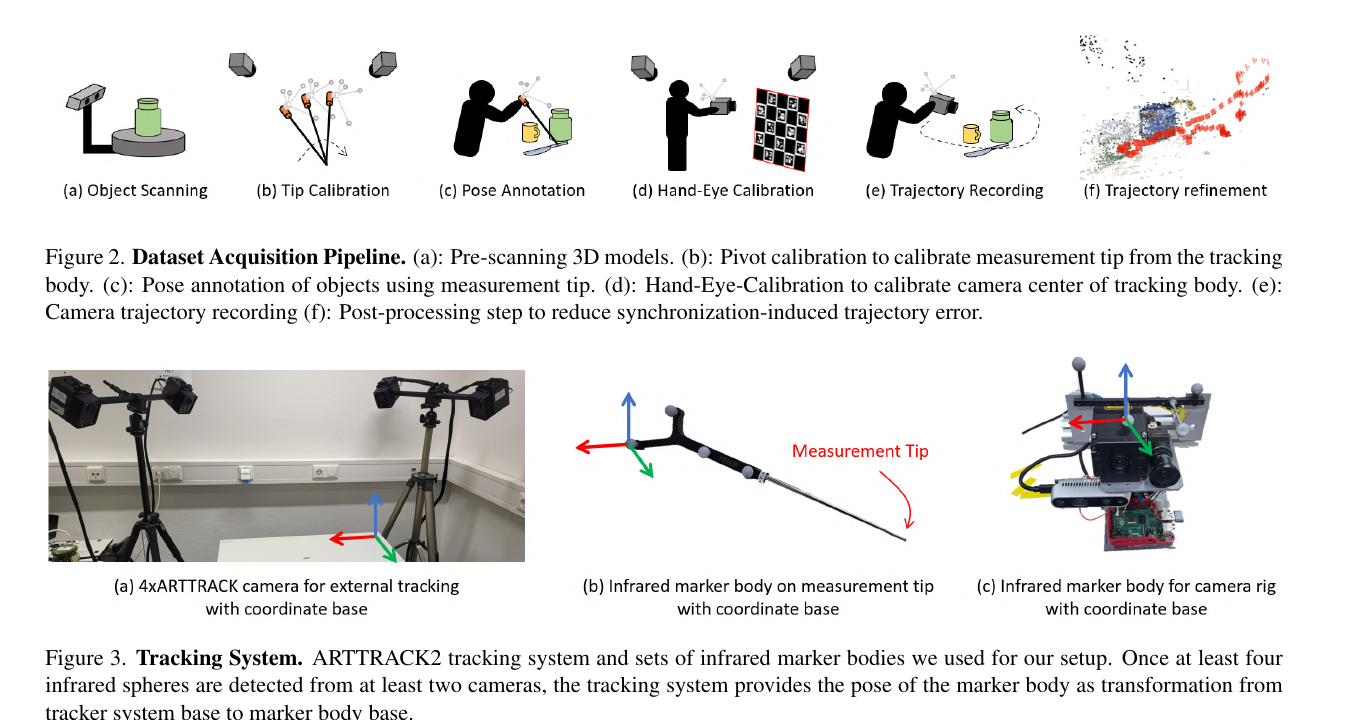
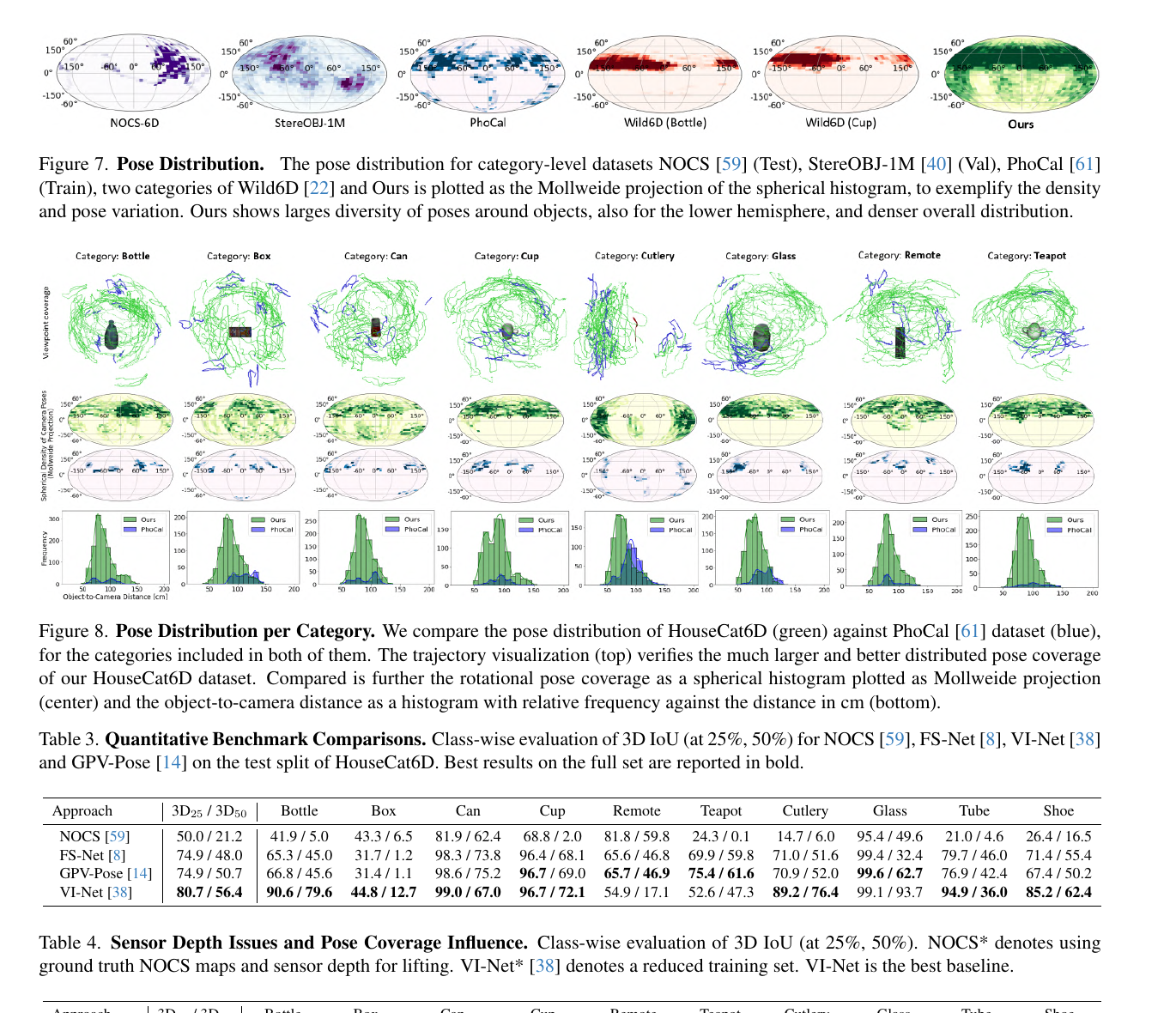
Original Figures 2–3: scan object models and calibrate the measurement probe, annotate objects, perform hand–eye calibration, then record freely moving camera trajectories with external ARTTRACK infrared tracking. Source: official CVPR 2024 paper. Image copyright belongs to the paper's authors and IEEE/CVF; reproduced here for paper analysis.Original Figures 7–8 and Table 3: HouseCat6D provides much denser lower-hemisphere and surrounding views. VI-Net achieves overall 3D25 / 3D50 of 80.7 / 56.4, but box and remote remain difficult. Source: official CVPR 2024 paper. Figure and table copyright belongs to the paper's authors and IEEE/CVF; reproduced here for paper analysis.
4. Dataset composition
194 real objects in 10 categories: bottle, box, can, cup, cutlery, glass, remote, shoe, teapot, tube.
41 large real indoor scenes: 34 training, 2 validation, 5 testing.
About 23.5k frames: 20k training, 1.4k validation, 3k testing.
About 160k object poses; each test scene contains 10 objects unseen during training.
Synchronized RGB, active-stereo depth, and RGB+P at four polarization angles.
Parallel-jaw grasp annotations in 16 scenes, about 10M total; split into 14 training, 1 validation, 1 testing.
Includes transparent / translucent glass, highly reflective cutlery, textureless objects, real occlusion, and complex backgrounds.
5. Annotation pipeline
Obtain high-quality meshes with structured-light scanning; difficult materials can use evaporating scanning spray.
An external four-camera infrared system tracks a measurement probe and handheld camera rig, without a checkerboard in the images.
Pivot calibration, measured 3D surface points, and ICP recover object pose in tracker coordinates.
Multiple-position observations improve hand–eye calibration; reported translation / rotation RMSE is about 0.27 mm / 0.42°.
Hardware triggers synchronize RGB, depth, and polarization; tracker–camera time offsets are then estimated.
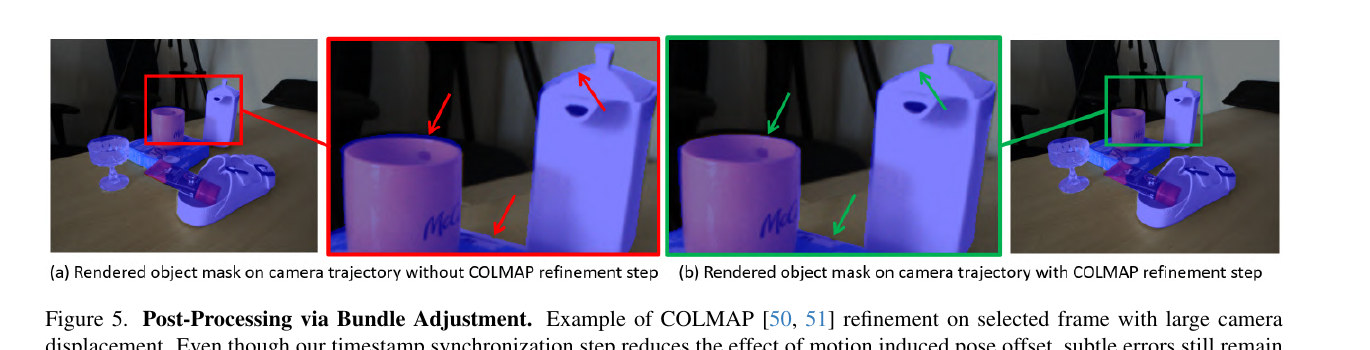
Free motion still creates synchronization and motion-induced offsets; selected fixed frames and COLMAP sparse bundle adjustment provide postprocessing.
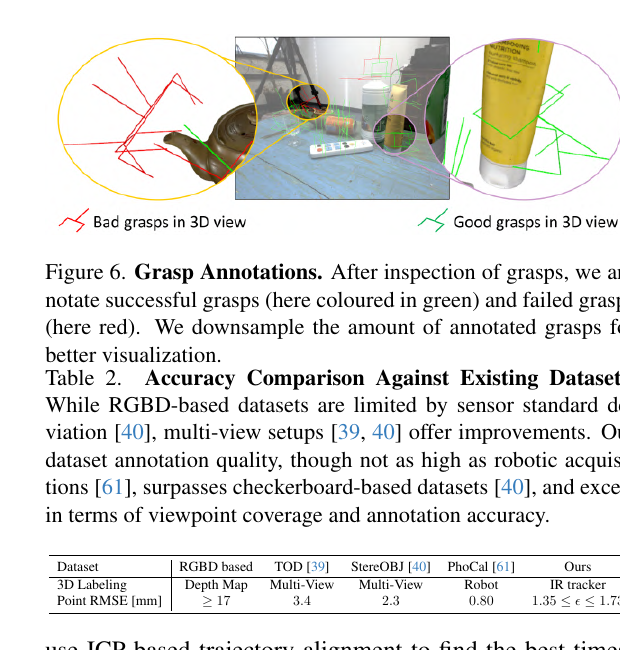
Estimated final point-level annotation error is 1.35–1.73 mm, better than checkerboard / ordinary RGB-D approaches, but less accurate than directly robot-captured PhoCaL at 0.80 mm.
VI-Net varies greatly by category: glass 99.1 / 93.7, bottle 90.6 / 79.6, but box 44.8 / 12.7 and remote 54.9 / 17.1.
Ground-truth NOCS maps with back-projected sensor depth reach overall 96.7 / 93.6. This identifies frontend coordinate prediction as a major error source, while glass / tube depth remains noisy.
Restricting VI-Net training to PhoCaL-like viewpoint coverage drops overall scores from 80.7 / 56.4 to 68.4 / 31.3, directly quantifying broad-view coverage’s value.
Grasping uses KGN as baseline; real Franka tests run 15 trials per object. Some transparent glasses reach 73.3% success after refinement, but remote drops from 53.3% to 33.3%; not all categories benefit.
7. Quick assessment
Highlights: combines scale, dense viewpoints, real materials, annotation accuracy, and grasp labels; detailed annotation engineering; public benchmarks expose category-level methods’ weaknesses in complex scenes.
Limitations: only 10 categories; RGB-D methods suffer active-stereo depth holes; polarization is not systematically used in the main pose table; real grasping trial counts are small.
Reading reminder: this is a dataset / benchmark paper. VI-Net 80.7 / 56.4 is a strong baseline on the new data, not the performance of a “HouseCat6D method.”
Intended readers: category-pose dataset construction, transparent / reflective perception, multimodal RGBD+P, precise extrinsic calibration, grasp poses, and real robot evaluation.
Available src/paper-notes/housecat6d-cvpr2024/deep.md
In-depth paper notes
Support reproduction, comparison, related-work writing, and identifying opportunities for further research.
Paper Reading Notes (Deep): HouseCat6D
1. Key assessment
HouseCat6D improves four weak points in category-level 6D pose data together:
Observation distribution: free camera motion covers surrounding and lower-hemisphere views beyond the tabletop upper hemisphere;
Materials: transparent / strongly reflective objects such as glass and cutlery become formal categories;
Annotation quality: external infrared tracking, a measurement probe, hand–eye calibration, synchronization, and bundle adjustment control point-level error to 1.35–1.73 mm;
Downstream tasks: the same scenes provide dense parallel-jaw grasp labels.
The benchmark also reveals two facts: VI-Net reaches only 56.4 overall 3D50, leaving realistic category pose far from saturation; even ground-truth NOCS coordinates suffer sensor-depth lifting errors on glass / tube. It exposes both representation and sensor-geometry errors.
2. Dataset size and splits
Item
Count / setting
Objects
194
Categories
10
Scenes
41
Total frames
About 23.5k
Object poses
About 160k
Grasp poses
About 10M
Pose split
34 train / 2 val / 5 test scenes
Frame split
20k train / 1.4k val / 3k test
Object split
124 train / 20 val / 50 test
Grasp split
14 train / 1 val / 1 test scenes
The 10 categories are bottle, box, can, cup, cutlery, glass, remote, shoe, teapot, and tube. Test instances are absent from training, making this a known-category, unseen-instance task.
Each frame can contain:
RGB;
active-stereo depth;
RGBP at four polarization angles;
camera trajectory;
Object masks, 6D poses, and CAD meshes;
Feasible / infeasible grasp poses for some sequences.
RGBD+P describes availability of ordinary RGB, depth, and polarization data; it does not imply a network fusing depth and polarization. Main pose baselines still primarily use RGB-D and do not establish substantial polarization gains for 6D pose.
3. Capture hardware and coordinate chain
Original Figures 2–3. Capture proceeds through mesh scanning, probe calibration, object-pose annotation, hand–eye calibration, trajectory recording, and postprocessing. External ARTTRACK tracks the probe and handheld camera rig. Source: official CVPR 2024 paper. Image copyright belongs to the paper's authors and IEEE/CVF; reproduced here for paper analysis.
Core coordinate frames include:
Tracker system base TB;
Infrared marker body MB;
Camera center CB;
Checkerboard base BB;
object / measurement-tip coordinates.
An external four-camera infrared system supplies marker poses instead of placing a checkerboard in every image. At least two infrared cameras must see the marker body’s four spheres to recover its transform relative to the tracker base.
Hardware:
Dedicated sensors for ordinary / polarization RGB and active-stereo depth;
Hardware triggers synchronize cameras as closely as possible;
A freely movable handheld rig expands workspace and viewpoint coverage.
4. From measurement probe to object pose
4.1 Pivot calibration
The physical probe tip differs from the marker-body origin. Holding the tip fixed while rotating the marker body, multiple observations minimize fixed-point position variance to recover the tip offset. The final calibration uses 18 poses and reports tip-position variance about 0.040 mm.
4.2 Object-pose annotation
Annotators collect 3D surface points with the probe and align them to the mesh:
Select surface correspondences for an initial transform;
Refine with ICP;
Cover several surfaces to avoid one-sided / coplanar degeneracy.
Simulated pivot and tracking errors give estimated mean RMSE about 0.32 mm / 0.43° for this step.
4.3 Hand–eye calibration
The authors collect camera and tracking-body trajectories at multiple positions, then use Horn alignment for a stable offset rather than relying on one checkerboard detection’s closed-form solution. Reported RMSE:
translation: 0.27 mm;
rotation: 0.42°.
4.4 Synchronization and trajectory postprocessing
Even with hardware triggers, infrared tracker / camera frequencies and timestamps differ. Trajectory ICP estimates their offset, with simulated error about 0.03 s, still enough to cause significant pose offsets during fast camera motion.
Original Figure 5. Initial trajectory projections on the left show mask offsets during fast motion; selected fixed frames and COLMAP refinement on the right better align object projections with RGB boundaries. Source: official CVPR 2024 paper. Image copyright belongs to the paper's authors and IEEE/CVF; reproduced here for paper analysis.
Postprocessing does not start SfM from scratch:
Existing tracking trajectories initialize it;
Humans select fixed frames with the best rendered-mask / RGB agreement;
This improves accuracy but adds manual fixed-frame selection. Reproducing capture requires annotation engineering as well as network code.
5. Interpreting annotation accuracy
Original Figure 6 and Table 2. Antipodal grasp candidates are tested in Isaac Gym and labeled successful / failed; estimated point-level pose-annotation RMSE is 1.35–1.73 mm. Source: official CVPR 2024 paper. Figure and table copyright belongs to the paper's authors and IEEE/CVF; reproduced here for paper analysis.
Table 2 compares object-model point RMSE under combined system error, not a single sensor’s nominal accuracy:
Data / approach
Annotation method
Point RMSE
Ordinary RGB-D lifting
Depth map
≥17 mm
TOD
multi-view
3.4 mm
StereoOBJ
multi-view
2.3 mm
PhoCaL
robot
0.80 mm
HouseCat6D
IR tracker
1.35–1.73 mm
The 1.35 and 1.73 bounds reflect different system-error combinations. SfM postprocessing gains cannot be fully quantified, so this range is not a directly measured error for every pixel.
Accuracy is slightly below robot-arm ground truth, but the handheld rig enables:
Larger workspaces;
More varied backgrounds;
More uniform camera poses;
Checkerboard-free images.
6. Viewpoint coverage
Original Figures 7–8 and Table 3. Mollweide histograms show lower-hemisphere and surrounding-view coverage; below are 3D IoU scores for four category-level pose baselines. Source: official CVPR 2024 paper. Figure and table copyright belongs to the paper's authors and IEEE/CVF; reproduced here for paper analysis.
Compared with NOCS, StereoOBJ-1M, PhoCaL, and Wild6D, HouseCat6D camera orientations provide:
Coverage beyond the upper hemisphere;
Multidirectional trajectories for every category;
A wider object-to-camera distance range;
Occlusion and nearby objects within real scenes.
Restricting VI-Net training to PhoCaL-like coverage gives:
Training coverage
3D25
3D50
HouseCat6D full
80.7
56.4
reduced VI-Net*
68.4
31.3
The 3D50 drop of 25.1 points makes pose coverage a quantifiable generalization variable beyond qualitative dataset diversity.
7. Category-level pose benchmark
Overall:
Method
3D25
3D50
NOCS
50.0
21.2
FS-Net
74.9
48.0
GPV-Pose
74.9
50.7
VI-Net
80.7
56.4
VI-Net 3D25 / 3D50 by category:
bottle: 90.6 / 79.6;
box: 44.8 / 12.7;
can: 99.0 / 67.0;
cup: 96.7 / 72.1;
remote: 54.9 / 17.1;
teapot: 52.6 / 47.3;
cutlery: 89.2 / 76.4;
glass: 99.1 / 93.7;
tube: 94.9 / 36.0;
shoe: 85.2 / 62.4.
High glass 3D IoU does not guarantee accurate rotation: IoU can tolerate approximate axial symmetry and size / center variation. Low box / remote scores combine intra-class appearance, thin structures, occlusion, and NOCS canonicalization effects.
8. Depth-error ablation
Ground-truth NOCS maps replace network predictions while retaining sensor-depth lifting:
Overall 3D25 / 3D50 reaches 96.7 / 93.6;
This attributes much ordinary-category error to 2D NOCS prediction;
Glass reaches only 80.0 / 68.0, well below VI-Net 99.1 / 93.7;
Strict tube performance also suffers from depth error.
Perfect canonical coordinates plus sensor depth can thus underperform learned 3D pipelines: transparent / reflective depth points may not lie on real surfaces, and perfect 2D coordinates cannot repair incorrect 3D measurements. Learned priors can instead bypass some missing data.
At 75% IoU, ground-truth NOCS + sensor depth averages only 22.6%, exposing lifting error more strongly than loose 3D50.
9. Grasp annotation and real experiments
Grasp generation:
Antipodal sampling on meshes;
Isaac Gym separates successful / failed candidates;
Object poses transform grasps into the tracker frame;
Reconstruct backgrounds and check collisions;
Project remaining grasps into each camera frame.
KGN predicts gripper keypoints from RGB-D and solves 6D grasp pose through PnP. Reported results include:
Test-set grasp coverage and object success rates;
Real grasp success on a Franka 7-DoF robot;
15 trials per object.
Real results (without / with keypoint refinement):
box: 80.0 / 80.0;
cup: 66.7 / 66.7;
glass: 66.7 / 73.3;
remote: 53.3 / 33.3;
unknown: 53.3 / 60.0.
Refinement does not consistently help; remote degrades clearly. The small trial count cannot tightly estimate category success, but demonstrates a complete perception-to-manipulation use of the data.
10. Limitations and usage risks
Only 10 categories, not an open-world household dataset;
Main pose benchmarks do not systematically use polarization; its benefit remains for future work;
Active-stereo depth still fails on transparent / reflective surfaces;
Separate detection, segmentation, lifting, and pose-solver error;
Report depth-valid ratios separately for glass / cutlery / tube;
Compare full and reduced viewpoint coverage;
Report GCR, OSR, and real GSR together in grasping;
Record each real robot failure type alongside mean success;
Establish an RGB-D baseline for polarization studies; data availability alone does not prove modality effectiveness.
12. Overall assessment
HouseCat6D is a strong 2024 category-pose dataset paper, connecting hardware, calibration, trajectories, materials, views, pose benchmarks, and grasping. VI-Net 80.7 / 56.4, reduced coverage 68.4 / 31.3, and category-dependent ground-truth NOCS + noisy-depth behavior identify interpretable sources of difficulty beyond dataset size.
It is not a final benchmark: categories remain limited, polarization underused, transparent depth fragile, and grasp statistics small. Its clear role is: a public, high-precision, wide-view, multimaterial stress test for realistic household category pose, with pose and grasping in one coordinate chain.