IFFNeRF: Initialisation Free and Fast 6DoF Pose Estimation from a Single Image and a NeRF Model
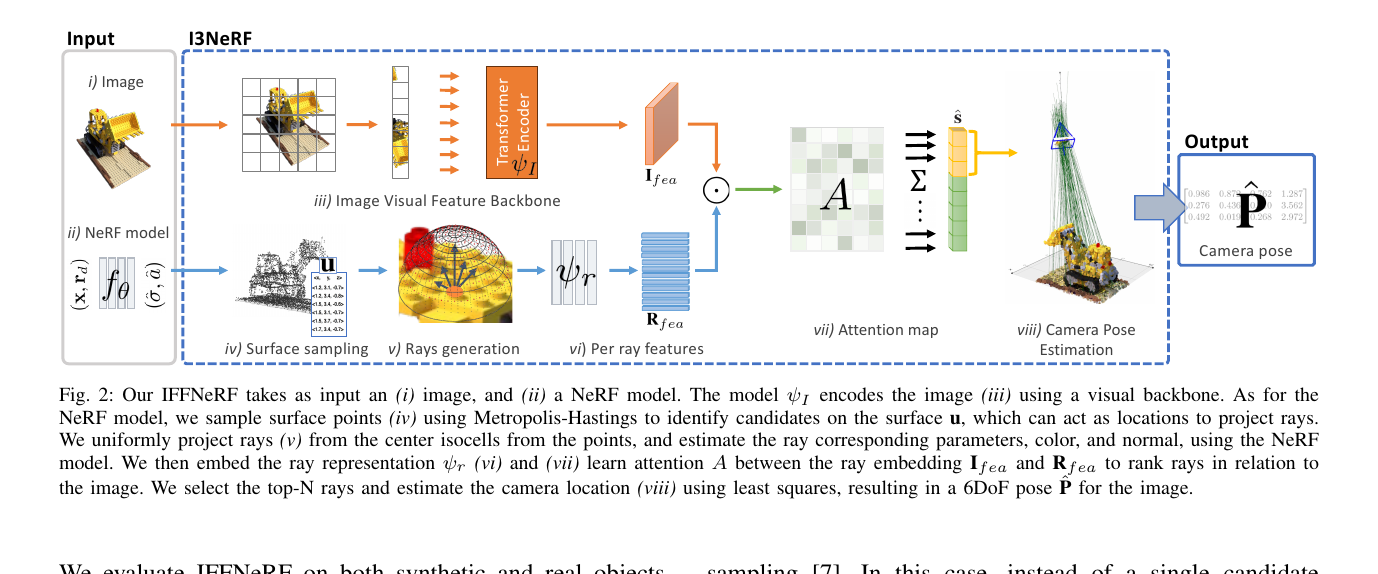
IFFNeRF samples surfaces from a NeRF density field and generates parameterized rays. DINOv2 image features and attention retrieve rays pointing toward the true camera center; weighted linear least squares recovers pose without initialization in around 29 ms.
camera intrinsicstrained NeRFper-scene IFFNeRF trainingnormalized scene scale
Reading Notes
Overview / Deep Dive
Available src/paper-notes/iffnerf-icra2024/coarse.md
Paper overview notes
Quickly assess the paper's scope, problem setting, core method, experimental findings, and whether to read it in depth.
Paper Reading Notes (Coarse): IFFNeRF: Initialisation Free and Fast 6DoF Pose Estimation from a Single Image and a NeRF Model
1. Basic information
Authors / affiliations: Matteo Bortolon, Theodore Tsesmelis, Stuart James, Fabio Poiesi, Alessio Del Bue; IIT, FBK, University of Trento, Durham University
IFFNeRF samples surface points from NeRF density, casts colored / normal-bearing rays in many directions, matches rays to a query using DINOv2 + attention, and solves camera location by weighted least squares. It achieves initialization-free pose at about 34 FPS, avoiding local iterative photometric optimization.
Original Figure 2: the query and object NeRF are encoded separately; attention ranks rays, whose geometric intersection determines camera pose. Source: arXiv. Image copyright belongs to the paper's authors and publisher; reproduced here for paper analysis.
3. Problem setting
Task: estimate query-camera 6DoF pose relative to a NeRF frame from one query RGB image and the target NeRF.
Required: a trained NeRF, query intrinsics, and IFFNeRF training for each scene / object.
Not required: near-GT initialization, CAD mesh, or iterative online NeRF optimization.
Output boundary: intersecting rays directly recovers camera location; read full orientation representation / evaluation in the ray-camera formulation’s context.
4. Core motivation
iNeRF requires local initialization and hundreds of differentiable-rendering iterations. IFFNeRF instead retrieves query-related rays covering broad viewpoints, replacing online optimization with learned matching.
5. Method overview
Sample surface points with density-based Metropolis–Hastings.
Generate isocell sphere / hemisphere rays around each point and query color / normal.
Encode the query with DINOv2 and rays with positional encoding + MLP.
Attention predicts each ray’s relevance to the query.
Select top-100 rays and solve the closest camera location to all rays using weighted least squares.
6. Experimental overview
Data: eight Synthetic NeRF objects; five real Tanks & Temples scenes.
Metrics: Mean Angular Error, Mean Translation Error, time.
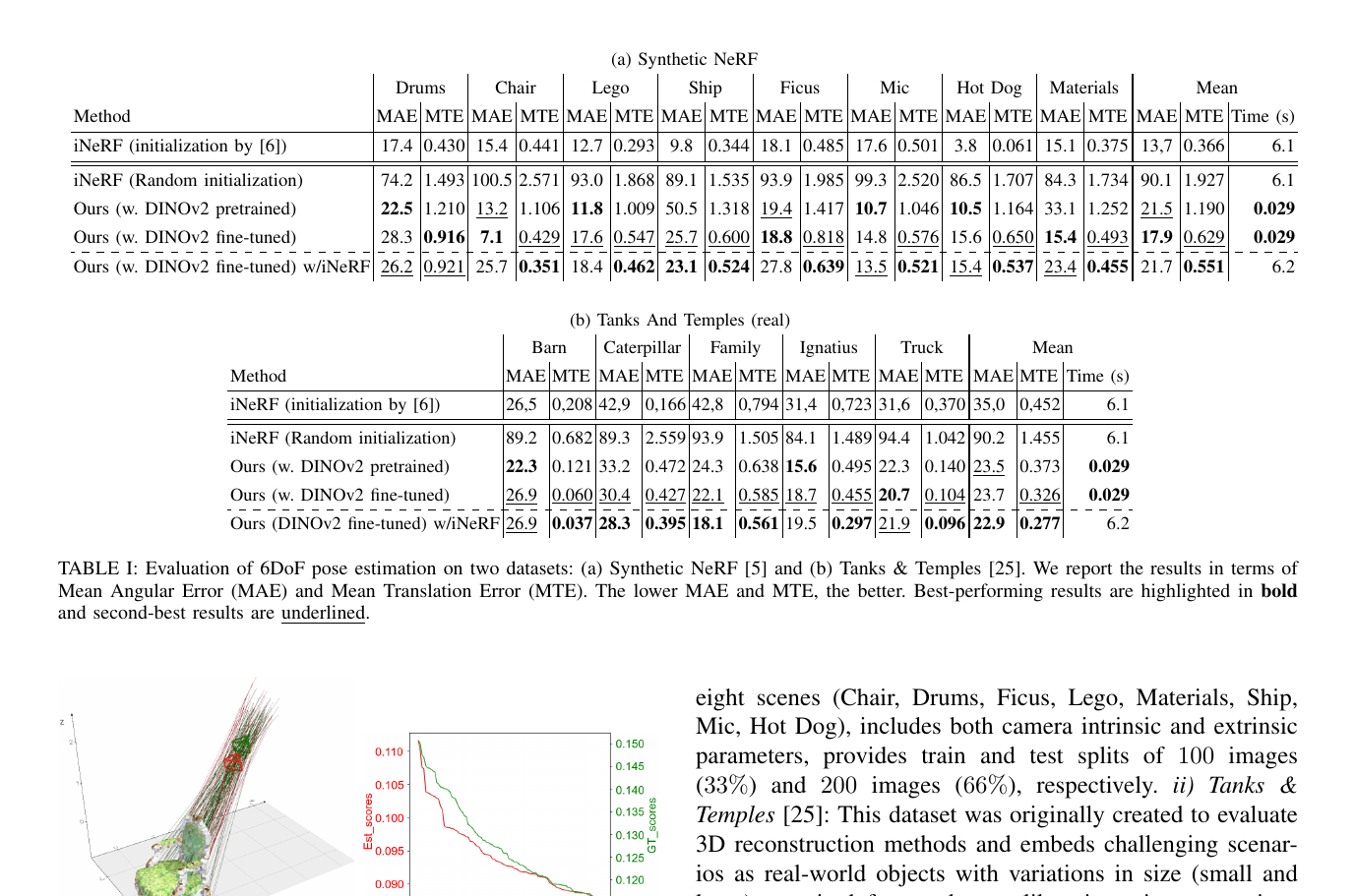
Speed: 29 ms / image, about 34 FPS; iNeRF about 6.1 s.
Conclusion: large gains over random-initialized iNeRF; near-GT iNeRF can still give better synthetic rotation.
7. Strengths and limitations
Strengths
Clear speed gains by removing local initialization and online iteration.
NeRF rays connect appearance with interpretable 3D line geometry.
More stable than iNeRF under real shadows / large viewpoint changes.
Limitations / risks
Attention training remains scene-specific, not direct generalization to any new NeRF.
Unit-box translation does not directly indicate metric robot accuracy.
Depends on NeRF geometry, intrinsics, and sufficient training-view coverage.
8. Research takeaways
NeRF pose can go beyond inverse rendering: compiling a radiance field into a matchable ray database and solving geometry in closed form can better suit real-time systems.
Available src/paper-notes/iffnerf-icra2024/deep.md
In-depth paper notes
Support reproduction, comparison, related-work writing, and identifying opportunities for further research.
Paper Reading Notes (Deep): IFFNeRF: Initialisation Free and Fast 6DoF Pose Estimation from a Single Image and a NeRF Model
1. Basic information
Authors / affiliations: Matteo Bortolon, Theodore Tsesmelis, Stuart James, Fabio Poiesi, Alessio Del Bue; IIT PAVIS, FBK TeV, University of Trento, Durham University
IFFNeRF replaces test-time inverse-NeRF pose optimization with ray retrieval: sample density-field surfaces, generate parameterized rays spanning potential camera views, learn attention between query patches and rays, then treat top rays as 3D lines toward the camera center and solve their weighted least-squares intersection.
2.1 Guide to the paper’s figures and tables
Figure / table
Contents
Key point
Figure 2
Complete pipeline
Attention retrieves; least squares solves geometry
Table I / Figure 5
Quantitative results and top-ray selection
29 ms; large gains over random-initialized iNeRF
Figure 6
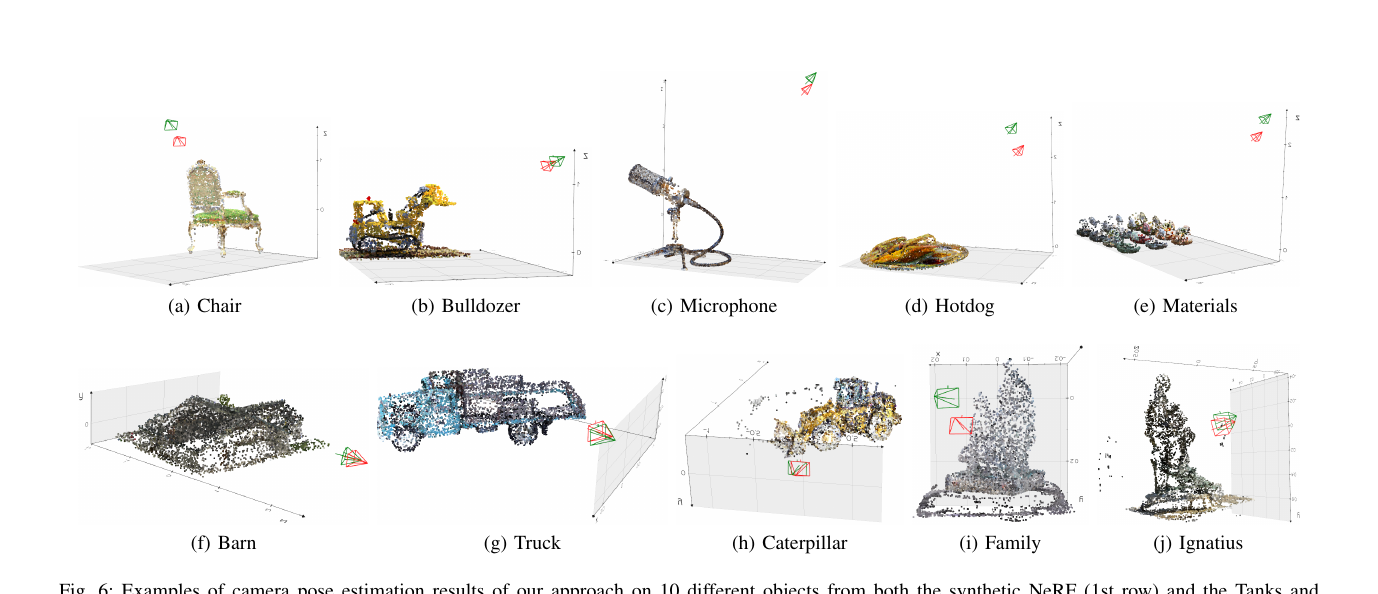
Synthetic / real qualitative camera poses
Green GT, red predictions; object-dependent errors vary widely
Original Figure 2: NeRF produces surface-conditioned rays while a visual backbone encodes the query. Attention aggregates image evidence into per-ray scores, and geometry outputs camera pose. Source: paper PDF. Image copyright belongs to the paper's authors and publisher; reproduced here for paper analysis.
3. Problem setting and task boundaries
Input / assumption
Required?
One query RGB image
Yes
Query camera intrinsics
Yes
Target object / scene NeRF
Yes
Initial camera pose
No
CAD / mesh
No
Query depth
No
Scene-specific IFFNeRF training
Yes
Test-time NeRF optimization
No; optional iNeRF refinement
Objects are scaled to a unit box, so MTE uses normalized units, not centimeters. Synthetic NeRF and Tanks & Temples are scene / view-synthesis datasets rather than standard object-pose benchmarks.
4. Research context
iNeRF: fixed NeRF weights, photometric gradients update camera pose; locally precise but initialization-dependent and slow online.
Parallel-iNeRF / Loc-NeRF: multiple initializations / sampling broaden the basin but retain optimization.
Feature-NeRF localization: learned features replace RGB residuals for illumination robustness.
Extract G=5000 3D surface points from NeRF. Metropolis–Hastings biases sampling by density rather than wasting uniform samples in empty volume.
This assumes density peaks approximate real surfaces. Floaters or transparent / reflective false density create wrong ray origins.
5.2 Rays generation
Around each surface point ro, isocell sampling generates directions rd, and NeRF queries:
ray origin;
unit direction;
rendered color;
local surface normal.
Hemispheres reduce irrelevant directions. Positional encoding + MLP makes ray features sensitive to nearby spatial parameters.
5.3 Image–ray attention
DINOv2 extracts W×H query-image patch features. Image features are queries and ray features keys / values; summing attention over image dimensions gives per-ray score s^j.
The soft training target depends on ray distance to the GT camera center: closer rays receive higher scores. L2 fits this target rather than a discrete pose class.
5.4 Top-ray least-squares
At test time select Ntop=100 rays. Ideally they intersect at the camera center; with discrete directions and matching noise, minimize weighted squared distances from point p to all 3D lines:
pminj∑s^j(I−rd,jrd,j⊤)(p−ro,j)22.
This becomes linear least squares. The formulation links rays to camera pose; it should not be simplified to ordinary PnP, which matches image pixels to CAD points instead of rays to a camera center.
6. Training and engineering complexity
Train each scene / object on its NeRF training split for about 1.5k iterations; about 45 min on RTX 3090.
Attention is scene-specific, the main offline cost behind initialization-free inference.
Inference takes about 29 ms and 3294 MB, versus iNeRF 6.1 s and 4870 MB.
Using IFFNeRF to initialize iNeRF improves some real scenes but takes about 6.2 s.
Tanks & Temples: Barn, Caterpillar, Family, Ignatius, Truck; mean about 247 train / 35 test views.
Two iNeRF initializations: the specified near-GT range and random training poses.
Metrics: MAE in degrees, MTE in unit-box-normalized translation, time.
Original Table I / Figure 5: synthetic / real, near-GT / random initialization, and runtime results; lower examples show predicted top rays and GT rays. Source: paper PDF. Image copyright belongs to the paper's authors and publisher; reproduced here for paper analysis.
7.2 Reading the main results correctly
Protocol
Method
Synthetic mean MAE / MTE
Real mean MAE / MTE
Time
Near-GT init
iNeRF
13.7 / 0.366
35.0 / 0.452
6.1 s
random init
iNeRF
90.1 / 1.927
90.2 / 1.455
6.1 s
No init
IFFNeRF fine-tuned
17.9 / 0.629
23.7 / 0.326
0.029 s
Authors’ claim: versus random-initialized iNeRF, synthetic angular / translation errors improve by about 72.2° / 1.29 units, and real errors by about 66.5° / 1.129 units.
My analysis:
Strong evidence of a wider capture range.
Not universal accuracy superiority with good initialization; near-initialized iNeRF has lower synthetic rotation error.
Stronger real-scene stability may reflect DINOv2’s resistance to shadows compared with photometric loss.
Original Figure 6: green cameras are GT, red are predictions. Translation and viewing-direction errors vary across scenes, so averages alone are insufficient. Source: paper PDF. Image copyright belongs to the paper's authors and publisher; reproduced here for paper analysis.
7.3 Robustness
With 50% Gaussian query noise, error rises 14.01° / 0.201 units: some robustness, but substantial degradation.
Pretrained versus scene-fine-tuned DINOv2 depends on the data; fine-tuning need not improve real rotation.
IFFNeRF + iNeRF improves real results further but may worsen synthetic rotation, linking refinement basins to initialization-error structure.
8. Critical analysis
Strengths
Replaces slow nonlinear optimization with attention and linear geometry.
Capture range and runtime have explicit experimental support.
Feature matching is a reasonable response to real illumination changes.
Weaknesses and assumptions
Scene-specific training prevents generalizable novel-object pose.
NeRF and IFFNeRF training costs are absent from online timing.
Unit-box MTE does not directly measure robot-grasp accuracy.
Small evaluation scale, without BOP symmetry / occlusion protocols.
NeRF geometry failure, clutter, and multi-object separation are not systematically tested.
9. Possible improvements
Train a cross-NeRF / object ray matcher so new NeRFs need indexing rather than fine-tuning.
Derive rotation / translation uncertainty from ray-score geometry.
Use multiscale rays or coarse-to-fine top-ray refinement.
Evaluate ADD(-S) / VSD on metric object NeRFs and BOP-like clutter.
Include NeRF quality / density uncertainty in ray confidence.
10. Research implications
Neural fields can be compiled into appearance-bearing geometric rays for retrieval and closed-form solving instead of serving as differentiable renderers at inference. For real-time robotics, this representation-to-searchable-primitives-to-solver design can be more practical than iterative inference.
11. Open questions
How is complete 6DoF orientation stably recovered from selected rays, and which quantities depend on ray directions / image relationships?
Can synthetic NeRF pretraining replace scene-specific training?
How sensitive is it to floaters, transparent objects, and sparse views?
Against one-step NeRF + feature matching, which is more stable under matched data / initialization protocols?