iFusion: Inverting Diffusion for Pose-Free Reconstruction from Sparse Views
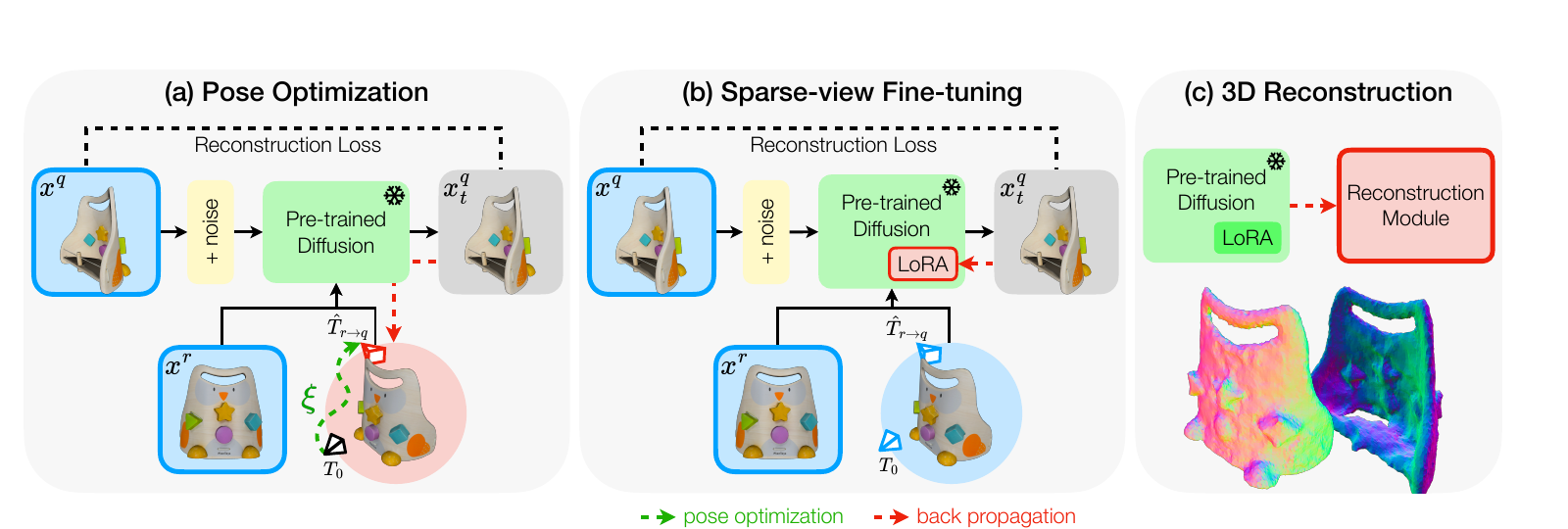
iFusion inverts Zero123 novel-view diffusion into an SE(3) view-pose optimizer between two object images with unknown camera poses. Self-estimated poses then guide LoRA fine-tuning and subsequent NeRF / 3DGS reconstruction geometrically.
Starting from two object images without known camera poses, iFusion inverts a pretrained diffusion prior to find the relative camera transform that best reconstructs the inputs. LoRA then adapts the generator for NeRF, NeuS, or Gaussian Splatting reconstruction of a 3D asset.
3. Task boundaries
Input: as few as two object RGB images, with unknown relative camera poses.
Output: relative camera pose and sparse-view 3D reconstruction supported by an adapted generator.
Pose here means camera alignment between input views, not BOP-style object-to-camera 6D pose.
Strongly depends on pretrained Zero123 / diffusion priors; chiefly validated under rendered GSO / OO3D protocols.
4. Method overview
Optimize the relative transform in a Lie-algebra parameterization of SE(3) so a frozen diffusion model better reconstructs the query.
Start from front, left, right, and back canonical poses to reduce local minima; anneal denoising timesteps during optimization.
Freeze the main model and adapt LoRA to the target’s few aligned views for novel-view synthesis.
Feed generated multiview images / SDS signals into existing reconstruction modules to obtain geometry.
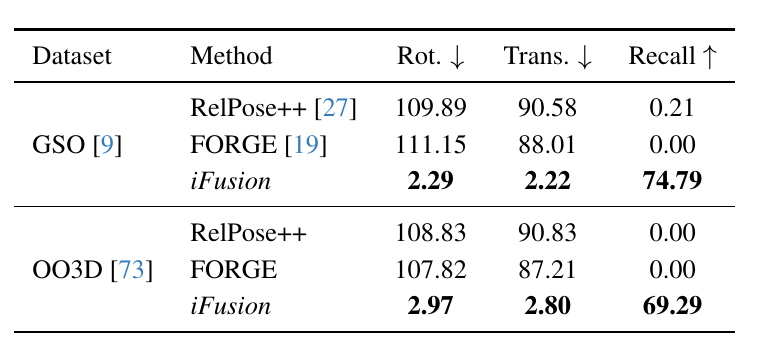
RelPose++ and FORGE recall is near 0 under this protocol; the authors attribute gains to large-scale diffusion object priors.
Sparse-view NVS on GSO: PSNR 18.73, SSIM 0.836, LPIPS 0.121; reconstruction gains also use Chamfer / IoU.
Four initializations take about 70.6 seconds; eight improve recall at nearly twice the latency.
6. Strengths, weaknesses, and reading assessment
Strengths
A novel way to infer unknown view poses at test time using generative reconstruction error.
Alignment followed by instance-specific LoRA reduces identity drift from generic generation.
Decoupled from reconstruction backends, making it a useful asset-acquisition frontend.
Risks / boundaries
Main values come from rendered two-view objects; real reflections, occlusion, background leakage, and scale ambiguity remain unvalidated.
Diffusion can favor plausible appearance over correct geometry.
Per-object test-time optimization / fine-tuning is expensive, limiting direct real-time 6D pose use.
7. Research takeaways
When camera poses are missing, strong generative priors can act as differentiable registration scorers. Independent geometry or subsequent pose verification is needed to avoid visually plausible but incorrect solutions.
Available src/paper-notes/ifusion-3dv2025/deep.md
In-depth paper notes
Support reproduction, comparison, related-work writing, and identifying opportunities for further research.
Paper Reading Notes (Deep): iFusion: Inverting Diffusion for Pose-Free Reconstruction from Sparse Views
1. Basic information
Method: iFusion
Authors / affiliations: Chin-Hsuan Wu, Yen-Chun Chen, Bolivar Solarte, Lu Yuan, Min Sun; National Tsing Hua University, Microsoft, Amazon
iFusion turns pretrained novel-view diffusion into a scorer for pose-free sparse-view reconstruction: a relative camera transform is plausible if it lets diffusion reconstruct the other view. After alignment, LoRA customizes the generator to the specific object.
Three separate stages, with later stages using estimated relative poses
Table 1
Two-view relative pose on GSO / OO3D
Rotation / translation measure camera-to-camera transforms, not object-to-camera 6D pose
Tables 2–3
NVS and reconstruction
Test whether alignment improves downstream results beyond pose-loss reduction
Original Figure 3: iFusion's three-stage framework. Source: arXiv PDF. Image copyright belongs to the paper's authors and publisher; reproduced here for paper analysis.Original Table 1: relative camera pose from two views; lower rotation / translation error and higher 5° recall are better. Source: arXiv PDF. Image copyright belongs to the paper's authors and publisher; reproduced here for paper analysis.
3. Problem setting and relation to 6D object pose
Given two or a few object images xr,xq with unknown relative camera transform Tr→q.
First output T^r→q, then an adapted target-object NVS generator that supports NeRF, NeuS, DreamGaussian, or other reconstruction backends.
Pose means view pose / relative camera transform, treating the object as fixed in multiview registration. Table 1 is not a BOP ADD or R,t object-pose result.
SfM / COLMAP needs many views and stable matching, which two low-texture / low-overlap object images may lack. iFusion uses learned appearance conditioned on a reference and relative camera: optimize the transform until generation reconstructs the real query. This is test-time inversion rather than supervised general relative-pose regression.
My analysis: the objective is powerful but risky. In-distribution targets may be more stable than sparse matching; hallucinated plausible backsides can instead pull camera transforms toward false geometry. Downstream geometric metrics are essential cross-checks.
5. Method details
5.1 SE(3) relative pose through diffusion inversion
Twist vector ξ∈se(3) represents the transform as T=T0exp(ξ). Reconstruction gradients from the frozen diffusion model update ξ, with symmetric forward / inverse constraints reducing one-direction-only degeneracy.
To reduce local minima, optimization starts from front, left, right, and back canonical poses T0 and anneals denoising timesteps coarse to fine. Initial directions yield distinct generative trajectories; a single T0 can get trapped by symmetry or low overlap.
5.2 From two aligned images to a target-specific generator
After estimating T^, iFusion adapts only small LoRA attention parameters instead of all Zero123 weights. Stochastic multiview conditioning uses aligned views to retain general priors while matching the target identity. Generated views or SDS/reconstruction losses then guide interchangeable 3D backends.
Stage
Optimized variables
Frozen / required conditions
Output
Pose inversion
ξ
Frozen Zero123, two object images
T^r→q
Sparse-view fine-tuning
LoRA parameters ϕ
Estimated T^ and few observations
More identity-consistent NVS generator
3D reconstruction
Backend geometry parameters
Generated views or SDS
3D asset
6. Experimental analysis
6.1 Data and evaluation protocol
The authors select 70 objects each from GSO and OO3D, render 5 views per object for pose experiments, and report 1400 views per dataset in §4.1. These counts do not directly agree as independent rendered frames (70×5=350), so 1400 is retained only as the paper’s reported value; the sampling / pairing count remains to be checked, see original §4.1. Reconstruction starts from the two views with greatest parallax. Pose uses median rotation / translation errors and recall satisfying both 5° thresholds; NVS uses PSNR, SSIM, LPIPS; reconstruction uses Chamfer Distance and volumetric IoU.
This controlled rendering protocol tests prior-based pose inversion. Its main results do not cover casual photos’ backgrounds, exposure, occlusion, or inconsistent focal lengths.
6.2 Main results
Dataset
iFusion rotation ↓
Translation ↓
5° recall ↑
Comparison
GSO
2.29
2.22
74.79
RelPose++ 109.89 / 90.58 / 0.21; FORGE recall 0
OO3D
2.97
2.80
69.29
RelPose++ and FORGE both have recall 0
GSO NVS also reaches PSNR 18.73, SSIM 0.836, LPIPS 0.121, showing downstream synthesis gains beyond pose-loss reduction. NVS also depends on LoRA, generation, and reconstruction backends, so gains cannot all be attributed to pose initialization.
6.3 Ablations and cost
Four initial poses give recall 74.79 in about 70.59 s; eight give 78.21 in about 133.7 s.
Four-way initialization gains support multimodal camera solutions; nearly doubled runtime also points toward offline asset production.
Timestep annealing plausibly uses coarse denoising’s broad basin before fine texture alignment. Stability improves, but there is no rigorous real-image calibration study.
Better 3D reconstruction: supported by NVS, Chamfer, and IoU, including backend contributions.
Pose-free real captures: a reasonable direction, but main quantitative evidence uses rendering and does not establish metric-accurate casual-photo reconstruction.
Potential failures
Homogeneous textures, approximate rotational symmetry, or tiny overlap can admit multiple visual explanations.
Out-of-distribution priors may invent geometry, jointly biasing pose and reconstruction.
LoRA and reconstruction both run at test time; practical accounting must include cumulative latency and memory.
8. Implications for pose research
Use generative-rendering likelihood to verify pose hypotheses rather than treating diffusion as geometric truth.
Combine image priors with epipolar, silhouette, calibration, or 3D consistency constraints, especially for metric robot-grasp pose.
Report relative camera pose, generation quality, reconstruction quality, and real object pose separately; one visual score cannot establish all four.