IndustryShapes: An RGB-D Benchmark Dataset for 6D Object Pose Estimation of Industrial Assembly Components and Tools
IndustryShapes builds Classic and Extended BOP datasets from 5 textureless, reflective, thin-structure, or symmetric industrial parts: 34 scenes, around 22,400 pose annotations, and 10 static RGB-D onboarding sequences. FoundationPose model-based AR on Classic / Extended is 0.67 / 0.69 versus model-free 0.25 / 0.33. Limits include only 5 objects, uneven train / test scene complexity, and inconsistent Extended depth-error reporting between the text and Table IV.
Intel RealSense D455 or D405-style RGB-D sensingknown CAD models for benchmark evaluationBOP-compatible pipelinestatic onboarding sequence for model-free evaluation
Reading Notes
Overview / Deep Dive
Available src/paper-notes/industryshapes-icra2026/coarse.md
Paper overview notes
Quickly assess the paper's scope, problem setting, core method, experimental findings, and whether to read it in depth.
Paper Reading Notes (Coarse): IndustryShapes
One-sentence summary
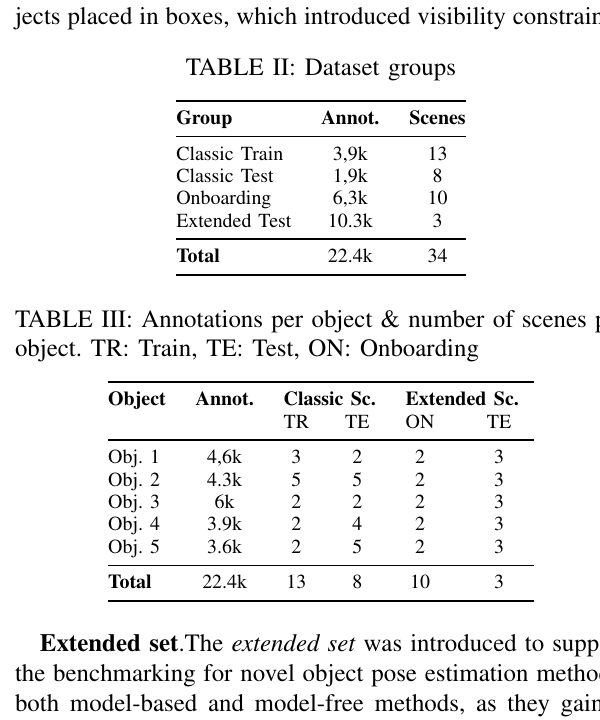
IndustryShapes builds Classic and Extended RGB-D / BOP benchmarks around 5 industrial parts with textureless, reflective, thin, complex, or symmetric geometry. It supports known-instance training and static onboarding for novel / model-free pose estimation.
2 static RGB-D onboarding sequences per object, 10 total, about 6.3K frames;
3 office test scenes, over 2K images, about 10.3K pose instances.
Together: 34 scenes and about 22.4K annotations, with RGB, depth, masks, poses, and CAD in BOP format.
Original Tables II–III: Classic, onboarding, and Extended test total 34 scenes and 22.4K annotations; data is uneven across the five objects. Source: original paper. Image copyright belongs to the paper's authors; reproduced here for academic analysis.
Annotation and evaluation
Laboratory / marker-compatible industrial data uses ArUco. Marker-free sequences recover camera motion with Metashape SfM, manually specify CAD 3D anchors, track their 2D correspondences, and solve pose with PnP. Classic uses RealSense D455; Extended uses handheld D405.
Evaluation includes ADD and BOP AR, the mean VSD / MSSD / MSPD recall. Baselines include EPOS, DOPE, ZebraPose, FoundPose, and model-based / model-free FoundationPose.
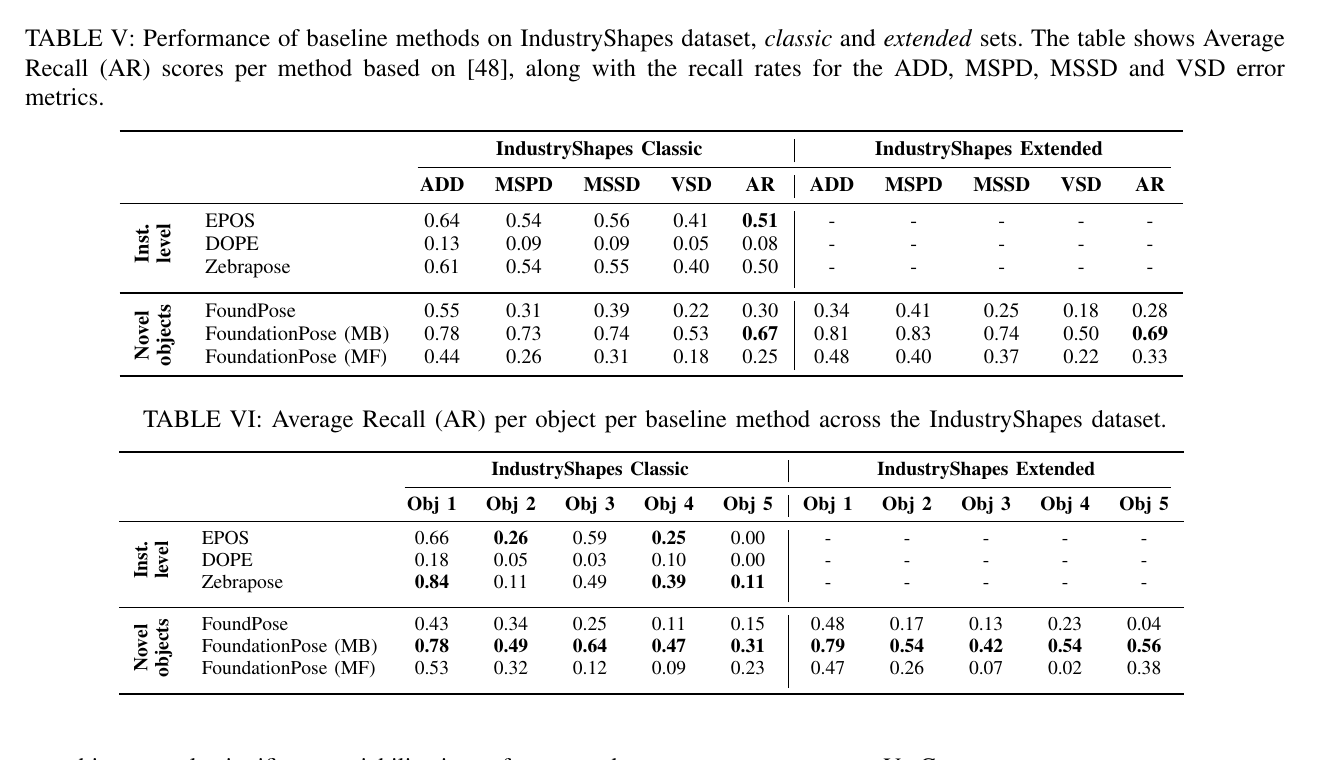
Reflective, thin Object 5 gives model-based FoundationPose Classic AR 0.31 versus Object 1 at 0.78; Extended gives 0.56 / 0.79.
CNOS / SAM6D segmentation mAP is 0.203 / 0.345 on Classic and 0.512 / 0.453 on Extended.
Original Tables V–VI: model-based FoundationPose leads both sets; object differences are large, with reflective, thin Object 5 hardest. Source: original paper. Image copyright belongs to the paper's authors; reproduced here for academic analysis.
Important boundaries
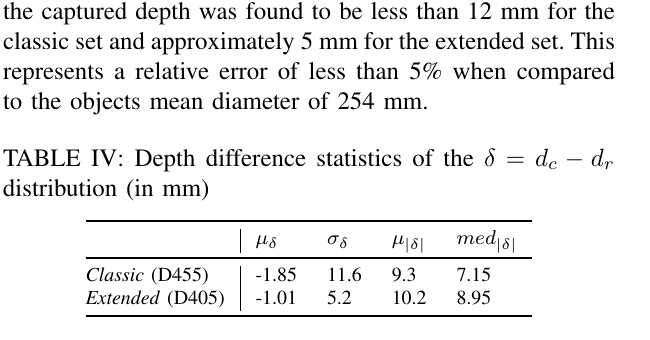
Only 5 objects are included. Training often uses one object / simple backgrounds, while testing is more cluttered, creating unequal objectwise domain shifts. The text calls Extended absolute depth error about 5 mm, but Table IV reports mean absolute difference 10.2 mm and standard deviation 5.2 mm. Use the explicitly labeled table values rather than conflating these statistics.
Reading assessment
This small dataset targets industrial materials / geometry often underrepresented in household benchmarks and supplies static onboarding. Use it as a difficult-industrial-object stress test rather than a large cross-category dataset. Report objects separately so averages do not hide failures such as Object 5.
Available src/paper-notes/industryshapes-icra2026/deep.md
In-depth paper notes
Support reproduction, comparison, related-work writing, and identifying opportunities for further research.
Paper Reading Notes (Deep): IndustryShapes
1. Which gap does the dataset address?
Many 6D benchmarks use household groceries, toys, or regular boxes. Industrial components / tools more often involve:
Large textureless metal / plastic surfaces;
Specular / partly reflective surfaces;
Sheets, fixtures, and elongated structures;
Repeated geometry and rotational symmetry;
Trays, holders, multiple instances, and occlusion at workstations;
New parts requiring quick onboarding videos without retraining large instance networks.
IndustryShapes selects 5 industrial objects for these difficulties and splits into Classic known-instance training / testing and Extended novel / model-free estimation with CAD or static onboarding sequences.
2. Five objects and task boundaries
Each object represents a failure source: texturelessness, complex geometry, reflection, thin structure, or symmetry. All provide scaled CAD and photorealistic texture for rendering / synthetic augmentation.
This is a curated stress test rather than foundation-model training data. Its value is diagnosing which material / geometry defeats a method, beyond an overall mean.
3. Classic set
Classic supports instance-level estimators:
21 scenes: 13 train, 8 test;
Training:
1217 images / 4 lab scenes;
1122 images / 8 industrial scenes;
1361 synthetic images of Object 3;
3700 frames total;
Testing: 923 real industrial images;
Total: 4623 images and about 6K annotated poses.
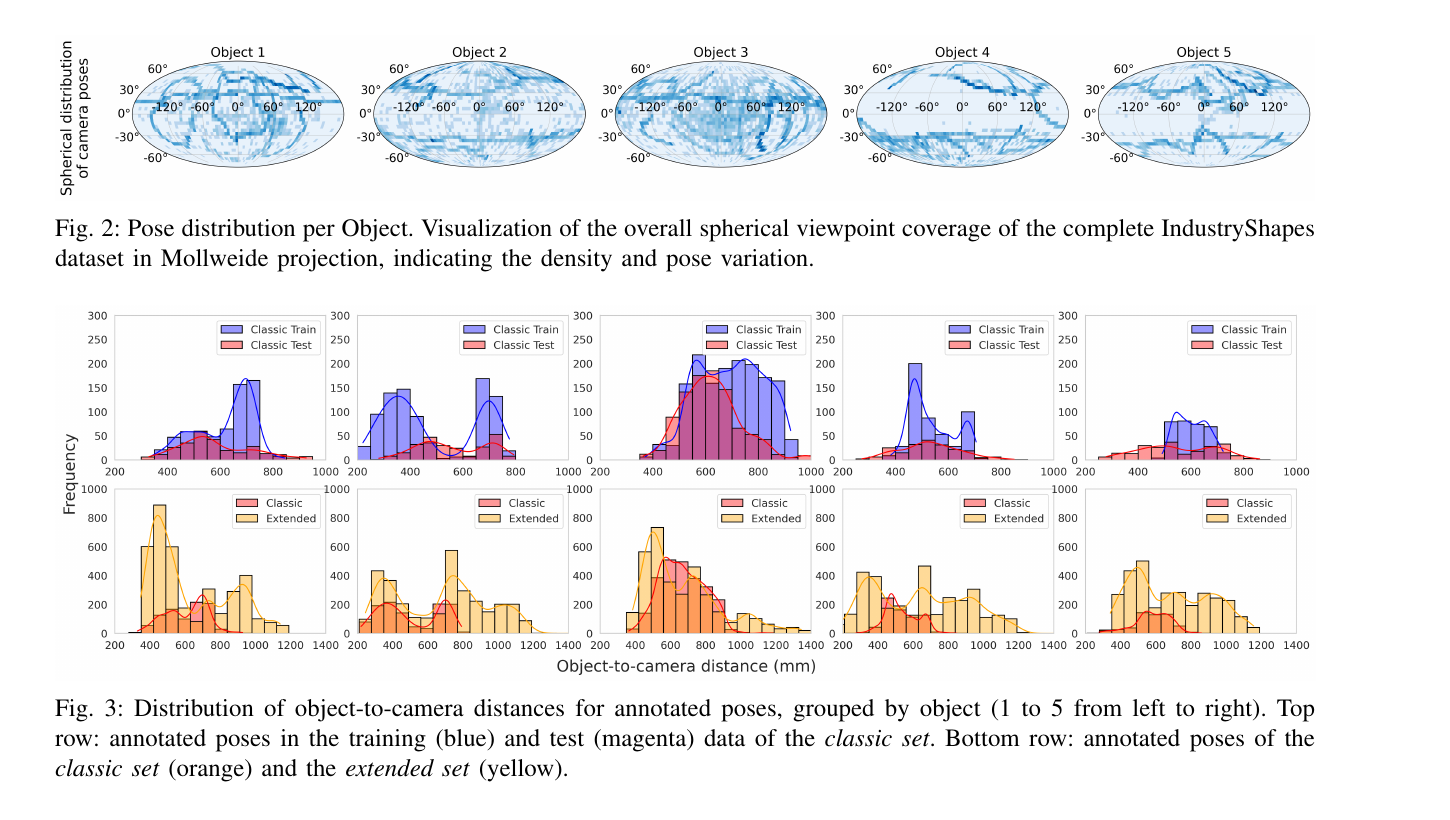
Classic uses Intel RealSense D455 at 640×480. Object–camera distances span 200–1000 mm, mostly 400–800 mm, near common assembly-line arm working distances.
Training often uses single-object / simple scenes; testing adds occlusion, multiple objects / instances, boxes, trays, and holders. This generalization test also has differing train–test gaps by object.
4. Extended set and static onboarding
Extended targets model-based and model-free novel-object estimators:
10 static RGB-D onboarding sequences, two per object;
About 650 frames per sequence, about 6.3K total;
3 test scenes, over 2K images, about 10.3K annotated instances;
One sequence places the object naturally upright; another changes the resting side or flips it to cover other surfaces. Static onboarding means a stationary object with an orbiting camera, useful for video-based reference representations such as model-free FoundationPose.
Original Tables II–III: Classic train/test, 10 onboarding sequences, and Extended test total 34 scenes and 22.4K annotations; Object 3 has the most data. Source: original paper. Image copyright belongs to the paper's authors; reproduced here for academic analysis.
Combined sets:
Group
annotations
scenes
Classic Train
3.9K
13
Classic Test
1.9K
8
Onboarding
6.3K
10
Extended Test
10.3K
3
Total
22.4K
34
Extended test has only 3 physical scenes; shared scenes with five objects and dense video produce 10.3K instances, which do not imply independent environments.
5. Pose / distance coverage
Original Figures 2–3: spherical viewpoint density per object and object–camera distances across Classic train/test and Classic/Extended. Source: original paper. Image copyright belongs to the paper's authors; reproduced here for academic analysis.
Coverage is uneven across objects and orientations, constrained by resting pose, trays, and workstation visibility. Handheld D405 gives closer and broader distances, but many frames can still follow one smooth trajectory.
Study pose-distribution generalization by spherical bins or viewpoint entropy, beyond random-frame averages.
6. 6D pose annotation
Two annotation routes:
6.1 Marker-based
Laboratory turntables and marker-compatible industrial scenes use ArUco camera poses plus object / marker calibration.
6.2 SfM + 3D anchor + PnP
Without markers:
Agisoft Metashape SfM recovers camera trajectories;
Manually choose known 3D anchors on CAD;
Software tracks their 2D image locations;
Form 2D–3D correspondences;
PnP recovers object-to-camera pose.
This reduces framewise manual effort, but depends on SfM stability in textureless industrial settings and anchor geometry.
7. Depth consistency and reporting conventions
Captured depth dc is compared with GT-pose-rendered depth dr:
δ=dc−dr.Original Table IV: Classic / Extended mean absolute depth differences are 9.3 / 10.2 mm, with standard deviations 11.6 / 5.2 mm. Source: original paper. Image copyright belongs to the paper's authors; reproduced here for academic analysis.
Split
mean signed
std
mean absolute
median absolute
Classic D455
-1.85 mm
11.6 mm
9.3 mm
7.15 mm
Extended D405
-1.01 mm
5.2 mm
10.2 mm
8.95 mm
The following prose gives absolute depth error below 12 mm for Classic and about 5 mm for Extended. Extended’s 5 mm conflicts with Table IV mean absolute 10.2 mm and appears to confuse standard deviation 5.2 mm with absolute error. This site uses labeled table values and flags the discrepancy for documentation clarification.
Depth residual also mixes pose, CAD, sensor, mask, and boundary errors rather than pure translation error.
8. Evaluation protocol
The paper uses:
ADD: mean model-point distance under predicted / GT poses;
VSD: discrepancy of visible rendered surfaces;
MSSD: symmetry-aware maximum surface distance;
MSPD: symmetry-aware maximum projection distance;
BOP AR:
AR=31(ARVSD+ARMSSD+ARMSPD).
ADD is not explicitly symmetry-aware and serves as an intuitive supplement; BOP AR better handles symmetric / near-symmetric geometry such as Object 5.
9. Baselines
Instance-level
EPOS;
DOPE;
ZebraPose.
Novel-object
FoundPose;
Model-based FoundationPose (MB, CAD supplied);
Model-free FoundationPose (MF, onboarding video).
Detection / segmentation
CNOS;
SAM6D.
The benchmark omits some contemporary methods such as Gen6D / OnePose++ due to adaptation costs, platform limitations, and per-object training time. It provides reference baselines rather than a complete leaderboard.
10. Overall pose results
Original Tables V–VI: model-based FoundationPose leads Classic / Extended; model-free performance drops substantially, with Object 5 persistently difficult. Source: original paper. Image copyright belongs to the paper's authors; reproduced here for academic analysis.
Classic
Method
ADD
MSPD
MSSD
VSD
AR
EPOS
0.64
0.54
0.56
0.41
0.51
DOPE
0.13
0.09
0.09
0.05
0.08
ZebraPose
0.61
0.54
0.55
0.40
0.50
FoundPose
0.55
0.31
0.39
0.22
0.30
FoundationPose MB
0.78
0.73
0.74
0.53
0.67
FoundationPose MF
0.44
0.26
0.31
0.18
0.25
Extended
Method
ADD
MSPD
MSSD
VSD
AR
FoundPose
0.34
0.41
0.25
0.18
0.28
FoundationPose MB
0.81
0.83
0.74
0.50
0.69
FoundationPose MF
0.48
0.40
0.37
0.22
0.33
Two clear conclusions:
CAD-based FoundationPose MB greatly exceeds static-onboarding MF; 10 videos do not yet match accurate object models.
Extended is not harder on every metric. Office distractors / occlusion coexist with different close handheld views, D405 sensing, and object presentation. Columns are not an in-distribution difficulty progression.
11. Per-object results
FoundationPose MB AR:
Split
Obj.1
Obj.2
Obj.3
Obj.4
Obj.5
Classic
0.78
0.49
0.64
0.47
0.31
Extended
0.79
0.54
0.42
0.54
0.56
Reflective, thin Object 5 is hardest on Classic. FoundPose reaches only 0.04 AR on Extended Object 5 versus FoundationPose MB 0.56, supporting accurate CAD rendering / refinement for this object.
Training conditions also confound objectwise gaps: Object 3 has 1361 extra synthetic images; some objects train with clutter and others mainly with simple backgrounds. Overall AR mixes method capability with training coverage.
12. Detection / segmentation
Paper Table VII:
Method
BBox Classic
BBox Extended
Segm Classic
Segm Extended
CNOS
0.240
0.574
0.203
0.512
SAM6D
0.270
0.527
0.345
0.453
Extended mAP is generally higher, possibly from favorable viewpoints, scales, or mask visibility despite office clutter. Do not attribute all pose failures to detection; separate GT masks, predicted masks, and full pipelines.
13. Main limitations
Only 5 objects. Useful for deep failure analysis, not broad category statistics.
Only 34 scenes. Extended test especially has only 3 physical scenes and correlated frames.
Cite explicit Table IV annotation-quality columns and explain the prose discrepancy.
15. Overall assessment
IndustryShapes combines known-instance / static-onboarding protocols, laboratory / workstation scenes, and CAD / model-free methods in one BOP-compatible package. It asks:
How much of a strong household-benchmark pose system’s capability survives reflective, thin industrial parts, single-object training to cluttered testing, or short onboarding videos?
FoundationPose MB AR 0.67 / 0.69 gives a strong reference; MF 0.25 / 0.33 and Object 5 failures show industrial novel-object pose remains unsolved.