InvariantCloud: A Globally Invariant, Uniquely Indexed Point Cloud Framework for Robust 6-DoF Tactile Pose Tracking
InvariantCloud prebuilds a global tactile mesh of 475 uniquely identified points, allowing direct per-frame matching without LK or nearest-neighbor search. Kabsch solves roll / pitch, contact-contour PCA solves yaw, and centroid / height recover translation. One-minute static translation MAE is 0.22 / 0.14 / 0.11 mm, with yaw 0.84°. It outperforms NormalFlow on weak contours such as eggs, but yaw is unobservable for perfectly spherical contact.
GelSight Mini RGB tactile streamintrinsic marker constellationcontact height map
Requirements
vision-based tactile sensor with stable markersknown-sphere indentation calibrationno-contact global marker referencecontinuous contact for frame trackingnon-circular contact silhouette for observable yaw
Full paper metadataAuthors, affiliations, research area, datasets, metrics, method tags, and reading statusExpandCollapse
Authors
Pengfei Ye, Yuxiang Ma, Yi Zhou, Wei Chen, Wenzhen Dong, Molong Duan
Affiliations
Hong Kong University of Science and Technology / Massachusetts Institute of Technology / Chinese University of Hong Kong
vision-based tactile sensor with stable markersknown-sphere indentation calibrationno-contact global marker referencecontinuous contact for frame trackingnon-circular contact silhouette for observable yaw
Reading Notes
Overview / Deep Dive
Available src/paper-notes/invariantcloud-icra2026/coarse.md
Paper overview notes
Quickly assess the paper's scope, problem setting, core method, experimental findings, and whether to read it in depth.
Authors / affiliations: Pengfei Ye, Yuxiang Ma, Yi Zhou et al.; HKUST, MIT, CUHK.
Task: track a contacted object’s sensor-relative 6D pose using GelSight Mini tactile images alone, without object CAD or external cameras, and support tactile SLAM across contacts.
2. Positioning in one sentence
InvariantCloud turns the sensor’s marker lattice into a dense 3D grid with permanent IDs. Each frame activates IDs inside the contact contour, bypassing LK / nearest-neighbor search and solving motion with Kabsch, PCA, and centroids.
3. Method overview
Press a known sphere at multiple sensor locations, train an MLP from RGB, pixel position, and marker information to surface normals, then integrate a height map with DCT Poisson integration.
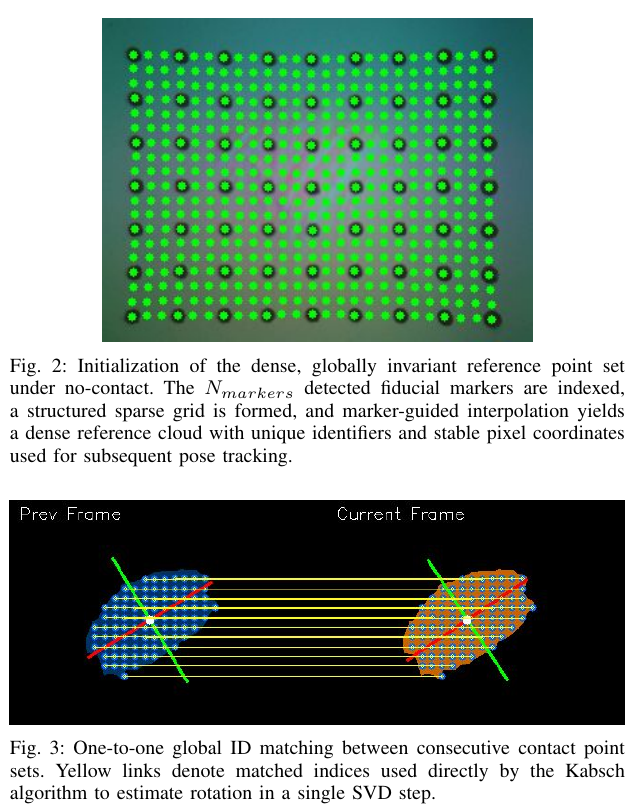
Detect undeformed markers and bilinearly interpolate a unique-ID reference grid; experiments use 19×25, totaling 475 points.
Fuse color differences and height depressions into a contact mask and select active global IDs.
Matching IDs directly give frame-to-frame 3D correspondences; one Kabsch SVD solves roll / pitch.
PCA on the contact subset’s 2D distribution recovers yaw about the sensor normal from its principal axis.
Changes in the contact region’s 3D centroid supply XYZ translation.
Original Figures 2–3: undeformed markers interpolate a dense permanent grid; IDs pair frames directly without nearest-neighbor ICP or optical-flow search. Source: InvariantCloud paper. Image copyright belongs to the paper's authors; reproduced here for academic analysis.
Accumulated MAE over one minute of stationary contact:
translation: 0.22 / 0.14 / 0.11 mm;
rotation: 0.62° / 0.69° / 0.84°.
LK+ICP gives 2.52 / 3.14 / 2.29 mm and 10.89° / 8.15° / 7.19°, with clear long-term drift.
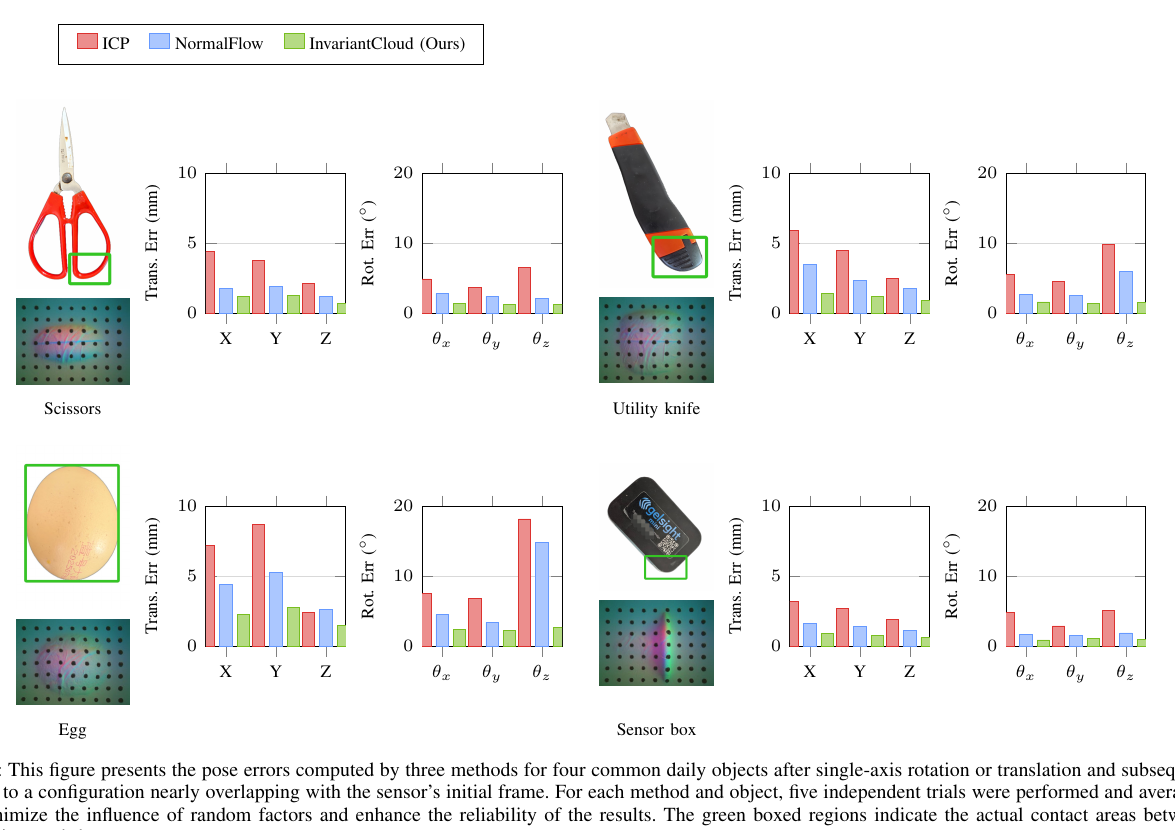
Return-pose tests use 5 trials per object / method. The full method is best overall across 6 DoFs; NormalFlow egg yaw-return error can approach 20°.
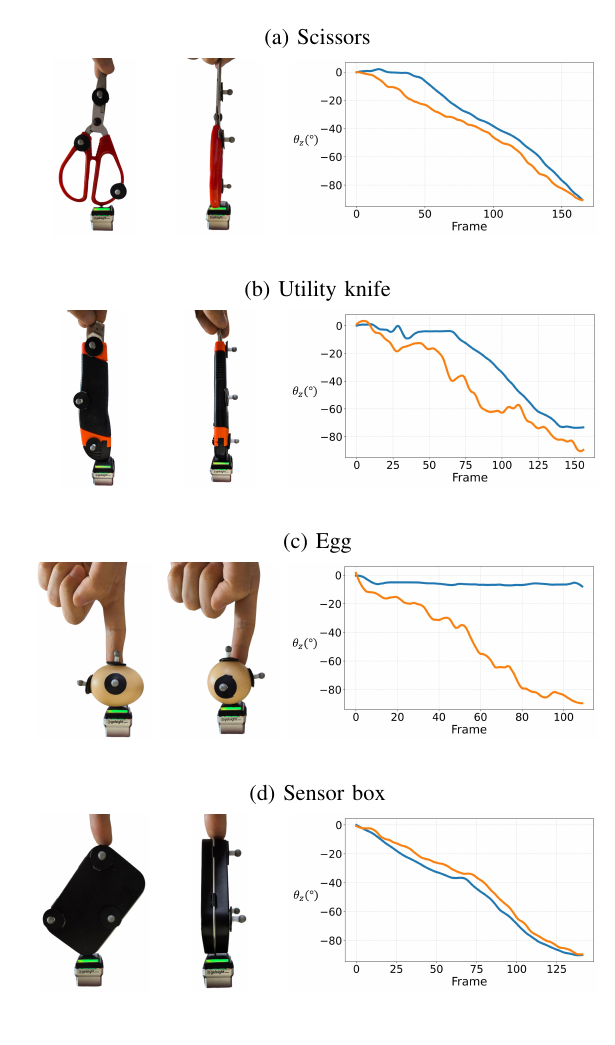
During 0→−90° yaw tracking, NormalFlow barely moves on egg contact and lags and plateaus late on utility-knife contact; InvariantCloud continues following both rotations.
Original Figure 6: five return trials per object / method. InvariantCloud (green) is best overall across DoFs; ICP (red) accumulates substantial error even while static. Source: InvariantCloud paper. Image copyright belongs to the paper's authors; reproduced here for academic analysis.
5. Quick assessment
Strengths: no object CAD, external RGB, or motion capture; global IDs remove repeated-search drift, and PCA explicitly addresses tactile yaw.
Key boundary: yaw comes from the contact contour’s principal axis, not markers rigidly rotating with the object. Perfectly spherical / circular contact makes yaw fundamentally unobservable.
Main limitations: sensor-specific stable markers, sphere-press calibration, and continuous contact; few objects / sequences, no complete runtime breakdown or public code.
Available src/paper-notes/invariantcloud-icra2026/deep.md
In-depth paper notes
Support reproduction, comparison, related-work writing, and identifying opportunities for further research.
Core problem: tactile contact patches are small, and markers shear / slip. Framewise LK / ICP mismatches accumulate drift, especially for yaw about the sensor normal.
Answer: fix a dense, uniquely indexed marker-derived cloud in sensor coordinates. Contact changes active IDs and heights; direct ID matching solves roll / pitch, contact-contour PCA gives absolute yaw, and centroids give translation.
My assessment: defining correspondence at initialization improves repeatability and weak-contour yaw. However, pose is local contact pose relative to the sensor; observability depends on contact geometry, continuity, and calibration.
2. Task boundaries
Not required:
Object CAD;
External RGB / depth cameras;
Online motion capture;
object-specific learning.
Required:
A GelSight-like visual tactile sensor with stable intrinsic markers;
Known-sphere press calibration;
An undeformed global marker reference;
Stable extractable contact contours and heights;
Continuous contact during framewise tracking.
Outputs use the sensor frame, supporting local in-gripper tracking rather than direct robot-base / world pose. Manipulation also needs sensor–gripper kinematics.
3. Height maps and global reference clouds
3.1 Sphere-press calibration
A known-diameter sphere indents the elastomer at multiple locations. Per-pixel features include:
RGB;
Normalized pixel coordinates;
Intrinsic-marker embeddings.
An MLP predicts local normal inclinations; DCT solves the Poisson equation to integrate gradients into height map H. Pixel (x,y) maps using image center and pixel-to-mm scale s to
P=((x−cx)s,(cy−y)s,h(x,y)s).
This determines Z translation and Kabsch-cloud accuracy. Objects need no training, but the sensor needs prior training / calibration: object-agnostic is not calibration-free.
3.2 Permanent IDs
Detect Nmarkers undeformed markers and sort rectangular rows / columns. Bilinear interpolation between markers creates a denser lattice; each grid location uses
g=r(n+1)+c+1
to obtain a globally unique ID. Experiments commonly use 19×25, or 475 points; cross-contact reconstruction uses 31×41.
Original Figures 2–3: dense green-lattice coordinates / IDs are defined once in the sensor frame. Contact masks select subsets whose shared IDs directly form Kabsch correspondences. Source: InvariantCloud paper. Image copyright belongs to the paper's authors; reproduced here for academic analysis.
The key is fixed identity rather than density alone. Re-covering the same sensor region restores the same ID set, so returning to the start does not inherit earlier matching errors.
4. Contact subset
Dual color-difference / height-depression thresholds followed by dilation / erosion produce contact mask Ct. Sampling it at integer lattice pixels selects active points, lifted into 3D using current heights.
The grid is sensor-fixed; object motion changes:
Which IDs lie inside the contact silhouette;
Their heights;
Contact centroid and principal axis.
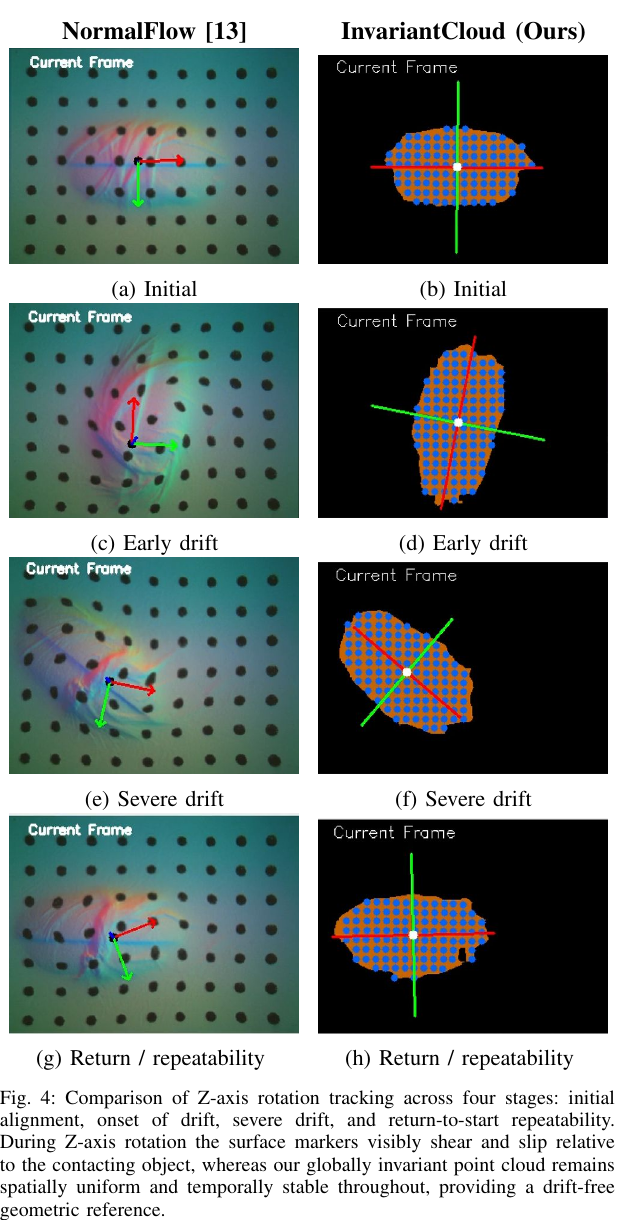
Markers may shear / slip on the elastomer. Unlike LK+ICP, local marker displacement is not the sole evidence for object yaw.
5. Decomposed 6D solving
5.1 Kabsch for roll / pitch
Common contact-cloud IDs give corresponding 3D sets {pi},{qi}. Center them and construct
H=i∑p~iq~i⊤=UΣV⊤,
then apply standard Kabsch
R⋆=Vdiag(1,1,signdet(VU⊤))U⊤
to solve the best rigid rotation.
This X / Y rotation estimate mainly uses contact height / normal changes for sensor-plane-relative roll / pitch. Yaw is separate because torsional elastomer slip breaks marker-based Z rotation registration.
5.2 PCA for yaw
For current contacting 2D global points
St={pi∈P∣Ct(pi)=1}
compute covariance Mt, take principal axis at, and define
θt=atan2(at,y,at,x).
Except for ideal circles, yaw changes the contact silhouette and active IDs. PCA therefore supplies an absolute sensor-frame direction rather than repeatedly composing small relative rotations.
Original Figure 4: marker shear / slip gradually drifts NormalFlow's local orientation. InvariantCloud recomputes yaw from the global-ID subset contour each frame and recovers the initial direction on return. Source: InvariantCloud paper. Image copyright belongs to the paper's authors; reproduced here for academic analysis.
PCA has clear geometric limits:
Circular / spherical contact has equal covariance eigenvalues and unobservable yaw;
Near-circular contours make axes highly sensitive to mask noise;
The axis has a 180° sign ambiguity; continuity needs the previous frame to select a consistent sign;
Pressure-induced patch deformation can change axes without rigid yaw.
5.3 Centroids for XYZ
Morphological closing finds the largest contact contour’s area-moment centroid; heights lift it to 3D. Centroid XY changes give planar translation and contact height gives Z.
This inexpensive nonaccumulating estimate assumes contact-centroid motion equals object translation. Rolling curved surfaces, pressure expansion, or nonrigid deformation violate that equivalence.
ICP remains for cross-contact refinement after absolute-yaw initialization rather than serving as the main per-frame solver. Globally invariant does not mean every registration step is ICP-free.
7. One-minute stationary drift
GelSight Mini runs at 320×240 and about 25 Hz. One-minute stationary contact, averaged over five sequences:
Method
Δx / Δy / Δz (mm)
Δθx / Δθy / Δθz (°)
InvariantCloud
0.22 / 0.14 / 0.11
0.62 / 0.69 / 0.84
NormalFlow
0.41 / 0.38 / 0.28
1.42 / 0.97 / 0.78
LK + ICP
2.52 / 3.14 / 2.29
10.89 / 8.15 / 7.19
The full method is not best in every cell: stationary yaw MAE 0.84° is slightly above NormalFlow 0.78°. Strengths are XYZ, roll / pitch, and dynamic / return-yaw stability, not winning all six Table I metrics.
8. Return repeatability
Four objects undergo random translations / rotations while maintaining contact, then return to high-overlap initial contours, with 5 trials per object / method.
Original Figure 6: five return tests for each of four household objects. InvariantCloud (green) has the lowest overall six-DoF error; NormalFlow egg Z-return error approaches 20°, and ICP drifts in translation / rotation. Source: InvariantCloud paper. Image copyright belongs to the paper's authors; reproduced here for academic analysis.
NormalFlow can recover yaw for distinctive scissors / box contours, but egg / knife elliptical or weakly differentiated patches are harder. Local normals and slipping markers lack absolute direction. Global IDs + silhouette PCA most convincingly help return repeatability here.
9. Dynamic yaw from 0→−90°
Three fluorescent object markers and motion capture verify approximately −90° actual rotation. The paper compares yaw curves:
Original Figure 8: both methods follow scissors / sensor-box rotation. NormalFlow nearly stalls on egg contact and lags and plateaus late on utility-knife contact, while InvariantCloud continues toward −90° in both cases. Source: InvariantCloud paper. Image copyright belongs to the paper's authors; reproduced here for academic analysis.
No per-object numeric table is given, so avoid extracting precision decimals by eye. Supported conclusions:
Distinct contours: both methods track;
Weak contours: NormalFlow’s local normals / markers are insufficient;
InvariantCloud is more stable with noncircular contact silhouettes;
Perfectly spherical contact remains unobservable, as the authors acknowledge.
10. Tactile SLAM demonstration
Repeated discrete GelSight Mini scans reconstruct a larger scissors surface without external motion capture. This demonstrates yaw initialization for cross-contact registration, but only as a single-object qualitative demo, without Chamfer distance, loop-closure error, or broad CAD comparisons.
11. Limitations and reproduction checklist
Circular / spherical yaw is unobservable; monitor PCA eigenvalue ratios near circularity.
Separately calibrate / version height MLPs, sphere data, marker ordering, and pixel-to-mm scale.
Thresholds, morphology, and pressure affect both PCA / centroids; ablate pressure strata.
A 31×41 grid improves reconstruction, but latency / noise versus grid density is not systematically reported.
Four household objects and few hand-operated trials need broader robot-controlled material / curvature / long-sequence benchmarks.
Lost / aging markers or elastomer creep can invalidate stable references; add online reference-health checks.
At this site’s review date, only a preprint was public; no official implementation repository was found.
12. Method implications
When sensors contain stable indexable structure, correspondence can be defined once in sensor coordinates and observations select active subsets. This recasts long-term matching drift as a representation problem. Observability still depends on noncircular contact geometry; fixed identity does not remove that limit.