Towards Co-Evaluation of Cameras, HDR, and Algorithms for Industrial-Grade 6DoF Pose Estimation
IPD provides 20 industrial parts, 2,300 physical scenes, 13 cameras, and over 100,000 object views. Robot Consistency evaluates MVD without millimeter-accurate manual ground truth. Synthetic validation gives an error bias of 0.13 mm versus 0.47 mm with 1 mm annotation jitter. Basler-HR is the most stable; Mertens HDR under spotlights achieves 3.061 mm MVD / 0.77 recall.
IPD jointly benchmarks resolution / baseline, RGB-D / polarization, four exposures, HDR, and three lighting conditions. Robot cross-view consistency replaces insufficiently precise manual pose truth, targeting millimeter-level 6DoF evaluation at 150–200 cm.
3. Guide to figures and tables
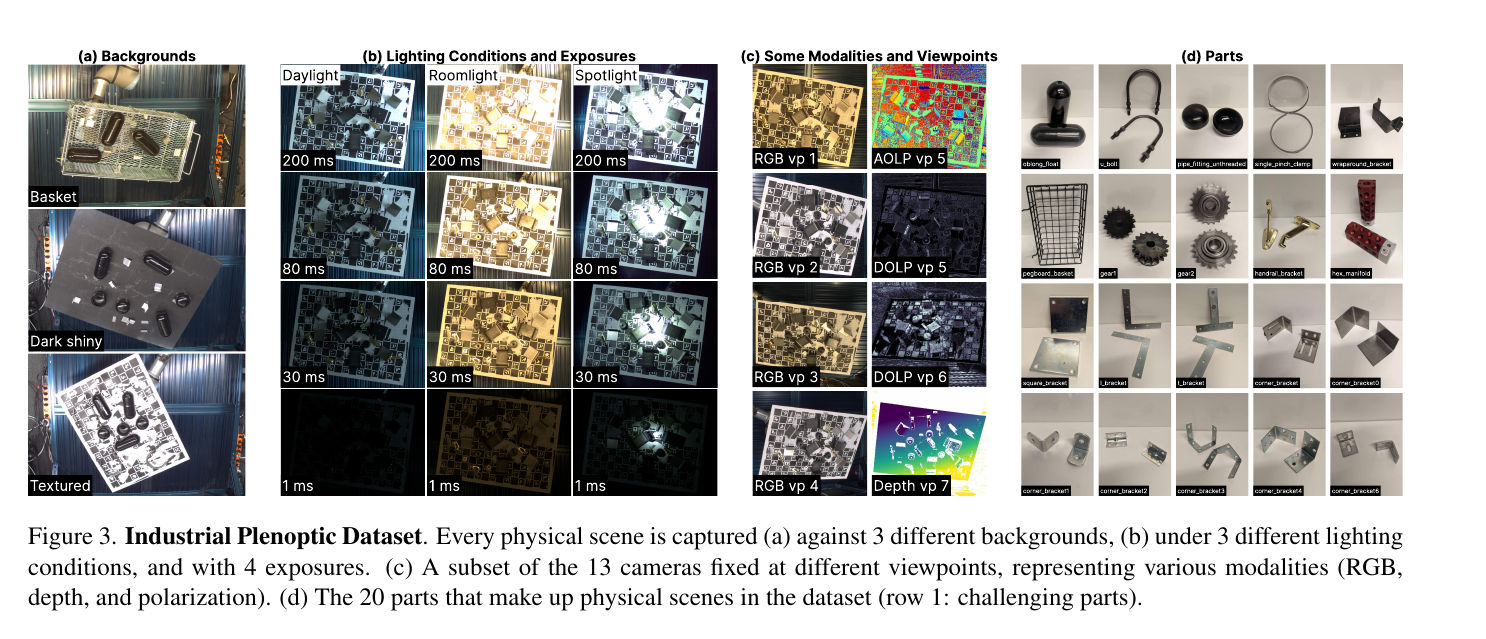
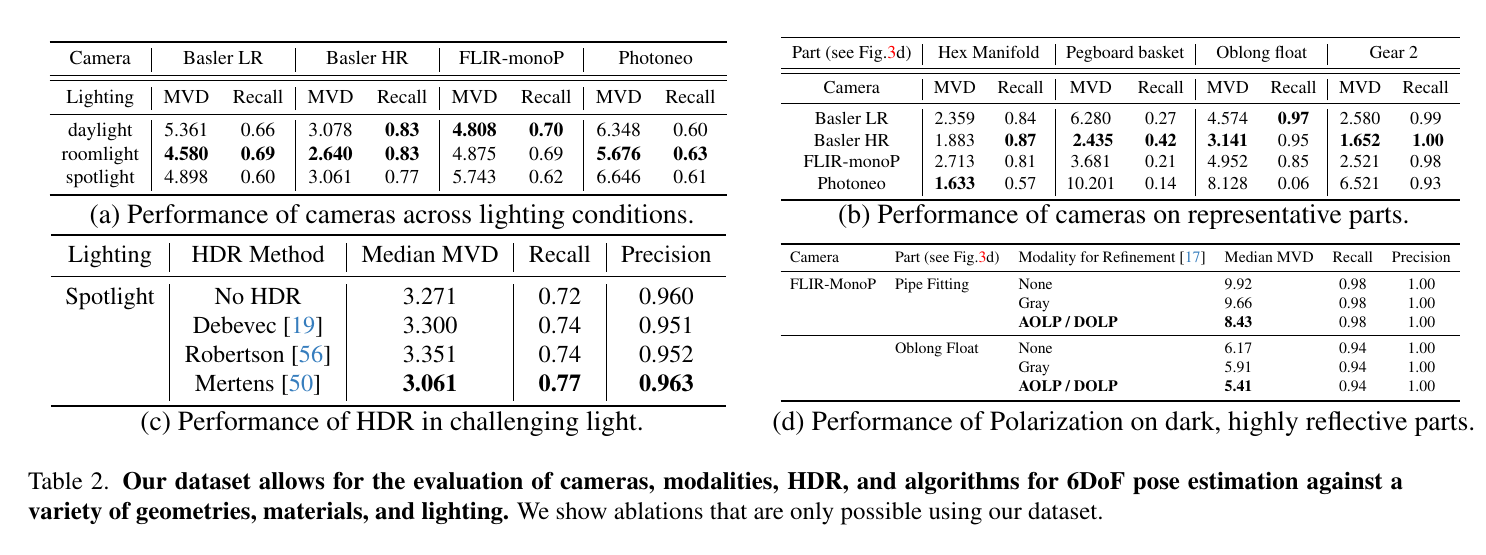
Original Figure 3: physical scenes span 3 backgrounds, 3 lighting conditions, 4 exposures, and RGB / depth / polarization from 13 cameras, with 20 industrial parts. Source: official CVPR 2024 paper. Image copyright belongs to the paper's authors and IEEE/CVF; reproduced here for paper analysis.Original Table 2: Basler-HR is most stable overall across lighting. Mertens HDR gives spotlight MVD 3.061 mm / recall 0.77; polarization-edge refinement helps dark reflective objects. Source: official CVPR 2024 paper. Table copyright belongs to the paper's authors and IEEE/CVF; reproduced here for paper analysis.
4. Dataset scale
20 industrial parts;
2,300 physical scenes;
About 30,000 frames and over 100,000 object views;
Roomlight, spotlight, daylight; spotlight dynamic range about 100–100,000 lux.
5. Robot Consistency
Objects are rigidly attached to a calibrated UR5e end effector and moved through 30 poses. Hand–eye calibration / kinematics map camera predictions into gripper coordinates, where the object transform should stay fixed.
Multiple predictions first estimate the constant object-to-gripper transform, then dispersion around that consensus estimates error. Under diverse views, independent predictions, and appropriate error assumptions, the authors show convergence with more samples and better ranking of precise models than manual labels with 1–3 mm noise.
Evaluation uses Maximum Vertex Distance:
MVD=vk∈Vmax∥Tpredvk−Trefvk∥2,
Worst-point deviation better matches assembly such as peg-in-hole than mean ADD.
6. Experiments at a glance
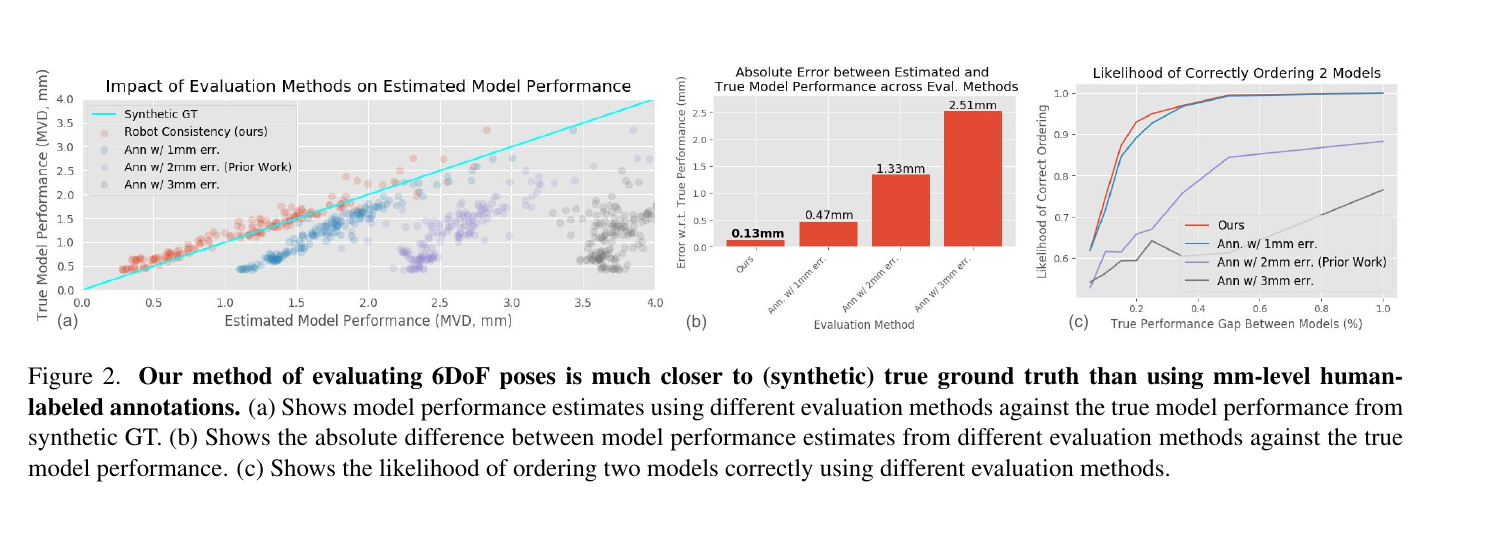
Synthetic validation: mean absolute gap from true error 0.13 mm for Robot Consistency versus 0.47 mm for 1 mm jittered labels.
Spotlight without HDR: 3.271 mm / recall 0.72; Mertens: 3.061 mm / recall 0.77.
Pipe-fitting MVD: no refinement 9.92, gray edges 9.66, AOLP/DOLP 8.43 mm.
Oblong float: 6.17 → 5.91 → 5.41 mm.
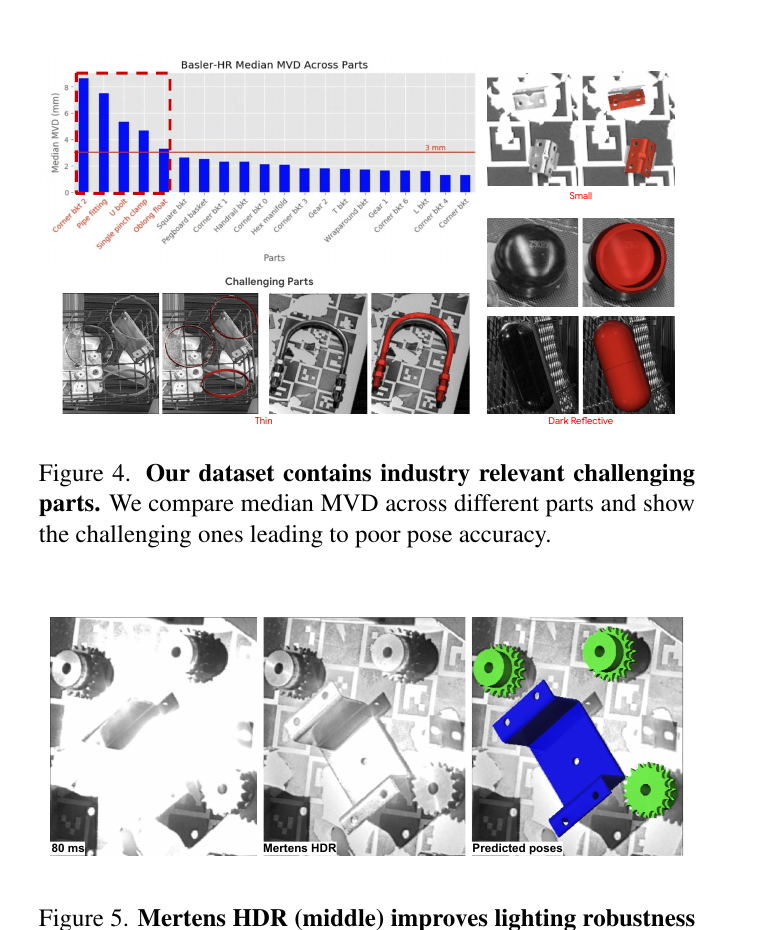
Thin, small, and dark reflective parts are hardest.
7. Quick assessment
Highlight: jointly compares cameras, exposure fusion, polarization, and pose algorithms on the same physical scene.
Strongest contribution: addresses evaluating millimeter-level algorithms when truth itself has millimeter error.
Interpretation boundary: not a new general backbone; experiments use Mask R-CNN + keypoints + multiview PnP / ICP and edge refinement.
Limitations: consistency cannot exclude all systematic bias. Theory depends on view distributions, calibration, and error assumptions; scenes have moderate clutter rather than dense bin-picking.
Intended readers: industrial 6DoF, camera / lighting design, HDR, polarization, millimeter benchmarks, and robot calibration.
Available src/paper-notes/ipd-cvpr2024/deep.md
In-depth paper notes
Support reproduction, comparison, related-work writing, and identifying opportunities for further research.
Paper Reading Notes (Deep): Industrial Plenoptic Dataset
1. Key assessment
Conventional benchmarks use 10%-diameter thresholds at 50–100 cm. Assembly may need less than 3 mm maximum deviation at 99% recall over 150–200 cm. Ground truth with 2–5 mm error cannot reliably distinguish submillimeter algorithms.
The solution has two parts:
Co-evaluation data with shared scenes, 13 multimodal cameras, 4 exposures, and 3 lighting conditions;
Robot Consistency estimates prediction error across robot poses, reducing dependence on manual GT precision.
IPD is therefore a vision-system design platform beyond single-model training.
2. Why ADD is insufficient
ADD averages distances over mesh vertices:
ADD(Tp,Tg)=∣V∣1v∈V∑∥Tpv−Tgv∥2.
Averages depend on sampling and can hide worst-point deviation, crucial for assembly tolerances. The paper uses:
MVD(Tp,Tg)=v∈Vmax∥Tpv−Tgv∥2.
MVD upper-bounds ADD. Experimental true positives still use 10 mm + 10°, while the goal is 3 mm / 99% recall; current tables do not establish that final industrial requirement.
3. Robot Consistency derivation
Let camera, robot base, gripper, and object frames be C, R, G, O. Hand–eye transform TCR and robot pose TRGi are known; the network predicts TCOi,pred.
Map each prediction into gripper coordinates:
T^GOi=TGRiTRCTCOi,pred.
Rigid attachment makes all T^GOi estimates share one constant. Estimate its Fréchet mean:
TGO⋆=argμ∈SE(3)mini=1∑Nρ2(μ,T^GOi),
Translation uses the sample mean and rotation quaternion averaging. Project TGO⋆ back into each camera observation and compute MVD:
Erc=N1i∑d(TCOi,pred,TCRTRGiTGO⋆).
Estimating TGO⋆ consumes degrees of freedom and creates finite-sample bias. Under independent, unbiased, and mild conditions, translation / rotation estimates are consistent at rate N−1/2. Uniform spherical views can also cancel some camera-frame-correlated bias.
4. Synthetic validation
Original Figure 2: estimated versus true errors, absolute gaps, and probability of correctly ranking two models. Robot Consistency better approximates high-accuracy truth than labels with 1–3 mm jitter. Source: official CVPR 2024 paper. Image copyright belongs to the paper's authors and IEEE/CVF; reproduced here for paper analysis.
Synthetic data uses 20 physical-scene analogues, 10 instances per scene, 30 viewpoints, and 4 cameras at 5MP. The authors train 24 keypoint models with varied backbones / convergence and compare:
Ground truth;
Robot Consistency;
Manual-style labels with 1 / 2 / 3 mm MVD jitter.
Mean absolute gap to true error is 0.13 mm for Robot Consistency versus 0.47 mm for 1 mm jittered labels. Label noise increasingly overestimates error as models improve, harming precise-model ranking.
This is synthetic validation, not real IPD ground-truth accuracy of 0.13 mm. Robot / hand–eye calibration, thermal drift, and deformation add real error sources.
5. Capture system
Original Figure 3: backgrounds, lighting / exposure, camera modalities / viewpoints, and 20 parts. Physical scenes repeat the same robot trajectory for controlled comparison. Source: official CVPR 2024 paper. Image copyright belongs to the paper's authors and IEEE/CVF; reproduced here for paper analysis.
1× Photoneo, 2064×1544 RGB-D, about 500 μm depth accuracy at 2 m.
Camera baselines span 10 cm–1 m. Kinematically calibrated UR5e relative accuracy is below 100 μm. Each scene uses 30 robot configurations, pitch / roll up to 30°, yaw over 360°, and workspace about 1 m × 1 m × 0.5 m.
Lighting and exposure
1 / 30 / 80 / 200 ms;
Roomlight about 1,000–2,000 lux;
Spotlight spans about 100 lux dark regions to 100,000 lux bright regions;
Original Table 2: four subtables control other variables to compare lighting×camera, part×camera, HDR algorithms, and polarization refinement. Source: official CVPR 2024 paper. Table copyright belongs to the paper's authors and IEEE/CVF; reproduced here for paper analysis.
Camera × lighting
Camera
Daylight MVD / R
Roomlight MVD / R
Spotlight MVD / R
Basler-LR
5.361 / .66
4.580 / .69
4.898 / .60
Basler-HR
3.078 / .83
2.640 / .83
3.061 / .77
FLIR-MonoP
4.808 / .70
4.875 / .69
5.743 / .62
Photoneo
6.348 / .60
5.676 / .63
6.646 / .61
Photoneo is not always best: spotlight red / near-infrared interferes with structured light, while dark reflective parts may return little laser signal. High-resolution multiview RGB is most stable overall.
HDR
spotlight + Basler-HR:
Method
Median MVD
Recall
Precision
No HDR
3.271
.72
.960
Debevec
3.300
.74
.951
Robertson
3.351
.74
.952
Mertens
3.061
.77
.963
HDR is not universally better: Debevec / Robertson MVD is slightly worse than no HDR; only Mertens improves MVD, recall, and precision together.
Polarization
For dark reflective objects:
Pipe fitting: no refinement 9.92, gray 9.66, AOLP/DOLP 8.43 mm;
Oblong float: 6.17, 5.91, 5.41 mm.
Angle / degree of linear polarization mainly improves dark-background edge contrast, not direct pose output.
7. Hardest parts
Original Figures 4–5: Basler-HR MVD rankings identify thin, small, dark reflective parts as hardest; exposure fusion below preserves dark / bright detail and improves pose. Source: official CVPR 2024 paper. Image copyright belongs to the paper's authors and IEEE/CVF; reproduced here for paper analysis.
Dark reflective parts: poor RGB dynamic range and structured-light return;
Spotlight: over- and underexposure on the same object;
Weak geometry: symmetry or insufficient keypoint discrimination.
Industrial errors should be stratified by sensor × material × geometry × lighting, beyond algorithm averages.
8. Experimental pose pipeline
Shared main-experiment components:
Mask R-CNN detection;
HRNet-style 2D keypoint heatmap;
Multiview RGB reprojection minimization / PnP;
Structured-light point registration / ICP;
Optional grayscale or AOLP/DOLP edge refinement;
NVISII / BlenderProc-style synthetic training.
Table 2 is controlled system ablation, not a latest-backbone contest. Researchers can replace algorithms while preserving cameras, scenes, and lighting.
9. Limitations and usage
Robot Consistency cannot detect every shared bias; consistently shifted predictions can still be inaccurate.
Independent / unbiased or specific camera-frame-bias assumptions may fail for correlated network errors.
High-quality robot kinematics and hand–eye calibration remain essential.
Semi-automatic annotations still group instance correspondences; the protocol is not annotation-free.
Moderate clutter does not cover heavily occluded multi-instance bins.
20 parts and one workstation limit material / robot / factory diversity.
Current 10 mm / 10° true positives remain above the 3 mm / 99% recall goal.
The costly rig should be subsetted for single-camera deployment rather than copied wholesale.
10. Overall assessment
IPD’s main contribution is controlled experimental design across camera, baseline, resolution, depth, polarization, exposure fusion, and algorithms in one physical scene. Robot Consistency offers a practical route when GT is insufficiently precise.
It does not establish industrial 6DoF at 3 mm / 99% recall. Spotlight, thin, small, and dark reflective failures motivate system co-design and conditional error analysis beyond another global mean.