KV-Tracker: Real-Time Pose Tracking with Transformers
KV-Tracker caches global information from a multiview visual geometry Transformer as a key–value scene representation, supporting online object-pose and geometry updates in monocular video while reducing repeated global computation and long-term drift.
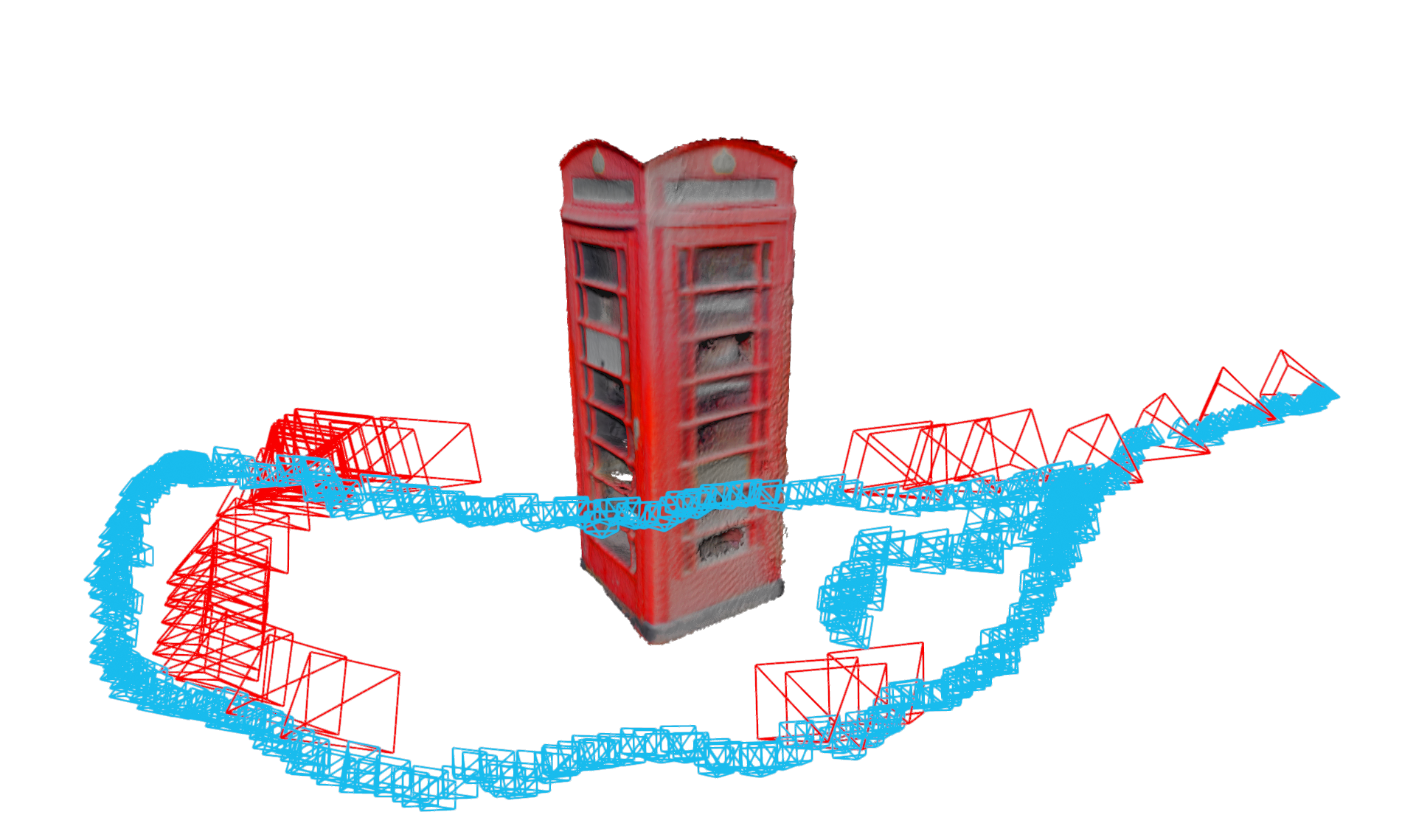
KV-Tracker maps a set of keyframes with a multi-view Transformer, then caches global-attention key-value pairs as static scene memory for single-frame online tracking, reaching about 27 FPS without retraining.
2.1 Guide to the paper’s figures and tables
Figure / table
Purpose
Overview reading tips
Figure 1
Telephone-booth keyframe mapping and real-time tracking
See how cached representations support online object tracking
Figure 2
Two-stage mapping / tracking system
Understand the read-only KV cache, which ordinary new frames do not modify
Figures 3 / 4
Scene-level and object-level results
Compare the difficulty of camera and object pose tracking
Tables 1 / 2
TUM, 7-Scenes, Arctic, and OnePose results
Examine speed–accuracy trade-offs
Relevant region of the original paper figure: red frustums are mapping keyframes; blue frustums are tracking frames processed at about 27 FPS. Sources: Project page / CVF Open Access. Image copyright belongs to the paper's authors and publisher; reproduced here for academic analysis.
3. Problem setting
Takes monocular RGB video without depth, CAD, or object priors.
Mapping selects keyframes and builds an object / scene representation; tracking outputs the camera or object pose for the latest frame.
Supports scene-level camera tracking and the harder task of on-the-fly object tracking / reconstruction.
4. Method overview
Process keyframes with a multi-view network such as π³ to obtain point maps and global-attention KV pairs.
Use the KV cache as the sole scene representation of observation history.
Apply cross-attention from each new frame to the cache, avoiding repeated global attention among all keyframes.
Select new keyframes by an angular threshold and periodically update mapping, while keeping ordinary tracking frames from modifying the cache.
5. Experimental overview
Datasets: TUM RGB-D, 7-Scenes, Arctic, OnePose.
Tracking reaches about 27 FPS, with overall system rates approaching 30 FPS; caching gives up to about 15× speedup over recomputing keys / values.
Results emphasize long-term consistency, low drift, and online reconstruction in addition to single-frame pose accuracy.
6. Quick assessment
Value: a practical engineering approach for turning offline multi-view foundation models into online pose trackers.
Strengths: clear cache semantics, model-agnostic design, and no fine-tuning.
Limitations: cache memory grows with keyframes; severe occlusion and fast object motion still require denser keyframes.
Intended readers: researchers interested in real-time tracking, Transformer KV caches, object SLAM, and RGB-only pose.
Available src/paper-notes/kv-tracker/deep.md
In-depth paper notes
Support reproduction, comparison, related-work writing, and identifying opportunities for further research.
Paper Reading Notes (Deep): KV-Tracker: Real-Time Pose Tracking with Transformers
Key assessment: KV-Tracker uses intermediate global-attention states from a multi-view network as scene memory, avoiding N² global interactions on every incoming frame.
2. Positioning in one sentence
Offline-style mapping of keyframes produces a frozen KV cache. Online query frames use cache cross-attention for object / scene pose tracking at nearly linear cost.
2.1 Guide to the paper’s figures and tables
Figure / table
Deep-dive questions
Figure 2
What are the mapping / tracking inputs, outputs, and cache lifecycle?
Figure 3
Why is object-level tracking harder than camera tracking?
Table 1
Are accuracy and FPS consistent across scene benchmarks?
Keyframe ablation
What is the trade-off among keyframe count, angular threshold, and memory?
Failure cases
Do mapping errors, occlusion, or long-term revisits cause drift?
Relevant region of the original paper figure: KV-Tracker maps keyframes and tracks online frames through the cached representation. Sources: Project page / CVF Open Access. Image copyright belongs to the paper's authors and publisher; reproduced here for academic analysis.
3. Problem setting and task boundaries
With N input frames, global attention in a multi-view Transformer scales quadratically with token count; recomputing it after every new video frame quickly becomes impractical.
Mapping retains the keys / values of a keyframe set; tracking queries them with the current frame.
Tracking frames do not modify the cache, avoiding catastrophic forgetting or representation drift caused by erroneous observations.
Object mode reconstructs objects online from video scans and tracks relative poses without depth, CAD, or object priors.
4. Research context
Multi-view models such as DUSt3R / MASt3R / VGGT / π³ contain strong geometry priors but are naturally better suited to offline batches.
CUT3R and StreamingVGGT learn state updates for streaming inputs. KV-Tracker instead caches an existing model’s attention states without retraining.
This resembles SLAM keyframe memory, but the memory is a foundation-model KV representation rather than a handcrafted map.
5. Research motivation
Multi-view global observations help with revisits and loop closure, whereas simple recurrent states can drift.
Rerunning all keyframes is computationally valid but slow; retaining only recent frames loses global structure.
Global-attention keys / values already encode past observations and can be cached at intermediate layers.
Keyframe selection controls coverage and memory growth; its angular threshold directly trades accuracy against efficiency.
6. Method details
6.1 Mapping
Automatically select keyframes from the RGB stream according to viewpoint changes.
Run the full multi-view network over the keyframe buffer to predict camera poses, local point maps, and confidence.
Cache K/V pairs from every global self-attention block as the global context of the scene / object.
6.2 Tracking
Encode each new frame into tokens and apply cross-attention from its query tokens to cached keys / values.
Disable unnecessary point-map / confidence decoding heads and output only the camera / object pose needed for real-time tracking.
Do not write ordinary tracking frames back to the cache; remap and update memory only when the keyframe criterion is met.
6.3 Object tracking
In object mode, use a segmentation mask to select an object crop and track camera / object pose relative to the object map.
Fewer than about 50–60 keyframes often provide adequate geometric coverage of a scanned object, though scene scale and viewpoint changes affect the requirement.
7. Experimental analysis
7.1 Data and Metrics
Scene level: TUM RGB-D, 7-Scenes, Arctic; object level: OnePose and related data.
Evaluate camera / object trajectories, pose accuracy, tracking drift, and runtime.
The paper reports about 27 FPS tracking on an RTX 4090, with overall high frame rates approaching 30 FPS.
7.2 Interpreting the Results
Caching gives up to about 15× speedup over recomputing known keys / values for each new frame.
The cache supports relocalization when the camera returns to earlier viewpoints, reducing drift relative to purely local recurrent states.
Object tracking is harder because objects can move and rotate quickly relative to the camera while exposing less surface. The paper still demonstrates on-the-fly reconstruction without CAD or depth.
7.3 Engineering Trade-offs
Too few keyframes: insufficient global coverage causes failures under occlusion or revisits.
Too many keyframes: cache memory grows linearly, and cross-attention and decoding slow down.
Threshold-based insertion automatically trades coverage against memory, but different scenes may need different thresholds.
8. Critical analysis
Strengths: reuse intermediate representations of existing multi-view foundation models without model changes, training, or new data.
Limitation: the cache is not an explicitly optimizable map; mapping errors may persist through later tracking.
Novel-object pose boundary: avoiding CAD and depth is valuable, but object identity / masks still require frontend segmentation or user input.
Long-term operation: memory growth, dynamic changes, and new objects require cache eviction / multiple-map strategies.
9. Implications for my research
Object pose pipelines can cache correspondence features, Gaussian features, or foundation tokens instead of rebuilding each frame.
Read-only tracking memory with controlled keyframe updates can use uncertainty triggers, adding keyframes only when uncertain.
For multiple objects, maintain separate KV caches while sharing backbone computation.
10. Open questions
How can the cache handle dynamic objects and scene changes without drift?
How can KV representations directly yield calibrated pose covariance?
How can key / value compression preserve long-term relocalization on embedded hardware?
11. Deep Reading Supplement: Speed–Map-Quality Trade-off
11.1 Mechanism
KV-Tracker builds on multi-view reconstruction networks with global self-attention, such as π³. Mapping produces point maps and global-attention K/V from keyframes; new tracking frames cross-attend to the cache instead of recomputing global attention over all history. Azimuth / elevation change thresholds control keyframes, at about 10° in the current protocol. Ordinary tracking frames do not write to the cache, keeping memory semantics more stable.
11.2 Exact Camera-Tracking Results
Mean TUM RGB-D ATE RMSE is 0.331 m for Point3R, 0.272 m for CUT3R, 0.132 m for TTT3R, 0.095 m for DPVO, and 0.098 m for KV-Tracker. KV-Tracker wins 6 of 8 scenes; on teddy, its 0.057 m compares with TTT3R’s 0.214 m. On 7-Scenes, averages are 0.439 for Point3R, 0.205 for CUT3R, 0.143 for TTT3R, and 0.059 m for KV-Tracker, which wins 7/7 scenes.
KV-Tracker tracks at about 27 FPS, up to about 15× faster than recomputing attention each time. Table 3 compares mean FPS: Point3R 5, CUT3R 17, TTT3R 17, Ours 27.
11.3 Object-Tracking Boundaries
On OnePose, Ours@518 + 2D bbox achieves recall of 5.3 / 69.3 / 92.9 at 1cm/1°, 3cm/3°, and 5cm/5°, with 16 FPS; OnePose++ achieves 51.1 / 80.8 / 87.7 at 11 FPS. On OnePose Low Texture, the same configuration reaches 12.1 / 80.0 / 94.4. This does not establish complete superiority to offline maps: strict 1cm / 1° performance still lags substantially, while coarse tracking is faster and requires no complete reconstruction beforehand.
11.4 Author Claims and My Analysis
Authors’ claims
My assessment
KV caching enables real-time foundation models
Supported by 27 FPS and the attention ablation, but cache memory grows with keyframe count.
Coarse recall at 5cm / 5° approaches or exceeds the baseline, but stricter thresholds reveal coverage and initialization limitations.
12. Reproduction and Extensions
Record keyframe thresholds, cache token count, input resolution, mask sources, object-level / scene-level modes, and fallback mechanisms. Useful extensions include cache eviction, object-change detection, KV compression, and uncertainty-triggered keyframes. Multiple objects can have independent caches with a shared image backbone.