L4D-Track: Language-to-4D Modeling Towards 6-DoF Tracking and Shape Reconstruction in 3D Point Cloud Stream
L4D-Track combines pairwise implicit 3D pose / shape fields with multilayer language alignment to causally track 6-DoF motion and reconstruct objects from point cloud streams. NOCS-REAL275 IoU75 / 5°5cm is 76.0 / 56.2; cross-domain YCB-Video without fine-tuning yields mean ADD / ADD-S of 80.4 / 86.1. NOCS / YCB speeds are 20.45 / 19.28 FPS, but the tracking protocol requires first-frame ground-truth pose and size.
segmented point-cloud streamper-frame object masksvideo-, scene- and object-level language captions
Requirements
ground-truth pose and size in the first tracking frameobject segmentation masksNOCS-REAL275 training categorieslanguage captions generated with GPT assistance2,048-point shape prior
Full paper metadataAuthors, affiliations, research area, datasets, metrics, method tags, and reading statusExpandCollapse
ground-truth pose and size in the first tracking frameobject segmentation masksNOCS-REAL275 training categorieslanguage captions generated with GPT assistance2,048-point shape prior
Reading Notes
Overview / Deep Dive
Available src/paper-notes/l4d-track-cvpr2024/coarse.md
Paper overview notes
Quickly assess the paper's scope, problem setting, core method, experimental findings, and whether to read it in depth.
Paper Reading Notes (Coarse): L4D-Track
1. Basic information
Title: L4D-Track: Language-to-4D Modeling Towards 6-DoF Tracking and Shape Reconstruction in 3D Point Cloud Stream
L4D-Track constructs pairwise 4D representations from adjacent segmented point-cloud frames, tracks relative SE(3) with energy-based pose hypotheses, reconstructs shape with neural pose-aligned fields, and uses video–scene–object language alignment to transfer a model trained on six NOCS categories to novel YCB-Video categories without fine-tuning.
3. Guide to figures and tables
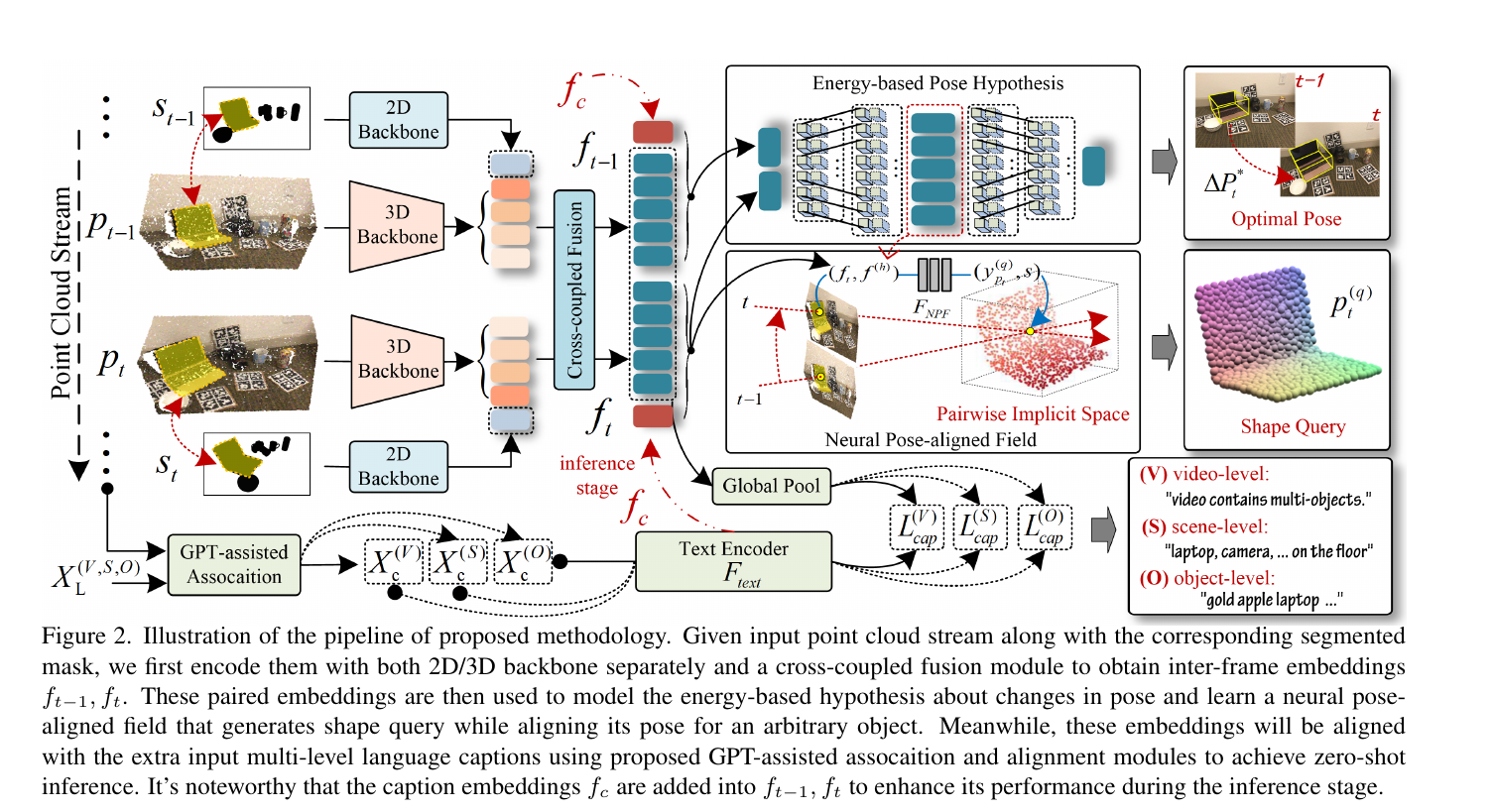
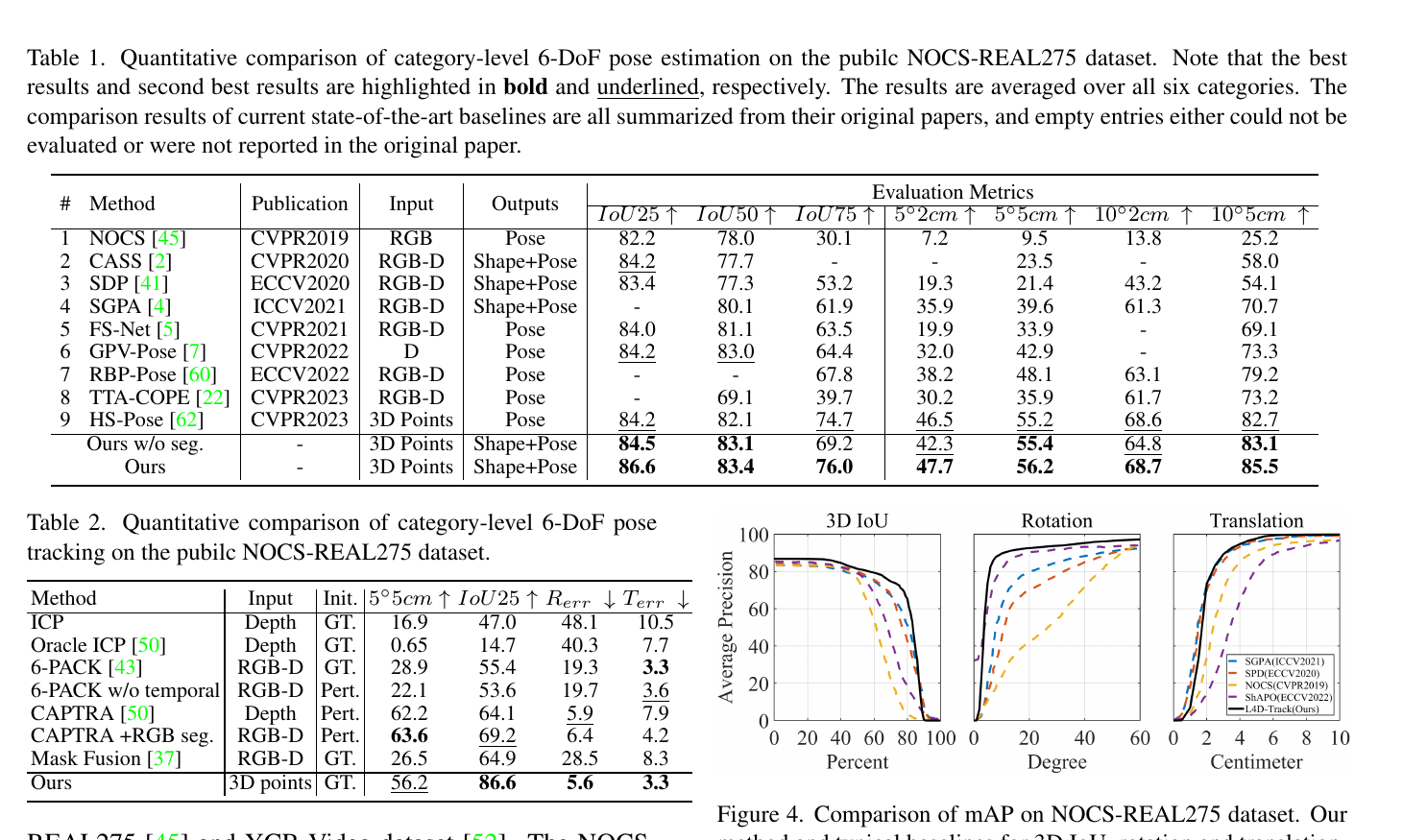
Original Figure 2: 2D masks and 3D points pass through two backbones and cross-coupled fusion to represent adjacent frames. The upper branch selects pose hypotheses with an energy model; the lower branch queries shape through a pose-aligned field. Language captions support training alignment and test-time feature enhancement. Source: CVPR 2024 official paper. Image copyright belongs to the paper's authors and IEEE/CVF; reproduced here for academic analysis.Original Tables 1–2 and Figure 4: on NOCS-REAL275, the full model reaches IoU75 76.0, 5°2cm 47.7, and 5°5cm 56.2. Tracking initialized with first-frame ground truth reaches 5°5cm 56.2, rotation error 5.6°, and translation error 3.3 cm. Source: CVPR 2024 official paper. Table copyright belongs to the paper's authors and IEEE/CVF; reproduced here for academic analysis.
4. Problem setting
Inputs: consecutive point-cloud frames, per-frame object segmentation masks, and language instructions / captions.
Initialization: the tracking protocol provides ground-truth pose and size in the first frame.
Outputs: per-frame 6DoF pose and the complete 3D shape corresponding to the current observation.
Training: only the six NOCS-REAL275 categories.
Testing: same-domain category-level tracking, plus transfer to 21 YCB-Video objects without fine-tuning.
5. Method overview
PointNet encodes point clouds; a 2D backbone encodes masks, and 2D features are back-projected into 3D.
Cross-coupled fusion corrects drift using feature differences between adjacent frames.
Learn conditional energies for 5×10⁴ relative pose hypotheses, select inter-frame ΔPt, and recursively update Pt=ΔPtPt−1.
Neural Pose-aligned Fields query SDF / surfaces in shape-prior coordinates, reconstructing shape while estimating pose.
LLaMA, GloVe, and GPT-4 help construct video-, scene-, and object-level instruction-caption pairs.
Apply three-level contrastive alignment between caption embeddings and pairwise 3D features; inject caption embeddings into tracking representations at test time.
Without the segmentation head: IoU75 69.2 and 5°2cm 42.3, showing a substantial mask-branch contribution.
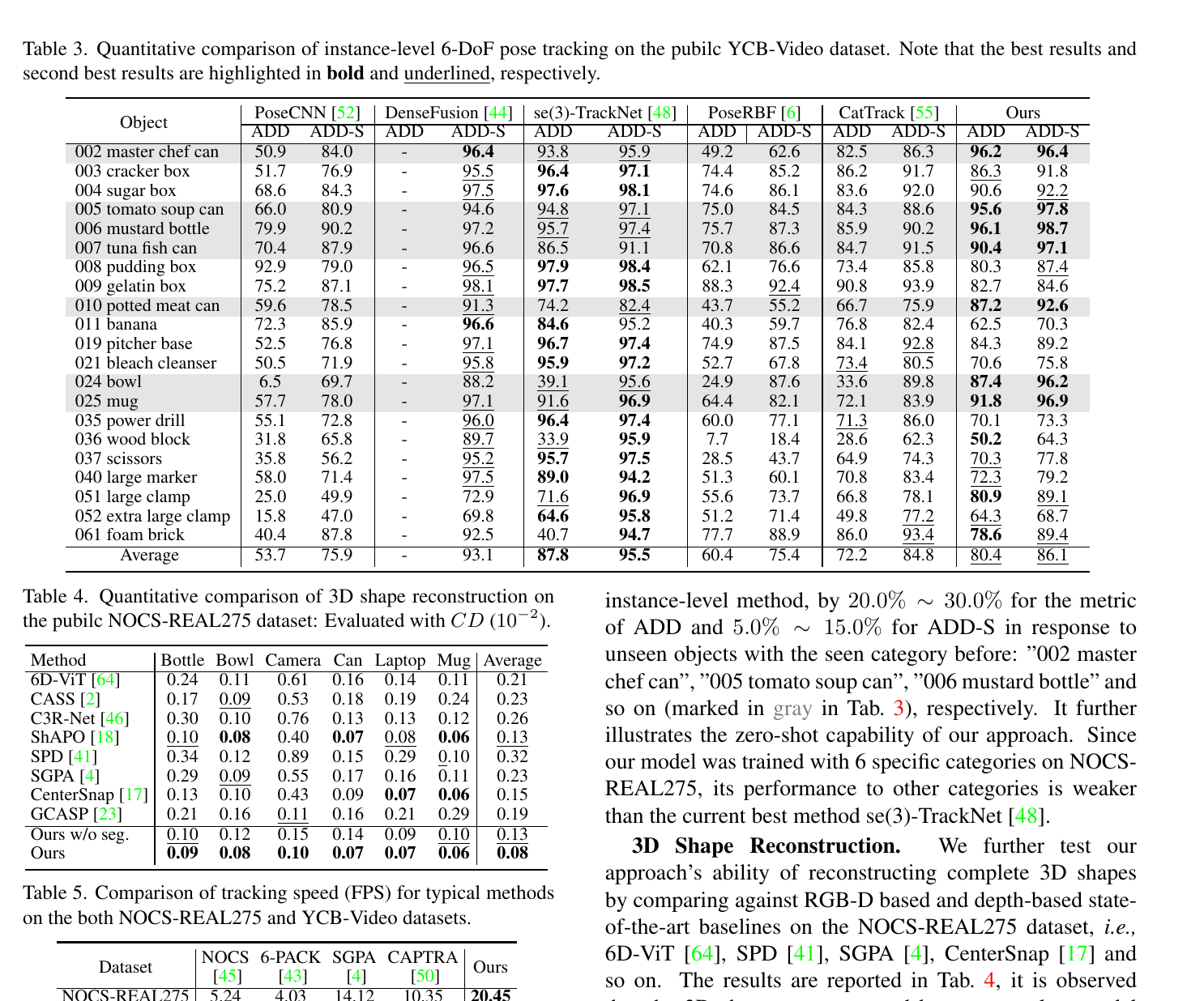
YCB-Video zero-shot mean ADD / ADD-S: 80.4 / 86.1, versus 87.8 / 95.5 for se(3)-TrackNet.
Mean NOCS shape-reconstruction CD (10−2): 0.08, versus 0.13 for both ShAPO and the variant without segmentation.
Speed: 20.45 FPS on NOCS and 19.28 FPS on YCB-Video, measured on the same A6000.
7. Quick assessment
Highlight: combines pose tracking, shape completion, and language-based category transfer in one causal point-cloud-stream system.
Strongest evidence: training sees only six NOCS categories, yet reaches 80.4 / 86.1 ADD(S) on YCB-Video without fine-tuning, supporting cross-category transfer.
Caution: zero-shot does not mean tracking without prompts or initialization. Object masks, first-frame GT pose / size, and language captions are still required.
Limitations: mean YCB results trail the dedicated se(3)-TrackNet. Training captions are constructed semi-automatically with GPT-4, and stronger controls against simpler category-text priors are needed.
Available src/paper-notes/l4d-track-cvpr2024/deep.md
In-depth paper notes
Support reproduction, comparison, related-work writing, and identifying opportunities for further research.
Paper Reading Notes (Deep): L4D-Track
1. Key assessment
L4D-Track addresses an online robotic-perception question: given consecutive point clouds of a segmented object, can a causal, real-time system maintain both pose and shape and transfer to categories unseen in training through language semantics?
The technical core has three layers:
Temporal geometry: pairwise representations of adjacent frames;
Semantics: contrastive alignment of three-level captions with 3D video representations.
Cross-dataset experiments provide the strongest evidence, but zero-shot must be read with its protocol: first-frame pose and size are ground truth, point clouds are segmented, and captions are provided. The task is category transfer for subsequent tracking / reconstruction, not automatic discovery and initialization of unknown objects in raw scenes.
2. Recursive Tracking Task
Let consecutive object point clouds be pt, masks be st, and absolute pose be:
Pt=(Rt,Tt)∈SE(3).
The network predicts the pose change between adjacent frames:
Pt=ΔPtPt−1=ΔPtΔPt−1⋯P0.
Errors therefore accumulate over time. First-frame P0 and size come from ground truth; detection, initialization, and relocalization after long tracking loss are outside the evaluation. Shape output estimates the complete tracked object, not the entire dynamic scene.
3. Pairwise 3D representation
Original Figure 2. The two time steps share 2D / 3D encoders, and feature difference \(\Delta\) enters bidirectional cross-coupled fusion. The same pairwise feature supports pose hypotheses, shape queries, and language alignment. Source: CVPR 2024 official paper. Image copyright belongs to the paper's authors and IEEE/CVF; reproduced here for academic analysis.
PointNet extracts 3D spatial features; a 2D backbone encodes masks and back-projects features onto points. For adjacent features fˉt−1,fˉt, first compute:
Δ=linear(fˉt−fˉt−1),
Cross-attention then constructs ft−1,ft. Here Δ explicitly tells the network which features change between frames, reducing temporal drift from independently encoding and then comparing frames.
Energy-based pose hypothesis
Instead of directly regressing one ΔPt with an MLP, the network learns an unnormalized conditional energy:
p(ΔPt∣ft−1,ft)∝expFη(ΔPt,ft−1,ft).
The implementation generates 5×10⁴ hypothesis matrices and selects the best. This represents multiple inter-view candidates but uses a large candidate set; hypothesis sampling coverage and posterior calibration for symmetric objects are not reported.
Neural Pose-aligned Fields
The shape prior samples Np=2048 points, and shape queries use the same coordinate system as the prior. The network learns SDF and scale; pose-aligned fields share canonical space between reconstruction and estimated pose, allowing shape completion to constrain pose structurally.
4. How Language Enters 4D
Language data are not native dataset annotations. The authors semi-automatically collect instruction-caption pairs with GPT-4 at three levels:
Video level: descriptions of the whole video / dynamics;
Scene level: relationships between objects and scenes;
Object level: instance shape, texture, color, and related attributes.
Visual tokens and instructions first pass through an LLaMA association model to generate response captions, which a pretrained ViT-L/14 text encoder then encodes. Training aligns pairwise 3D and caption features with an InfoNCE-style loss:
L^cap=λvLcap(V)+λsLcap(S)+λoLcap(O).
At test time, caption embeddings are also added directly to adjacent-frame representations. LLaMA weights are frozen, while linear layers and visual / language encoders are updated.
The language pipeline includes LLaMA, GPT-4, GloVe, and ViT-L/14. Ablations remove caption losses level by level, but simpler controls such as category-name embeddings, fixed CLIP text, or removing the LLaMA caption generator do not fully isolate the source of gains.
5. NOCS Pose and Tracking
Original Tables 1–2 and Figure 4. Table 1 compares single-frame estimation with this joint pose + shape method; Table 2 is the tracking comparison initialized from the first frame. Source: CVPR 2024 official paper. Table copyright belongs to the paper's authors and IEEE/CVF; reproduced here for academic analysis.
Method
IoU75
5°2cm
5°5cm
10°5cm
HS-Pose
74.7
46.5
55.2
82.7
L4D-Track without segmentation
69.2
42.3
55.4
83.1
L4D-Track full
76.0
47.7
56.2
85.5
Gains over HS-Pose are modest: IoU75 +1.3, 5°2cm +1.2, and 5°5cm +1.0. More value comes from performing tracking and reconstruction with the same model than from a large single-frame pose improvement.
In tracking Table 2:
Method
Initialization
5°5cm
IoU25
Rerr
Terr
CAPTRA + RGB seg.
perturbation
63.6
69.2
6.4°
4.2 cm
L4D-Track
GT
56.2
86.6
5.6°
3.3 cm
The claim of outperforming most baselines is supported, but leadership is not universal: CAPTRA has higher 5°5cm. Initialization also differs, so boldface alone is insufficient.
6. Cross-Category YCB-Video Transfer and Shape
Original Tables 3–5: Table 3 transfers directly from six NOCS categories to 21 YCB-Video objects; Table 4 reports NOCS shape CD; Table 5 compares speed on the same RTX A6000. Source: CVPR 2024 official paper. Table copyright belongs to the paper's authors and IEEE/CVF; reproduced here for academic analysis.
YCB-Video averages:
Method
ADD
ADD-S
PoseCNN
53.7
75.9
PoseRBF
60.4
75.4
CatTrack
72.2
84.8
L4D-Track
80.4
86.1
se(3)-TrackNet
87.8
95.5
L4D-Track substantially exceeds CatTrack but trails se(3)-TrackNet by 7.4 / 9.4 points. Category variation is large: mustard bottle reaches 96.1 / 98.7, banana only 62.5 / 70.3, and wood block 50.2 / 64.3. Language enables cross-category transfer without eliminating geometry / appearance domain gaps.
Mean NOCS shape CD (10−2, lower is better) is 0.08 versus ShAPO’s 0.13; camera-category CD falls from ShAPO’s 0.40 to 0.10. On the same A6000, speed is 20.45 FPS on NOCS and 19.28 FPS on YCB, faster than SGPA at 14.12 / 16.52 and CAPTRA at 10.35 / 12.44.
7. Interpreting the Ablations
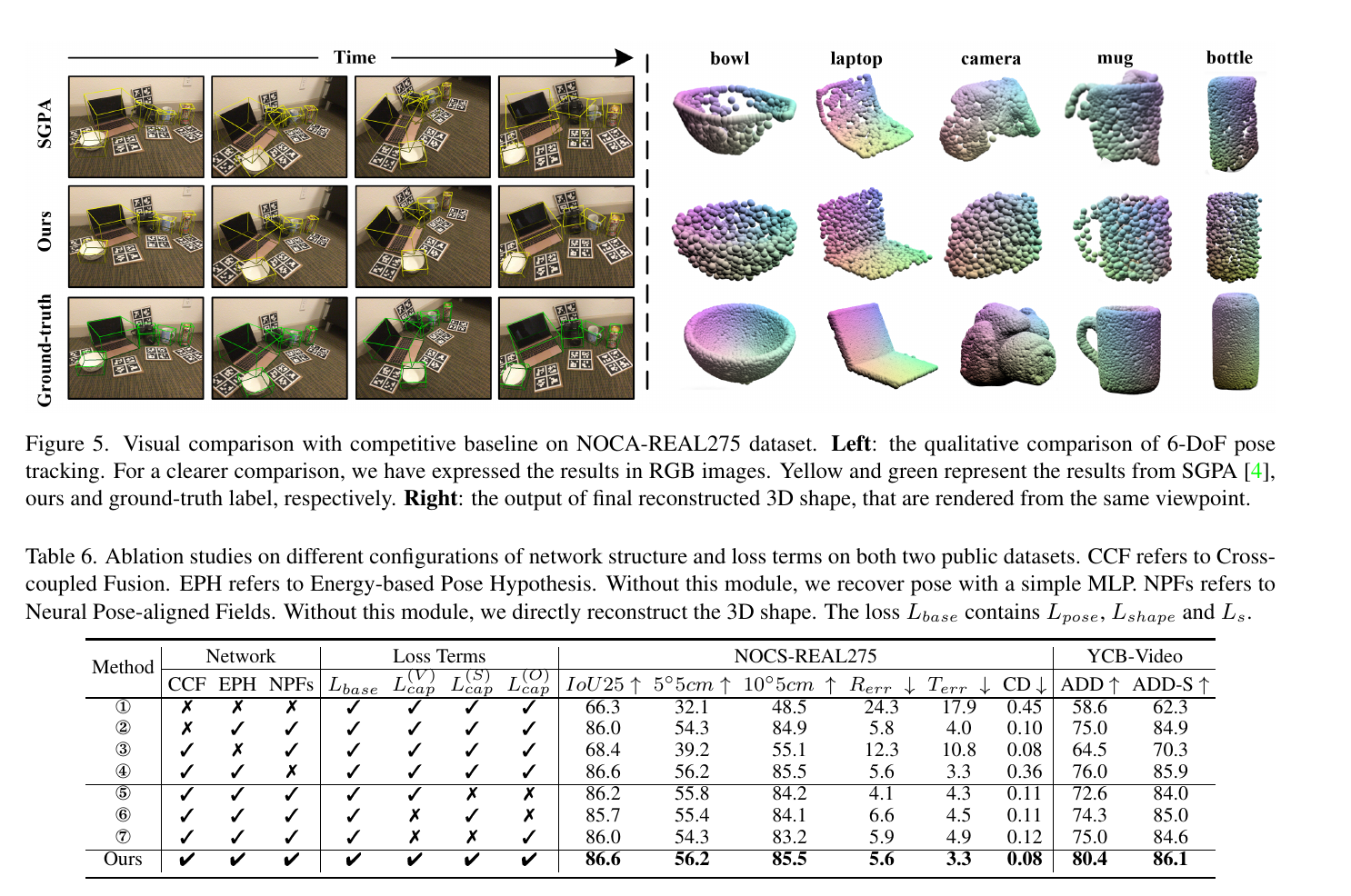
Original Figure 5 and Table 6: the upper region shows pose tracking and shape reconstruction; the lower region removes cross-coupled fusion, energy-based hypotheses, pose-aligned fields, and three levels of caption loss in turn. Source: CVPR 2024 official paper. Image and table copyright belongs to the paper's authors and IEEE/CVF; reproduced here for academic analysis.
Key structural ablations:
Without all core structures, NOCS IoU25 / 5°5cm falls to 66.3 / 32.1, and YCB ADD / ADD-S to 58.6 / 62.3.
With cross-coupled fusion and pose hypotheses but no NPFs, pose reaches 86.6 / 56.2 while shape CD worsens to 0.36; NPFs mainly support reconstruction.
Without energy-based hypotheses, NOCS Rerr is 12.3°, versus 5.6° for the full model, supporting greater stability than a single MLP.
Retaining only the video / scene / object caption loss gives NOCS 5°5cm of 55.8 / 55.4 / 54.3, respectively, versus 56.2 for the full model. Adding the other two caption-loss levels gives a combined gain of about 0.4–1.9 points; these are not isolated single-loss removal ablations.
YCB ADD rises from 72.6 / 74.3 / 75.0 in the corresponding variants to 80.4. Cross-domain gains exceed same-domain NOCS gains, consistent with language priors serving generalization.
8. Training and Reproducibility
4× RTX A6000;
batch size 32;
30 epochs + validation early stopping;
Learning rate 10−7;
Pose hypotheses 5×10⁴;
shape prior 2,048 points;
Train only on NOCS-REAL275;
No YCB-Video fine-tuning;
Disable the segmentation head and 2D backbone for cross-domain inference.
The last condition matters: transfer to YCB uses the points-only variant, so an external system still determines target-point-cloud cropping and first-frame target selection.
Per-frame object masks or cropped point clouds are not free inputs in open scenes.
Semi-automatically generated captions do not match the distribution of natural user instructions.
No evaluation of long-sequence drift, recovery from tracking loss, or relocalization across occlusion is reported.
Unknown categories are tested only through this YCB-Video cross-domain setting.
A shape-prior autoencoder is required; reconstruction is not entirely prior-free.
The multi-component language stack complicates training and reproduction, with insufficient simplified baselines.
Single-frame estimation, tracking, and cross-domain points-only protocols in the tables are distinct settings.
10. Overall assessment
L4D-Track contributes system integration and broader tasks: a pairwise 3D representation supports pose, shape, and language alignment, with cross-dataset transfer at about 20 FPS. NOCS single-frame gains are moderate; YCB-Video results without fine-tuning and shape reconstruction better demonstrate its value.
It is best understood as a language-enhanced generalization framework for initialized, segmented point-cloud tracking. The key next tests are removing first-frame ground truth, integrating open-vocabulary segmentation, and measuring accumulated drift under long-sequence occlusion and relocalization.