LaPose predicts Laplace means / variances for NOCS through DINOv2 / ConvNet branches, allowing learned PnP to use local shape uncertainty. Translation / size are normalized by the ground-truth 3D box diagonal, with absolute scale separately estimated by MobileNet. A single model achieves REAL275 70.7 NIoU25 and 57.4 normalized 10°0.5d, but absolute IoU75 is only 2.6.
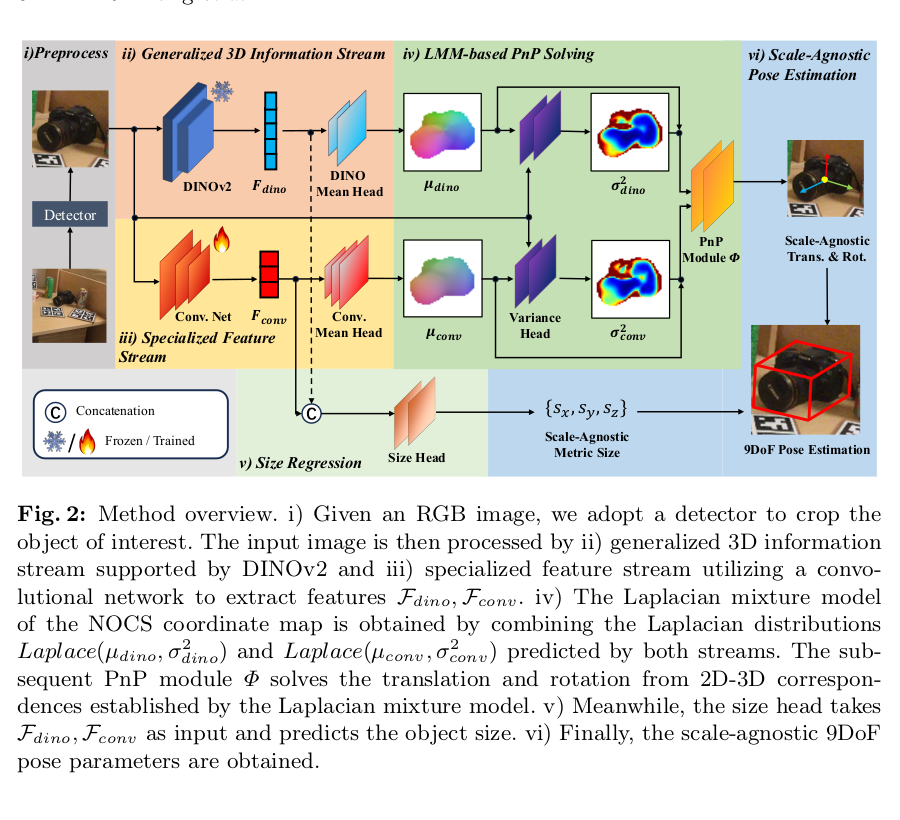
From one RGB image and external detections, LaPose predicts two per-pixel Laplace distributions over NOCS. Frozen DINOv2 supplies general 3D cues and a convolutional branch category-specific cues. Learned PnP reads both means / variances to reduce unreliable correspondences. Dividing translation / size by the true 3D-box diagonal yields scale-agnostic 9DoF targets; a separate MobileNet restores absolute scale.
3. Guide to figures and tables
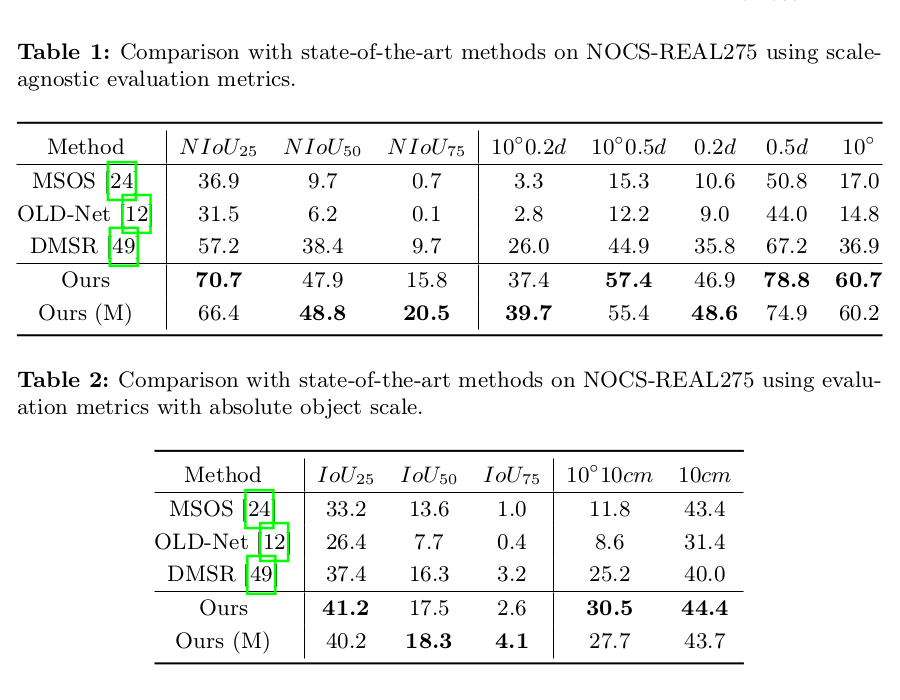
Original Figure 2: DINOv2 and a category-specific ConvNet each predict NOCS means / variances. The PnP module jointly reads distribution parameters and 2D coordinates; the size head and normalized translation form scale-agnostic 9DoF. Source: ECVA official paper. Image copyright belongs to the paper's authors and Springer Nature; reproduced here for academic analysis.Original Tables 1–2: single-model LaPose reaches normalized IoU25 / 10°0.5d of 70.7 / 57.4, but absolute-scale IoU50 / 10°10cm of 17.5 / 30.5. Normalized metrics remove true object size and cannot replace absolute metric pose. Source: ECVA official paper. Table copyright belongs to the paper's authors and Springer Nature; reproduced here for academic analysis.
4. Problem setting
Inputs: one RGB image, camera intrinsics, and Mask R-CNN object detection / crops; NOCS categories are bottle, bowl, camera, can, laptop, and mug.
Outputs: rotation, translation, and metric size for unseen instances within known categories.
The main network predicts normalized pose: true size s and translation t are divided by GT 3D-box diagonal d.
A separate MobileNet predicts d from RGB to recover absolute scale. This reduces interference from scale uncertainty in pose-head training without removing monocular scale unobservability.
5. Method overview
Crop and resize objects with an external detector.
Frozen DINOv2 and a trainable ConvNet produce Fdino and Fconv.
Each branch predicts per-pixel NOCS mean μ and variance σ2 with a Laplace aleatoric NLL. Variance has no direct labels but is driven by supervised NOCS residuals.
A learned convolutional PnP module receives both (μ,σ2) sets and 2D pixel coordinates, directly regressing a 6D rotation representation and normalized translation.
A size head regresses residuals relative to category-mean normalized size.
Rotation uses the first-two-column 6D representation; axial-symmetric categories such as bowl / can supervise only the unambiguous y-axis vector.
For absolute metric pose, an independent MobileNet predicts box diagonal d to denormalize translation / size.
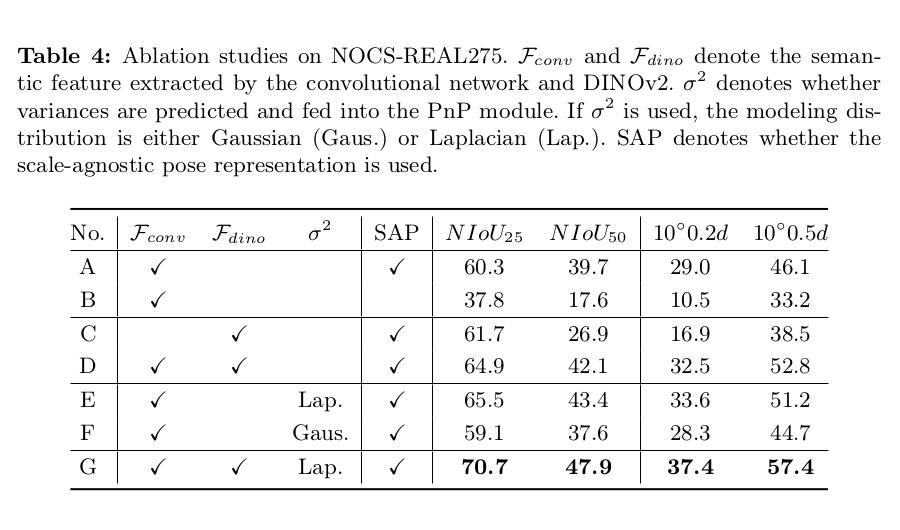
ConvNet alone reaches 60.3 NIoU25; dual streams 64.9; Laplace variance raises this to 70.7.
Removing the scale-agnostic representation reduces NIoU25 from 60.3 to 37.8.
Gaussian uncertainty performs worse than no uncertainty. Single-stream Laplace adds 5.2 NIoU25, and dual-stream Laplacian mixtures improve further.
About 10 FPS is reported, without a clear end-to-end breakdown for detection, DINOv2, PnP, and scale MobileNet.
7. Quick assessment
Strengths: explicitly passes monocular shape uncertainty to a correspondence solver; combines DINOv2 general cues with category-specific features; reports normalized and absolute metrics.
Limitations: learned PnP is not an interchangeable analytic PnP solver. Scale still relies on appearance priors; training / testing covers six NOCS categories, REAL275 training mixes real and synthetic data, and external detections affect end-to-end results.
Support reproduction, comparison, related-work writing, and identifying opportunities for further research.
Paper Reading Notes (Deep): LaPose
1. Key assessment
LaPose separates two problems in RGB-only category pose:
Shape ambiguity: a pixel’s NOCS need not be a deterministic point; predicted variance identifies unreliable correspondences;
Metric scale ambiguity: the same image size can represent a small nearby or large distant object; gradients from this unobservable quantity should not corrupt rotation / normalized translation.
The effective combination is dual-stream supervised uncertainty + learned PnP + scale normalization. DINOv2 alone is weak: NIoU50 is 26.9 versus ConvNet’s 39.7. General features need category-supervised NOCS integration.
2. Inputs, Outputs, and Supervision
LaPose estimates category-level 9DoF for six NOCS categories:
(R,t,s),R∈SO(3),t∈R3,s∈R3.
Inputs are RGB crops, Mask R-CNN detections, and intrinsics. Training supervision includes:
visible mask;
per-pixel GT NOCS map;
GT rotation / translation / metric size;
category average normalized size.
This is supervised category pose, not zero-shot use of frozen DINOv2. Under the NOCS protocol, REAL275 experiments use CAMERA25 and REAL training data together, not synthetic-only sim-to-real transfer.
3. Dual-Stream Laplacian Mixture
Original Figure 2. Blue DINOv2 is frozen; the orange convolutional branch and prediction heads train. The streams each produce Laplace parameters rather than concatenating features into one NOCS prediction. Source: ECVA official paper. Image copyright belongs to the paper's authors and Springer Nature; reproduced here for academic analysis.
DINOv2 acts as a generalized 3D-information stream, offering patch semantics relatively consistent across instances and poses. The ConvNet learns local shape conventions for the six NOCS categories.
Each stream predicts per-visible-pixel NOCS mean μ and variance σ2 using a Laplace aleatoric loss:
L3D=σ2λ∥Mvis⊙(Cgt3D−μ)∥1+Mvis⊙logσ2.
For a large residual, increasing variance reduces the first term, while the log term prevents unlimited variance. The paper calls variance self-supervised; more precisely, this is supervised heteroscedastic learning without variance labels, still driven by GT NOCS residuals.
The two distributions form an LMM, but mixture weights are not learned and inference performs no explicit sampling / marginalization. The solver actually receives:
(μdino,σdino2,μconv,σconv2,C2D).
The LMM thus provides parameterized evidence from two heteroscedastic experts rather than explicitly solving an interpretable mixture posterior.
4. PnP as a Learned Approximation
The theoretical objective is expected L1 reprojection under the NOCS distribution:
P∗=argP∈SE(3)minN1i∑Exi∼ηi∥π(KPxi)−ui∥1.
The authors find direct optimization difficult and use a convolutional network Φ similar to prior work:
(Rout,tout)=Φ(μd,σd2,μc,σc2,C2D).
Inference runs neither EPnP / RANSAC nor explicit minimization of that objective. LMM-based PnP is a pose-regression network conditioned on correspondence distributions. It is fast and end-to-end, with these costs:
No guarantee of geometric optimality / projection consistency;
Potential category-appearance shortcuts in the solver;
Retraining may be needed for new cameras, crop conventions, or categories;
Inverse-uncertainty use of predicted variance is supported only indirectly through ablations and visualizations.
Rotation predicts the first two matrix columns rx,ry and orthogonalizes them. Axial-symmetric categories such as bowl / can supervise only ry, avoiding forced single-valued regression of unidentifiable yaw.
5. Scale-Agnostic Pose
For true 3D-box size s=(sx,sy,sz), the diagonal is:
d=sx2+sy2+sz2.
LaPose uses:
snorm=s/d,tnorm=t/d.
The size head regresses snorm−savg. Translation is split into projected center (ox,oy) and normalized depth tz/d, then converted into crop-relative translation / scale-invariant (δx,δy,δz) and back-projected with intrinsics.
This gives near-small and far-large cases with the same image a shared, identifiable normalized target. Metric robot translation still requires d. A separate MobileNet predicts box diagonal, then:
t=dtnorm,s=dsnorm.
SAP is useful factorization, not new physical information resolving monocular scale. Normalized metrics measure shape ratios / orientation / relative translation; absolute metrics assess actual metric outputs.
6. REAL275 Main Results
Original Tables 1–2. Ours shares one model across six categories; Ours (M) trains each category separately. Comparing the best values from both rows without acknowledging capacity differences is misleading. Source: ECVA official paper. Table copyright belongs to the paper's authors and Springer Nature; reproduced here for academic analysis.
Scale-agnostic:
Method
NIoU25
NIoU50
NIoU75
10°0.2d
10°0.5d
10°
DMSR
57.2
38.4
9.7
26.0
44.9
36.9
LaPose
70.7
47.9
15.8
37.4
57.4
60.7
LaPose (M)
66.4
48.8
20.5
39.7
55.4
60.2
For NIoU25 / 10°0.5d, the single model exceeds DMSR by +13.5 / +12.5 points; per-category models gain +10.8 at strict NIoU75. The clearest gain is rotation-only 10°, from 36.9 to 60.7.
Absolute-scale:
Method
IoU25
IoU50
IoU75
10°10cm
10cm
DMSR
37.4
16.3
3.2
25.2
40.0
LaPose
41.2
17.5
2.6
30.5
44.4
LaPose (M)
40.2
18.3
4.1
27.7
43.7
Absolute-scale advantages shrink markedly, and single-model IoU75 trails DMSR, showing the independent diagonal predictor remains a bottleneck. All baselines are recomputed with a corrected NOCS evaluation script; these scores should not be merged directly with old tables using the uncorrected script.
7. Evidence for Uncertainty Calibration
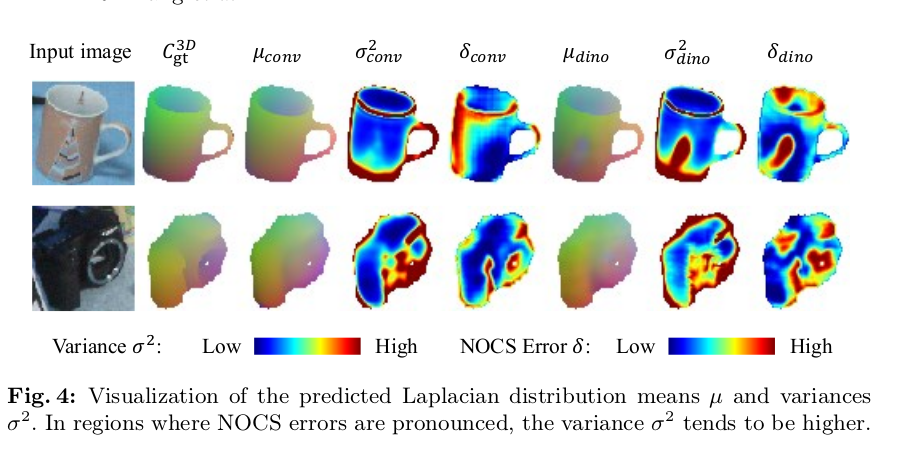
Original Figure 4: difficult regions such as camera lenses and mug handles often have both high NOCS residuals and high variance, supporting variance as a local-error cue. Source: ECVA official paper. Image copyright belongs to the paper's authors and Springer Nature; reproduced here for academic analysis.
Visualizations show spatial association between variance and error, but the paper does not report:
NLL;
expected calibration error;
sparsification / risk-coverage curve;
Quantitative correlation between variance quantiles and NOCS error;
Calibration under OOD / detection errors.
Variance can therefore be described as useful for pose, without claiming well-calibrated probabilistic uncertainty.
8. Ablation Breakdown
Original Table 4: SAP, dual streams, and Laplace variance each help; Gaussian uncertainty performs worse than the deterministic ConvNet. Source: ECVA official paper. Table copyright belongs to the paper's authors and Springer Nature; reproduced here for academic analysis.
Configuration
NIoU25
NIoU50
10°0.2d
10°0.5d
Conv + SAP
60.3
39.7
29.0
46.1
Conv, no SAP
37.8
17.6
10.5
33.2
DINO + SAP
61.7
26.9
16.9
38.5
Conv + DINO + SAP
64.9
42.1
32.5
52.8
Conv + Laplace + SAP
65.5
43.4
33.6
51.2
Conv + Gaussian + SAP
59.1
37.6
28.3
44.7
Dual-stream LMM + SAP
70.7
47.9
37.4
57.4
SAP is the largest individual change, but it alters target parameterization and evaluation space together; the +22.5 NIoU25 cannot all be attributed to network capability.
Dual deterministic streams add +4.6 NIoU25 / +6.7 10°0.5d over Conv-only; dual Laplace adds another +5.8 / +4.6. Gaussian’s negative effect shows that adding uncertainty heads is not automatically useful; heavy-tailed Laplace better matches L1 NOCS residuals.
9. Limitations and Common Misreadings
Scale-agnostic metrics deliberately remove metric-scale error; they do not establish full 9DoF;
Absolute scale still comes from a monocular MobileNet appearance prior;
Learned PnP has no analytic geometry guarantee and is not RANSAC-PnP;
Variance is supervised through GT NOCS residuals, not unsupervised uncertainty;
Only six NOCS categories are covered, and REAL275 test has just 2.7K images;
REAL275 training uses REAL train + CAMERA, not zero-shot real transfer;
Detection comes from external Mask R-CNN / prior detections;
Symmetry uses category-level axis conventions, without covering instance textures that break geometric symmetry;
About 10 FPS lacks an end-to-end module breakdown;
Multi-model rows use independent category networks, with greater capacity / deployment cost than one shared model.
10. Reproduction Checklist
Use the authors’ corrected NOCS evaluator;
Report shared and per-category models separately;
Distinguish CAMERA-only from CAMERA+REAL training;
Use identical external detections;
Keep DINOv2 frozen and ConvNet trainable;
Train both μ,σ2 sets inside visible masks;
Compare learned PnP against analytic EPnP / uncertainty-weighted RANSAC;
Include detection, DINO, PnP, and the MobileNet scale head in runtime.
11. Overall assessment
LaPose makes a useful statistical and geometric decomposition of RGB-only category pose: NOCS pixels need not be equally reliable, and inherently unobservable absolute scale need not dominate pose training. REAL275 normalized rotation and joint-threshold gains are substantial, with relatively complete dual-stream Laplace ablations.
The key boundary is that a learned network consumes the LMM, rather than explicit probabilistic PnP, and SAP delegates metric scale to a separate network. The method learns pose apart from scale more stably; it does not uniquely recover true physical size from one RGB image. Read normalized and absolute tables together to assess it accurately.