Living Scenes: Multi-object Relocalization and Reconstruction in Changing 3D Environments
MoRE² uses a shared SE(3)-equivariant encoder–DeepSDF decoder for cross-scan instance matching, 6-DoF registration, and object reconstruction, jointly optimizing the pose graph and latent geometry. FlyingShape / 3RScan MR is 74.39 / 49.07 and MRR is 62.00 / 40.74. Advantages persist with noisy Mask3D segmentations, but instance segmentation is required, and nonrigidity or ambiguity between identical instances is not addressed.
instance-segmented point clouds from temporally separated 3D scans
Requirements
multiple scans of the same environmentinstance segmentation masksrigid object motion between scansShapeNet-derived synthetic training datatest-time SE(3) and latent-code optimization
Full paper metadataAuthors, affiliations, research area, datasets, metrics, method tags, and reading statusExpandCollapse
Authors
Liyuan Zhu, Shengyu Huang, Konrad Schindler, Iro Armeni
multiple scans of the same environmentinstance segmentation masksrigid object motion between scansShapeNet-derived synthetic training datatest-time SE(3) and latent-code optimization
Reading Notes
Overview / Deep Dive
Available src/paper-notes/living-scenes-cvpr2024/coarse.md
Paper overview notes
Quickly assess the paper's scope, problem setting, core method, experimental findings, and whether to read it in depth.
Paper Reading Notes (Coarse): Living Scenes / MoRE²
1. Basic information
Title: Living Scenes: Multi-object Relocalization and Reconstruction in Changing 3D Environments
Authors: Liyuan Zhu, Shengyu Huang, Konrad Schindler, Iro Armeni
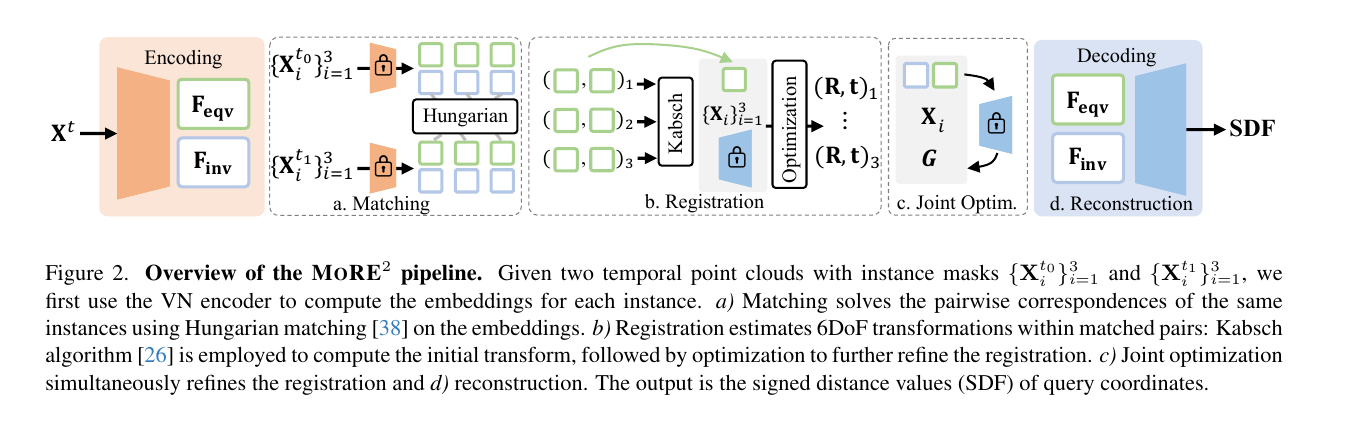
MoRE² formulates object pose in changing long-term scenes as joint cross-time instance matching → per-object 6DoF registration → accumulated reconstruction, maintaining an object-level map through a shared SE(3)-equivariant implicit representation and joint test-time optimization.
3. Guide to figures and tables
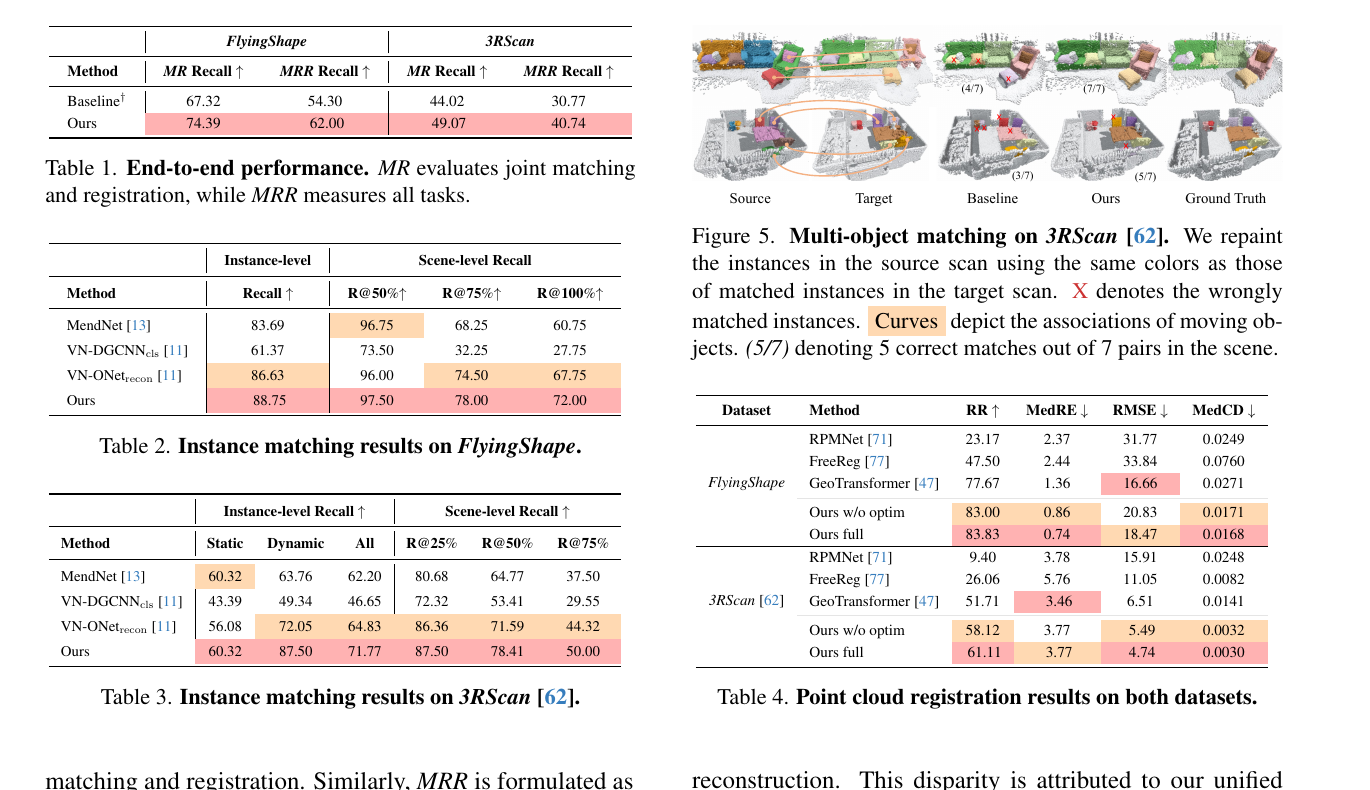
Original Figure 2: invariant / equivariant embeddings support instance matching and pose solving, respectively. Kabsch initializes alignment; joint pose-graph and implicit-geometry optimization follows, and the decoder outputs SDF. Source: CVPR 2024 official paper. Image copyright belongs to the paper's authors and IEEE/CVF; reproduced here for academic analysis.Original Tables 1–4 and Figure 5: end-to-end MR is 74.39 / 49.07 and MRR is 62.00 / 40.74 on FlyingShape / 3RScan. Registration recall on real 3RScan reaches 61.11. Source: CVPR 2024 official paper. Figure and table copyright belongs to the paper's authors and IEEE/CVF; reproduced here for academic analysis.
4. Problem setting
Inputs: repeated 3D scans of the same indoor environment at irregular intervals, with instance segmentation per scan.
Outputs:
Same-instance matches across scans;
A 6DoF rigid transform for each moved object relative to the reference scan;
Object reconstructions from aligned partial clouds across time.
No continuous motion trajectories are modeled. Scans may be far apart in time; only endpoint-to-endpoint object transforms are recovered.
Assumes rigid objects and instance segmentation from GT or Mask3D.
5. Method overview
A Vector-Neuron-style encoder outputs rotation-invariant Finv and equivariant Feqv features while retaining scale and center information.
Instance matching combines invariant-embedding similarity with residuals after Kabsch alignment of equivariant embeddings; Hungarian assignment enforces one-to-one matches.
For matched clouds, Feqv initializes SE(3) through Kabsch, followed by SDF-alignment and Chamfer-loss registration.
A DeepSDF-style decoder maps invariant codes and canonicalized query coordinates to SDF.
Build a multi-time pose graph, accumulate object observations in common coordinates, and jointly optimize equivariant embeddings and graph poses for 200 iterations.
Train one network on ShapeNet-derived synthetic data only, freeze it, and test on FlyingShape and real 3RScan.
6. Experiments at a glance
End-to-end metrics:
MR: both matching and registration succeed;
MRR: matching, registration, and reconstruction all succeed.
FlyingShape: MR 74.39, MRR 62.00, versus 67.32 / 54.30 for the combined baseline.
3RScan: MR 49.07, MRR 40.74, versus baseline 44.02 / 30.77.
3RScan dynamic-instance matching recall: 87.50; all-instance recall is 71.77.
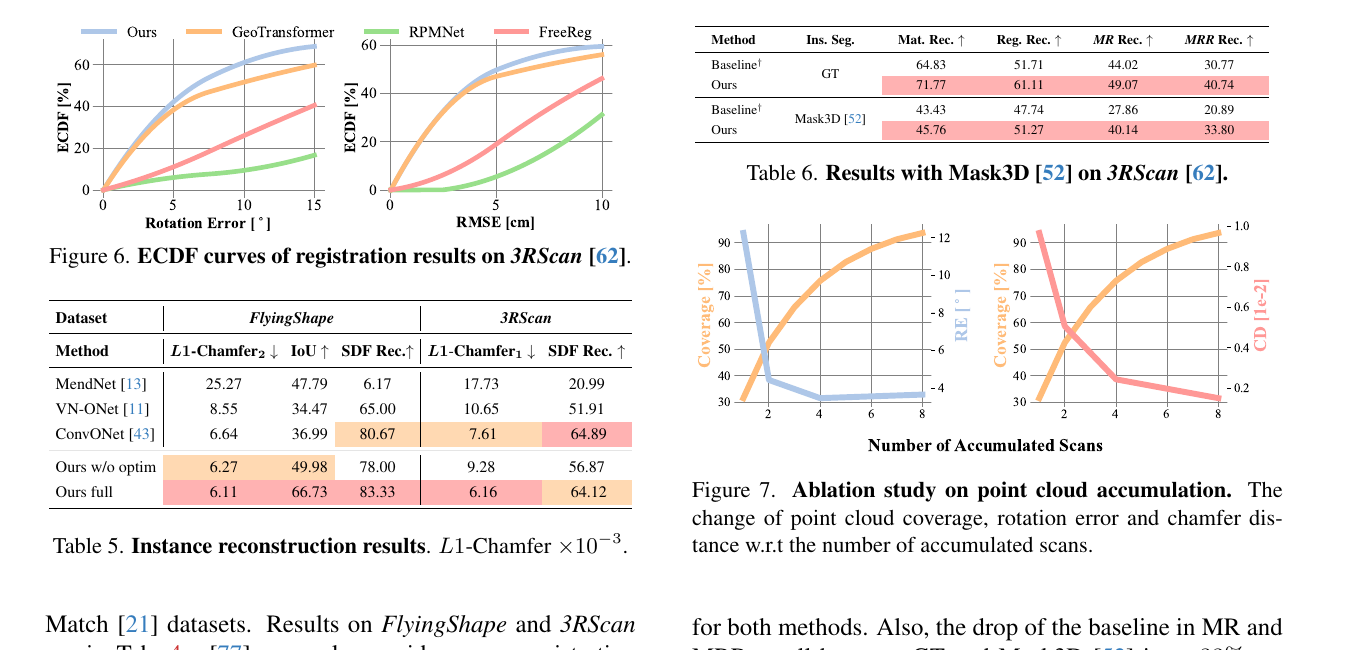
Replacing GT masks with Mask3D gives 3RScan MR / MRR of 40.14 / 33.80. Performance drops but still exceeds the combined baseline at 27.86 / 20.89.
Accumulating 1 to 4 scans substantially improves registration and reconstruction. Shape coverage approaches 75% at about 4 scans, then gains saturate.
7. Quick assessment
Strengths: extends pose to changing long-term scenes; shared representations reduce mismatch between separate modules; transfers synthetic-only training to real scans; code, weights, and data processing are public.
Task boundary: relative cross-scan object SE(3) and long-term object-centric reconstruction, an extension beyond single-frame BOP absolute object-to-camera pose.
Intended readers: object relocalization, 3D change understanding, SE(3)-equivariant features, pose graphs, neural implicit reconstruction, and long-term robot mapping.
Available src/paper-notes/living-scenes-cvpr2024/deep.md
In-depth paper notes
Support reproduction, comparison, related-work writing, and identifying opportunities for further research.
Paper Reading Notes (Deep): Living Scenes / MoRE²
1. Key assessment
Living Scenes extends object pose from location in the current camera to motion since the previous scan and increasingly complete reconstruction from long-term observations. MoRE² uses one SE(3)-equivariant latent representation for matching, registration, and reconstruction, then jointly optimizes graph poses and implicit object surfaces at test time.
This outperforms combinations of individually strong subtask baselines on end-to-end measures: 3RScan matching + registration + reconstruction recall rises from 30.77 to 40.74. Shared geometry mainly improves consistency along the error-propagation chain, beyond a small standalone registration gain.
The task assumes instance-segmented inputs and rigid motion. Outputs are relative cross-scan 6DoF, not single-frame BOP absolute pose. Identically shaped instances, nonrigid changes, and large scene-topology changes remain future work.
2. Formalizing Living Scenes
Given scans of one environment acquired at irregular times:
{St}t=1T,St={Xit}i=1Nt,
Here Xit∈R3×ni is an instance-segmented partial point cloud.
With S1 as reference, for each rescan t>1:
For Xi1, determine the corresponding physical instance Xjt;
Estimate rigid transform Tit=(Rit,tit)∈SE(3);
Align and accumulate all observations:
Xi1:T=Xi1∘Ti2Xi2∘⋯∘TiTXiT;
Recover an implicit object surface / mesh from the accumulated cloud.
Added or removed objects may remain unmatched; intermediate motion is not modeled. Relocalization here estimates object motion between scan endpoints.
3. One Representation for Three Tasks
Original Figure 2. Matching combines invariant / equivariant embeddings; registration follows Kabsch initialization with implicit-surface alignment. Joint optimization adjusts graph poses and latent geometry together, and the decoder outputs SDF. Source: CVPR 2024 official paper. Image copyright belongs to the paper's authors and IEEE/CVF; reproduced here for academic analysis.
Encoder outputs:
Finv: global rotation-invariant embedding for object identity;
For query coordinate p, the canonicalized latent coordinate is:
Fq=⟨Feqv,Fsp−Fc⟩.
DeepSDF-style decoder:
SDF(p)=Ψ(Finv,Fq).
Training minimizes only single-shape L1 SDF reconstruction loss. Matching and registration mainly arise from representation structure and test-time optimization, rather than separately trained task heads.
4. Instance Matching: Identity Similarity and Rotational Alignability
Invariant embeddings form cosine-similarity matrix Λ between reference and rescan objects. Using Λ alone confuses similar shapes; MoRE² also treats equivariant embeddings as latent 3D vectors:
Solve latent rotation Rij for each candidate pair with Kabsch;
Compute alignment residual:
E(i,j)=∥RijFeqv,i−Feqv,j∥2;
Combine scores:
H=Λ⊘E;
Maximize global pair scores through Hungarian assignment.
Candidates must resemble the same identity and admit a consistent rotation. Unassigned objects are treated as additions / removals according to temporal order.
Hungarian one-to-one assignment is a risk: nearly identical chairs may lack enough pairwise latent evidence to establish identity. Spatial context or global motion consistency would be needed and is not addressed.
5. Registration: Equivariant Kabsch to Continuous Surface Alignment
SDF loss moves source points toward the target continuous zero-level surface without discrete point-to-point correspondences;
Chamfer prevents learned shape priors from drifting toward surfaces unsupported by observations.
Pose is optimized on the SE(3) manifold. Compared with discrete-correspondence methods such as GeoTransformer, this is natural when partiality varies and scans expose different surfaces, at the cost of test-time iteration and shape-prior bias.
6. Joint Optimization and Multi-Time Accumulation
Build pose graph G over observations of the same object and jointly optimize:
Ljoint=Lsdf+Lz,Lz=∥F′−F∥2.
Relative transforms in G on the SE(3) manifold;
Latent equivariant embedding F′ with Adam;
Lz to regularize test-time adaptation toward the training prior;
The paper uses 200 iterations.
New scans can improve earlier scan poses, rather than independently registering pairs and stitching them once. A common latent surface geometrically reconciles multiple partial observations.
7. Data, Metrics, and Protocols
Training:
ShapeNet subset;
mesh watertight preprocessing;
SDF sampling;
Synthetic depth rendering and point-cloud back-projection;
Synthetic objects only for the shared encoder–decoder.
Evaluation:
FlyingShape: a synthetic living-scene benchmark derived from ShapeNet;
3RScan: real indoor reference / rescans with extended instance-matching and reconstruction protocols.
The official hidden 3RScan test server is no longer maintained; reproduction relies on the authors’ processed splits / evaluation code.
Metrics:
instance matching recall;
Scene-level matching recall R@25/50/75/100;
registration recall RR;
median rotation error MedRE;
translation RMSE;
median Chamfer distance MedCD;
reconstruction L1-Chamfer, IoU, SDF recall;
MR: matching and registration both succeed;
MRR: matching, registration, and reconstruction all succeed.
Later tasks therefore receive only earlier-stage successes, revealing compounded pipeline errors.
8. Main results
Original Tables 1–4 and Figure 5. End-to-end and matching results appear on the left; real 3RScan multi-object matching and registration on the right. Red marks best and orange second-best values. Source: CVPR 2024 official paper. Figure and table copyright belongs to the paper's authors and IEEE/CVF; reproduced here for academic analysis.
End-to-end results:
Dataset
Method
MR
MRR
FlyingShape
component-wise baseline
67.32
54.30
FlyingShape
MoRE²
74.39
62.00
3RScan
component-wise baseline
44.02
30.77
3RScan
MoRE²
49.07
40.74
The 3RScan MRR gain of 9.97 exceeds the MR gain of 5.05, suggesting unified representation / joint optimization better controls error propagation into final reconstruction.
Matching:
FlyingShape instance recall 88.75, scene R@100 72.00;
Dynamic objects outperform static ones, perhaps because moved objects have more complete, isolated crops while static objects mix with background / segmentation. This should not be read as larger motion being inherently easier.
Registration:
Dataset
Method
RR
MedRE
RMSE
MedCD
FlyingShape
GeoTransformer
77.67
1.36
16.66
0.0271
FlyingShape
MoRE² full
83.83
0.74
18.47
0.0168
3RScan
GeoTransformer
51.71
3.46
6.51
0.0141
3RScan
MoRE² full
61.11
3.77
4.74
0.0030
MoRE² does not minimize every error: GeoTransformer has better FlyingShape RMSE and 3RScan MedRE. Its strengths are higher success recall and lower geometric distance, consistent with continuous implicit surfaces helping low-overlap alignment.
9. Reconstruction and Noisy Segmentation
Original Figures 6–7 and Tables 5–6. The upper region compares registration ECDFs, reconstruction, and Mask3D conditions; the right shows scan-accumulation gains saturating after about four observations. Source: CVPR 2024 official paper. Figure and table copyright belongs to the paper's authors and IEEE/CVF; reproduced here for academic analysis.
Reconstruction:
Dataset
Method
L1-Chamfer
IoU
SDF recall
FlyingShape
ConvONet
6.64
36.99
80.67
FlyingShape
MoRE² w/o optim
6.27
49.98
78.00
FlyingShape
MoRE² full
6.11
66.73
83.33
3RScan
ConvONet
7.61
—
64.89
3RScan
MoRE² full
6.16
—
64.12
3RScan provides incomplete, non-watertight meshes, so evaluation uses one-way Chamfer and SDF recall, not directly comparable to FlyingShape two-way Chamfer. Real-data SDF recall is 64.12 for MoRE², slightly below ConvONet’s 64.89, but Chamfer is better.
Replacing GT instance segmentation with Mask3D:
Method
Match
Reg
MR
MRR
baseline + Mask3D
43.43
47.74
27.86
20.89
MoRE² + Mask3D
45.76
51.27
40.14
33.80
From GT to Mask3D, baseline MR / MRR drops by about 33% relatively, versus about 18% for MoRE². Shared latent shapes buffer missing / noisy clouds, but absolute performance still drops substantially; instance segmentation is not solved.
10. When Accumulation Helps
Increasing from 1 point cloud to 4:
Quickly increases surface coverage;
Substantially reduces rotation error and Chamfer;
Reaches nearly 75% coverage at the fourth observation;
Additional scans then provide smaller marginal gains.
This supports joint accumulation provided new views reveal new surfaces. Repeated similar viewpoints or worse segmentation need not yield monotonic improvement.
11. Relation to Pose Estimation and Tracking
Compared with BOP absolute pose:
BOP takes a current image and known target object and predicts object→camera;
MoRE² takes multiple point-cloud scans and predicts relative object motion between scans;
MoRE² needs no CAD but requires reference-instance observations and segmentation.
Compared with short-term multi-object tracking:
Tracking assumes frequent frames and continuous motion, using velocity / association history;
Living-scene observations are far apart with unknown intermediate trajectories;
Matching depends more on object-identity geometry, and pose changes can be large.
Compared with scene-level registration:
Scene registration mainly aligns static background;
MoRE² identifies independently moved objects and estimates a different SE(3) for each;
Output is a set of object transforms and meshes rather than one global transform.
12. Limitations
Instance segmentation is an external input;
Rigidity excludes cloth, soft objects, and structural deformation;
Identical objects still create identity ambiguity;
One-to-one Hungarian assignment does not naturally handle splits / merges;
ShapeNet shape priors may oversmooth long-tail real objects;
Joint test-time optimization uses 200 iterations, costing more than one forward pass;
3RScan GT / server status complicates independent validation;
Background changes and large-scale scene topology are not modeled;
Geometry-only clouds omit RGB / text semantics that could aid identical-shape matching;
Accumulation depends on views revealing new surfaces.
13. Reproduction Checklist
Use the authors’ ShapeNet subset and watertight-mesh preprocessing;
Reproduce SDF sampling, depth rendering, and cloud partiality;
Preserve Vector Neuron equivariance and centroid / scale normalization;
Store Finv,Feqv,Fs,Fc separately;
Combine cosine similarity and latent Kabsch residuals for matching;
Permit unmatched instances in Hungarian assignment;
Start registration from the same Kabsch initialization;
Implement both SDF and Chamfer losses;
Update poses on SE(3), not as unconstrained matrices;
Use the same 200 joint-optimization iterations and latent regularizer;
Show failures for identical objects, low overlap, and segmentation errors.
14. Overall assessment
MoRE² places 6DoF registration within object-centric long-term scene understanding. Shared invariant / equivariant / implicit representations let identity, pose, and shape constrain each other; 3RScan MRR of 40.74 versus baseline 30.77 demonstrates the system-level benefit.
It still needs good instance segmentation, rigid objects, and test-time optimization, and does not solve identical-instance ambiguity. The strongest conclusion is that for intermittently acquired long-term indoor scans, sharing one equivariant implicit representation for matching, relative SE(3), and accumulated reconstruction better resists error propagation than assembling independent modules.