Effects of Markers in Training Datasets on the Accuracy of 6D Pose Estimation
Paired synthetic scenes isolate marker shortcuts in training images, comparing fixed markers, two-stage LaMa inpainting, fully random markers, and mixed fixed / random augmentation. On markerless Teabox tests, fixed-marker training yields ADD-(S) 76.6, 8.2 points below the markerless baseline's 84.8; inpainting restores 84.8. Five-object YCB-V and ZebraPose checks broadly support limited pose degradation after inpainting. Real averages exclude severely failed mug / wood-block cases, and multiple-seed intervals are absent. Label-noise sweeps show that translation errors above 4 mm or rotation errors around 2.5° quickly erode precise-ground-truth benefits.
RGB training images with or without fiducial markersknown object CAD models6D pose labels
Requirements
paired or controlled marker / markerless data for causal comparisonknown marker geometry and visibility masks for automatic removalan instance-level pose estimator such as GDR-Net or ZebraPoseaccurate object pose ground truthsynthetic rendering for controlled label-noise studies
Full paper metadataAuthors, affiliations, research area, datasets, metrics, method tags, and reading statusExpandCollapse
paired or controlled marker / markerless data for causal comparisonknown marker geometry and visibility masks for automatic removalan instance-level pose estimator such as GDR-Net or ZebraPoseaccurate object pose ground truthsynthetic rendering for controlled label-noise studies
Reading Notes
Overview / Deep Dive
Available src/paper-notes/marker-dataset-bias-wacv2024/coarse.md
Paper overview notes
Quickly assess the paper's scope, problem setting, core method, experimental findings, and whether to read it in depth.
Paper Reading Notes (Coarse): Effects of Markers in Training Datasets on the Accuracy of 6D Pose Estimation
1. Basic information
Authors: Janis Rosskamp, Rene Weller, Gabriel Zachmann
Affiliation: University of Bremen, Computer Graphics and Virtual Reality
Study scope: primarily GDR-Net, checked with ZebraPose; controlled teabox experiments and 5 YCB-V objects
Reading mode: Overview
2. One-sentence summary
This paper studies a hidden data shortcut: optical markers provide accurate automatic pose labels but also appear in training images and correlate with pose. Removing markers at test time drops teabox GDR-Net ADD-(S) from 84.8 to 76.6. Two-stage LaMa inpainting restores 84.8, while modest label noise quickly erodes that benefit. Accurate marker-based GT plus removal may therefore outperform markerless images with coarse manual labels.
3. What Was Compared?
Case
Training-image treatment
Purpose
I
No markers
Ideal markerless baseline
II
Fixed-position markers
Direct training on marker-based automatic captures
III
Markers added, then removed by inpainting
Retain label accuracy while reducing visual shortcuts
IV
Randomly place 1–5 markers per image
Decouple markers from pose
V
Half fixed, half random markers
Approximate real data mixed with synthetic augmentation
The controlled synthetic teabox experiments keep objects, lighting, backgrounds, and camera poses identical, changing only marker appearance and label perturbations to isolate causes.
4. Marker Removal
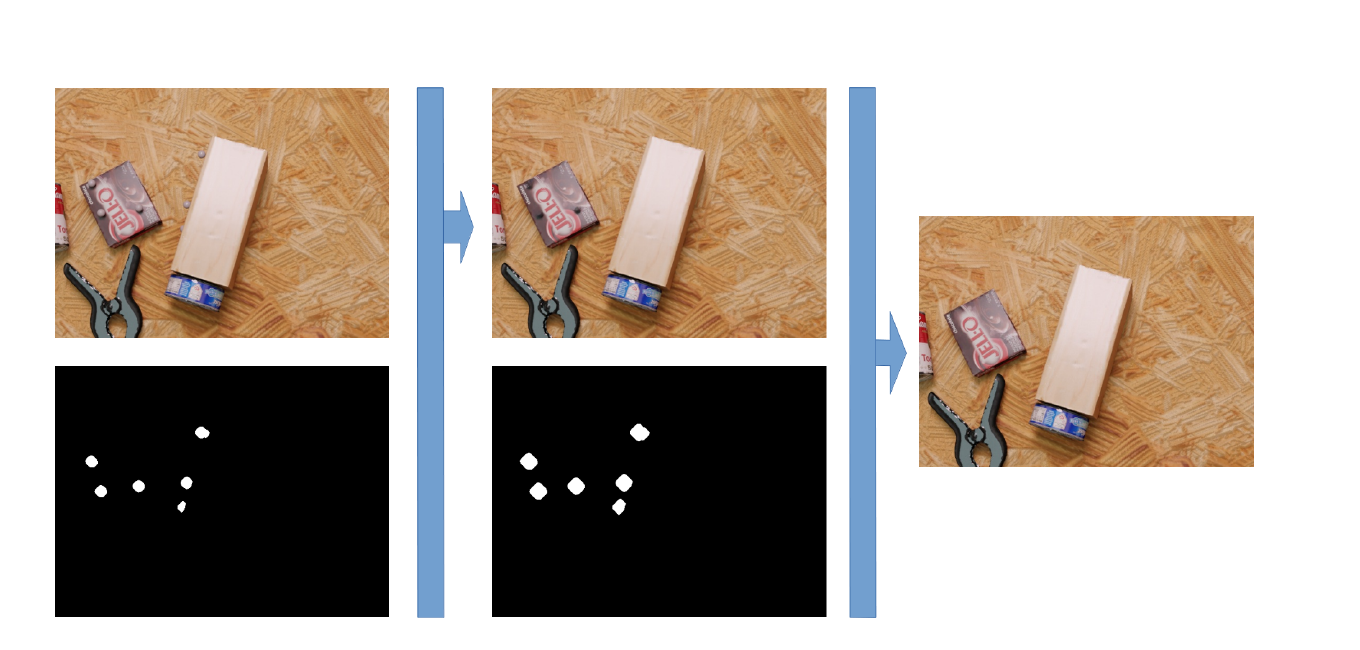
Known marker 3D positions are projected to obtain visible masks, then expanded by binary nearest-neighbor dilation. LaMa first uses roughly 4× dilation; a second pass uses roughly 8× dilation to remove remaining traces.
Original Figure 2: a smaller dilated mask removes YCB-V markers first, and a larger mask supports a second inpainting pass to reduce boundary traces. This needs known 3D marker positions and visibility, not generic unsupervised marker detection. Source: CVF Open Access. Image copyright belongs to the paper's authors and publisher; reproduced here for academic analysis.
The authors acknowledge residual artifacts and elongated marker shadows, but observe no measurable recall degradation in these experiments.
5. Main results
5.1 Teabox: Evidence of Marker Shortcuts
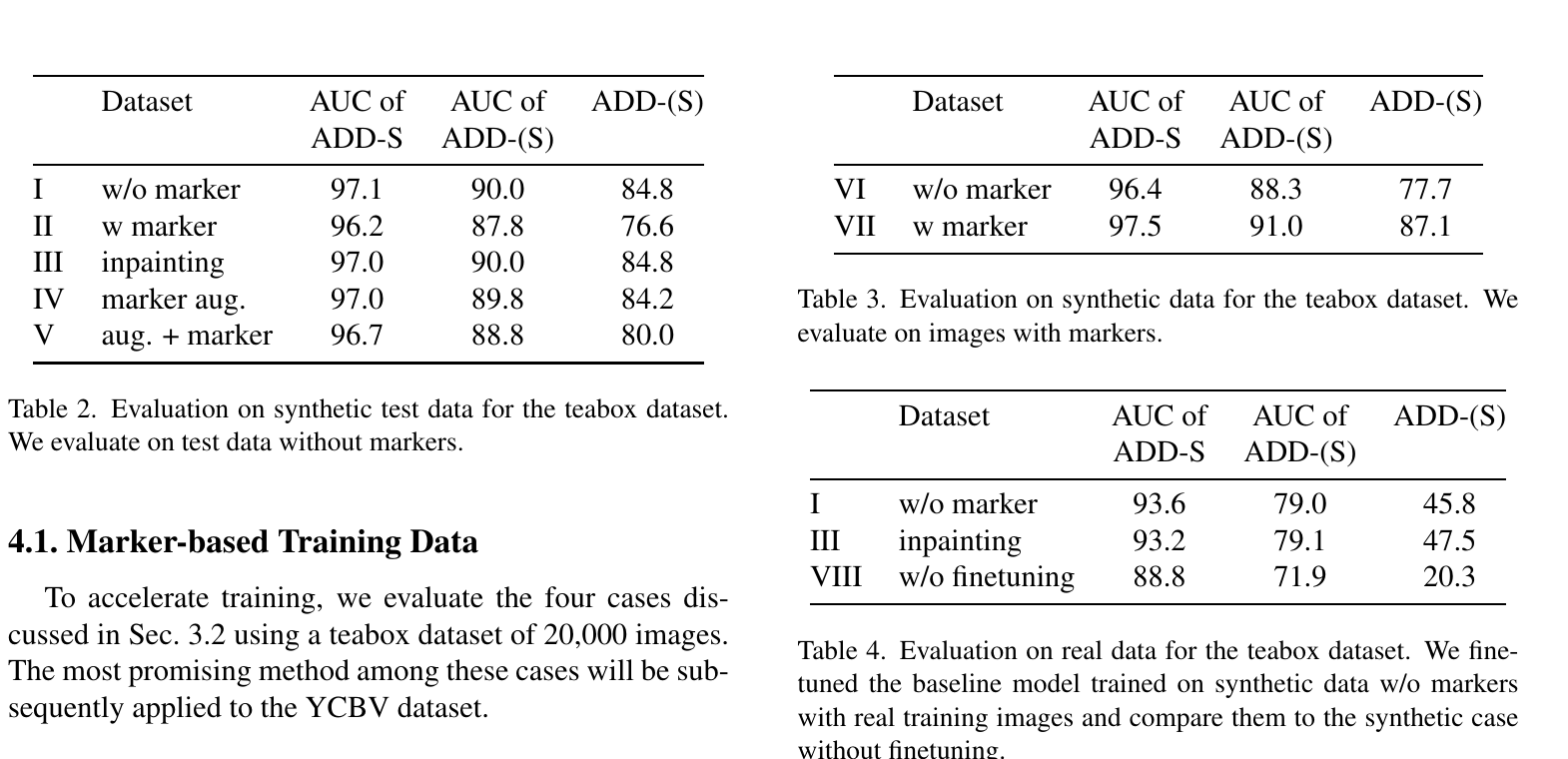
Original Tables 2–4: left, five training strategies tested on markerless synthetic data; upper right, a marker-test sanity check; lower right, 200-image fine-tuning for real markerless-teabox evaluation. Source: CVF Open Access. Image copyright belongs to the paper's authors and publisher; reproduced here for academic analysis.
On markerless synthetic tests:
Training strategy
AUC ADD-(S)
ADD-(S)
I no markers
90.0
84.8
II fixed markers
87.8
76.6
III Inpainting
90.0
84.8
IV fully random markers
89.8
84.2
V fixed + random mixture
88.8
80.0
Key interpretations:
II loses 8.2 percentage points in ADD-(S) versus I. The text separately says 5.6 points, inconsistent with Table 2; the conclusion says about 8. Use the table values.
III exactly matches I: in this controlled dataset, inpainting artifacts do not harm pose.
IV nearly restores the baseline; V restores it only partly because half the images retain fixed marker–pose correlations.
With markers in both training and testing, VII reaches 87.1 versus 77.7 for markerless training / marker testing. This supports actual marker use, beyond surface occlusion alone.
5.2 Real YCB-V: Similar Averages with Clear Object Failures
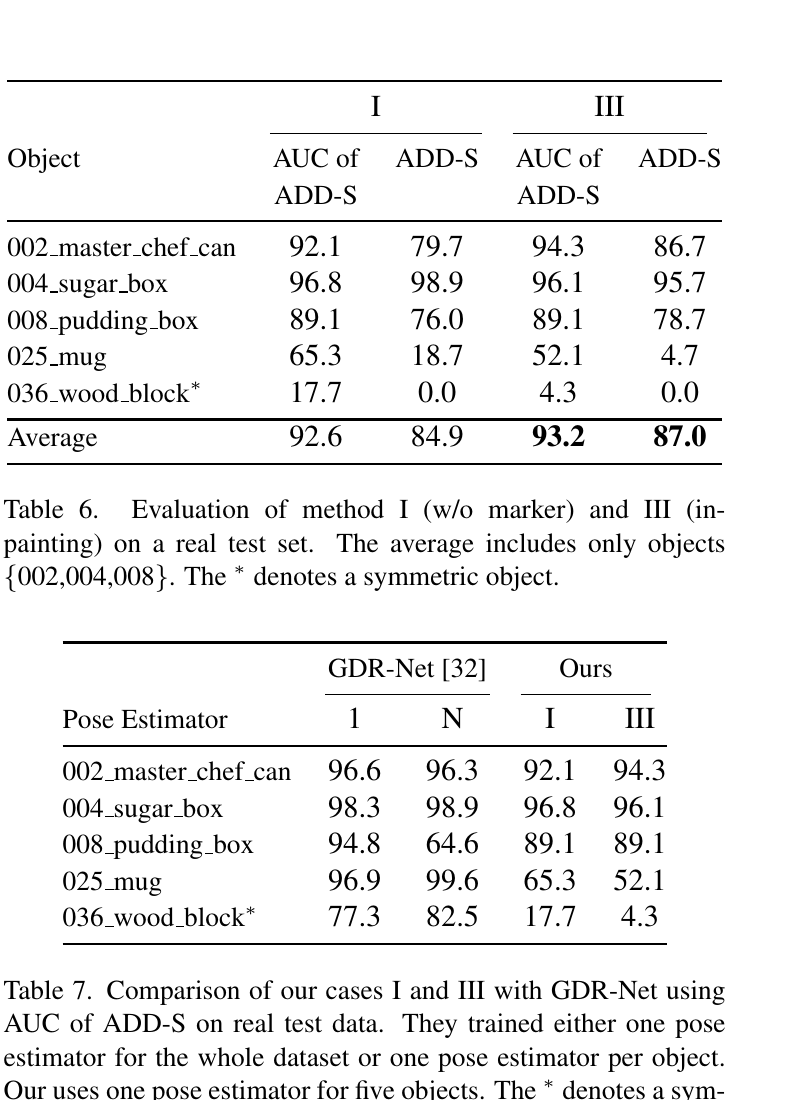
Original Tables 6–7: I trains without markers; III inpaints marker images. Table 6 averages only objects 002, 004, and 008, excluding mug and wood block after synthetic-to-real failure. Source: CVF Open Access. Image copyright belongs to the paper's authors and publisher; reproduced here for academic analysis.
For retained objects 002 / 004 / 008, real-data AUC ADD-S is 92.6 → 93.2 and ADD-S 84.9 → 87.0; inpainting does not lower the average.
025 mug and symmetric 036 wood block perform poorly under both strategies; the authors attribute this to the synthetic-to-real gap and exclude them from Table 6 averages.
ZebraPose gives synthetic mean AUC ADD-S of 92.9 versus 92.3, and real scores of 60.9 versus 61.8. This supports no obvious harm from inpainting, not a universal improvement.
5.3 Label Error: Millimeters and Degrees Already Matter
Teabox training labels receive zero-mean Gaussian pose noise: σt∈{0,2,4,8} mm and σR∈{0,2.5,5}°.
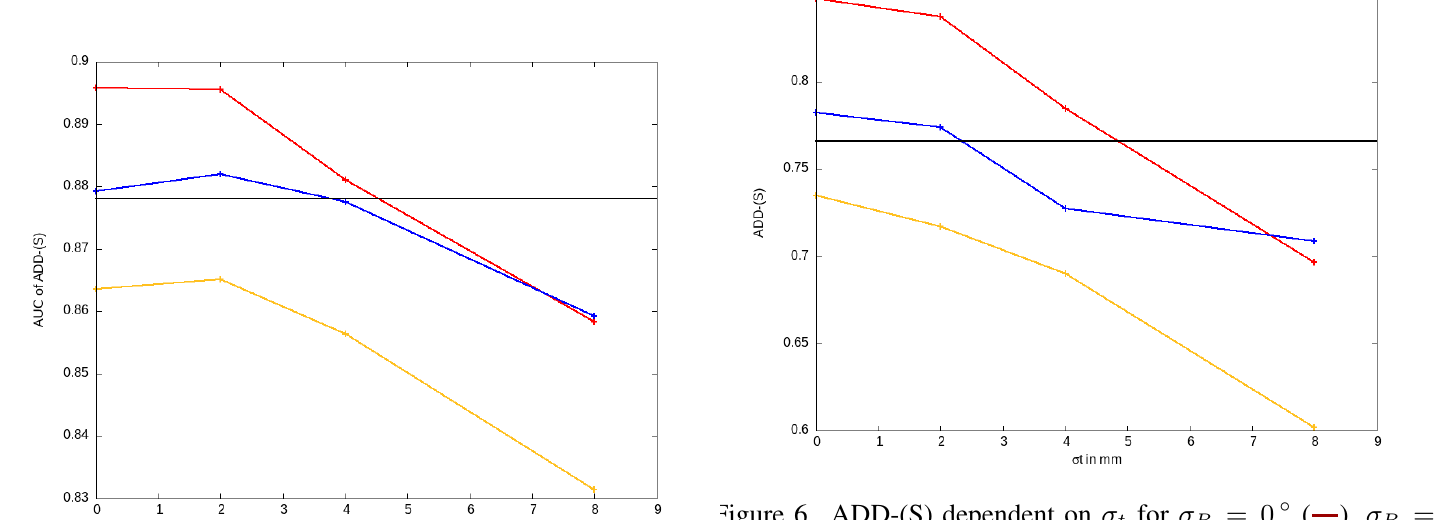
Original Figures 5–6: AUC ADD-(S) on the left and ADD-(S) on the right. Red, blue, and yellow indicate 0°, 2.5°, and 5° rotation noise; black is direct fixed-marker training. Rotation noise and translation noise of 4 mm or more generally reduce performance. Source: CVF Open Access. Image copyright belongs to the paper's authors and publisher; reproduced here for academic analysis.
Pure 2 mm translation noise has little effect; clear degradation starts at 4 mm.
Rotation noise of 2.5° lowers recall by about 1.5–7 percentage points, depending on the metric and translation noise.
With about σR=2.5° plus translation error, or pure translation error of about 4 mm, accuracy can approach or fall below the marker-shortcut approach.
6. Coarse Reading Assessment
This is a practical data-engineering audit rather than a new pose network. Its main finding is a trade-off:
Markers supply accurate, low-labor pose GT but introduce visual shortcuts. Given accurate masks, inpainting removes those shortcuts in these experiments, and label-accuracy gains may outweigh repair artifacts.
Generalization needs caution: real YCB-V covers only 5 objects and excludes two major failures from the average. Independent zero-mean Gaussian noise differs from scene-dependent systematic marker-to-object calibration biases. The approach merits use and further validation, but lossless repair of arbitrary marker-based datasets is not established.
Available src/paper-notes/marker-dataset-bias-wacv2024/deep.md
In-depth paper notes
Support reproduction, comparison, related-work writing, and identifying opportunities for further research.
Paper Reading Notes (Deep): Effects of Markers in Training Datasets on the Accuracy of 6D Pose Estimation
1. What Do Training Images Teach a Pose Network to Use?
Many real 6D pose datasets rely on complex annotation:
Manually align CAD to RGB-D clouds, then refine with ICP;
Use robot kinematics, multiple cameras, or optical motion capture for poses;
Attach active / passive markers for automatic accurate trajectories.
The third option is fast and accurate but creates a conflict: markers appear in training RGB and usually disappear at deployment. Rigidly attached markers have pose-correlated 2D positions, visible counts, and projected shapes. Networks may use them as extra keypoints, easier to learn than object textures.
The controlled experiments ask:
How much do fixed markers hurt markerless testing?
Which is preferable: accurate marker-based labels with image cleanup, or naturally markerless images with coarser labels?
The contribution fits WACV as an empirical analysis of data production, shortcut learning, and GT fidelity rather than a larger model.
2. Causal Variables and Five Training Conditions
BlenderProc2 generates paired images with identical objects, backgrounds, distractors, lighting, physically simulated resting poses, and camera poses. Only marker presence / treatment changes. This isolates causes more effectively than comparing separate real datasets.
Case
Training condition
Question
I
w/o marker
Ideal markerless upper bound
II
w marker
Direct effect of fixed-marker shortcuts
III
inpainting
Recover the upper bound after removal? Do artifacts create a new domain gap?
IV
marker augmentation
Do random 1–5 markers per image induce marker invariance?
V
aug. + marker
Half fixed, half random: real fixed capture + synthetic augmentation
VI / VII
Train with I / II respectively, test with markers
Test actual marker use versus occlusion alone
VIII
Synthetic baseline without real fine-tuning
Measure benefits of 200 real-image fine-tuning
Only training data change; no new pose loss is introduced. GDR-Net retains original parameters and augmentation, with ZebraPose checking model dependence.
3. Dataset Construction
3.1 Controlled Teabox Dataset
One box-shaped tea package;
Synthetic training: 20,000 images, about 800 unique scenes;
Each scene uses random backgrounds, distractors, and physics-generated resting poses, rendered from 25 random camera positions;
Synthetic test: 1,000 images, 500 unique scenes, two views each;
Real training: 200 images each with and without markers;
Real markerless test: 59 images across 3 scenes.
Teabox makes full data-condition and label-noise sweeps tractable, but its simple shape, strong texture, and single identity may not represent textureless or complex symmetric objects.
3.2 YCB-V Subset
Five YCB-V objects are selected:
002 master chef can;
004 sugar box;
008 pudding box;
025 mug;
036 wood block (symmetric).
The large synthetic set has about 80,000 images; synthetic testing uses 1,000 images with about 300 appearances per object. Real BOP / YCB-V testing contains 975 object instances. GDR-Net shares one network across five objects; ZebraPose trains separately per object on about 10,000 images / object.
This exposes cross-object trends and synthetic-to-real failures, but coverage is small and later averages exclude the two worst failures.
The authors use LaMa’s pretrained large-mask inpainting model (Suvorov et al.), without object / dataset adaptation. Mask provenance is central:
Marker 3D positions are known;
Project markers into the current camera image;
Check visibility using scene depth;
Obtain accurate marker masks;
Apply nearest-neighbor binary dilation about 4 times;
After the first inpainting pass, repeat with masks dilated about 8 times.
Original Figure 2: a smaller mask first removes markers, then a larger mask cleans boundary artifacts, producing a largely marker-free image. Source: CVF Open Access. Image copyright belongs to the paper's authors and publisher; reproduced here for academic analysis.
This uses stronger information than generic automatic segmentation because the capture system already knows marker poses. Capture for motion-capture annotation should therefore preserve marker geometry / masks alongside RGB.
Examples cover synthetic YCB-V, real teabox, and textureless tools. Some artifacts and elongated shadows remain without manual cleanup, testing whether an automatic pipeline suffices rather than whether perfect retouching is lossless.
5. Marker Augmentation: Randomizing Correlation
Fixed markers remain at the same object-surface locations, strongly correlating projection and pose. Each synthetic image instead samples 1–5 markers on the surface, resampling overlap or unsuitable geometry.
The aim is to disrupt stable p(marker appearance∣R,t) so one marker position cannot predict pose. Case IV randomizes every image; V randomizes half and retains fixed markers in half, modeling real capture supplemented by synthetic randomization.
This avoids hallucinating hidden textures, but synthetic marker materials, shadows, contact, and specularities may be unrealistic, and random markers still occlude surfaces.
6. Constructing Label Error
To simulate markerless annotation, the BOP toolkit forms colored RGB / depth clouds; a person places CAD near the object and runs ICP. The authors annotate 37 multi-object frames and compare them with exact synthetic poses:
Error interval
0–2
2–4
4–6
6+
Translation-error frame counts (mm)
79
20
9
2
Rotation-error frame counts (°)
76
12
14
10
The authors describe translation errors with a normal distribution of mean μ=0.1 and “variance” σ=2.2. Sparse rotation samples fit common distributions poorly. The subsequent sweep nevertheless approximates translation / rotation perturbations as independent zero-mean Gaussian noise:
σt∈{0,2,4,8}mm,σR∈{0,2.5,5}∘.
Images remain fixed; only training-pose labels are perturbed. Test GT stays exact.
This quantifies random-label-noise sensitivity, not all real error sources. Marker-to-object registration can create object-level systematic bias, while depth scale, extrinsics, and ICP can produce view-correlated errors.
7. Networks, Training, and Metrics
7.1 GDR-Net
RGB-only 6D pose estimator;
teabox: batch size 24, 10 epochs;
YCB-V: batch size 24, 80 epochs;
All data conditions use the same seed to reduce initialization differences;
GDR-Net’s original parameters and augmentation are retained.
A shared seed improves control but no multi-seed mean / variance is reported, leaving uncertainty about 0.5–1-point differences versus training variation.
7.2 Metrics
ADD: mean distance between corresponding model points;
ADD-S: mean predicted-point distance to nearest GT surface points, suitable for symmetry;
ADD-(S): ADD-S for symmetric objects, ADD otherwise;
ADD-(S) success: error below 10% of object diameter;
AUC: ADD-S / ADD-(S) curve area up to a 10 cm threshold.
Table 2 reports AUC ADD-S, AUC ADD-(S), and ADD-(S). AUC ADD-S varies by only about 1 point across conditions; ADD-(S) is more sensitive and drives the shortcut discussion.
8. Teabox Results: Separating Shortcuts, Occlusion, and Domain Mismatch
Original Tables 2–4: Table 2 is the controlled comparison; Table 3 swaps the test domain to verify marker utility; Table 4 tests inpainting real marker images for fine-tuning. Source: CVF Open Access. Image copyright belongs to the paper's authors and publisher; reproduced here for academic analysis.
8.1 Five Training Conditions on Markerless Tests
Case
AUC ADD-S
AUC ADD-(S)
ADD-(S)
I w/o marker
97.1
90.0
84.8
II w marker
96.2
87.8
76.6
III inpainting
97.0
90.0
84.8
IV marker aug.
97.0
89.8
84.2
V aug. + marker
96.7
88.8
80.0
The findings are clear:
Fixed-marker training and markerless testing create a domain mismatch;
Inpainting fully restores the table’s ADD-(S) baseline;
Fully random marker augmentation nearly restores it;
Fixed + random mixtures retain some shortcut.
The paper has an internal numeric inconsistency: Table 2 gives an ADD-(S) gap of 84.8−76.6=8.2 points, Section 4.1 says 5.6 percentage points, and the conclusion says 8. This site uses the table’s 8.2 points rather than repeating 5.6.
The conclusion’s roughly 3-point augmentation gain over unedited markers is closer to mixed Case V, 80.0−76.6=3.4. Fully random Case IV improves by 7.6 points. State the augmentation protocol explicitly.
8.2 Why Surface Occlusion Alone Is Insufficient
Table 3 switches to tests with markers:
Training
AUC ADD-S
AUC ADD-(S)
ADD-(S)
VI w/o marker
96.4
88.3
77.7
VII w marker
97.5
91.0
87.1
If markers only occluded surfaces, marker-trained models would not clearly win on marker tests. The network uses markers as pose-discriminative features, helpful when present in both domains. Deployment mismatch is the real issue.
8.3 Real Teabox Fine-Tuning
Fine-tune a markerless synthetic model on 200 real images for 6 epochs, then evaluate on 59 real markerless images:
Real fine-tuning data
AUC ADD-S
AUC ADD-(S)
ADD-(S)
I markerless real
93.6
79.0
45.8
III inpainted real
93.2
79.1
47.5
VIII no real finetuning
88.8
71.9
20.3
The two fine-tuning strategies are close and both exceed no fine-tuning by over 25 points. This supports automatic cleanup of real marker images before pose training, but 59 test images, one object, and 3 scenes cannot resolve small differences across broad domains.
9. YCB-V: Similar Averages and Object-Level Failures
9.1 Synthetic test
Five-object GDR-Net averages:
markerless I: AUC ADD-S 79.9, ADD-S 78.0;
inpainting III: AUC ADD-S 81.3, ADD-S 77.5.
Objects improve or decline without a consistent advantage: evidence supports no systematic harm from inpainting, not universal pose improvement.
9.2 Real test
Original Tables 6–7: Table 6 averages only 002, 004, and 008. Table 7 shows this shared five-object network performing far worse on mug and wood block than the original GDR-Net configuration. I versus III is the relevant comparison, not overall state-of-the-art ranking. Source: CVF Open Access. Image copyright belongs to the paper's authors and publisher; reproduced here for academic analysis.
Object
I AUC ADD-S
III AUC ADD-S
I ADD-S
III ADD-S
002 master chef can
92.1
94.3
79.7
86.7
004 sugar box
96.8
96.1
98.9
95.7
008 pudding box
89.1
89.1
76.0
78.7
025 mug
65.3
52.1
18.7
4.7
036 wood block
17.7
4.3
0.0
0.0
Only the first three objects enter the reported average: AUC ADD-S 92.6 → 93.2 and ADD-S 84.9 → 87.0. Mug and wood block are excluded for synthetic-to-real failures.
This averaging must be explicit, rather than simply claiming a 2.1-point YCB-V improvement. Including all five would change the conclusion substantially. The authors openly show failures and distinguish their shared network from GDR-Net’s per-object / alternative setup in Table 7, but post-hoc exclusion still makes the average selective.
9.3 ZebraPose Cross-Check
To test dependence on GDR-Net, ZebraPose trains per object:
Test domain
Markerless I
Inpainting III
Synthetic AUC ADD-S
92.9
92.3
Real AUC ADD-S
60.9
61.8
The strategies remain close and swap direction between synthetic / real data. This strengthens no-obvious-harm evidence but not stable 0.6–0.9-point gains, especially without multi-seed variance.
10. Label Noise: Accurate GT Can Offset Marker-Removal Costs
Original Figures 5–6, cropped side by side by this site: horizontal axes are translation-noise standard deviations; red / blue / yellow denote 0° / 2.5° / 5° rotation noise. Black is direct fixed-marker training (Case II). AUC and threshold recall differ in sensitivity, but rotation and larger translation errors erode accurate-label benefits. Source: CVF Open Access. Image copyright belongs to the paper's authors and publisher; reproduced here for academic analysis.
Adding 2.5° rotation noise alone can reduce recall by about 1.5–7 points;
Case II’s black line provides a trade-off: sufficiently coarse manual markerless labels may be worse than accurate labels with marker shortcuts. The preferred approach here is accurate tracking followed by inpainting.
Curves are not strictly monotonic: some σt=2 combinations improve slightly, and σt=8,σR=2.5° may beat pure 8 mm noise. The authors note this. With one seed, training randomness or noise regularization is more plausible than a general benefit from rotation noise.
11. What Is Actually Established?
Claim
Evidence strength
Interpretation
Fixed markers create pose shortcuts
Strong
Paired synthetic controls plus marker-test sanity check
Two-stage inpainting restores teabox baseline
Strong
Exact Table 2 match and consistent real fine-tuning
Inpainting is broadly harmless on YCB-V
Moderate
GDR-Net / ZebraPose averages are close, but few objects, two severe failures, and no multiple seeds
Marker augmentation works
Moderate
Fully random IV nearly recovers; practically feasible mixed V only partly recovers
Conditional on better labels, known masks, suitable repair, and stable calibration
12. Limitations and Potential Biases
12.1 Narrow Object / Scene Coverage
The causal study uses teabox; YCB-V adds only five objects. Texture, relative marker size, mounting surfaces, and symmetry can all change shortcut strength.
12.2 Nearly Oracle Masks
Known 3D marker positions, camera poses, and depth visibility give highly accurate masks. A capture system preserving only object pose would make cleanup harder.
12.3 Residual Marker Shadows
Elongated shadows can remain, although uncommon under the chosen lighting. Networks could infer marker locations from shadows; limited impact here does not establish lighting-independent robustness.
12.4 Selective Real-Test Averaging
Table 6 excludes mug / wood block after observing failures. Publishing complete per-object rows is valuable; this site must retain failed rows and explain the average.
12.5 One Seed and No Uncertainty Intervals
A shared seed controls comparisons but is not repeated training. The 8.2-point teabox effect is robust; 0.6–2.1-point YCB-V differences may reflect variation.
12.6 Label Noise Is Not Full Calibration Error
Independent zero-mean Gaussian noise mainly models random manual errors. Object–marker registration, camera extrinsics, or clock errors may impose a consistent SE(3) bias across frames, harder to average away.
13. Reproduction Essentials
Use 6DPoseDataGenTools to record paired scenes under the same seed;
Ensure markerless / marker / inpainting / augmentation conditions change only the intended variables;
Preserve marker 3D poses and masks, not just final object GT;
Distinguish AUC ADD-S, AUC ADD-(S), and 10%d ADD-(S);
Reproduce the Table 2 8.2-point gap, not the contradictory 5.6 in the text;
Report real YCB-V averages for both 3 retained objects and all 5;
Run at least 3–5 seeds and provide confidence intervals for small differences;
Test systematic SE(3) calibration bias, depth-scale bias, and correlated temporal drift;
Use activation / occlusion attribution to check attention to inpainting boundaries or marker shadows.
Release raw and cleaned RGB: allow later inpainting choices and artifact audits.
Add marker-swap tests: place markers inconsistently with GT to quantify shortcut reliance.
Evaluate all four train / test marker combinations: report more than marker training → markerless testing.
Provide GT uncertainty: record object–marker registration and synchronization errors rather than treating motion capture as exact.
Look beyond averages: stratify by material, symmetry, marker-area fraction, occlusion, and pose bins.
15. Overall assessment
The contribution is a data-quality principle rather than a new state-of-the-art estimator:
Any device used to obtain labels can also become a visual shortcut for predicting them. Removing its appearance and preserving label accuracy must be designed together.
Paired synthetic controls, real fine-tuning, cross-object YCB-V tests, a second pose network, and label-noise sweeps provide a broad evidence chain. Fixed markers cause domain mismatch; two-stage inpainting is nearly lossless here; label accuracy matters.
Generalization remains limited by five objects, one seed, oracle masks, Gaussian noise, and selective averages. New datasets should integrate marker removal, calibration uncertainty, and shortcut auditing into their protocol rather than treat cleanup as final retouching.