MemPose: Category-level Object Pose Estimation with Memory
MemPose adds per-category external feature memory of length 96 to an AG-Pose-style RGB-D category-level 9-DoF pipeline. Historical pooled local keypoint features are updated through similarity merging with Gumbel perturbations; current keypoints read memory through attention and gated fusion. Main results freeze memory: REAL275 IoU75 81.0 / 5°2 cm 59.9, HouseCat6D IoU50 81.5 / IoU75 56.4, and Wild6D IoU75 46.2. The model uses 225M parameters at 33 FPS versus AG-Pose's 223M at 35 FPS. Test-time updates raise REAL275 5°2 cm to 63.6 only in additional experiments, without a complete stream-order or contamination-prevention protocol.
predefined object category label for memory routinginstance mask from Mask R-CNN or an equivalent segmentordepth and camera intrinsics for point-cloud back-projectioncategory-level 9DoF and NOCS supervision during trainingtraining-time memory buffers saved with the model checkpoint
Full paper metadataAuthors, affiliations, research area, datasets, metrics, method tags, and reading statusExpandCollapse
predefined object category label for memory routinginstance mask from Mask R-CNN or an equivalent segmentordepth and camera intrinsics for point-cloud back-projectioncategory-level 9DoF and NOCS supervision during trainingtraining-time memory buffers saved with the model checkpoint
Reading Notes
Overview / Deep Dive
Available src/paper-notes/mempose-eccv2026/coarse.md
Paper overview notes
Quickly assess the paper's scope, problem setting, core method, experimental findings, and whether to read it in depth.
Paper Reading Notes (Coarse): MemPose: Category-level Object Pose Estimation with Memory
1. Basic information
Title: MemPose: Category-level Object Pose Estimation with Memory
Code / project: none linked by the paper, arXiv, or ECCV at this site’s verification time
Reading mode: Overview
2. Positioning in one sentence
MemPose adds per-category external feature memory to an AG-Pose-style RGB-D 9DoF pipeline. Historical local keypoint features become a 96-entry buffer, updated by similarity merging with Gumbel noise, retrieved by attention, and fused through gates. Main results freeze memory after training, yielding small to moderate REAL275, CAMERA25, HouseCat6D, and Wild6D gains.
Key assessment
Its main idea shifts category knowledge from fixed shape priors or network weights into readable / writable nonparametric feature prototypes. The simple, low-parameter addition has cross-dataset and ablation support.
Memory does not imply continuous deployment learning: main results freeze the trained buffer; test-time updates appear only in an extra REAL275 experiment. Standard MemPose is a feedforward pose network with external category prototypes, not a validated lifelong-learning or unsupervised online-adaptation system.
Gains beyond parameter count and potential updates
33 FPS beating 35 FPS, or risk-free test updates
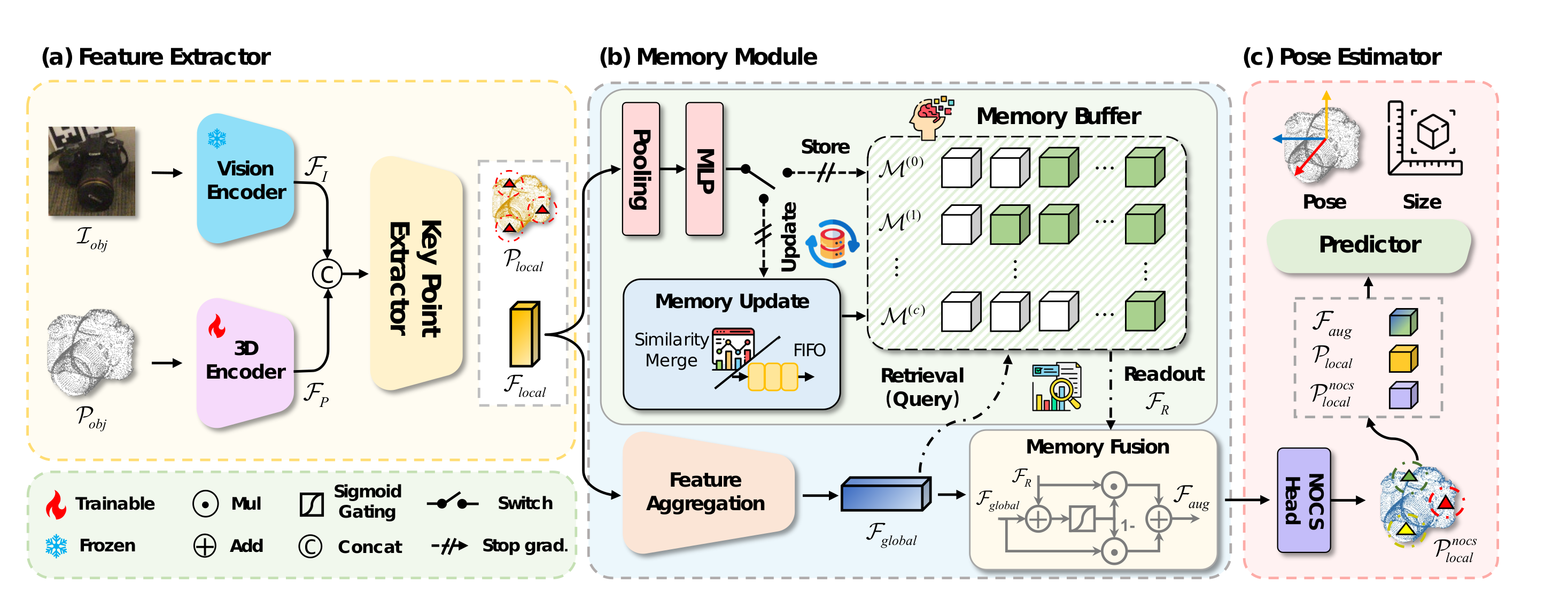
Original Figure 2: DINOv2 / PointNet++ extract RGB-D features; adaptive keypoints represent local structure. Category buffers write, merge, retrieve, and gate features before NOCS, rotation, translation, and size prediction. Source: arXiv. Image copyright belongs to the paper's authors and publisher; reproduced here for academic analysis.
3. Problem setting
Task: category-level object pose and size estimation (COPE).
Setting: predefined categories with unseen test instances, without instance-specific CAD.
Inputs: RGB crop Iobj, cloud Pobj back-projected from cropped depth and intrinsics, external instance mask, category ID.
Outputs: rotation R∈SO(3), translation t∈R3, and 3-axis size s∈R3: 9DoF pose and size.
CAD: no target-instance CAD at inference, but 9DoF / NOCS training supervision remains.
Task Boundaries
Model-free here means no instance CAD, not absence of detection, masks, depth, categories, or supervision.
Operates on one segmented object, not full-image instance discovery.
Memory contains pooled learned features, not RGB, CAD, maps, or displayable NOCS models.
Main inference freezes memory; only an extra experiment updates from the test stream.
4. Core motivation
Within-category shape variation motivates two existing knowledge sources:
Explicit shape priors: average models with deformation are interpretable but costly to prepare and fixed afterward.
Parametric prior-free networks: PointNet, DINOv2, keypoints, or spherical features encode categories in efficient but fixed weights.
The authors add an external updateable, instance-retrievable experience pool, compressing keypoint context into one token per object in a fixed-capacity category buffer.
5. Method overview
5.1 RGB-D and Keypoints
Frozen DINOv2 ViT-S/14 extracts RGB semantics.
PointNet++ extracts geometry from 1,024 input points.
Interpolate corresponding DINOv2 features onto points and concatenate with geometry.
Initialize 96 learnable category embeddings that cross-attend salient regions.
Cosine similarity and softmax weights yield 96 adaptive keypoints and local features.
5.2 Memory Writing and Updates
Each category has a buffer of length L=96 and dimension C=256. Average-pooled local features pass through an MLP and normalization to form entries.
Warm-up: fill without retrieval or merging;
Once full, compare new / stored entries by cosine similarity;
Add Gumbel noise with scale λ=0.1;
Merge the highest-scoring stored entry with the new entry using a 1/2 mean;
Update before retrieval.
This keeps capacity fixed but is not a count-weighted unbiased mean: each merge absorbs new data with 0.5 weight and depends on order.
5.3 Retrieval and Fusion
AG-Pose-style geometry aggregation forms global features per keypoint. These query 96 category entries as keys / values through scaled dot-product attention, yielding FR.
A sigmoid gate fuses historical and current features:
Memory: 96 entries per category; 6 categories for REAL275 / Wild6D, 10 for HouseCat6D.
Stored with register_buffer, outside optimization and backpropagation.
One NVIDIA L40; 120K iterations; batch 36.
Adam; triangular2 cyclical learning rate from 2×10⁻⁵ to 5×10⁻⁴.
Mask R-CNN masks as in AG-Pose / DPDN.
Three Distinct States
State
Memory writes?
Main tables?
Meaning
Training warm-up
Yes, fill first
Yes
Avoid retrieval from unstable early features
Frozen inference after training
Read only
Yes
Tables 1–3; no test-history updates
Test-time update
Yes, current stream
Table 8 only
Define order, reset, and transductive fairness
7. Experimental overview
7.1 Data and Metrics
Dataset
Role
Main use
CAMERA25
300K synthetic RGB-D, six NOCS categories
Synthetic train / test; part of REAL275 / Wild6D training
REAL275
Six-category real NOCS tests
Main benchmark and memory ablations
HouseCat6D
Ten household categories, occlusion, glass, cutlery
Harder categories and materials
Wild6D
Five categories, 162 objects, 486 background videos
Test split only; train on CAMERA25 + REAL275
Metrics include 3D-box IoU mAP and joint 5°2 cm, 5°5 cm, 10°2 cm, 10°5 cm. The methods section does not restate symmetry-evaluator conventions; use benchmark protocols.
7.2 Main results
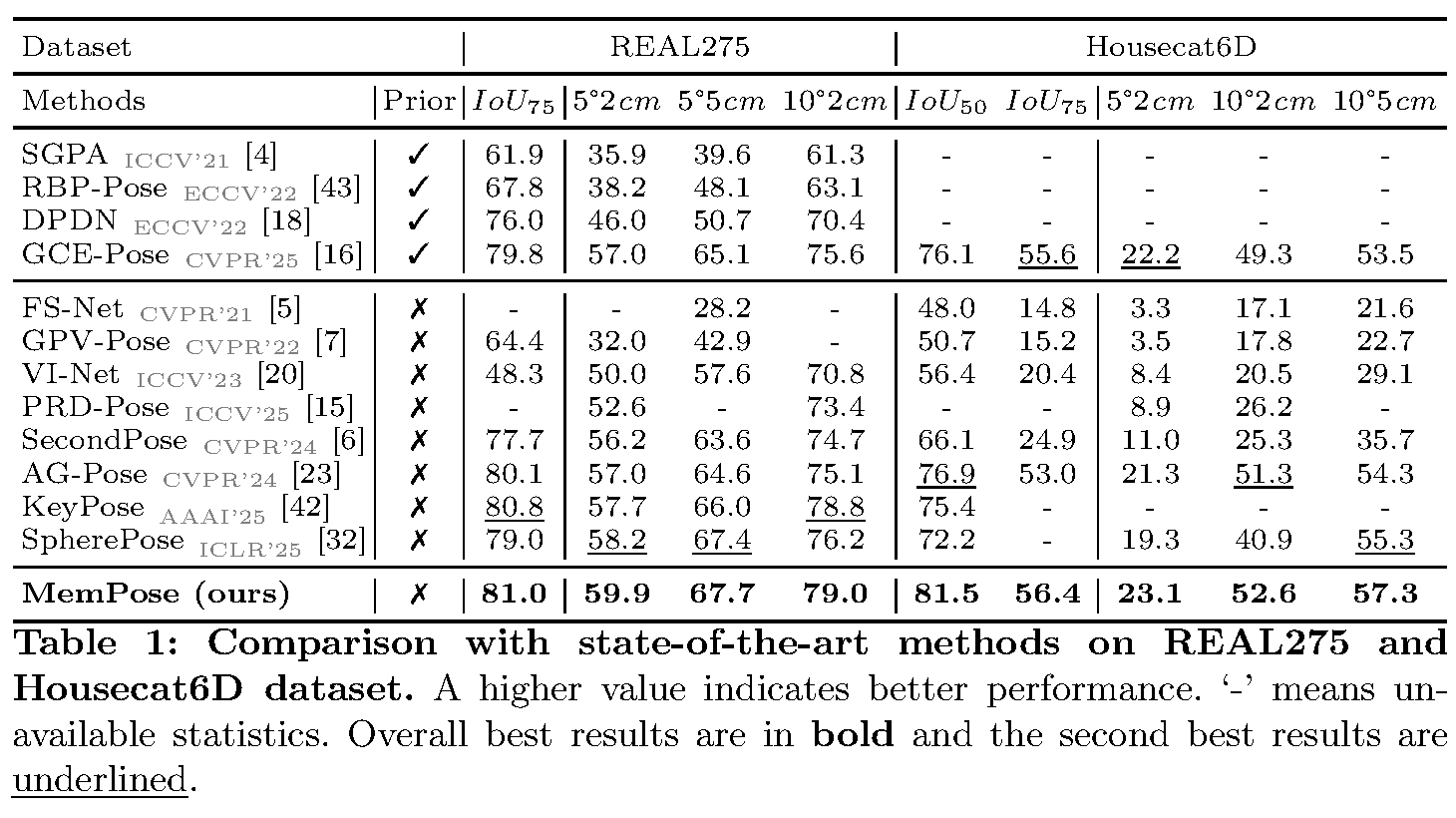
Original Table 1: REAL275 IoU75 81.0, 5°2 cm 59.9, 5°5 cm 67.7, 10°2 cm 79.0; HouseCat6D IoU50 81.5, IoU75 56.4, 5°2 cm 23.1, 10°2 cm 52.6, 10°5 cm 57.3. Source: arXiv. Image copyright belongs to the paper's authors and publisher; reproduced here for academic analysis.
Gains span real domains but vary in size: strict REAL275 pose usually improves 1–3 points, HouseCat6D IoU more clearly, and Wild6D supports video-domain transfer.
7.3 Memory ablation
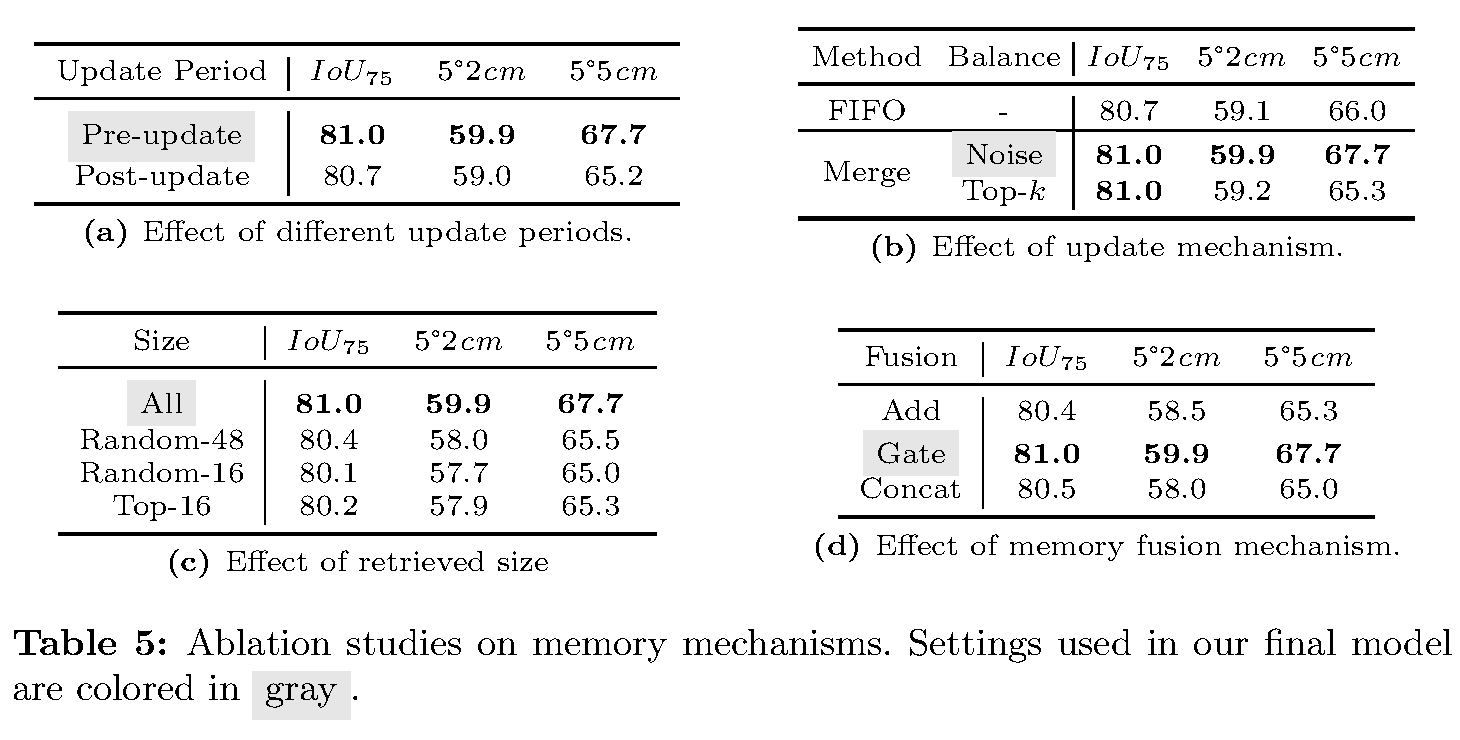
Original Table 5: pre-update, noisy similarity merging, all 96 entries, and gate fusion form the final configuration. Most gaps are about 0.3–2.7 points; gates add 2.7 over concatenation at 5°5 cm. Source: arXiv. Image copyright belongs to the paper's authors and publisher; reproduced here for academic analysis.
Buffer 0→96: IoU75 79.5→81.0, 5°2 cm 57.0→59.9, 10°2 cm 75.1→79.0; length 256 adds no further benefit.
Locally pooled entries outperform global / fused entries.
Warm-up, pre-update, noise-balanced merge, and gates beat their alternatives.
All 96 entries beat random / attention Top-16 by modest margins; retrieval latency is not broken down.
Table 6 no-memory IoU75 is 79.5, versus AG-Pose 80.1 in Tables 1 / 7, an unexplained 0.6-point reproduction gap.
7.4 Parameters, Speed, and Test Updates
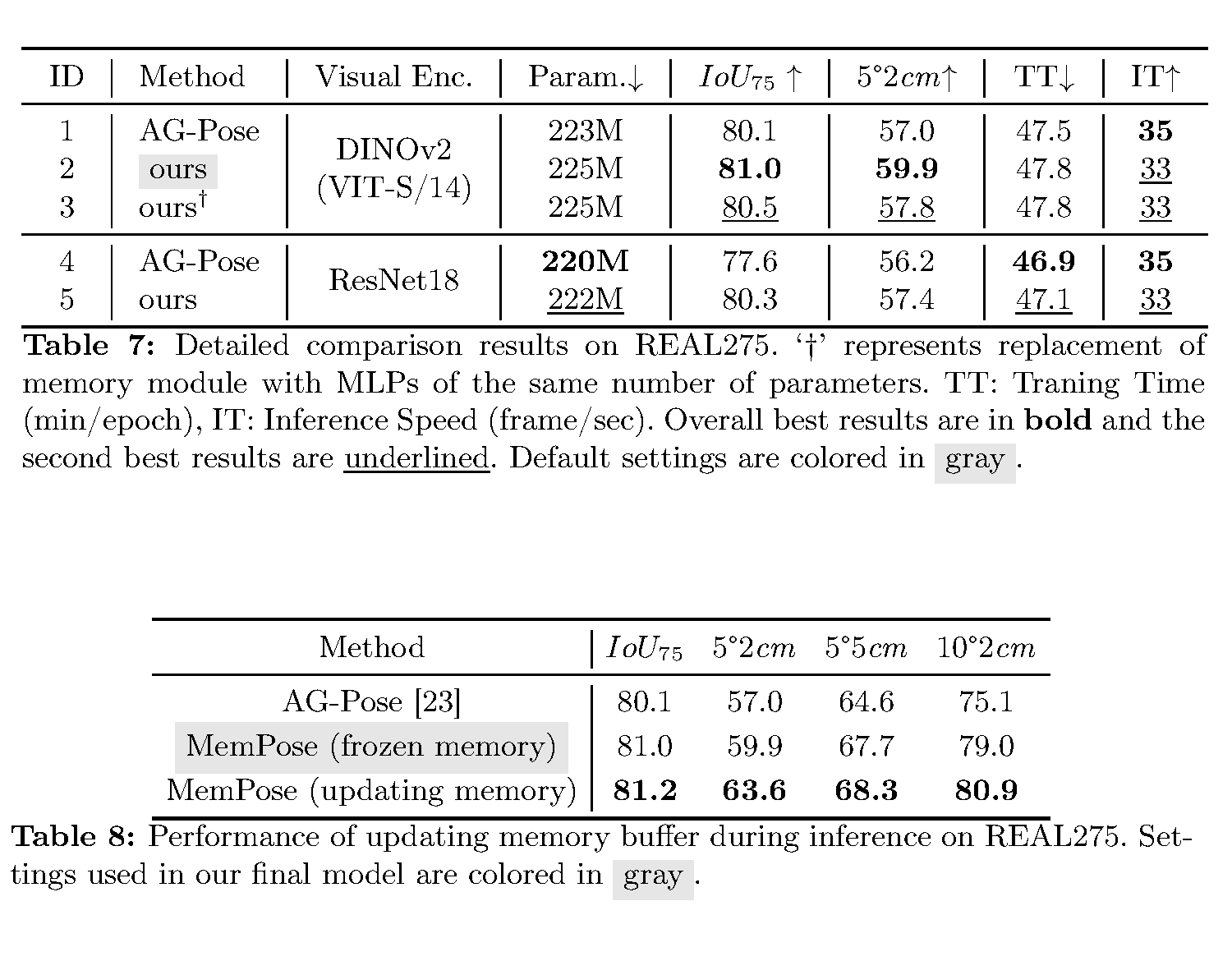
Original Tables 7–8, stacked by this site without changing values: MemPose 225M parameters / about 33 FPS versus AG-Pose 223M / 35 FPS. Main results freeze memory; test updates raise REAL275 5°2 cm from 59.9 to 63.6. Source: arXiv. Image copyright belongs to the paper's authors and publisher; reproduced here for academic analysis.
Same DINOv2: 223M→225M parameters, 47.5→47.8 min / epoch, 35→33 FPS.
The text calls 33 versus 35 FPS slightly higher throughput, opposite to the table. MemPose is about 2 FPS slower.
An equal-parameter MLP reaches IoU75 80.5 / 5°2 cm 57.8, below memory at 81.0 / 59.9. Gains exceed parameter count alone, though MLP also slightly beats AG-Pose.
Test updates raise REAL275 5°2 cm from 59.9 to 63.6. Stream order, resets, scene contamination, and order variance are underspecified, justifying separation from main comparisons.
8. Strengths and limitations
Strengths
Clear memory integration into a strong RGB-D keypoint baseline supports transfer to other category-pose networks.
Fixed per-category nonparametric capacity adds only about 2M learnable parameters.
Frozen main protocols avoid using test updates to inflate comparisons.
REAL275, CAMERA25, HouseCat6D, Wild6D cover synthetic, controlled real, and video domains.
Code / project: no public code or project page linked by the paper, arXiv, or ECCV at this site’s verification time
Reading mode: Deep Dive
Reading focus: what external memory stores, whether writing / retrieval constitutes dynamic memory, whether main results update on the test stream, and whether gains can be separated from parameter count, backbone, and mask settings.
2. Positioning in one sentence
MemPose is an RGB-D category-level 9DoF object pose and size network. It builds on AG-Pose’s instance-adaptive keypoints and geometric aggregation, storing each historical training instance’s pooled local features in a nonparametric per-category memory buffer of length 96. Similarity merging with Gumbel noise updates new tokens; current keypoints attend to historical representations and fuse them through a sigmoid gate before joint NOCS, rotation, translation, and size prediction.
My central assessment
MemPose proposes a storage format for category knowledge, rather than a new pose representation or geometric solver. It seeks a third route between fixing category shape as an average prior and implicitly compressing all experience into static weights: a readable / writable feature prototype bank with fixed capacity, carried in checkpoints.
Experiments support its effectiveness on an AG-Pose-style baseline: most REAL275, HouseCat6D, CAMERA25, and Wild6D metrics improve; an equal-parameter MLP does not recover the full benefit; and update / retrieval / fusion ablations agree in direction. HouseCat6D IoU and Wild6D IoU75 gains particularly suggest benefits beyond the synthetic NOCS domain.
However, the paper’s dynamic memory narrative must be separated by stage:
During training, the buffer updates with mini-batches and is indeed dynamic.
All main benchmarks freeze the buffer at inference and use only query-dependent readout.
Continued test-time updates appear only in an additional REAL275 experiment, without stream-order, reset, leakage-boundary, or cross-domain contamination protocols.
Standard MemPose is therefore not a fully validated continual learner. A more precise description is: nonparametric category priors for frozen inference, produced by dynamic compression during training.
Most gaps are small; not every choice is a major breakthrough
Tables 7–8
Parameters, training time, FPS, equal-parameter MLP, ResNet18, frozen / updated memory
Separates parameter increases from memory effects and reveals test-update potential
The original wording reverses 33 vs. 35 FPS; test updates differ from the fair main-table setting
Original Figure 2: frozen DINOv2 and a trainable 3D encoder extract RGB-D representations, and an instance-adaptive keypoint extractor produces local structural features. Category memory handles writes, updates, queries, and gated fusion; enhanced keypoint features feed NOCS and pose / size prediction. Source: arXiv. Image copyright belongs to the paper's authors and publisher; reproduced here for academic analysis.
3. Problem setting and task boundaries
3.1 Task definition
Given an RGB-D image containing objects from predefined categories, an external instance mask first defines the object crop:
Iobj∈RH×W×3.
Depth, mask, and camera intrinsics back-project the observation, which is downsampled to:
Pobj∈RN×3.
The goal is to recover this unseen instance’s 9DoF pose and size:
R∈SO(3),t∈R3,s∈R3.
Here R,t is the rigid pose from object coordinates to camera coordinates, and s is the size along three axes. 9DoF collectively denotes rotation, translation, and anisotropic size; it is neither an arbitrary affine transform nor a set of nonrigid deformation parameters.
3.2 Instance-level / category-level and seen / unseen
Category-level: training covers predefined semantic categories; test objects are new instances of those categories.
Unseen instance: no CAD or instance-specific training is needed for the test object, but its semantic category is included in training.
Not an unseen category: routing explicitly selects category buffers; the paper specifies no unknown detection or new-buffer initialization for objects outside training categories.
Not instance-level model-based pose: the method does not use target CAD for 2D–3D template matching or registration.
3.3 Inputs, outputs, and dependencies
Item
Required?
Evidence / role
RGB
Yes
DINOv2 ViT-S/14 supplies semantic features
Depth
Yes
Back-projects a 1,024-point object cloud; PointNet++ supplies geometric features
Camera intrinsics
Yes
Construct the camera-frame point cloud from crop depth
Instance mask
Yes
The paper uses the same Mask R-CNN masks as AG-Pose / DPDN
Category ID
Yes
Selects the category-specific memory buffer
Target CAD
No
A main benefit of the category-level prior-free setting
NOCS / 9DoF GT
During training
Supervises NOCS, rotation, translation, size, and keypoint constraints
Multi-view / video
No
Standard input is a segmented single RGB-D frame; Wild6D videos are only a data source
Test-time optimization
No
Main results use one forward pass plus memory readout, without iterative refinement
3.4 Model-free does not mean prior-free in every sense
This paper and the category-level pose community often call independence from instance CAD model-free. MemPose still uses substantial priors:
A category vocabulary and category IDs.
Training data annotated with 9DoF / NOCS labels.
Mask R-CNN segmentation;
Depth and a camera model.
Category memory compressed from training data.
DINOv2’s large-scale visual pretraining.
Thus, “CAD-free category-level pose” is appropriate wording, rather than “requiring no models or priors.”
3.5 Is the pipeline end-to-end?
The network from RGB-D crops to R,t,s is jointly trained, but the full system is not end-to-end from raw scenes: an external detector supplies masks, and category routing is determined before the pose network. Missed detections, wrong categories, and masks mixing multiple instances are not addressed in the main model design.
4. Research context
4.1 Shape-prior methods
NOCS defines a normalized object coordinate space, mapping different instances of a category into a shared canonical frame. SPD, SGPA, RBP-Pose, DPDN, GCE-Pose, and others further use average category shape priors, deformation, and correspondence to recover instance shape or matches before solving pose.
These methods offer explicit structural priors compatible with NOCS / correspondence, but incur prior-construction and preprocessing costs; a fixed template also struggles with long-tailed within-category geometry. MemPose does not deform such a prior: it takes no explicit shape prior as input.
4.2 Prior-free parametric methods
FS-Net, GPV-Pose, VI-Net, SecondPose, AG-Pose, KeyPose, SpherePose, and others learn pose-sensitive representations directly from RGB-D / clouds. AG-Pose is particularly close: instance-adaptive keypoints and local / global geometric aggregation establish category-level correspondence.
MemPose inherits much of its backbone, keypoint extraction, and pose head from AG-Pose. Its additions are:
Pool local keypoint features into a memory entry.
Maintain a fixed-capacity buffer for each category.
Use similarity-based merging and balance.
Read through attention and fuse through gates.
The fairest question is therefore whether external memory yields repeatable gains on a strong prior-free keypoint baseline such as AG-Pose, rather than whether MemPose surpasses every approach to category-level pose.
4.3 Difference from temporal memory
MemFlow, streaming point tracking, 3D object tracking, VLA memory, and video memory usually depend on temporal continuity: memory stores earlier states of the same scene or object. MemPose requires neither the same instance nor continuous video. It aggregates pooled features from different training instances by semantic category for intra-category analogical retrieval.
Its memory is thus closer to a category prototype bank than trajectory memory. Only the test-update variant begins to resemble stream memory, and continual sequences are not central to the evaluation.
4.4 Relationship to retrieval / prototype learning
From a machine-learning perspective, MemPose can be understood as:
A parametric encoder generates the current query.
A nonparametric buffer stores prototype tokens from the training distribution.
A gate controls the mixture of current features and historical prototypes.
Calling this memory is reasonable, but writing, reading, and finite capacity do not automatically imply human-like memory. Establishing learned geometric semantics requires more systematic retrieval analysis than a single attention example.
5. Research motivation
5.1 Why is a fixed average shape insufficient?
A category can include tall and squat cups, different handles, shoe styles, or camera bodies. Average shapes often blur minority instances’ local structures, and a prebuilt prior does not update with new data.
5.2 Why are network parameters insufficient?
In principle, large-model weights can encode all category experience, but weight updates require backpropagation. Observing a new instance at deployment does not immediately add a structural prototype. An external buffer allows retrievable content to change without changing parameters.
5.3 Why store local keypoints rather than final pose features?
The authors argue that final output features depend strongly on the current network state and recent updates, potentially favoring temporal recency over geometric relevance during retrieval. They choose average-pooled local keypoint features to represent local structure more directly.
This motivation is plausible, but average pooling discards keypoint arrangement, relative positions, and multiple local modes. Whether these tokens are more geometric than global features is supported mainly by Table 4a’s performance differences, not explicit shape reconstruction or retrieval-precision metrics.
5.4 Why fixed capacity?
Storing every historical instance would grow memory and attention complexity with training-set size. A category buffer of length 96 fixes the compute budget, while similarity merging seeks to compress similar instances into a token.
6. Method details
6.1 Overall pipeline
Mask R-CNN supplies the object mask to crop RGB and depth.
Camera intrinsics back-project depth into a 1,024-point object cloud.
Frozen DINOv2 extracts RGB semantics, and PointNet++ extracts point features.
Interpolate image features onto 3D points and concatenate with point features.
Cross-attention uses 96 learnable category embeddings to identify instance-adaptive keypoints.
Local keypoint features are both written to category memory and geometrically aggregated.
After memory warm-up, update first, then query all entries using global keypoint features.
Fuse retrieved and current global features through a sigmoid gate.
A NOCS head predicts canonical keypoint coordinates; a pose / size head jointly recovers R,t,s.
6.2 Module inputs and outputs
Module
Input
Output
Role
Main risk
DINOv2 encoder
224×224 RGB crop
Point-aligned FI
Semantic and texture context
Frozen-backbone domain bias; specular and textureless cases may still fail
PointNet++
1,024-point object cloud
FP
Local 3D geometry
Depth holes and background inside masks contaminate features
Keypoint extractor
Concatenated Fobj, 96 category embeddings
Plocal,Flocal
Stable, discriminative object regions
No guarantee of fixed keypoint semantics across instances
Memory writer
Pooled Flocal
One Fmem
Compresses one instance into one token
Average pooling loses spatial structure
Similarity merge
New token + category buffer
Updated fixed-capacity buffer
Removes redundancy while retaining new experience
A 0.5 mean has no counts, is order-sensitive, and may overwrite rare shapes
Geometric aggregation
Current local keypoint features / neighborhoods
Fglobal
Local and global structural context
Inherits AG-Pose’s assumptions and complexity
Memory retrieval
Fglobal query + 96 entries
FR
Reads category experience relevant to the current object
Attention may retrieve by pose / appearance rather than shape
Gated fusion
FR,Fglobal
Faug
Adaptively controls historical and current contributions
No explicit confidence or out-of-distribution rejection in the gate
NOCS / pose head
Faug,Plocal,Plocalnocs
R,t,s
Produces 9DoF predictions
Depends on NOCS supervision and external masks
6.3 RGB-D feature extraction
PointNet++ produces:
FP∈RN×C1.
DINOv2 ViT-S/14 image features are projected onto 3D points through pixel correspondence and linear interpolation:
FI∈RN×C2.
After concatenation:
Fobj=[FP;FI]∈RN×C,
Experiments set C1=C2=128 and C=256. The snowflake in the figure marks the frozen visual encoder; the 3D encoder and subsequent modules are trainable.
6.4 Instance-adaptive keypoints
The model initializes M=96 learnable category embeddings:
Fcat∈RM×C.
Cross-attention uses Fobj as context to obtain instance features:
Fins=CrossAttn(Fcat,Fobj).
Cosine similarities between Fins and each object-point feature then form:
H∈RM×N.
Softmax weights yield weighted coordinates and features:
Plocal=softmax(H)Pobj,Flocal=softmax(H)Fobj.
These keypoints are data-driven soft locations, rather than conventional FPS or manually defined semantic landmarks. They can move with instance shape, but maintaining part semantics across instances requires joint NOCS, pose, diversity, and reconstruction constraints.
6.5 Category-specific memory
The paper defines per-category buffers:
M={M(c)∣c=0,…,k},M(c)∈RL×C.
Here L=96. REAL275 / Wild6D settings involve 6 categories and HouseCat6D has 10, so the nonparametric memory tensors contain approximately 6×96×256 and 10×96×256 values, respectively, far fewer than 225M learnable parameters.
Entry construction
Average-pool an instance’s 96 local features:
Flocalavg=AvgPool(Flocal),
Then apply an MLP and normalization:
Fmem=Norm(MLP(Flocalavg)).
Each instance ultimately contributes one 256-dimensional token. This makes retrieval inexpensive but compresses the configuration of multiple local keypoints into an unordered mean. The “structural representation” resides mainly in encoder features; the token itself stores neither point coordinates nor adjacency.
6.6 Warm-up, updates, and Gumbel balance
Each category buffer starts empty. Before it contains L entries, the model only enqueues features, without retrieval / merging. The authors argue that this prevents unstable early-training features from participating in queries.
Once full, compute cosine similarities between a new token and existing entries:
i∗=argimaxcos(Fmem,Mi(c)).
The basic merge is:
Mi∗(c)←21(Mi∗(c)+Fmem).
To prevent repeated selection of a few frequent slots, the final configuration adds Gumbel noise to similarity:
g=−log(−logu),u∼U(0,1),simi←simi+λg,qquadλ=0.1.
This lightly randomizes selection of the most similar entry for balance. The paper also compares FIFO and random top-k selection.
My analysis: the statistical meaning of a 0.5 merge
If a slot successively absorbs x1,x2,… through m←(m+x)/2, the newest sample always receives weight 0.5 and older contributions decay exponentially. This is not the mean of all historical samples in that cluster, and it records no count. It adapts quickly to new distributions, but batch order, category frequency, and outliers may substantially change the final checkpoint memory.
The paper reports neither memory variance across data orders nor entry age, update counts, or cluster occupancy visualizations. Long-term extensions should compare count-weighted means, EMA decay, reservoir sampling, coresets, and uncertainty-aware replacement.
6.7 Update-before-retrieve
The final setting updates memory with the current sample before retrieval. Its token may therefore already have entered the buffer directly or indirectly when it reads from that buffer. The authors describe this as using the latest context; Table 5a also favors it over post-update.
This differs somewhat from reading historical experience from “previously observed instances”: the current sample has a short path back into its own enhanced features. Stop-gradient / nontrainable buffer storage makes this different from an ordinary residual connection, but retrieval may more easily match the current instance. Leave-current-out retrieval would more strictly test whether gains arise from cross-instance memory rather than self-entries.
6.8 Memory retrieval
Current keypoints first undergo AG-Pose-style geometric aggregation, combining kNN local details with global relationships among all keypoints:
Fglobal∈RM×C.
The current category’s L entries form keys and values:
Each current keypoint can assign different attention to the 96 category entries. Although an entry is an instance-level pooled token, queries remain at keypoint level, so FR and Fglobal share dimensions.
6.9 Adaptive gate fusion
Direct addition assumes memory is always reliable; concatenation leaves all fusion to subsequent layers. MemPose explicitly predicts a gate:
With WR,Wf∈RC×1, each keypoint receives a scalar mixing weight broadcast across feature channels. This is lighter than channel-wise gating but cannot express trust in some feature dimensions and distrust in others.
6.10 NOCS, pose, and size prediction
Self-attention and an MLP process Faug to predict keypoint NOCS coordinates:
Plocalnocs∈RM×3.
The final predictor jointly reads Plocal, Plocalnocs, and Faug to recover R,t,s. Rather than specifying an Umeyama closed-form solver, the paper describes joint prediction based on keypoint correspondences and features.
7. Training objectives and engineering complexity
7.1 Pose loss
Lpose=∥Rgt−R∥2+∥tgt−t∥2+∥sgt−s∥2.
L2 on rotation matrices is simple and stable but is not an SO(3) geodesic distance. This term does not explicitly minimize over symmetry-equivalent rotations. Training labels and evaluation for symmetric categories need confirmation from the data protocol or code.
7.2 Keypoint diversity loss
For keypoint pairs closer than threshold th1=0.01, impose:
d(Pi,Pj)=max{th1−∥Pi−Pj∥2,0}.
Summation gives Ldiv. It prevents all 96 keypoints from collapsing but only constrains minimum separation, without guaranteeing uniform coverage or semantic correspondence.
Pobj′ is the object cloud after outlier removal. This one-sided distance keeps keypoints near observed surfaces without ensuring coverage of all visible regions.
7.4 NOCS supervision
The paper transforms camera-frame keypoints into normalized space using GT R,t,s to obtain Plocalgt, then supervises Plocalnocs with Smooth L1. Rotation direction and size normalization must match the data’s coordinate conventions exactly. Without public code, reproduction should first test round-trip projection with GT.
7.5 Partial reconstruction
The model also decodes a partial point cloud from keypoint positions and features, constrained by object-aware Chamfer distance. This supports representation learning rather than outputting a complete shape. Reconstruction quality is not reported, and memory is not used for explicit shape completion.
No loss-term ablation is provided, so it remains unclear whether memory gains depend on this particular combination of reconstruction and keypoint losses.
7.7 Training configuration
crop: 224×224;
points: N=1024; keypoints: M=96;
feature: C1=C2=128, C=256;
Buffer length: 96 per category.
optimizer: Adam;
Training: 120K iterations, batch 36, one NVIDIA L40.
Cyclical learning rate: 2×10⁻⁵ to 5×10⁻⁴, triangular2 schedule.
Augmentation: follows DPDN / AG-Pose, with random rotation, translation, and scale ranges listed. The original scale interval is typeset as U(−0.18,1.2); code is needed to determine whether this denotes asymmetric scaling or a typo.
7.8 Memory parameters and storage
The buffer is stored through register_buffer:
Saved and restored with checkpoints.
Not updated by the optimizer.
Excluded from gradient backpropagation.
Entries written online from current encoder features.
It is therefore nonparametric state, but the full system still has 225M trainable parameters. Calling the entire method nonparametric is inaccurate; only the memory bank is nonparametric.
8. Inference protocol: the crucial evidence boundary
8.1 Frozen-memory main results
After training, category buffers are saved and only read during testing. Tables 1–3 and all main SOTA comparisons use this setting, with three benefits:
Test samples are independent, so results do not depend on order.
Test-distribution information is not written back into model state.
Comparison with existing static networks remains fair.
Although buffer contents are fixed, retrieval attention and gates vary with the query: reading is dynamic, while stored content does not update.
8.2 Additional updating-memory experiment
The authors also allow new object features to be written into memory at test time. REAL275 results are:
Setting
IoU75
5°2 cm
5°5 cm
10°2 cm
AG-Pose
80.1
57.0
64.6
75.1
MemPose frozen
81.0
59.9
67.7
79.0
MemPose updating
81.2
63.6
68.3
80.9
The 5°2 cm gain of +3.7 points from updating is worth studying further, but the paper leaves several details unclear:
Test-sample traversal order.
Whether memory resets per scene / category / sequence.
Means and variances across random orders.
Whether known category labels may be used.
Whether a test sample influences its own prediction after updating.
Memory contamination when domains arrive consecutively.
Self-reinforcement from erroneous predictions.
This is better viewed as a transductive / online-adaptation proof of concept, separate from the frozen-baseline protocol.
9. Experimental analysis
9.1 Datasets
REAL275 / CAMERA25
REAL275 is NOCS’s real test set with six categories. The paper lists 4.3K training images / 7 scenes, 2.75K test images / 6 scenes, and 3 test objects per category. CAMERA25 contains 300K synthetic RGB-D images of the same categories, with 25K held out for synthetic testing. REAL275 evaluation includes CAMERA25 in training.
HouseCat6D
HouseCat6D covers ten household categories, including photometrically challenging glass and utensils, with substantial occlusion. Compared with NOCS’s six categories, it better tests category scaling and complex real materials, while still relying on provided masks / depth.
Wild6D
Wild6D has five categories, 162 objects, and 486 videos with different backgrounds. The paper uses only its test set and trains on CAMERA25 plus REAL275. Despite the video source, standard MemPose inference does not perform temporal tracking: each frame remains a segmented RGB-D observation.
The paper’s benchmark count
The abstract states four benchmarks, and the body lists REAL275, CAMERA25, HouseCat6D, and Wild6D; the contribution / conclusion instead says “three challenging benchmarks.” This may group CAMERA25 and REAL275 as the NOCS family, but no explanation is given. This site records four named datasets, with REAL275, HouseCat6D, and Wild6D as the three real-benchmark groups.
9.2 Metrics
3D IoU mAP
Predicted R,t,s defines an oriented 3D bounding box for IoU against GT. REAL275 / CAMERA25 mainly report IoU75; HouseCat6D additionally reports IoU25 / IoU50 / IoU75. IoU emphasizes overall box overlap and is insensitive to detailed object shape and surface correspondence.
Joint rotation / translation thresholds
5°2 cm requires rotation error below 5° and translation error below 2 cm; other thresholds follow the same rule. It constrains orientation and center together but not size directly, so it should be read alongside IoU.
Metric limitations
No ADD(-S), MSSD, MSPD, or real grasping success rate.
Rotation error for symmetric objects is only described as following previous works, without complete rules.
mAP thresholds do not reveal error-distribution tails or calibration.
Fixed masks partly isolate segmentation failures, so results do not represent end-to-end system success.
9.3 Main REAL275 and HouseCat6D results
Original Table 1: MemPose is best among listed methods on all four reported REAL275 metrics and five HouseCat6D metrics; available metrics, explicit priors, and backbones nevertheless differ across baselines. Source: arXiv. Image copyright belongs to the paper's authors and publisher; reproduced here for academic analysis.
REAL275
Method
Prior
IoU75
5°2 cm
5°5 cm
10°2 cm
GCE-Pose
Yes
79.8
57.0
65.1
75.6
AG-Pose
No
80.1
57.0
64.6
75.1
KeyPose
No
80.8
57.7
66.0
78.8
SpherePose
No
79.0
58.2
67.4
76.2
MemPose
No
81.0
59.9
67.7
79.0
Gains over the closest strong prior-free methods are mostly 1–3 points. Strict 5°2 cm rises from SpherePose’s 58.2 to 59.9, supporting better accuracy from memory without an order-of-magnitude change.
HouseCat6D
Method
Prior
IoU50
IoU75
5°2 cm
10°2 cm
10°5 cm
GCE-Pose
Yes
76.1
55.6
22.2
49.3
53.5
AG-Pose
No
76.9
53.0
21.3
51.3
54.3
SpherePose
No
72.2
Not reported
19.3
40.9
55.3
MemPose
No
81.5
56.4
23.1
52.6
57.3
HouseCat6D IoU50 / IoU75 improve over AG-Pose by 4.6 / 3.4 points, more than on REAL275. This fits the motivation of handling within-category shape diversity, yet strict 5°2 cm remains only 23.1, leaving complex materials and occlusion far from solved.
9.4 CAMERA25
MemPose reports IoU50 94.2, IoU75 92.5, 5°2 cm 78.4, 5°5 cm 84.6, 10°2 cm 87.0, and 10°5 cm 92.6.
It slightly exceeds SpherePose on five metrics, but IoU50 is 94.2 versus SpherePose’s 94.8. “Achieves the best performance” can mean an overall lead; it must not be rewritten as leading every metric. Synthetic CAMERA25 is near saturation, and gaps of 0.1–2.2 points may be more sensitive to training configuration.
9.5 Wild6D
Method
IoU75
5°2 cm
5°5 cm
10°2 cm
10°5 cm
AG-Pose
36.2
21.4
27.3
29.1
40.1
Diff9D
38.2
25.5
30.5
32.5
40.9
MH6D
41.9
27.0
31.2
34.4
40.5
MemPose
46.2
29.7
33.5
35.8
43.2
IoU75 improves over MH6D by 4.3 points, with about 2.5 points averaged across four pose thresholds. Wild6D’s many real videos and backgrounds provide stronger evidence of cross-scene generalization. However, training includes REAL275; category and annotation overlap must be interpreted under the standard Wild6D protocol, not called unseen-category zero-shot performance.
10. Ablation studies
10.1 What to store: local / global / fused
Entry type
IoU75
5°2 cm
5°5 cm
Local
81.0
59.9
67.7
Global
80.5
58.0
66.5
Fused
80.4
58.1
66.8
Local pooled features perform best, supporting the design rationale of emphasizing structure rather than final task state. However, all three candidates come from the same network; there are no comparisons with explicit NOCS keypoints, canonical point descriptors, or raw geometric prototypes.
10.2 Warm-up
Construction strategy
IoU75
5°2 cm
5°5 cm
warm-up
81.0
59.9
67.7
No warm-up
80.8
59.0
66.0
random initialization
80.4
58.0
65.0
Early features do appear unsuitable for immediate retrieval, but the IoU gap with / without warm-up is 0.2; benefits mainly concern strict pose. The paper does not explain whether the entire memory branch is disabled during warm-up or how optimization scales remain stable.
10.3 Updates, merging, retrieval, and fusion
Original Table 5: the final design uses pre-update, Gumbel-noise-balanced merging, retrieval of all entries, and gated fusion. Preferred settings agree in direction, but many gaps are below 1 point. Source: arXiv. Image copyright belongs to the paper's authors and publisher; reproduced here for academic analysis.
Update timing
pre-update: 81.0 / 59.9 / 67.7;
post-update: 80.7 / 59.0 / 65.2.
The 5°5 cm gap is 2.5 points, but pre-update may insert the current token into its own retrieval. Leave-one-out controls are needed to attribute gains entirely to more timely historical memory.
Merge strategy
FIFO: 80.7 / 59.1 / 66.0;
similarity merge + noise: 81.0 / 59.9 / 67.7;
similarity merge + top-k: 81.0 / 59.2 / 65.3.
Gumbel noise clearly beats top-k on strict pose, suggesting small continuous perturbations may be more stable than discrete random slot selection. However, only λ=0.1 is reported, without temperature / noise-scale sensitivity.
Retrieval size
all 96: 81.0 / 59.9 / 67.7;
random 48: 80.4 / 58.0 / 65.5;
random 16: 80.1 / 57.7 / 65.0;
attention Top-16: 80.2 / 57.9 / 65.3.
Full retrieval performs best, but Top-16 only slightly exceeds Random-16, suggesting limited strength in the current attention ranking. Low-latency alternatives include product quantization, prototype clustering, or coarse filtering before attention; measured FPS for these retrieval sizes is not reported.
Fusion
Add: 80.4 / 58.5 / 65.3;
Gate: 81.0 / 59.9 / 67.7;
Concat: 80.5 / 58.0 / 65.0.
On 5°5 cm, gating exceeds concatenation by 2.7 points, a more persuasive module comparison. Visualizing gates against occlusion, shape novelty, and memory similarity could test whether unreliable memory actually receives lower weight.
10.4 Buffer length
Buffer length
IoU75
5°2 cm
5°5 cm
10°2 cm
0
79.5
57.0
64.6
75.1
16
79.6
57.2
64.9
77.1
48
80.0
58.5
66.5
78.3
96
81.0
59.9
67.7
79.0
256
80.8
59.1
67.9
78.6
Length 96 offers the best overall trade-off; 256 does not consistently help, contradicting the assumption that more memory is always better. Possible causes include redundant tokens, diluted attention, long-tail noise, or insufficient training.
Length 0 is called the AG-Pose baseline, yet its IoU75 is 79.5 versus 80.1 in Tables 1 / 7. The unexplained 0.6-point difference could reflect retraining randomness, but no variance or seeds are given. This matters when some ablation gaps are only 0.3–0.6 point.
10.5 Retrieval visualization
Figure 4 shows attention from one query to 96 memory entries. High-scoring instances have more similar pose / size, while low-scoring ones differ in orientation. This establishes nonuniform attention, but remains a single example:
No quantitative definition of top-k retrieval accuracy.
Pose, size, and shape similarity are not separated.
Retrieval of similarly posed observations could indicate viewpoint prototypes rather than canonical geometric memory.
No failed queries, other categories, or OOD shapes are shown.
10.6 Parameters and an equal-parameter control
Original Tables 7–8, stacked vertically by this site without changing values: with DINOv2 unchanged, MemPose adds about 2M parameters and slows from 35 to 33 FPS; an equal-parameter MLP trails the memory version. Main results freeze memory, and test updates are an additional setting. Source: arXiv. Image copyright belongs to the paper's authors and publisher; reproduced here for academic analysis.
Model
Backbone
Parameters
IoU75
5°2 cm
Training min / epoch
FPS
AG-Pose
DINOv2 ViT-S/14
223M
80.1
57.0
47.5
35
MemPose
DINOv2 ViT-S/14
225M
81.0
59.9
47.8
33
Equal-parameter MLP replacing memory
DINOv2 ViT-S/14
225M
80.5
57.8
47.8
33
AG-Pose
ResNet18
220M
77.6
56.2
46.9
35
MemPose
ResNet18
222M
80.3
57.4
47.1
33
The equal-parameter MLP shows that memory gains are not solely from 2M extra weights. However, the MLP itself raises AG-Pose IoU75 from 80.1 to 80.5 and 5°2 cm from 57.0 to 57.8; the additional gains attributable to memory organization are approximately 0.5 / 2.1 points.
The original describes 33 vs. 35 FPS as “even slightly higher throughput,” clearly contradicting Table 7. Numerically, MemPose is 2 FPS, about 5.7%, slower than AG-Pose. This is likely a writing error; the detail page should retain table facts instead of repeating the mistaken sentence.
11. Robustness and failure boundaries
11.1 Occlusion
HouseCat6D and Wild6D show operation in real occluded domains, but no visible-ratio breakdown is given. Memory may supply category experience for partial observations or cause negative transfer when visible parts resemble the wrong prototype.
11.2 Textureless / weakly textured objects
RGB-D streams reduce dependence on texture, with PointNet++ and local geometry providing advantages. They still require valid depth; no dedicated tests address depth holes / multipath on metal, glass, or transparent objects.
11.3 Symmetric objects
NOCS categories include axially or approximately symmetric objects. The method and loss do not detail symmetry-aware rotation supervision, nor report results by symmetry type. Even with standard benchmark symmetry handling, retrieval may cluster equivalent orientations into separate prototypes.
11.4 Mask noise
Using the same Mask R-CNN masks where possible improves fairness. However, there are no GT-mask upper bounds, erosion / dilation tests, mixed neighboring instances, or wrong-category experiments. In deployment, category-buffer routing will be sensitive to detector errors.
11.5 Depth noise
No experiments cover random depth dropout, Gaussian noise, quantization, misalignment, or sensor transfer. Since clouds drive keypoints, memory writing, and queries, contaminated depth may enter category memory and propagate under test-time updates.
11.6 Domain gap
CAMERA25 synthetic data is used for REAL275 and Wild6D training, supporting some sim-to-real generalization. Contributions from DINOv2, real training data, and prototypes are not separated; there are no synthetic-only memory, real-only memory, or cross-domain memory-swap controls.
11.7 Category imbalance and long tails
A fixed 96-entry buffer per category prevents frequent categories from taking more global capacity. Within a category, common shapes may still merge repeatedly and displace rare instances. Gumbel noise balances similar-slot updates but adds no explicit rarity weight or diversity objective.
Four named datasets; AG-Pose / SpherePose and other comparisons
Fairly strong
Frozen-memory gains agree in direction, from small to moderate rather than a universal leap
Similarity-based updates make memory adaptive
FIFO / merge-noise / top-k and buffer-length ablations
Moderate
Effective on REAL275; training order, cross-domain updates, and long-term stability remain untested
Gains come from memory rather than more parameters
Equal-parameter MLP and ResNet18 controls
Fairly strong
Memory beats the equal-parameter MLP, though the MLP also helps slightly
Memory retrieves pose-relevant category knowledge
One-query attention in Figure 4
Weak
Intuitive visualization, too few samples; pose similarity does not establish geometry similarity
Almost no added engineering cost
225M vs. 223M, 47.8 vs. 47.5 min, 33 vs. 35 FPS
Moderate
Small parameter / training overhead, but slightly slower; original wording misreads FPS
Memory can update continually at inference
REAL275 Table 8
Preliminary
A +3.7-point signal, short of complete continual / online evaluation
13. Critical analysis
13.1 Strengths
Clear plug-in design
Rather than rewriting category-level pose, MemPose adds a writer, buffer, readout, and gate to a strong keypoint baseline. This is easier to transfer and ablate fairly than a wholly new, tightly coupled architecture.
Main comparisons avoid test-set updates
The paper explicitly freezes memory for main results, avoiding gains from test ordering. This is especially important for memory methods: transductive adaptation should not be compared with static baselines as ordinary inference.
Fairly comprehensive multilevel ablations
Beyond memory on / off, the paper compares entry types, warm-up, update timing, merge balance, retrieval count, fusion, buffer length, backbones, equal-parameter MLPs, inference updates, and efficiency. Although confined to REAL275, most key choices have direct evidence.
Benefits on complex real datasets
HouseCat6D and Wild6D go beyond minor tuning on synthetic CAMERA25. Their different real materials, occlusions, and backgrounds make aggregate gains more credible.
13.2 Weaknesses
Memory’s geometric nature is not rigorously established
Entries are average-pooled multimodal learned features, combining PointNet++ geometry and DINOv2 appearance. Figure 4’s similar poses / sizes among high-attention instances may instead suggest observation-orientation encoding. Without canonicalization, shape-retrieval labels, or disentanglement, primarily geometric storage cannot be distinguished from appearance / pose storage.
Training-time current-entry retrieval may create a self-enhancement shortcut
Pre-update merges the current token before using it for the current query. Better performance weakens the causal explanation of analogy from historical instances. Stricter controls should compare post-update, pre-update with self-exclusion, and reading only the previous batch.
Fixed 0.5 merging is overly heuristic
It tracks neither sample count, confidence, age, nor cluster size, overweights recent samples, and Gumbel noise may reduce slot concentration while increasing random drift. Stability under long-term updates or category-distribution shifts remains unknown.
Missing statistical variance
The Table 6 baseline differs by 0.6 point, while some ablation gaps are only 0.2–0.6 point. Without multiple seeds, standard deviations, or significance tests, small differences should not be overinterpreted.
Substantial input dependencies remain
Mask R-CNN, RGB-D, camera intrinsics, and category IDs are prerequisites. There are no safeguards for transparent / reflective objects, wrong masks, or unknown categories. The improvement concerns segmented category-level pose rather than a complete robot perception stack.
Incomplete online-memory protocol
Only one REAL275 update result is given, without stream order, resets, forgetting, domain switches, error accumulation, or memory corruption tests. Enabling deployment updates could reduce reproducibility and make test samples affect one another.
Insufficient open-source and reproduction material
No code / project page was available at verification. register_buffer batch-write order, distributed-training behavior, Gumbel sampling, category routing, memory checkpoints, and evaluator details may all affect reproduction.
13.3 Implicit assumptions
The detector knows the correct category and supplies a sufficiently clean single-instance mask.
Depth and RGB are aligned, with reliable intrinsics.
Training and test categories match.
96 prototypes per category cover instance variation adequately.
Pooled local-feature similarity represents useful structural similarity.
Checkpoint memory remains consistent with encoder parameters.
Frozen DINOv2 features work in the target domain.
Standard NOCS symmetry and size conventions apply across datasets.
13.4 Real-world feasibility
33 FPS suggests real-time potential for a single crop, but a complete system also needs segmentation, depth back-projection, and multi-instance loops. The paper does not specify whether FPS includes these stages, hardware settings, or batch size. Most of the 225M parameters come from DINOv2; embedded deployment still requires compression.
For household robots, frozen memory may provide a stable prior. For robots continually observing new objects, updating is more attractive, but needs OOD gating, error rollback, and per-environment isolation rather than writing every test observation into a long-term buffer.
14. Reproduction checklist
14.1 Data and preprocessing
Use official REAL275 / CAMERA25, HouseCat6D, and Wild6D splits.
Reproduce the AG-Pose / DPDN Mask R-CNN masks.
Check RGB crops, depth crops, and transformed intrinsics.
Downsample to 1,024 points, recording units and outlier-removal rules.
Check category-ID to memory-index mapping.
Check NOCS, rotation, translation, and size coordinate conventions.
Use official symmetry-aware benchmark evaluation rather than an approximate custom evaluator.
14.2 Model
Confirm DINOv2 ViT-S/14 is fully frozen.
Check interpolation from image tokens to 3D points.
Determine whether the 96 category embeddings are shared or separate per category.
At least 3 seeds, reporting means and standard deviations.
Reproduce AG-Pose, the equal-parameter MLP, and buffer length 0.
14.5 Inference and timing
Separate pose-network FPS from end-to-end detector + crop + back-projection + pose FPS.
Fix batch size and hardware.
Keep frozen-memory samples independent.
Preregister stream order, reset policy, known-category conditions, and cross-order variance for updating memory.
15. Potential improvements
15.1 Canonical geometric memory
Current entries may strongly encode observation pose. Keypoints / local features could first be aligned to a canonical frame using predicted NOCS, then written into memory, encouraging retrieval by shape parts rather than camera viewpoint.
15.2 Count- and confidence-aware prototype updates
Store count, variance, last-update time, and reliability per slot:
m←n+1nm+n+11x,
Alternatively, use confidence-weighted EMA. Observations with poor masks, missing depth, or high pose uncertainty should not receive equal write weights.
15.3 Diversity-aware coreset
Similarity merging mainly removes redundancy without ensuring coverage of boundary shapes. k-center, determinantal point processes, online clustering, or class-conditional reservoir sampling could preserve long-tailed instances.
15.4 Unknown / OOD gating
Estimate query distance to the memory manifold before retrieval. If category labels are wrong, an object is out of distribution, or even top attention is low, reduce wa, fall back to current features, or reject the output.
15.5 Cross-category compositional memory
Strict category buffers prevent interference but block shared cross-category structures such as bottle openings, handles, and cylinders. Part-level memory with semantic-part / geometry routing could remove the hard category-ID boundary.
15.6 Continual protocol
Claims of dynamic inference-time memory should establish:
chronological stream;
domain switch;
repeated / new instances;
category imbalance;
Both reset-memory and long-running no-reset settings.
online accuracy, forward transfer, forgetting, order variance;
Recovery after erroneous writes.
15.7 Memory interpretability
Find each slot’s nearest training instances and characterize shape, pose, size, visibility, and category attributes. Linear probes can test encoded content, distinguishing geometric, viewpoint, and appearance memory.
15.8 Mask / depth robustness
Simulate mask erosion, dilation, neighboring-instance contamination, depth dropout, and RGB-depth misalignment during training, feeding corruption scores to the gate. Compare clean frozen memory with contaminated updating memory.
15.9 Lightweight deployment
DINOv2 dominates the 225M parameters. Options include distillation, smaller ViTs, RGB feature caching, quantized memory, and Top-k approximate retrieval, evaluated through end-to-end multi-instance throughput rather than single-crop FPS.
16. Research implications
16.1 Directly reusable designs
Compress intermediate training representations into fixed-capacity category banks.
Decouple updates from the optimizer and save state in checkpoint buffers.
Use query attention for memory readout and learnable gates for fusion.
Freeze memory in main comparisons and report test updates as a separate protocol.
Include an equal-parameter MLP to test whether gains simply reflect additional parameters.
16.2 Required baselines
Category-level memory pose research should at least compare:
Original AG-Pose.
An equal-parameter MLP.
FIFO queue;
random reservoir;
prototype clustering / k-means;
frozen vs. updating;
GT mask vs. predicted mask;
current-entry excluded vs. pre-update self-readable.
16.3 Potential new research direction
One promising direction is uncertainty-aware canonical memory for category-level pose: first map observations to NOCS, store part prototypes with covariance, retrieve according to visible parts and depth reliability, and output a pose distribution instead of a single R,t,s. This could address symmetry, partial observations, and contaminated writes together.
16.4 Recommended wording when citing results
Recommended:
MemPose adds per-category external feature memory to an AG-Pose-style RGB-D category-level pose network. Similarity merging updates it during training, while standard testing freezes it. REAL275 5°2 cm reaches 59.9, 1.7 points above SpherePose; HouseCat6D IoU50 reaches 81.5, 4.6 points above AG-Pose.
Avoid:
“MemPose continually learns and remembers all new objects at test time”: main results do not update test memory.
“Memory has no compute overhead and is faster”: the reported 33 FPS is below AG-Pose’s 35 FPS.
“SOTA on every metric of every benchmark”: CAMERA25 IoU50 trails SpherePose, and baseline reporting is incomplete.
“No priors required”: categories, masks, RGB-D, intrinsics, and trained memory are still required.
17. Open questions
Conceptual questions
Does an entry represent shape, pose, size, appearance, or a mixture?
Are test updates continual learning, test-time adaptation, or transductive inference?
How do fixed per-category buffers handle unknown or wrong categories?
Method questions
Does pre-update allow the current sample to read its own token?
Why does 0.5 merging beat count-aware means / EMA?
Is Gumbel noise sampled independently per entry, and are entries renormalized after merging?
Is matching 96 keypoints to 96 memory entries empirical or structurally meaningful?
Is the gate a per-keypoint scalar or implemented per channel?
Experimental questions
Why is Table 6 length-0 IoU75 79.5 different from AG-Pose’s 80.1 in Tables 1 / 7?
Does seed variance exceed some 0.2–0.6-point ablation gaps?
How do HouseCat6D gains vary by category, visibility, and depth quality?
What are stream-order, reset, and contamination results for updating memory?
Does Figure 4 attention correlate with shape similarity across the full test set?
Reproduction questions
No public code / project page is currently available.
No direct links to the Mask R-CNN checkpoint or generated masks.
Align symmetry evaluation, rotation conventions, and preprocessing with the benchmark.
Verify the implementation of the original scale-augmentation interval.
Whether 33 FPS includes DINOv2, PointNet++, and memory, and excludes the detector, is unclear.
18. Overall assessment
Strength of contribution
MemPose is a clear, effective, incremental category-level pose contribution. It introduces no new geometric coordinate system, but brings external memory as a category-knowledge carrier into a mature RGB-D keypoint pipeline. Fairly extensive ablations show that this is more than extra parameters.
Strength of evidence
Frozen-memory main results: fairly strong, consistent across four named datasets.
Memory components: fairly strong, with entry, update, retrieval, fusion, length, and equal-parameter controls.
Geometric-memory explanation: moderate to weak, mainly one retrieval visualization.
Online / continual memory: preliminary, one additional dataset experiment with incomplete protocols.
Engineering efficiency: moderate, with transparent parameters and training time but mistaken FPS wording and unclear end-to-end scope.
Reproducibility: currently weak, without public code.
Concise conclusion
MemPose shows that compressing training instances’ local RGB-D keypoint features into fixed-capacity per-category banks, then retrieving through attention and fusing through gates, consistently improves category-level 9DoF pose. Standard inference reads frozen memory; genuinely continual updating remains an additional direction without a sufficiently specified protocol.