For CAD-free one-shot RGB 6D pose estimation of unseen rigid instances, a posed reference image and coarse 3D cuboid supply the priors. A CroCo-initialized ViT fuses the reference image with a proxy-shape pointmap to predict dense query-to-unseen-cuboid 2D–3D correspondences and confidence, followed by RANSAC-PnP.
Code / project: no official implementation link is provided in the paper or public author pages
Reading mode: Overview
2. Positioning in one sentence
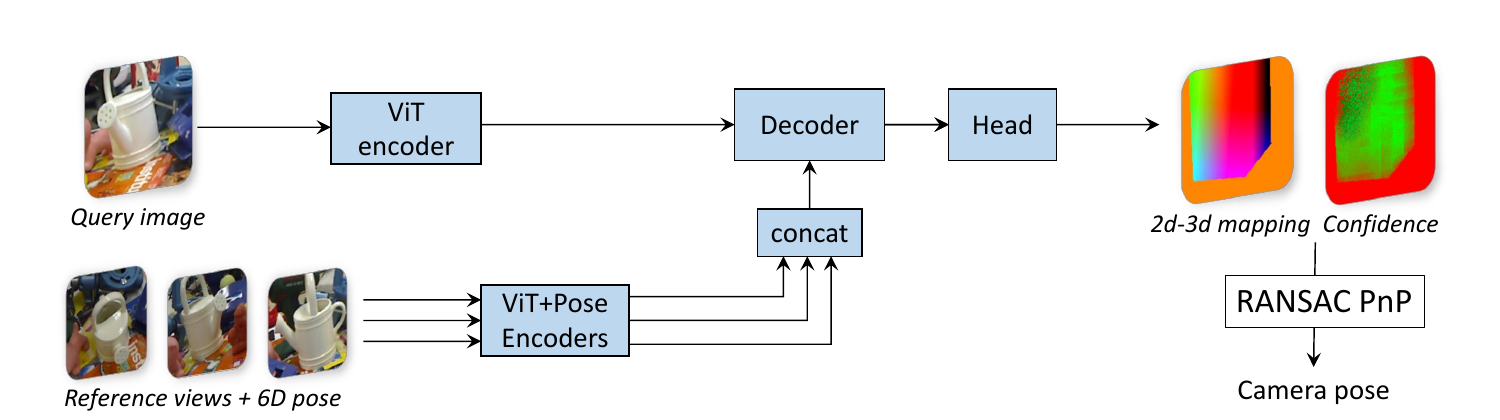
MFOS is CAD-free, RGB-only unseen-instance one-shot pose estimation. Given a query crop, several same-object references annotated with 6D poses, and a rough 3D cuboid, a CroCo-initialized Transformer predicts dense query-pixel coordinates on an invisible proxy cuboid and confidence; RANSAC PnP solves R,t.
Method inputs and outputs
Item
Content (compiled for this site)
Inference inputs
Query RGB crop, same-object reference RGB with known poses, intrinsics, and rough center / size defining the proxy cuboid. Target box / identity come from an external frontend.
Final output
Query object-to-camera rotation R and translation t, solved by RANSAC PnP from predicted pixel-to-cuboid coordinates and confidence.
Requirements
No target CAD, depth, or real-surface reconstruction; posed references and rough cuboid remain necessary. One-shot need not mean one image; metric translation follows proxy / reference coordinates.
2.1 Guide to the paper’s figures and tables
Figure / table
Purpose
Overview reading tips
Figure 1
Query and posed-reference network
Outputs proxy coordinates, not true CAD-surface coordinates
Figure 3
Pose Encoder
How rendered pose information enters reference features
Table 1
LINEMOD results
Compare MFOS, Gen6D, OnePose, and OnePose++ inputs
Tables 2—5
Proxy, data, reference count, CroCo
Identify cuboid, data diversity, and geometric-pretraining contributions
Table 6
Equal limited-reference comparison
MFOS does not beat OnePose++ at every strict threshold
Tables 7—8
OnePose / LowTexture and timing
Consider accuracy, SfM, and offline reference encoding together
Original Figure 1: ViT encodes query RGB; ViT + Pose Encoder fuse reference images and 6D poses. A Transformer decoder outputs dense 2D-3D mapping and confidence, then RANSAC PnP recovers camera pose. Source: arXiv. Image copyright belongs to the paper's authors and publisher; reproduced here for academic analysis.
3. Problem setting
Task: instance-level unseen-object one-shot 6D pose. Targets receive no object-specific training, and category labels are not test inputs.
Inputs:
Target query RGB crop;
K same-object reference RGB images with known object-to-camera poses;
Intrinsics;
Rough object size / 3D box defining the proxy cuboid.
Outputs: query object-to-camera rotation R and translation t.
Not required: true CAD mesh, query depth, surface clouds, or target-specific test-time fine-tuning.
Still required: detection / retrieval for approximate target crops and a posed-reference database. MFOS does not discover targets or calibrate new objects from scratch.
4. Core motivation
CAD-based pose requires meshes, rendering, or training per new object. OnePose / OnePose++ avoid explicit CAD but first reconstruct references with SfM.
True-surface coordinates require inferring unfamiliar complex geometry. MFOS uses a shared cuboid proxy and learns to transfer reference-pose information into the query.
Query tokens cross-attend all reference tokens; CroCo cross-view completion pretraining supplies geometric priors for implicit matching.
5. Method overview
Proxy shape: define a roughly centered / sized cuboid and render per-reference RGB-encoded 3D-coordinate pointmaps.
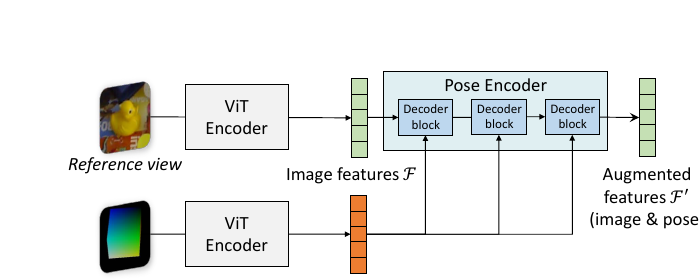
Image + Pose Encoder: ViT-Base encodes query / references; a small ViT encodes proxy pointmaps and cross-attention fuses them into reference features.
Query-to-reference decoder: query features cross-attend concatenated pose-augmented reference features and predict per-pixel proxy coordinates / confidence.
RANSAC PnP: remove low-confidence regions and sample 2D-3D correspondences for SQ-PnP / RANSAC.
Original Figure 3: Pose Encoder fuses reference visual features with rendered-proxy pose features through decoder blocks, producing pose-informed reference tokens. Source: Paper PDF. Image copyright belongs to the paper's authors and publisher; reproduced here for academic analysis.
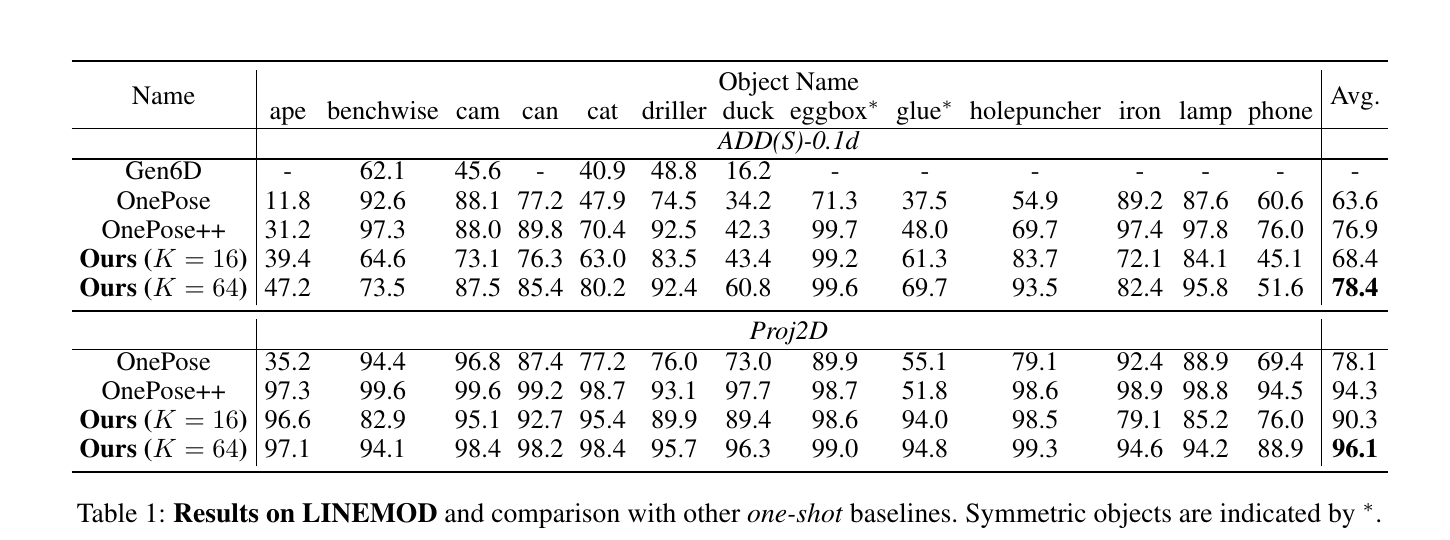
Original Table 1: at $K=64$, MFOS mean ADD(S)-0.1d / Proj2D is 78.4 / 96.1, versus OnePose++ 76.9 and 94.3. Stars mark symmetric objects, which are excluded during training. Source: Paper PDF. Image copyright belongs to the paper's authors and publisher; reproduced here for academic analysis.
LINEMOD: MFOS K=64 ADD(S)-0.1d / Proj2D is 78.4 / 96.1, versus OnePose++ 76.9 / 94.3. Reference counts differ; see Table 6 for stricter controls.
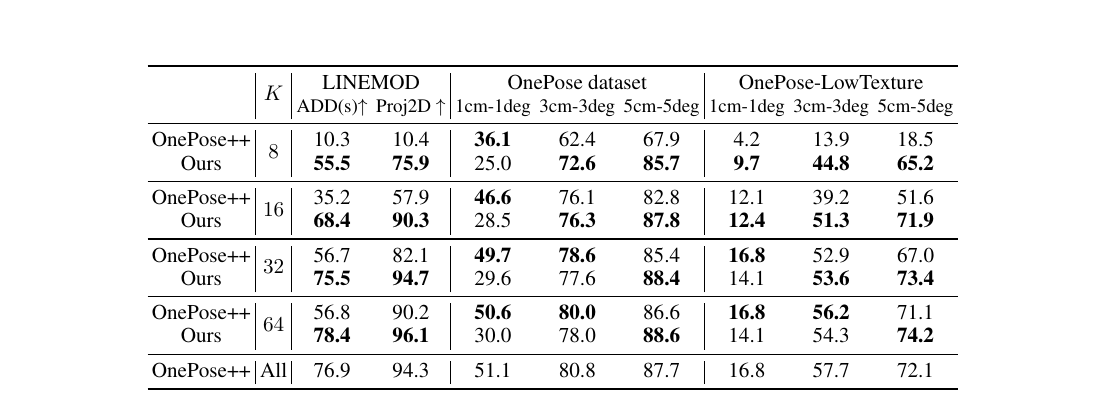
Equal K: at K=16, MFOS LINEMOD ADD(S)-0.1d / Proj2D is 68.4 / 90.3, versus OnePose++ 35.2 / 57.9. On strict OnePose 1cm-1deg, MFOS 28.5 trails OnePose++ 46.6.
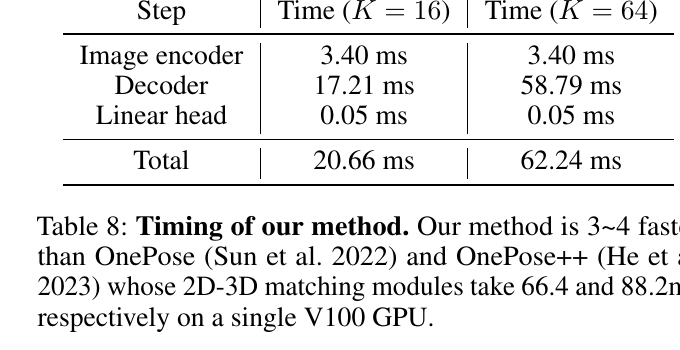
With offline reference encoding, query forward takes 20.66 ms (K=16) or 62.24 ms (K=64) on one V100, excluding detection and reference-pose acquisition.
7. Strengths and limitations
Strengths
A shared cuboid avoids true-surface modeling, CAD, depth, and SfM reconstruction.
Dense correspondences + confidence retain geometric PnP solving rather than direct black-box pose regression.
Targeted CroCo, data-diversity, and reference-count ablations are valuable, especially limited-reference comparisons.
Limitations / risks
Model-free still needs posed references, acquired through fiducials / SfM / calibration, plus rough boxes, intrinsics, and detection.
The implementation targets rigid asymmetric objects; supplementary failures include symmetry and complex shapes.
Proxy coordinates do not lie on true surfaces and often trail OnePose++ under strict 1cm-1deg thresholds.
Official sources provide no reproducible repository; CroCo weights and large multi-source training raise reproduction costs.
Baseline suitability: important for CAD-free RGB posed-reference unseen-instance pose; inputs differ from unposed-reference or category-level tasks, and strict sub-centimeter comparisons need care.
Worth deep reading: cuboid-to-cuboid versus cuboid-to-CAD, the decisive CroCo ablation, and reference-set train/test mismatch.
Available src/paper-notes/mfos/deep.md
In-depth paper notes
Support reproduction, comparison, related-work writing, and identifying opportunities for further research.
Code / project: no official implementation link in the paper or public author pages
Reading mode: Deep Dive
2. Positioning in one sentence
MFOS replaces CAD / SfM models with posed references and a rough cuboid. CroCo-initialized ViT features encode multiple references; a decoder predicts dense query correspondences to an invisible proxy cuboid plus confidence, then RANSAC PnP solves pose. Surface-level precision is traded for CAD-free RGB generalization with fewer references.
Method inputs and outputs
Item
Content (compiled for this site)
Inference inputs
Query RGB crop, K posed reference RGBs, intrinsics, rough 3D box. Proxy rendering converts poses / box into image-aligned cuboid pointmaps for Pose Encoder.
Final output
RANSAC PnP recovers query cuboid pose, converted through its fixed relation to the object into object-to-camera (R,t).
Training inputs
Multi-object reference / query RGB, poses, and rough boxes. Query GT renders supervision maps; it is not supplied as query-decoder conditioning.
Training targets
Per-query-pixel proxy 3D coordinates and positive confidence, with confidence-weighted regression to GT proxy maps; no dense true-surface correspondence labels.
Output details
Four channels: proxy 3D coordinates + confidence. Coordinates belong to normalized cuboid space, not CAD surfaces / depth. PnP translation is restored using proxy dimensions, in reference-pose length units.
Requirements
External detection / crops, reference poses, intrinsics, rough size. No query mask, depth, or SfM surface reconstruction. The proxy–object coordinate relation remains necessary.
2.1 Guide to the paper’s figures and tables
Figure / table
Role
Reading guidance
Figure 1
End-to-end flow
Coordinate-map 3D lies on the proxy, not object surfaces
Figure 2
References and cuboid pointmaps
Image-aligned pose conditioning
Figure 3
Pose Encoder
Cross-attention injects pose into visual tokens
Figure 4
Decoder cross-attention
Implicit inter-image matches without correspondence supervision
Table 1
LINEMOD
Then check equal-K fairness in Table 6
Tables 2—5
Proxy, data, views, pretraining
Most informative design ablations
Tables 6—8
Limited views, OnePose, timing
Separate strict precision, SfM dependencies, and network-only latency
Original Figure 1: query and posed-reference features interact in a decoder, predicting pixel-to-proxy 3D coordinates and confidence; RANSAC PnP recovers camera pose. Source: arXiv. Image copyright belongs to the paper's authors and publisher; reproduced here for academic analysis.
3. Problem and Task Boundaries
For rigid instance O, estimate object-to-camera pose in the query:
xcam=Rxobj+t.
xobj need not lie on a true mesh. A box-scaled proxy coordinate system places xproxy on a cuboid; its pose converts to object pose through the tied center / dimensions.
Inference inputs: query crop Iq; K reference images {Ii} of the same object; reference poses Pi=(Ri,ti); intrinsics; rough center / dimensions or 3D box.
Inference outputs: query R,t, with internal dense 2D-to-proxy-3D and confidence maps.
Frontend assumptions: target identity and approximate bbox are known, typically from detection / retrieval; LINEMOD uses YOLOv5 detections.
Training: one shared cross-object model, without target-specific training / fine-tuning at test time: unseen instance-level pose.
CAD / depth / masks / views: no CAD, depth, query masks, or real reconstruction. Posed multi-view RGB and intrinsics are required; query / references are box-centered crops.
Key boundaries:
Not category-level pose: no category NOCS or shared shape prior.
New objects still need reference-pose annotation, potentially from fiducials or SfM.
Detection / retrieval and reference-pose acquisition remain outside the pipeline.
4. Research context
Model-specific CAD pose: meshes, rendering, or object-specific training provide precision at onboarding cost.
Category-level pose: NOCS / shape priors generalize within fixed categories, not arbitrary unknown categories.
Model-agnostic RGB-D / video: BundleTrack, FS6D, OVE6D use depth, video, or geometry with stronger information but higher input requirements.
One-shot RGB references: Gen6D combines detection, view selection, and volume refinement; OnePose / OnePose++ build video / SfM 3D representations before matching.
MFOS: no true-surface targets or point-cloud reconstruction; reference poses and shared cuboid geometry transfer implicitly through a Transformer.
5. Research motivation
A shared Transformer cannot directly infer arbitrary unseen-object surfaces whose topology, texture, and geometry vary.
Rendered reference-pose pointmaps align with visual features, allowing image-like pose input without handcrafted rotation / translation embeddings.
Cuboids replace complex mesh topology with shared simple geometry. The network transfers reference pose to query pose, not object reconstruction.
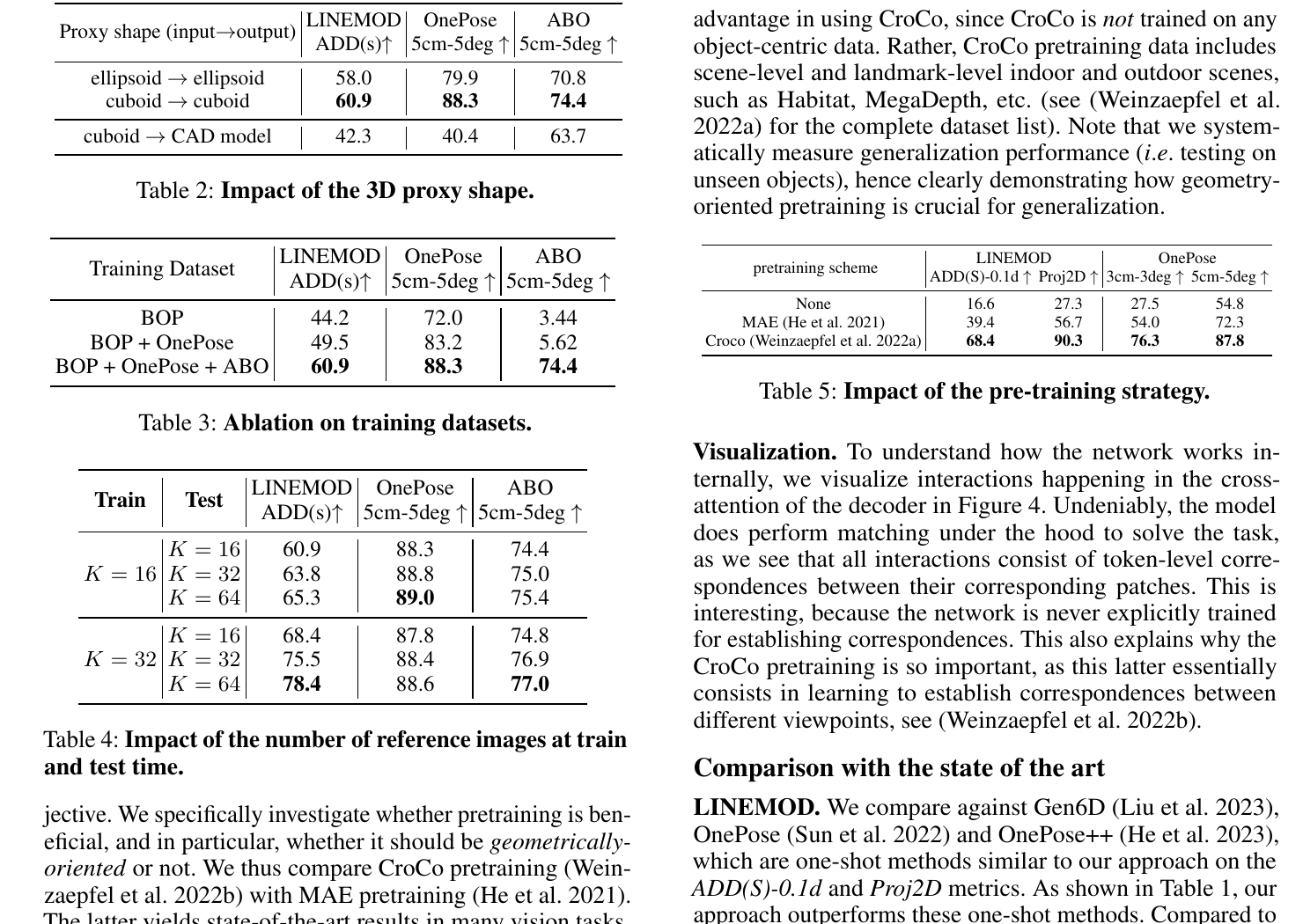
CroCo cross-view completion learns matching priors suited to query–reference attention; ablations show an advantage over MAE.
6. Method details
6.1 Overall pipeline
Prepare reference RGBs and Pi=(Ri,ti), with a rough centered / sized cuboid.
Render each reference-camera cuboid pointmap in approximately [−1,1]3 proxy coordinates; outside pixels are null.
A shared ViT encodes query / reference RGB. Pose Encoder fuses each reference’s image and proxy-pointmap features.
Query tokens cross-attend pose-augmented tokens from all references and select useful information.
A linear head predicts four channels: y^i∈R3 proxy coordinates and positive confidence τi.
Retain confident pixels and sample 1024 2D-3D correspondences by confidence; SQ-PnP + RANSAC (up to 1000 iterations, 5 px threshold) solves R,t.
Module
Input
Output
Role
Connection
Proxy renderer
Rough box, reference pose, K
Reference-aligned 3D pointmaps
Shared CAD-free pose geometry
Second Pose Encoder visual input
Image Encoder
Query / reference crops
ViT tokens
Reusable cross-object features
Fuse reference visual / pose tokens
Pose Encoder
Reference visual / proxy tokens
Pose-augmented references
Image-aligned R,t conditioning
Query decoder retrieval
Query Decoder
Query and all reference tokens
Query tokens
Implicit multi-view matching
Coordinate / confidence head
Prediction + PnP
Tokens, intrinsics
R,t
Robust geometry from dense maps
Final output
6.2 Cuboid Proxy, Not Object Surfaces
Original Figure 3: separate ViTs tokenize reference RGB and rendered proxies; decoder blocks inject pose features into visual features. Source: Paper PDF. Image copyright belongs to the paper's authors and publisher; reproduced here for academic analysis.
Instead of a 6D pose vector, cuboid / ellipsoid rendering provides per-pixel 3D proxy coordinates in a three-channel map; a single-layer ViT extracts pose tokens. Three properties follow:
Spatial alignment: reference RGB and pose maps share patch grids, supporting local visual / geometry attention.
Object independence: cuboid topology stays fixed across varied meshes; only center / scale changes.
Rough-scale tolerance: random proxy rotations, translations, or 10% scaling cause small LINEMOD / OnePose changes, favoring stable frames over precise boxes.
Reference sampling: 32 training references, 8 random and 24 farthest-sampled. Randomize proxy translation / rotation / scale; use 224 x 224 crops with shift / scale / rotation augmentation.
Optimization: CroCo v2, AdamW, 40K steps, cosine decay 10−4 to 10−6; batches of 16 objects, each with 16 queries + 32 references. Training for 40K steps takes about 32 hours on 4 A100 GPUs.
6.5 Inference and engineering complexity
Reference features can be encoded offline; farthest sampling selects K views per query, with rendered cuboid maps.
Query forward for K=16/64 takes 20.66 / 62.24 ms (V100): image encoder 3.40 ms, decoder 17.21 / 58.79 ms, head 0.05 ms.
These exclude detection, reference-pose annotation, capture, proxy sizing, and host-side PnP integration; they are not end-to-end robot latency.
In-place reshaping stores reference tokens once per object instead of duplicating them per query. Multi-reference attention tensor layout matters for memory.
7. Experimental analysis
7.1 Datasets and Metrics
Dataset
Use
Evaluation focus
LINEMOD
13 rigid models, about 13K real images
CAD supports ADD / ADD-S and Proj2D; YOLOv5 crops and about 180 training references
OnePose
Real capture sequences, no CAD
CAD-free posed-reference transfer with cm-degree
OnePose-LowTexture
40 household low-texture objects
Weak texture
ABO
Large product image / render collection
Cross-source transfer and data diversity
ADD(-S)-0.1d: mean transformed-point error below 10% of object diameter; ADD-S for symmetry.
Proj2D: mean projection error below 5 px.
cm-degree: rotation and translation errors must both meet thresholds, such as 1cm-1deg, 3cm-3deg, 5cm-5deg.
Together these reveal a trade-off: proxy correspondences support stable broad-threshold pose more than surface-level pixel-accurate alignment.
7.2 LINEMOD Main Results
Original Table 1: one-shot LINEMOD comparisons. MFOS $K=64$ averages ADD(S)-0.1d / Proj2D of 78.4 / 96.1, versus OnePose++ 76.9 / 94.3. Source: Paper PDF. Image copyright belongs to the paper's authors and publisher; reproduced here for academic analysis.
Method
Object prior
LINEMOD ADD(S)-0.1d
Proj2D
Caution
Gen6D
Posed RGB references
Selected categories
Selected categories
No CAD / depth, but detection / view selection / refinement
OnePose
SfM representation
63.6
78.1
Requires reference-video reconstruction
OnePose++
SfM cloud / matching
76.9
94.3
Strong precise matches; account for references and preprocessing
MFOS, K=16
Posed RGB + cuboid
68.4
90.3
Strong with fewer references
MFOS, K=64
Posed RGB + cuboid
78.4
96.1
Main result; baseline K may differ
My analysis: Table 1 supports strong LINEMOD performance, but the strongest baseline and MFOS need not use equal reference counts. Matched-K Table 6 is closer to controlled evaluation.
7.3 Proxy, Data, Views, and CroCo Ablations
Original Tables 2--5: proxy shapes, training data, training / test references, and pretraining. The crop has Tables 2--4 on the left, Table 5 on the right. Source: Paper PDF. Image copyright belongs to the paper's authors and publisher; reproduced here for academic analysis.
Strong, but capability depends heavily on external pretraining
Ktrain=16, Ktest=16/32/64
LINEMOD 60.9 / 63.8 / 65.3
More test-time references are usable
Modest gains; larger Ktrain models are stronger
Ktrain=32, Ktest=16/32/64
LINEMOD 68.4 / 75.5 / 78.4
Multi-reference context matters in training and testing
One-shot does not mean one reference image
7.4 Equal Reference Counts
Original Table 6: MFOS versus OnePose++ at equal $K$. MFOS often wins LINEMOD and broader 3cm / 5cm thresholds, but trails clearly on OnePose 1cm-1deg. Source: Paper PDF. Image copyright belongs to the paper's authors and publisher; reproduced here for academic analysis.
At K=16, MFOS LINEMOD ADD / Proj2D is 68.4 / 90.3 versus OnePose++ 35.2 / 57.9.
On OnePose at K=16, 3cm-3deg / 5cm-5deg is 76.3 / 87.8 versus 76.1 / 82.8, but 1cm-1deg is 28.5 versus 46.6.
On OnePose-LowTexture at K=16, 5cm-5deg is 71.9 versus 51.6; this is not superiority at every precision tier.
The finding is stable pose under limited views, weak texture, and broad tolerance, with lower fine-localization precision from proxy targets.
7.5 OnePose, Speed, and Availability
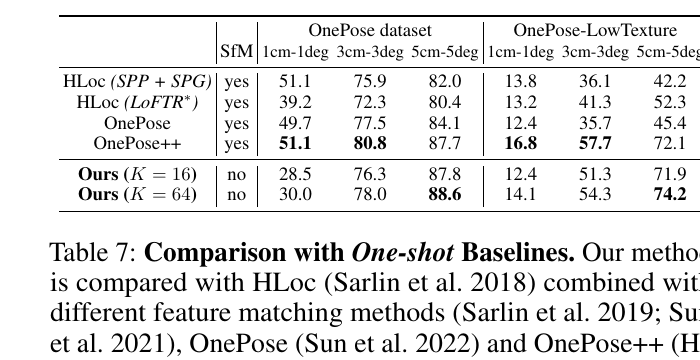
Original Table 7: HLoc, OnePose, OnePose++ comparisons on OnePose / LowTexture. MFOS with `SfM=no` builds no explicit 3D reconstruction; $K=64$ reaches 88.6 / 74.2 at 5cm-5deg. Source: Paper PDF. Image copyright belongs to the paper's authors and publisher; reproduced here for academic analysis.Original Table 8: network timing on one V100 with offline reference encoding. $K=16/64$ totals 20.66 / 62.24 ms; decoder cost mainly grows with $K$. Source: Paper PDF. Image copyright belongs to the paper's authors and publisher; reproduced here for academic analysis.
Table 7: MFOS K=64 without SfM reaches 88.6 on OnePose 5cm-5deg versus 87.7, and 74.2 on LowTexture versus 72.1. Corresponding 1cm-1deg remains lower (30.0 versus 51.1; 14.1 versus 16.8).
Table 8: the authors report about 3—4× speedup over OnePose / OnePose++ matching modules. Offline encoding, detection, and pose acquisition are excluded; this is pose-network latency.
7.6 Robustness and Failures
Occlusion / clutter: confidence and RANSAC reject some background / false matches. Attention visualizations show stable patch matches, without a dedicated severe-occlusion recovery module.
Low texture: broader-threshold LowTexture results support reference-conditioned CroCo features, not guaranteed robustness to absent or repeated textures.
Symmetry: training excludes symmetric objects, which supplementary failures highlight. ADD-S on eggbox / glue does not imply algorithmic symmetry-aware multi-hypothesis handling.
Complex shapes: asymmetric complex objects also fail; cuboids omit surface detail and can leave pose evidence ambiguous.
Detection / annotation noise: crop shifts affect tokens. A 10% reference / proxy perturbation study supports mild robustness, without systematic bias or incorrect-intrinsics evaluation.
Reusable idea: a stable topology-independent proxy can generalize better than true-surface coordinates when only pose is needed.
Baselines: CAD-free RGB posed-reference unseen-object studies should include MFOS, Gen6D, OnePose / OnePose++; report pose sources, K, SfM, detection / GT crops, strict and broad thresholds.
Research entry points: add local surfaces / uncertainty-aware refinement for precision, symmetry, and complex shapes, or reduce posed-reference acquisition cost.
11. Open questions
Concept: how does proxy R,t convert across object-coordinate conventions, especially inconsistent centers?
Experiment: does cuboid-to-CAD remain worse under identical training objects, given OnePose removal in Table 2?
Engineering: how do fiducial / SfM / SLAM pose errors and database coverage affect PnP inliers?
Reproduction: without official preprocessing / code, rebuild CroCo initialization, BOP / ABO / OnePose mixing, and memory-efficient multi-reference attention.