Learning Instance-Aware Correspondences for Robust Multi-Instance Point Cloud Registration in Cluttered Scenes
MIRETR iteratively learns instance-aware superpoint features and masks, expanding coarse matches into per-instance dense correspondences and SE(3) hypotheses without expensive multimodel fitting. The full model's mean F1 on Scan2CAD / ROBI / ShapeNet is 93.40 / 39.80 / 94.44. On ROBI, removing both instance-aware designs lowers F1 to 18.65, and reverting to global attention gives only 10.96.
model point cloudcluttered scene point cloudsparse superpointsinstance-aware dense correspondences
Requirements
target CAD / model point clouddepth-derived scene point cloudthe same model may appear an unknown number of timesKPFCNN backboneweighted-SVD pose solver
Full paper metadataAuthors, affiliations, research area, datasets, metrics, method tags, and reading statusExpandCollapse
Authors
Zhiyuan Yu, Zheng Qin, Lintao Zheng, Kai Xu
Affiliations
National University of Defense Technology / Defense Innovation Institute, Academy of Military Sciences
target CAD / model point clouddepth-derived scene point cloudthe same model may appear an unknown number of timesKPFCNN backboneweighted-SVD pose solver
Reading Notes
Overview / Deep Dive
Available src/paper-notes/miretr-cvpr2024/coarse.md
Paper overview notes
Quickly assess the paper's scope, problem setting, core method, experimental findings, and whether to read it in depth.
Paper Reading Notes (Coarse): MIRETR
1. Basic information
Title: Learning Instance-Aware Correspondences for Robust Multi-Instance Point Cloud Registration in Cluttered Scenes
Authors: Zhiyuan Yu, Zheng Qin, Lintao Zheng, Kai Xu
Affiliations: National University of Defense Technology; Defense Innovation Institute, Academy of Military Sciences
MIRETR estimates poses for an unknown number of CAD instances in clutter. Each scene superpoint iteratively predicts an instance mask and encodes context only within it. Coarse matches then generate per-instance dense correspondences and SE(3) candidates, bypassing traditional multi-model fitting.
3. Guide to figures and tables
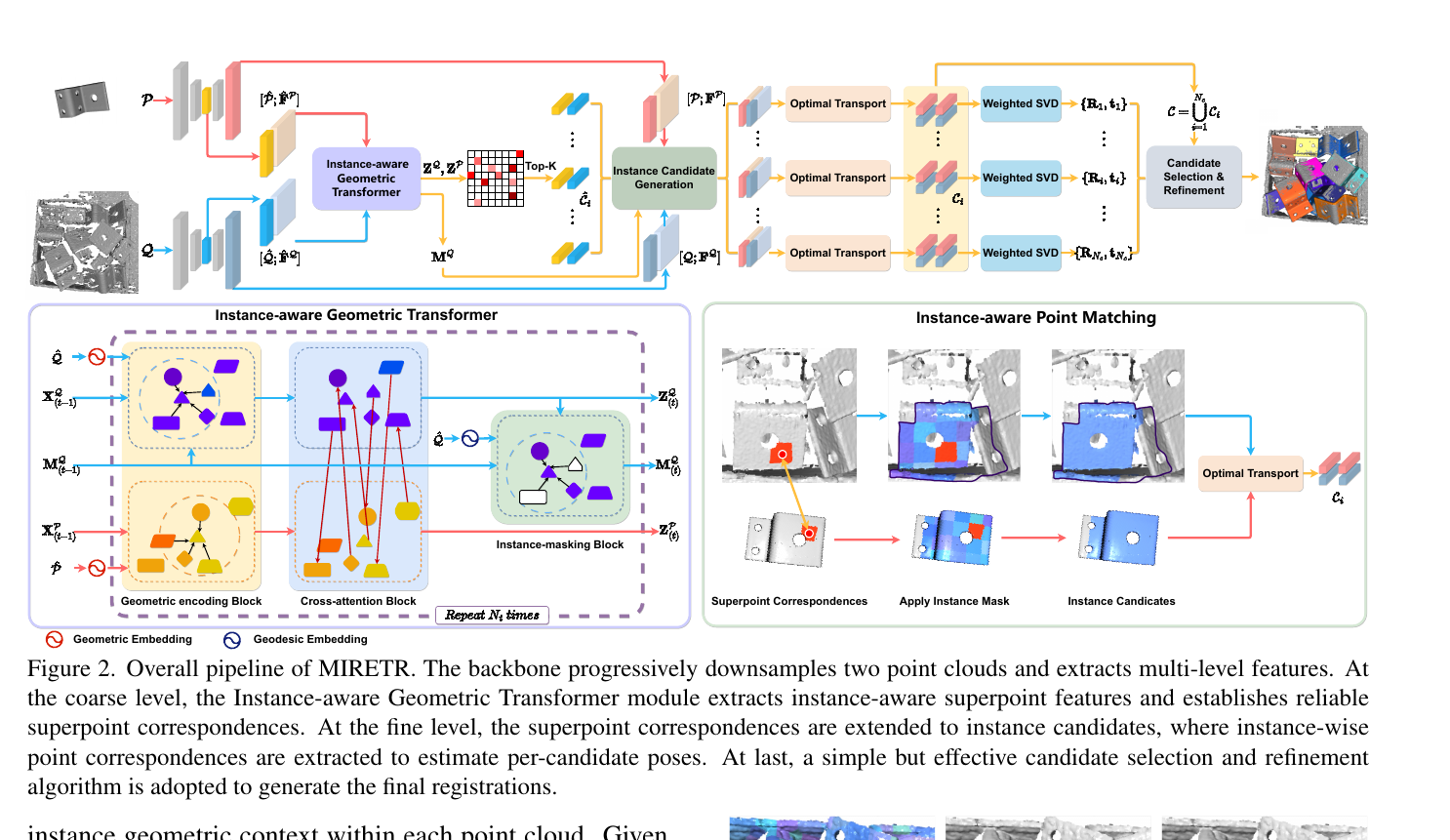
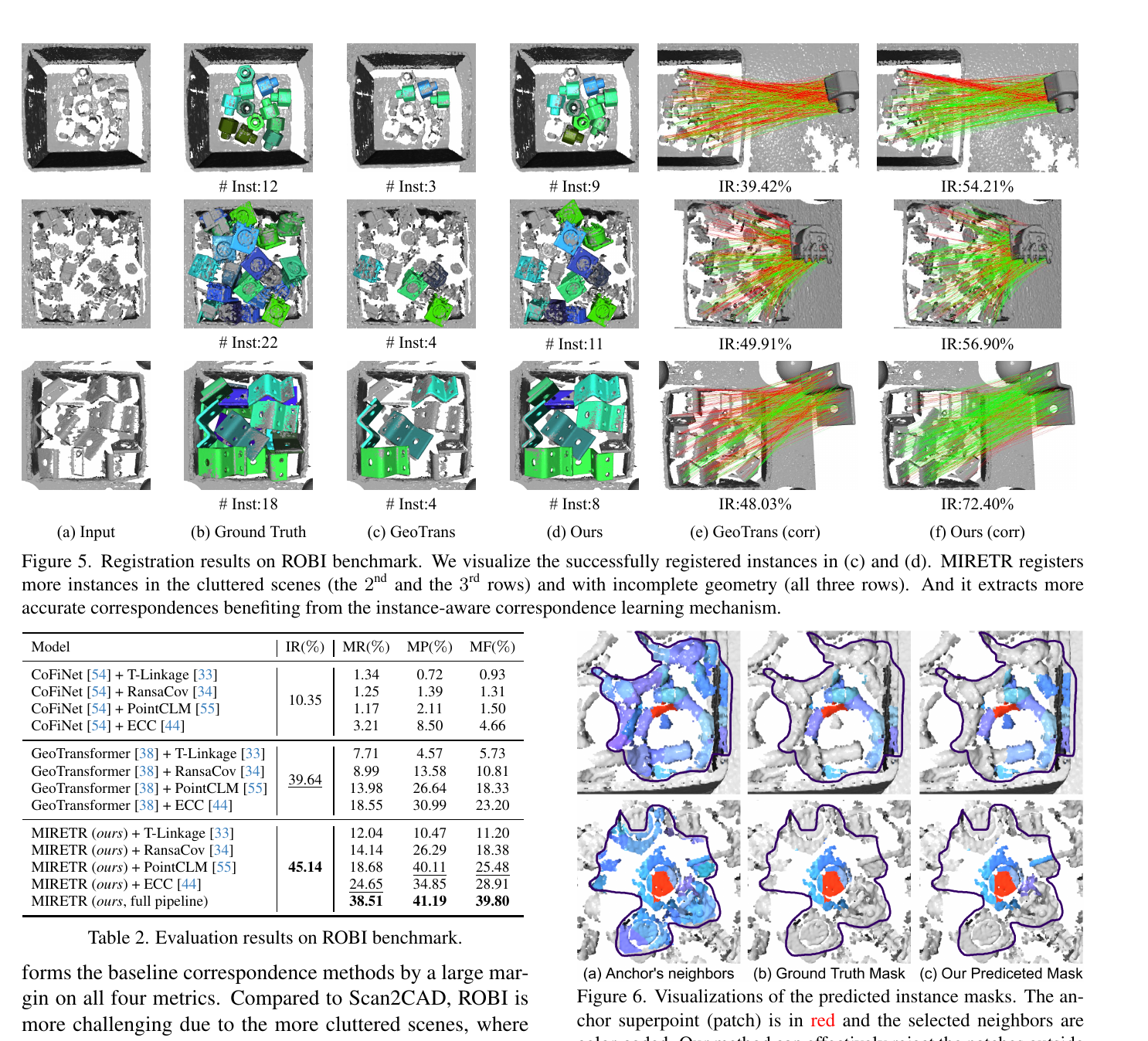
Original Figure 2: KPFCNN extracts multi-scale point features; an Instance-aware Geometric Transformer jointly updates coarse superpoint features and masks. Fine candidates use optimal transport and weighted SVD, followed by selection and refinement. Source: CVPR 2024 official paper. Image copyright belongs to the paper's authors and IEEE/CVF; reproduced here for academic analysis.Original Figures 5–6 and Table 2: MIRETR recovers more heavily occluded ROBI instances. Full-pipeline MR / MP / MF is 38.51 / 41.19 / 39.80, and predicted-instance-mask mIoU is 69.26. Source: CVPR 2024 official paper. Image and table copyright belongs to the paper's authors and IEEE/CVF; reproduced here for academic analysis.
4. Problem setting
Inputs: model cloud P and scene cloud Q.
Scene: Q may contain an unknown number K of instances of P, plus background, occlusion, and inter-instance contact.
Generalization evidence: training on the first 30 ShapeNet categories and testing on the remaining 25 still yields 94.44 MF, supporting cross-category geometric matching.
Limitations: correct model clouds are supplied, so a real system must first choose which CAD to search for. ROBI recall of 38.51 also leaves extreme bin picking unresolved.
Intended readers: multi-instance pose, cloud registration, industrial bin picking, coarse-to-fine correspondence, and open-set geometric matching.
Available src/paper-notes/miretr-cvpr2024/deep.md
In-depth paper notes
Support reproduction, comparison, related-work writing, and identifying opportunities for further research.
Paper Reading Notes (Deep): MIRETR
1. Key assessment
Multi-instance registration changes more than output count. Global scene attention lets complete neighbors and background dominate sparse occluded-instance points; subsequent multi-model fitting must cluster huge numbers of correspondence hypotheses.
MIRETR separates instances during correspondence learning. Each scene superpoint predicts an anchor-relative mask for same-instance context; the mask later expands coarse matches into candidates. Features, matching, and pose grouping share one signal.
The global-attention ROBI variant reaches only 10.96 MF versus 39.80 for the full model, providing strong causal evidence.
2. Problem Definition
Model cloud:
P={pi∈R3}i=1N,
Scene cloud:
Q=Q0∪Q1∪⋯∪QK,
Here Q0 is background, Q1,…,QK are K instances of the model, and K is unknown. Solve each instance:
Correspondences should cover many instances, not only the most complete;
They must be assigned correctly, avoiding transforms that mix objects.
Open-set means geometric models can come from unseen objects / categories, not model-free open-vocabulary detection.
3. Instance-Aware Context
Original Figure 2. Top: model-to-scene coarse-to-fine flow. Lower left: iterative masked geometry encoding; lower right: coarse matches expand into candidate-specific dense matches. Source: CVPR 2024 official paper. Image copyright belongs to the paper's authors and IEEE/CVF; reproduced here for academic analysis.
KPFCNN downsamples into P^,Q^ and assigns local patches by point-to-node partition. The Instance-aware Geometric Transformer repeats:
Geometric encoding: encode anchor-neighborhood distances / angles, using the previous mask to exclude other instances;
Cross-attention: exchange model / scene superpoint information for geometric consistency;
Instance masking: predict the anchor’s neighborhood mask from updated features.
Initial masks are imperfect, but local neighborhoods provide weak priors. Better features improve masks and purify subsequent context: a learned EM-like iteration.
Three supervision terms:
L=Lcircle+Lnll+Lmask,
They constrain superpoint features, dense matching, and instance masks, respectively.
4. Superpoint Matches to Instance Poses
Traditional pipelines give all correspondences to T-Linkage, RansaCov, ECC, or PointCLM. For every superpoint correspondence, MIRETR:
Takes the model patch;
Collects neighboring scene patches within the predicted instance mask;
Applies optimal transport to local correspondences;
r is model diameter. Merged candidates are reestimated and refined using surviving inliers. Approximate instance purity avoids global multi-model fitting.
5. Scan2CAD
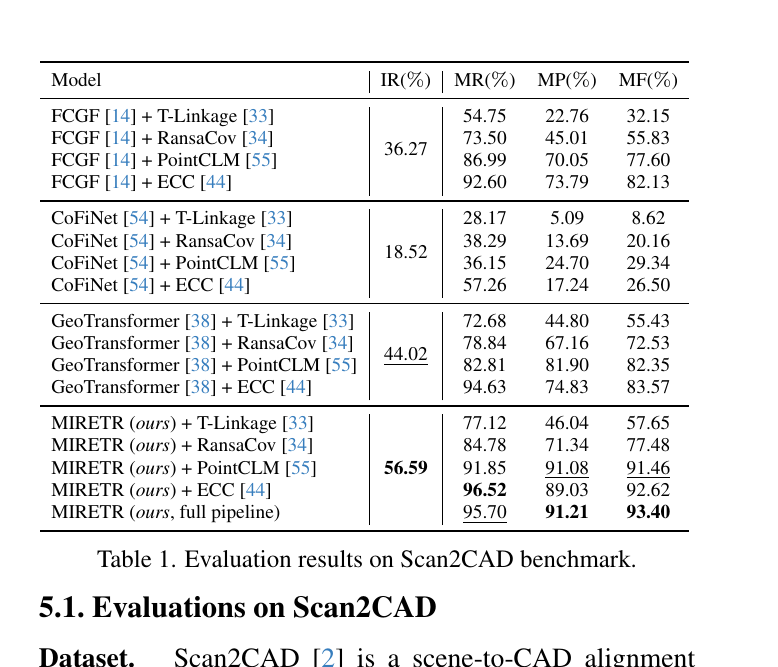
Original Table 1. Correspondence IR is 56.59; full-pipeline MR / MP / MF is 95.70 / 91.21 / 93.40. Source: CVPR 2024 official paper. Table copyright belongs to the paper's authors and IEEE/CVF; reproduced here for academic analysis.
ECC has high recall but low precision, suggesting more false positives. Full MIRETR raises precision to 91.21 with little recall loss.
6. ROBI: Challenging Clutter
Original Figures 5–6 and Table 2. Colored CAD overlays mark successful instances; correspondence lines and masks show exclusion of other objects and background. Source: CVPR 2024 official paper. Image and table copyright belongs to the paper's authors and IEEE/CVF; reproduced here for academic analysis.
ROBI has 7 reflective metal parts, 63 bin-picking scenes, and 4,880 pairs, split 6:1:2 by scene. Results:
Method
IR
MR
MP
MF
GeoTransformer + ECC
39.64
18.55
30.99
23.20
MIRETR + PointCLM
45.14
18.68
40.11
25.48
MIRETR + ECC
45.14
24.65
34.85
28.91
MIRETR full
—
38.51
41.19
39.80
Full MIRETR improves MF over GeoTransformer + ECC by 16.6 points, but absolute MF is only 39.80. Missing depth, reflections, and severe occlusion remain difficult.
Mask mIoU is 69.26 versus 38.13 without masking. Mean successful instances are 13.7 versus MIRETR + PointCLM 6.2, emphasizing recovered hard / low-overlap instances rather than precision on easy ones alone.
7. Unseen Categories and Ablations
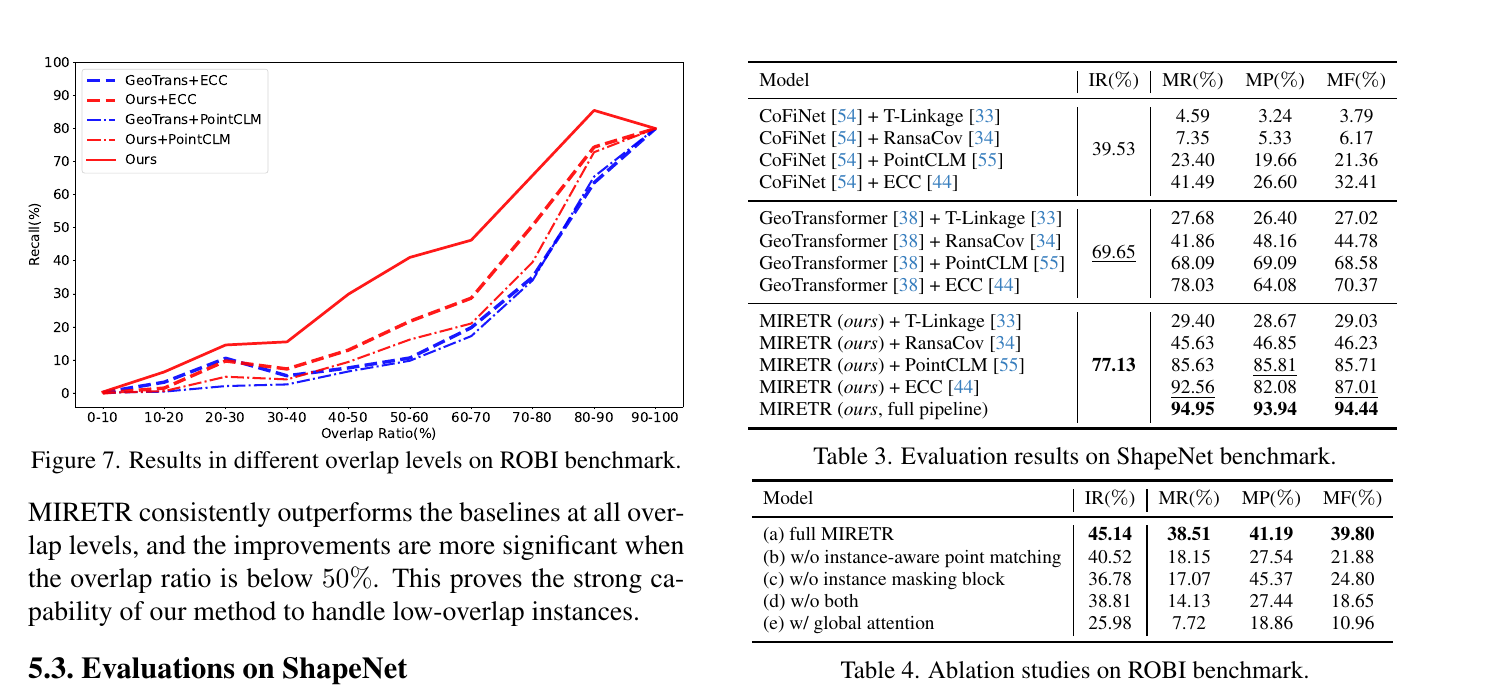
Original Figure 7 and Tables 3–4: overlap bins on the left show largest gains below 50%; right, unseen ShapeNet categories and ROBI ablations. Source: CVPR 2024 official paper. Figure and table copyright belongs to the paper's authors and IEEE/CVF; reproduced here for academic analysis.
Train on the first 30 ShapeNet categories, test on the remaining 25; scenes contain 4–16 randomly transformed instances. Full model:
IR/MR/MP/MF=77.13/94.95/93.94/94.44.
GeoTransformer + ECC MF is 70.37, with full MIRETR higher by 24.07 points. Synthetic CAD clouds have easier noise / occlusion than ROBI; 94.44 does not predict real bin-picking accuracy, but supports geometry beyond fixed categories.
ROBI ablations:
Configuration
IR
MR
MP
MF
Full
45.14
38.51
41.19
39.80
No instance-aware point matching
40.52
18.15
27.54
21.88
No instance-masking block
36.78
17.07
45.37
24.80
Neither
38.81
14.13
27.44
18.65
global attention
25.98
7.72
18.86
10.96
Without masking, precision is highest but recall collapses, retaining few easy instances. Global attention is worst, supporting cross-instance context contamination as the core issue.
8. Engineering Significance
MIRETR suits known-part bin picking:
Unknown instance counts;
Multiple poses from one forward process;
Better low-overlap / touching-instance handling than global matching;
Reusable weighted SVD and registration tools;
Geometry-based cross-category matching.
A complete robot system still needs:
Model selection from a CAD library;
Adequate depth quality;
Symmetry handling;
Collision / graspability checks per candidate;
End-to-end timing and memory tests against cycle-time targets.
The main paper gives no runtime; efficiency over multi-model fitting is primarily structural and still needs deployment benchmarks.
9. Limitations and Reproduction Checks
Scan2CAD replaces scans with aligned CAD, reducing original scan-noise difficulty.
ShapeNet scenes copy transformed instances of one CAD, leaving domain gaps.
ROBI scenes contain one part type; mixed-CAD multi-category clutter is untested.
Correct model clouds are supplied, excluding retrieval failures.
Masks are anchor-relative, not globally consistent segmentation; merging still needs thresholds.
High symmetry may require symmetry-aware ADD candidate similarity.
No main-text FPS, parameter counts, candidate-count sensitivity, or depth-noise calibration.
10. Overall assessment
Instance boundaries move from postprocessing into features, then coarse matches, dense correspondences, and pose candidates. Low-overlap curves, mask mIoU, and ablations support this logic beyond leaderboard scores.
This remains model-to-scene registration rather than general object discovery, with real ROBI MF only 39.80. Natural extensions include mixed CAD, symmetry-aware merging, and RGB / foundation features to compensate for reflective-part depth gaps.